#9. Part 2 – A place where the pulse and romance of modernity throb—from the Galata Tower in the New City district to the Sapphire Observation Deck…
1. The European Soul of Istanbul: The Heritage and Allure of the New City
If the Old City (Sultanahmet) stands as a monumental testament to Istanbul’s grand past—where history and religion intertwine in an epic narrative—the New City of Beyoğlu, located just across the golden waters of the Golden Horn, is a vibrant arena where the city’s present and future dynamically unfold.
Since the days of the Ottoman Empire, this district has historically served as a cosmopolitan hub, home to foreign embassies, Christian enclaves, and Jewish communities, earning it the enduring nickname “The European Side of Istanbul.” Here, European architectural elegance and modern sensibilities blend seamlessly over deeply rooted Islamic traditions, offering an enchanting contrast to the ancient quarters across the water.
Departing from the historical monuments of Part 1, we now invite you to explore contemporary skyscrapers, bustling youthful energy, and romantic alleys that gaze down upon the deep blue sea. Let us begin our journey into the Istanbul New City Walking Tour: Part 2.
2. Smart Transit Guide: Moving Between the Old and New Cities
When crossing from the historical heart to the contemporary hub, utilizing the Tram T1 line remains the most practical and efficient choice for any walking tourist.
Board the tram at Eminönü Station—famed for the vibrant bustle of the Egyptian Bazaar and the savory aroma of traditional fish sandwiches—and head towards the terminus, Kabataş. The very next stop is Karaköy Station, which serves as the premier gateway to your New City exploration.
At these key transit hubs, you will encounter Istanbul’s unique interconnected public transportation networks:
- Karaköy Station: Transfer to the historic Tünel (F2) funicular—the world’s second-oldest underground railway—to effortlessly ascend the steep hill leading directly to Galata Tower.
- Kabataş Station (Terminus): From here, you can board the F1 funicular directly to Taksim Square or enjoy a scenic, short walk to Dolmabahçe Palace.
The Tram T1 line operates daily from 06:00 to 24:00. During peak afternoon hours, trams run frequently at intervals of 2 to 5 minutes, ensuring minimal waiting times.
To ride, simply tap your all-in-one İstanbulkart or a contactless personal credit card at the turnstile before entering the platform. Notably, there is no need to tap your card again upon exiting at your destination.
To assist you in mapping out your itinerary, we have organized the key stations and nearby landmarks along the T1 line between Kabataş and Aksaray:
- Kabataş — Terminus / F1 Funicular to Taksim Square & walking distance to Dolmabahçe Palace
- Fındıklı-Mimar Sinan Ü. — Access to Mimar Sinan Fine Arts University
- Tophane — Best stop for the Istanbul Museum of Modern Art
- Karaköy — Entryway to Galata Tower & transfer point for the historic F2 Tünel Funicular
- [🚃 Tram route traversing the historic Galata Bridge]
- Eminönü — Bosphorus Ferry Piers & the Egyptian (Spice) Bazaar
3. Architectural Wonders and Modern Landmarks: The Top 6 Must-Visit Spots
1) The Eternal Sentinel of the Bosphorus: Galata Tower
Dominating the skyline of Istanbul’s New City, the iconic Galata Tower is an unmissable destination that commands your attention.
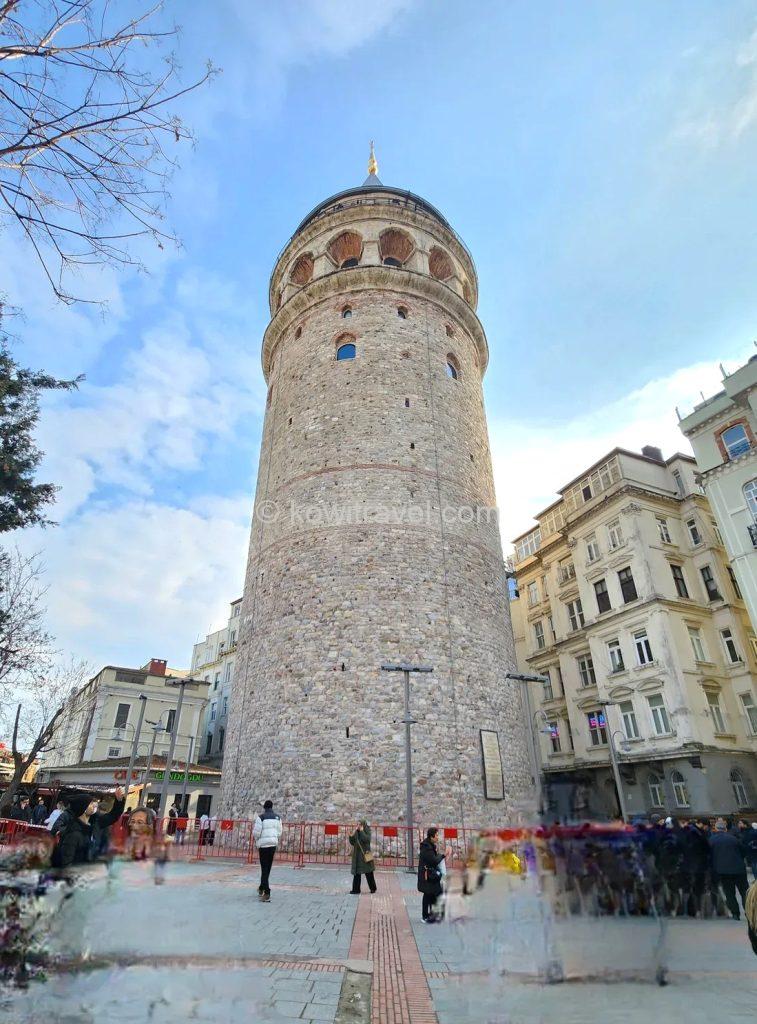
The magnificent Galata Tower, viewed from the square in the New City district during a walking tour of Istanbul. Long lines of tourists have formed, all eager to see the tower.
📌 The Tumultuous 700-Year History of Galata Tower
According to local records, this magnificent tower has stood firm through more than seven centuries of Istanbul’s turbulent history, undergoing constant transformations in both name and purpose.
Originally built within the Byzantine realm by Genoese merchants to fortify their autonomous merchant colony, it served as the highest vantage point of their defensive walls. At its inception, it was grandly dedicated as the ‘Tower of Christ’ (Christea Turris).
Following the conquest of Constantinople in 1453 by Sultan Mehmed II, the Ottoman administration repurposed the sturdy structure into a prison for Christian prisoners of war working in the nearby naval shipyards. By the 16th century, it experienced a celestial transformation, operating briefly as an astronomical observatory.
Given that Istanbul was historically prone to devastating fires due to its dense wooden housing, this tower—offering a panoramic 360-degree view—was later designated as the premier fire watchtower. Ironically, the tower itself fell victim to massive blazes multiple times, requiring its conical roof and upper levels to be painstakingly restored across centuries.


The exotic atmosphere of Galata Tower (left), alongside the medieval legacy left by the Genoese and the tower’s distinctive pointed conical roof (right).
📌 3 Essential Highlights to Observe at Galata Tower
- The Legend of the Human Wings: The sheer presence of its robust, Romanesque stone cylinder is breathtaking. Local lore holds that in the 17th century, a brilliant Ottoman polymath named Hezarfen Ahmed Çelebi attached custom-engineered artificial wings to his body, leaped from the very top of the tower, and glided across the Bosphorus Strait to Usküdar on the Asian side—a distance of roughly 3.3 kilometers. While this marked a monumental milestone in unpowered human flight, historical accounts note that the reigning Sultan, though astounded, deemed him too capable and therefore “dangerous,” subsequently exiling the inventor to Algeria.
- The Immense Mass of Medieval Engineering: While the tower appears slender and elegant from afar, standing directly beneath its base reveals its true defensive scale. The stone walls at the foundation measure an astonishing 3.75 metres in thickness, offering a tangible sense of how it was built to withstand heavy medieval siege weaponry.
- The Ultimate Vista Overlooking the Metropolis: Ascending to the observation deck rewards you with a sweeping panorama where the Golden Horn meets the Bosphorus Strait. Looking across the water, the majestic silhouettes of the Hagia Sophia and the Blue Mosque frame the historic Old City skyline. The charming cafes nestled in the cobblestone streets below, combined with this high-altitude view, make every minute spent waiting in the queue completely worthwhile.
2) The Pulse of Contemporary Istanbul: İstiklal Avenue
Widely regarded as the cultural heart and the grand artery of the New City, this massive pedestrian boulevard hosts millions of diverse visitors daily.
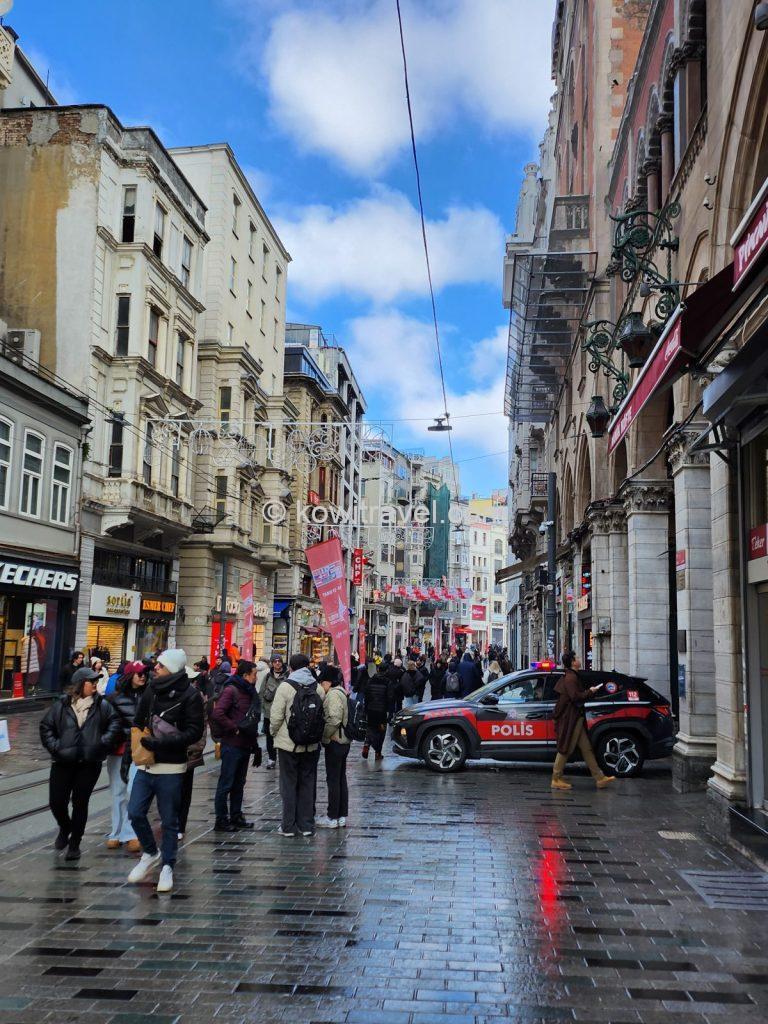
Istiklal Avenue, the city’s busiest thoroughfare—often called the “Myeong-dong of Istanbul.” Tracks for the iconic red vintage tram run down the center of the street, flanked by a variety of brand-name shops and restaurants.
“İstiklal” means “Independence” in Turkish; it is said that the street was given this name to commemorate the victory in the Turkish War of Independence—led by Mustafa Kemal Atatürk—and the subsequent establishment of the Republic of Türkiye in 1923.
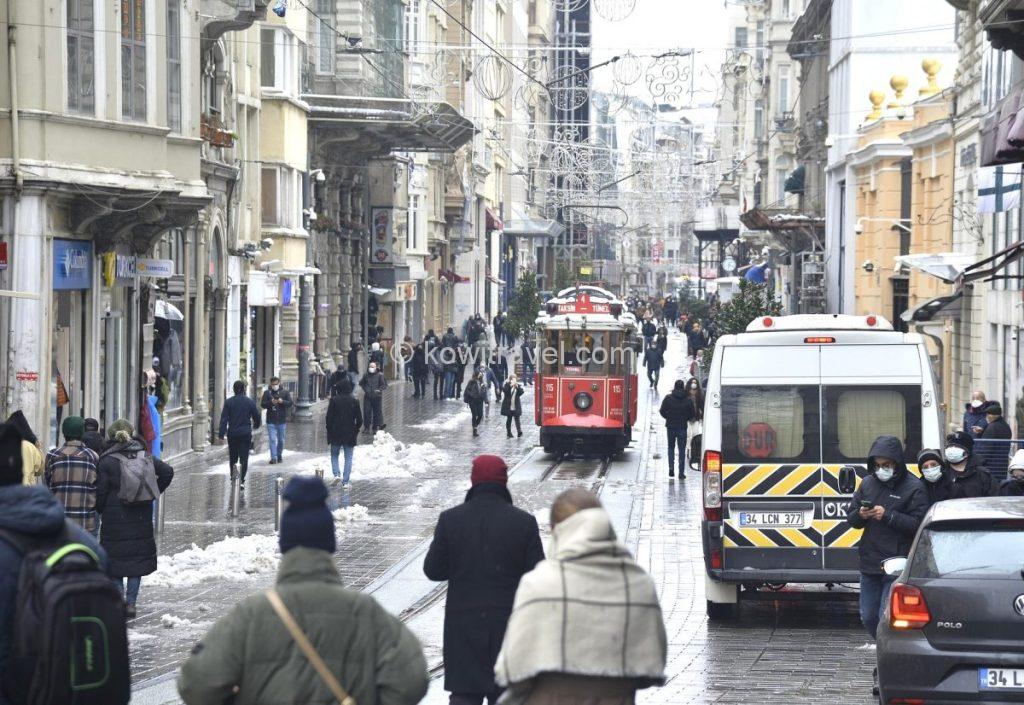

The nostalgic tram, with its striking red exterior, set against the backdrop of the street on a winter day.
The rhythmic, nostalgic chime of the vintage red tram car, the melodic strains of local street performers, and the architectural harmony of historic European facades housing modern storefronts create a unique atmosphere.
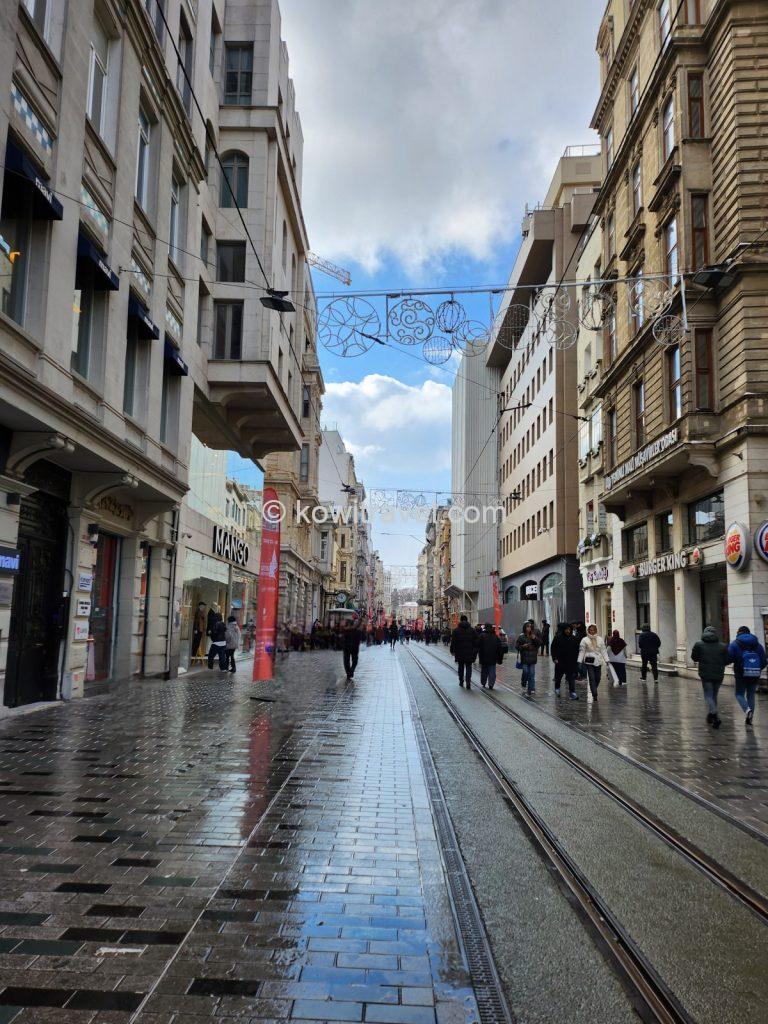
Istiklal Avenue, Istanbul’s premier bustling district. Tracks for the iconic nostalgic tram stretch along the center of the road, while trendy brand shops and historic restaurants line both sides.
Walking this avenue allows you to feel the living, youthful heartbeat of modern Istanbul.
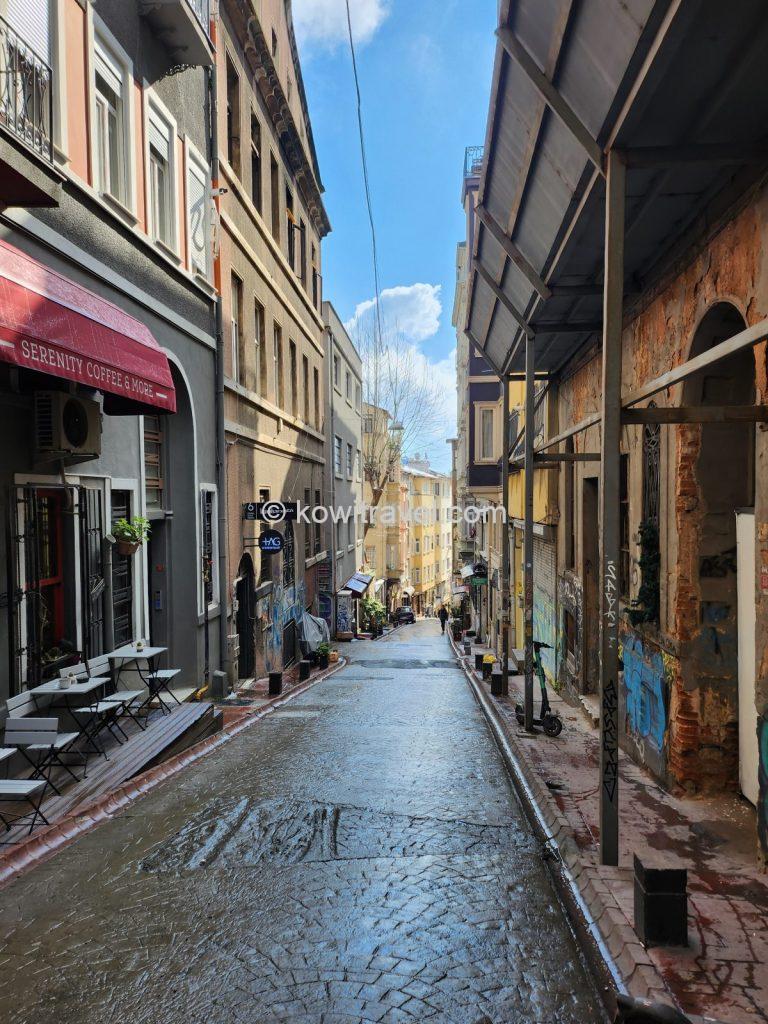
Scenes of exotic alleyways near Istiklal Avenue and Galata Tower. Damp cobblestones, charming cafes, and hip graffiti covering the walls blend together to create the lyrical atmosphere unique to the New City district.
3) A Sanctuary of Peace Amid the Bustle: Church of Saint Anthony of Padua
Navigating the vibrant crowds of İstiklal Avenue leads to a serene sanctuary: the Church of Saint Anthony of Padua (Sent Antuan Kilisesi). Discovering a Roman Catholic cathedral of this scale and beauty right in the heart of Istanbul is an extraordinary experience.
👉[ Check Mass Times for St. Anthony of Padua Church ]
This sacred site holds profound historical significance: it is where Pope John XXIII (then Father Angelo Giuseppe Roncalli) served for a decade before ascending to the papacy. During his tenure, he made the historic decision to introduce Turkish into the church services, earning deep respect and affection from both local Muslims and the Catholic community.
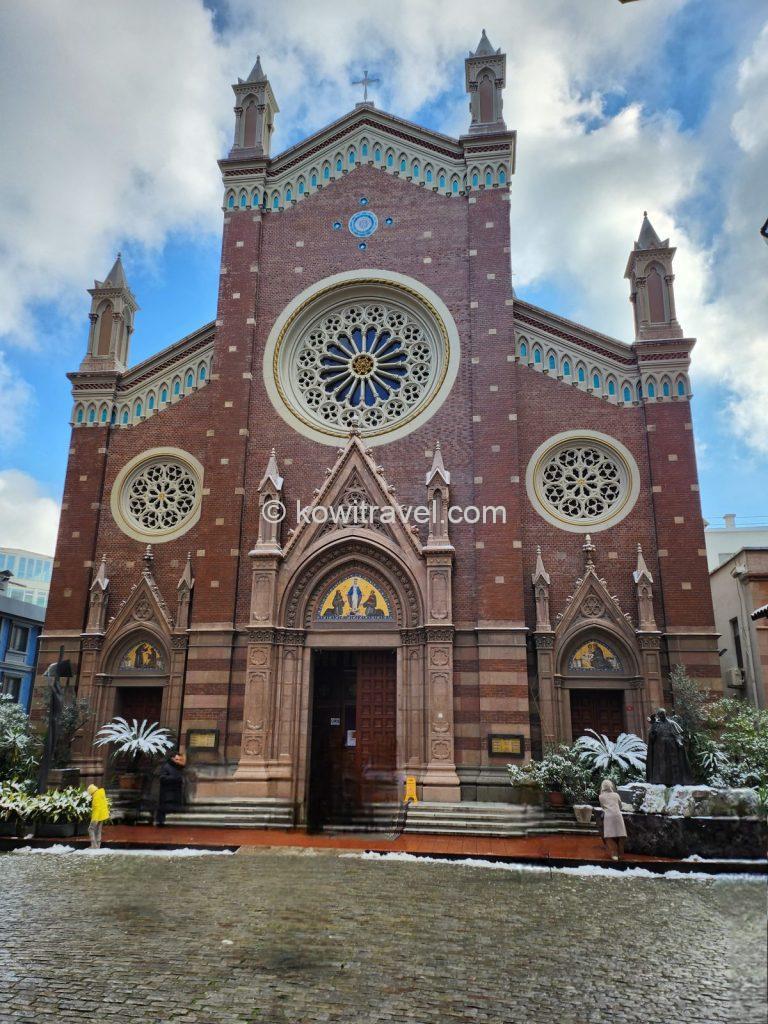
As a global cathedral attracting Catholic worshippers and tourists from around the world, Mass is conducted in different languages at specific times and days; if you wish to attend, please check the cathedral’s website in advance for the schedule by language.
Constructed in the early 20th century by a prominent Italian architect, this Neo-Gothic masterpiece leaves an impression the moment you enter. It showcases the pinnacle of European cathedral design, with soaring ribbed vaults and grand marble pillars creating an atmosphere of reverence.
Natural light filters through the large stained-glass windows behind the high altar, casting a gentle glow that complements the interior lighting. In the evenings, the modern lighting design bathes the arches in mystical shades of violet and gold, accentuating the church’s sacred ambiance.
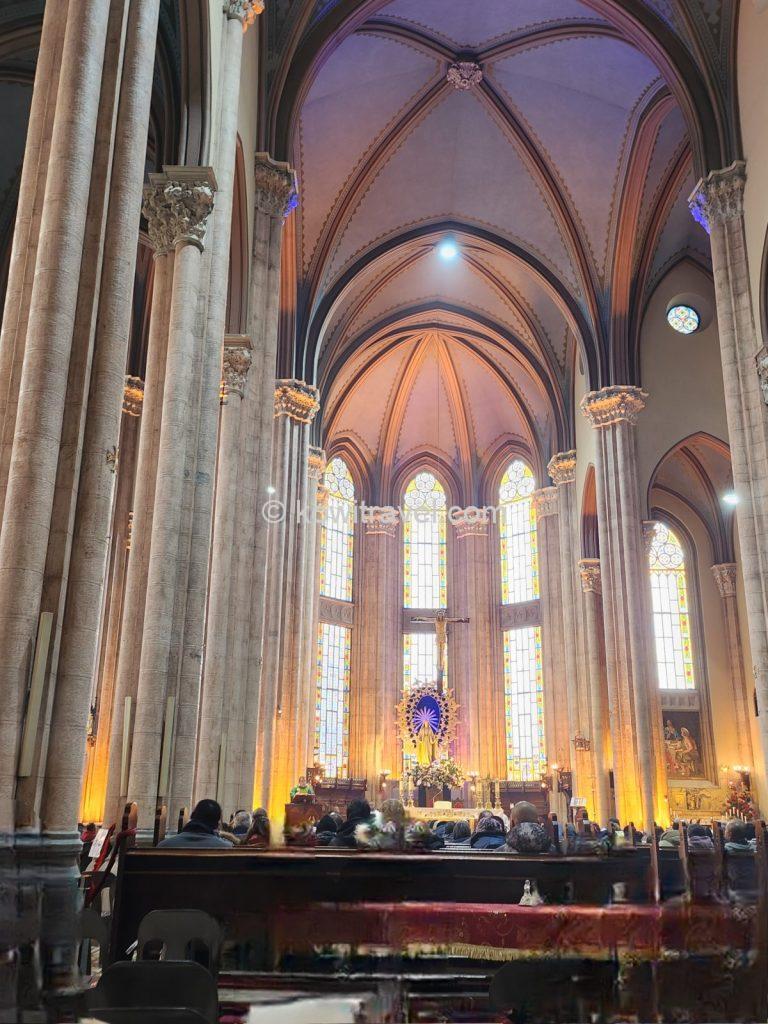
A view of the cathedral interior during Mass. Non-local visitors are assigned seating at the rear.
Watching parishioners and visitors sit quietly along the wooden pews offers a moment of profound reflection. Stepping inside transitions you from one of the city’s most energetic avenues into a realm of absolute quiet, making it a comforting sanctuary for any weary traveler.
4) The Pinnacle of Imperial Grandeur: Dolmabahçe Palace and Mosque
4)-1 An Opulent Mirage Anchored on the Bosphorus: Dolmabahçe Palace
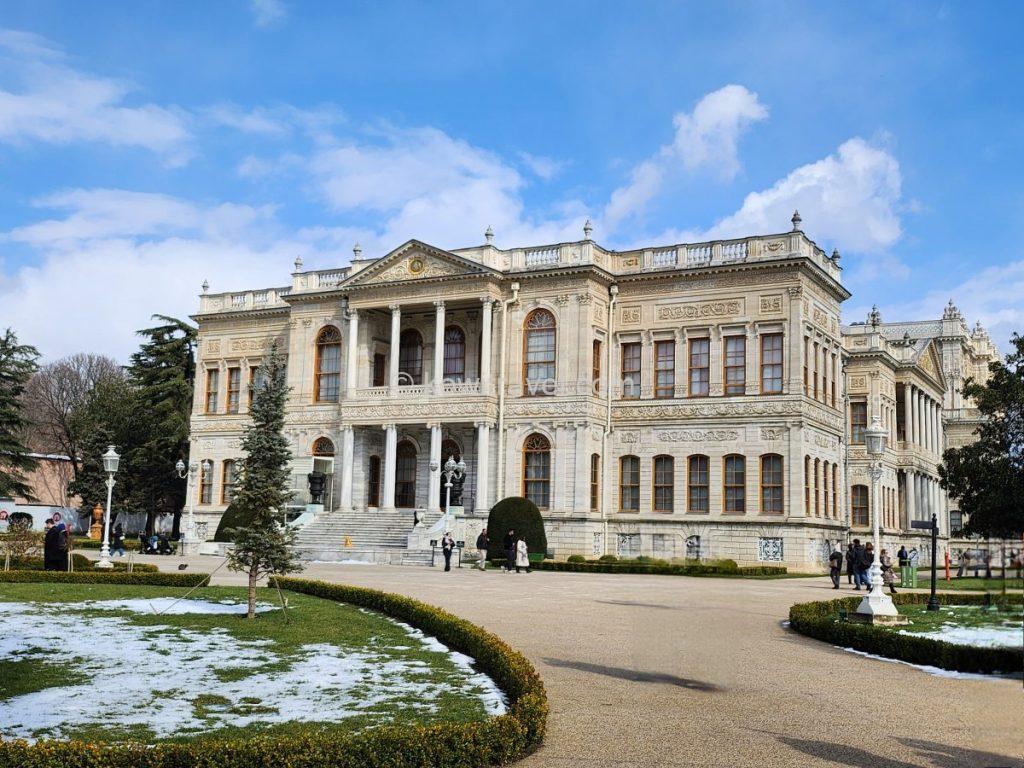
The beautiful garden that greets you first upon entering Dolmabahçe Palace.
In 1856, Sultan Abdülmecid I, the 31st ruler of the Ottoman Empire, chose to move the royal court away from the traditional Topkapı Palace to this ultra-luxurious waterfront residence built on reclaimed land along the Bosphorus.
Inspired by the Palace of Versailles and designed with a blend of Baroque, Rococo, and Neoclassical styles, the palace displays an overwhelming scale of imperial opulence.
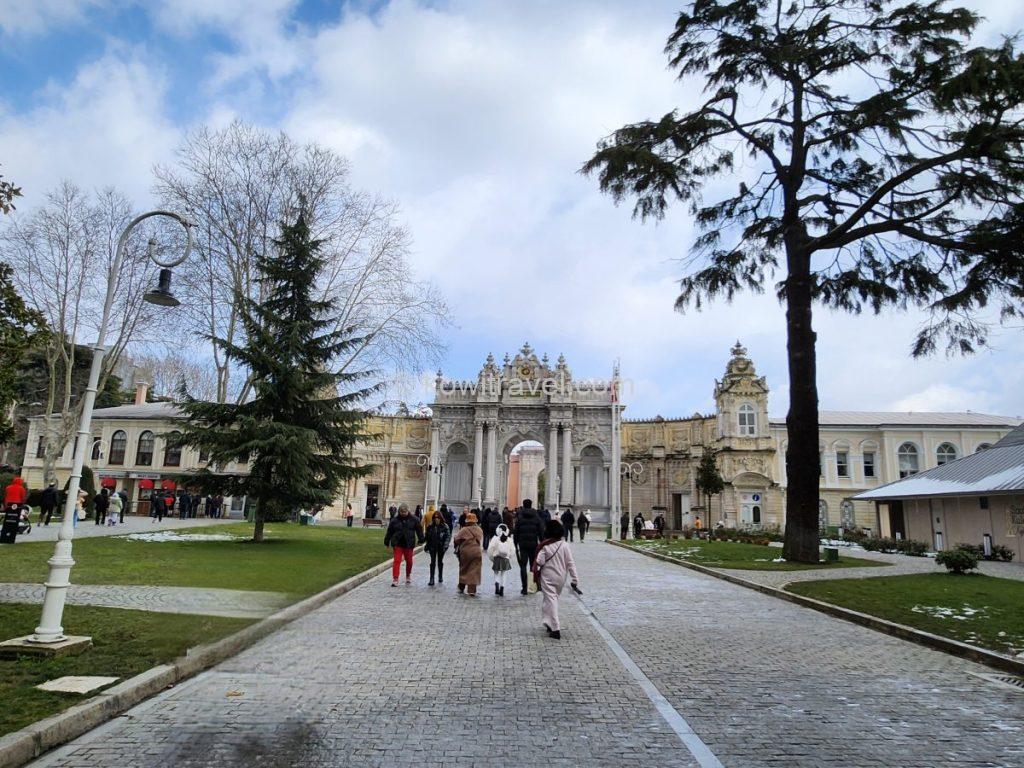
After passing through the security checkpoint near the entrance clock tower, you proceed toward the palace’s main gate.
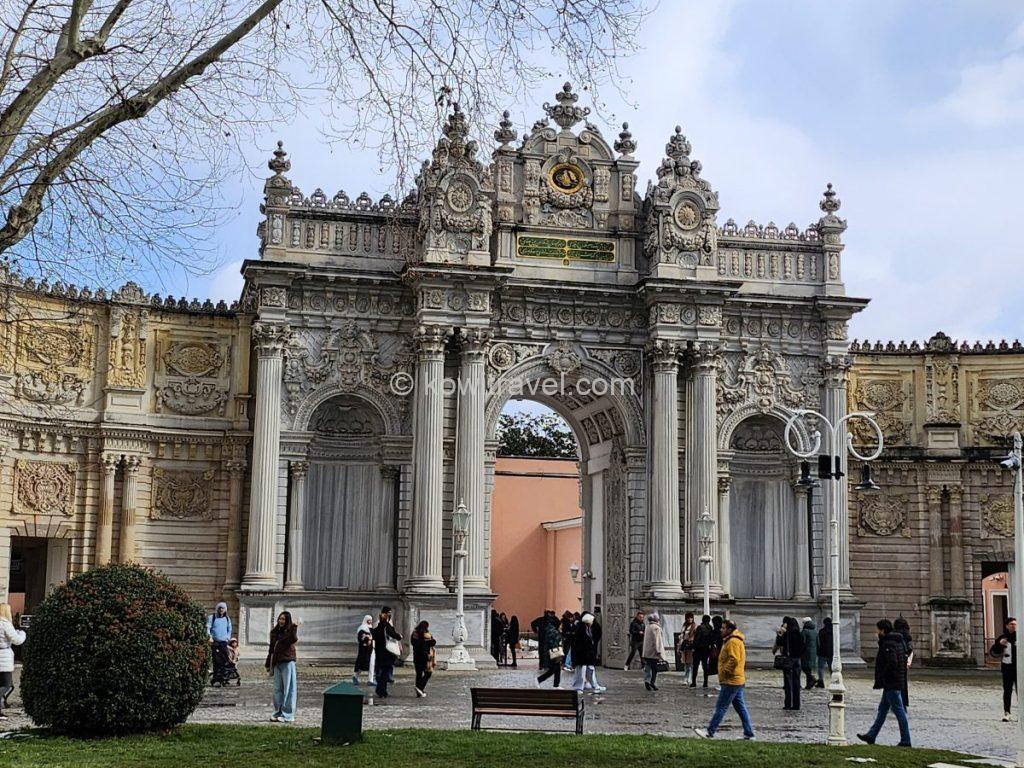
The palace’s main entrance, known as the ‘Clock Gate’ (or Treasury Gate). The ticket office is located behind the pillar to the left of the central archway; this is where audio guide headphones are provided. You will need to present your passport to receive them.
Historical records state that over 14 tons of gold leaf and 40 tons of silver were used to embellish the interior spaces. In the grand Ceremonial Hall, a magnificent 4.5-ton Bohemian crystal chandelier—a gift from Queen Victoria—hangs from the dome, commanding the room.
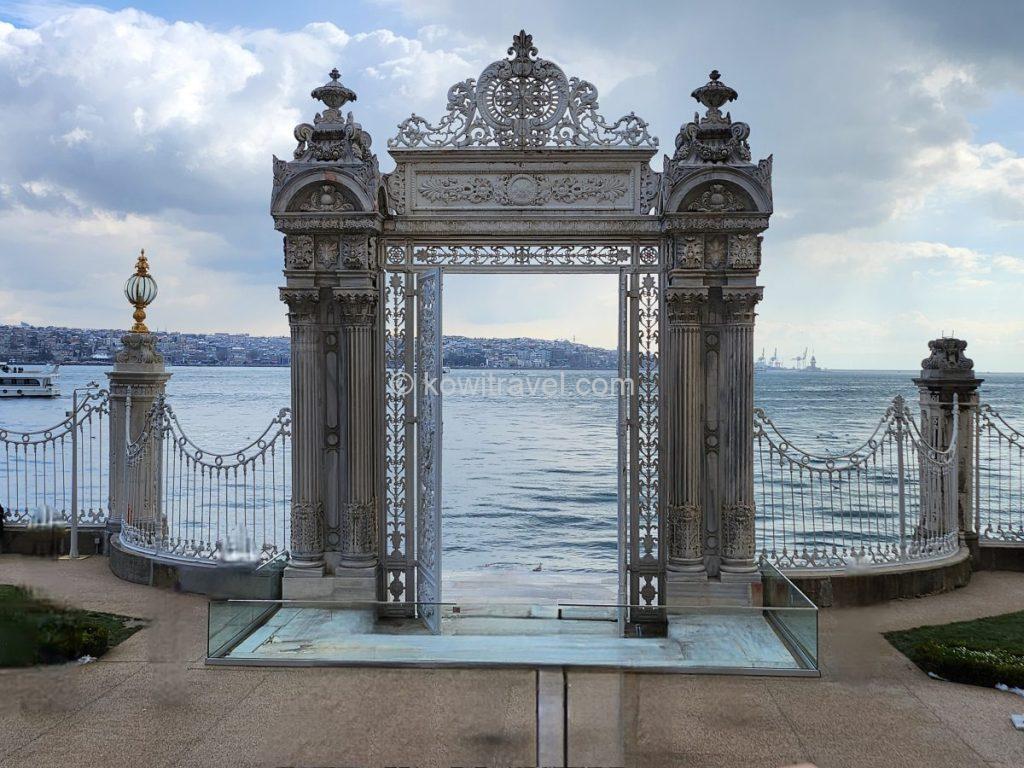

The ‘Sea Gate’—the royal maritime entrance connecting the palace to the sea (left)—and the magnificent marble exterior viewed from the central staircase of the main palace building (right).
However, this lavish spending contributed heavily to the financial decline of the late Ottoman state.


The Dolmabahçe Clock Tower, an iconic Istanbul landmark that stands tall in the center of the plaza, greeting visitors just before they pass through the security checkpoint on the left to enter the palace’s main entrance, the ‘Treasury Gate.’ Built in the late 19th century, this four-story structure features intricate carvings in the European Neo-Baroque style.
This palace also holds a revered place in modern history as the official residence and site of the passing of Mustafa Kemal Atatürk, the founding father of the Republic of Türkiye. The clocks throughout the palace remain permanently set to 9:05 AM, the exact moment he passed away on November 10, 1938, leaving a touching impression on all who visit.
👉 Photography is strictly prohibited inside the palace for the following reasons:
- Preventing Flash Damage to Protect Artifacts and Cultural Heritage
The palace interior is filled with centuries-old French crystal chandeliers, British wall clocks, premium silk Hereke carpets, and large oil paintings. Intense light—specifically ultraviolet and infrared rays—from the camera flashes of numerous tourists can cause dyes to fade and inflict irreversible damage on textiles and paintings; therefore, a total ban on photography was implemented to eliminate this risk.
- Preventing Congestion and Ensuring Visitor Safety
Dolmabahçe Palace features long, narrow corridors and visitor pathways. If every visitor were to stop in each lavish room to take selfies or photographs, severe bottlenecks would occur, making it impossible to tour the palace and compromising visitor safety.
- Theft Prevention and Security
The items on display—such as jewelry, gold furniture, and crowns—are priceless, high-value artifacts. If detailed photographs of the interior were to be leaked, the specific locations of these artifacts or the internal layout of the palace could be exposed, making them targets for criminal activity, such as theft.
4)-2 A Realm of Enclosed Beauty: The Dolmabahçe Harem
A crucial area to explore within the estate is the Harem, which housed the private quarters of the Sultan and the royal family. Unlike the maze-like, traditional Islamic layouts found at Topkapı Palace, the Harem at Dolmabahçe blends European residential luxury with the strict protocols of the Ottoman court.
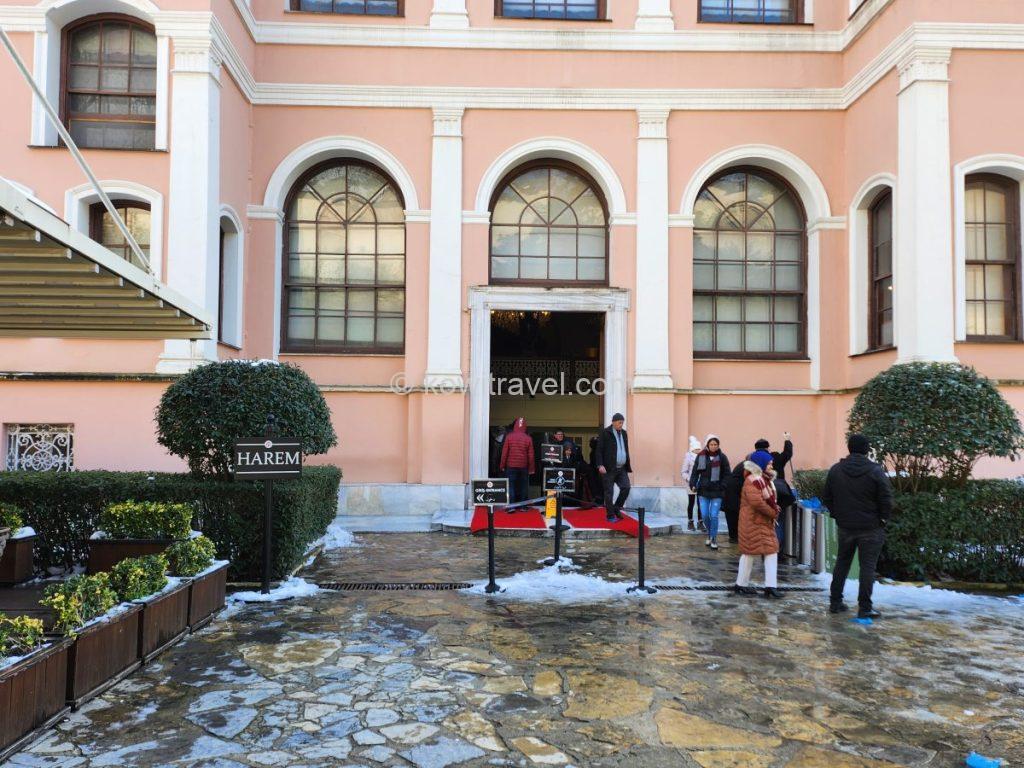
Upon entry, you must remove your shoes and carry them in the plastic bag provided at the entrance while you tour the palace.
Deriving its name from the Arabic word meaning “forbidden” or “sacred,” this wing was a highly secure zone, strictly off-limits to any male outside the immediate royal lineage. Occupying more than half of the palace’s total footprint, it operated like an elite residential fortress. Heavy iron doors separated the administrative wing from the Harem, with guards stationed around the clock to secure the perimeter.
Spanning two main levels, the Harem features grand halls and long corridors arranged strictly according to royal rank:
- The Quarters of the Valide Sultan: The residence of the Sultan’s mother, the most powerful woman in the Harem. Her rooms occupy a premium location, offering beautiful views of the Bosphorus.
- The Royal Consorts’ Suites: Apartments assigned to the Sultan’s wives and consorts, scaled according to their standing and whether they had given birth to a royal prince.
- The Blue Hall and The Pink Hall: Grand reception rooms named after their elegant interior decorations, where the Sultan gathered with the family for religious holidays and imperial celebrations.
- The Princes’ Education Chambers: Formal study rooms where the young heirs to the throne received their education in statecraft.
💡 2 Unique Historical Details of the Dolmabahçe Harem
- The Fusion of European Luxury: Breaking away from classic Eastern designs, the rooms feature fine European furniture, large crystal chandeliers, and imported oil paintings, creating the impression of a grand European royal residence.
- The Passing of Atatürk: This historic setting witnessed the final chapters of the Ottoman dynasty and later served as the residence for President Atatürk during his visits to Istanbul. The bedroom where he passed away on November 10, 1938, is preserved with a Turkish flag draping his bed, creating a moving experience for visitors.
4)-3 Elegance in Stone: The Dolmabahçe Mosque
Commissioned by the mother of Sultan Abdülmecid I, Bezmiâlem Valide Sultan, and completed in 1855, this unique waterfront mosque features distinct architectural details.
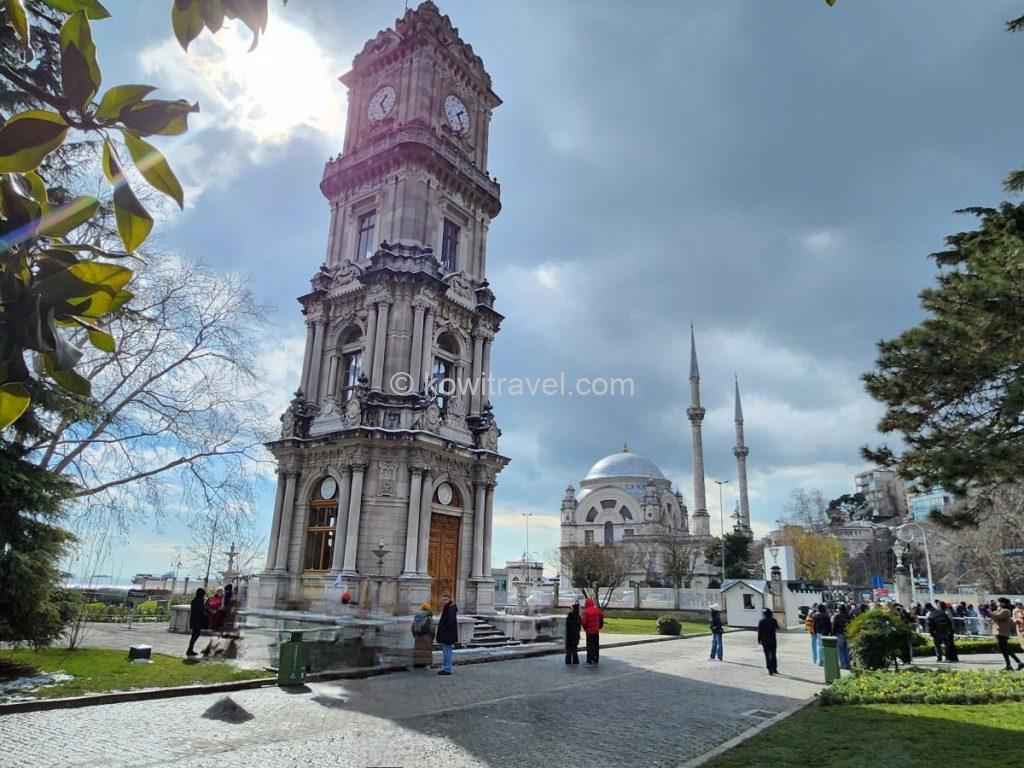
The Dolmabahçe Mosque, located just a one- or two-minute walk south from the Dolmabahçe Clock Tower and the palace’s main entrance, heading toward the pier.
Its most striking feature is the design of its twin minarets. Moving away from classic Islamic styles, they are designed like slender Corinthian columns, rising elegantly towards the sky. Located right along the shore near the southern gate, it served as the formal imperial mosque where the Sultan attended Friday prayers and state religious ceremonies.
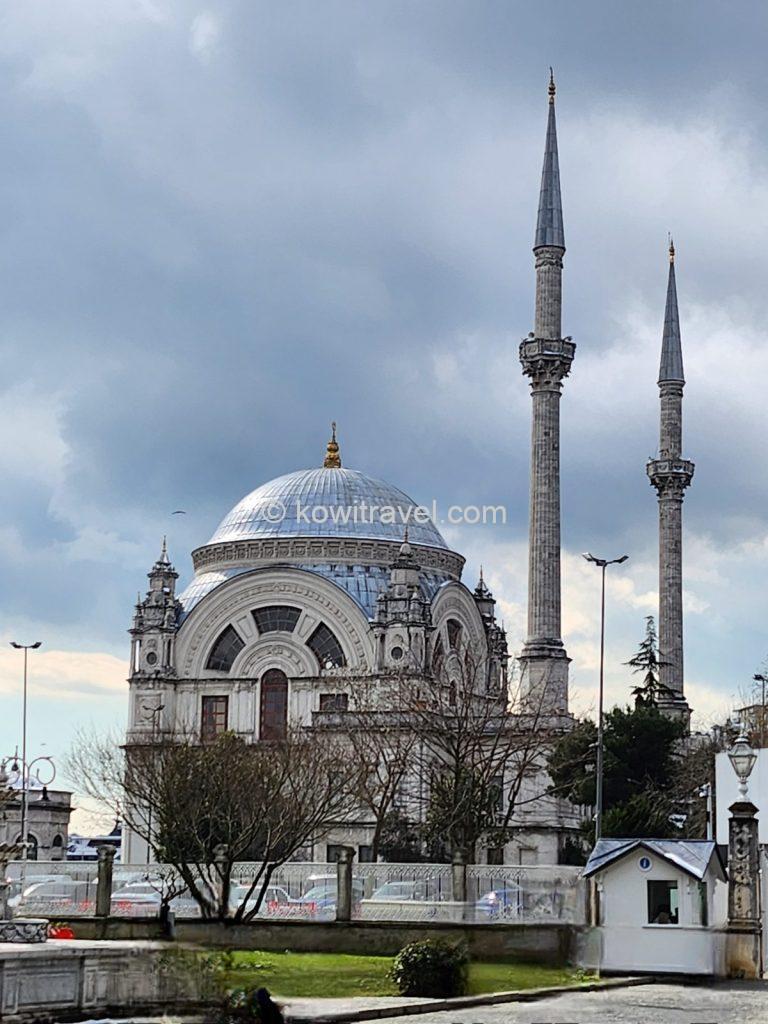
It is distinguished by its slender, elegantly soaring minarets, which resemble the refined Corinthian marble columns found in European palaces.
The main structure features a geometric, prism-like design that brings a light, contemporary European feel to the waterfront. Having briefly served as a naval museum in the mid-20th century, this historic structure stands as an elegant landmark along the Bosphorus.
5) The Jewel of the Waterfront: Ortaköy Mosque
Situated roughly 2.3 kilometers north of Dolmabahçe Palace along the coastline stands the beautiful Ortaköy Mosque, a landmark often called the “Jewel of the Bosphorus.”
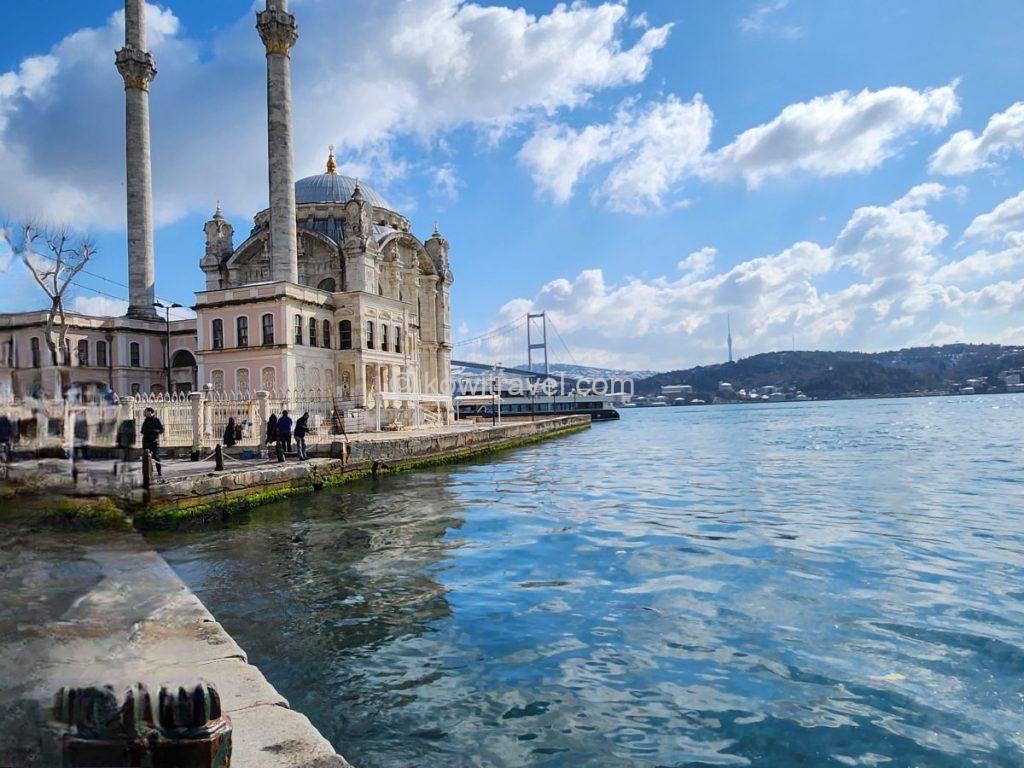
The Ortaköy Mosque, which looks like a white palace floating upon the waters of the Bosphorus.
Commissioned by Sultan Abdülmecid I as a royal prayer sanctuary, it provided a serene place for worship when the ruler traveled by imperial barge along the strait or resided at nearby summer pavilions.
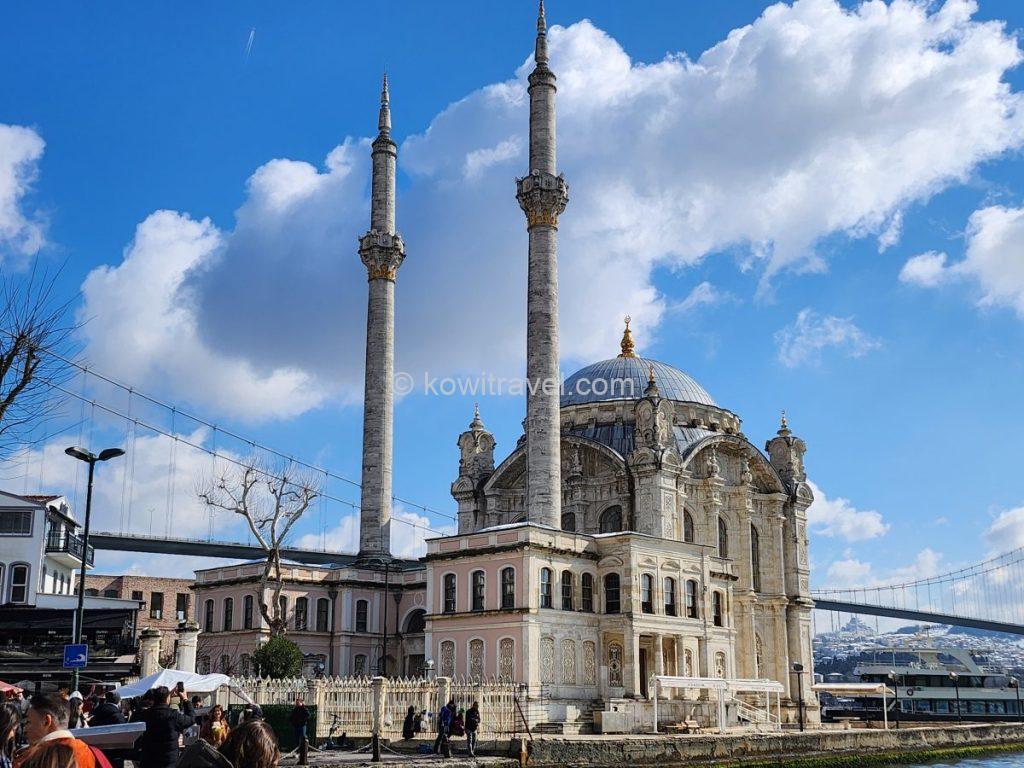
The signature Istanbul view created by the Bosphorus Bridge and the mosque. Here, one can experience the unique atmosphere of Istanbul, where the past and present coexist in perfect harmony across the waters.
While popular among travelers for its striking waterfront setting, its formal historical name is the Büyük Mecidiye Camii. Positioned right on the edge of the pier, it creates a dramatic sight against the moving waters of the Bosphorus.
The mosque’s design features intricate exterior stone carvings, balanced by large, tall windows that fill the interior with natural light. This innovative Baroque layout brings the shifting colors of the Bosphorus right into the prayer hall, defining the mosque’s unique character.
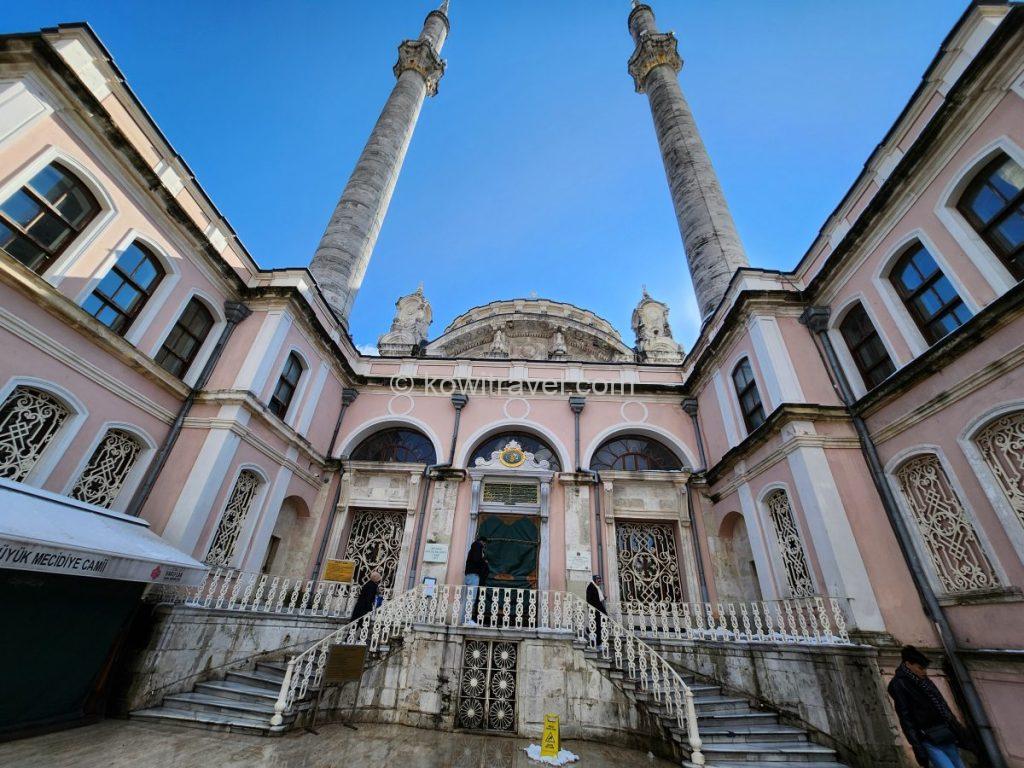
A view of the mosque’s courtyard and exterior. The facade, featuring soft pink and beige marble tones, reflects the ornate European Baroque and Rococo styles more strongly than traditional Islamic architecture.


The interior is so magnificent and distinctive that it has been dubbed a “Temple of Light.” Through the large, densely arranged grid-patterned windows, the blue waters of the Bosphorus and the sunlight pour in from all directions; blending with the interior lighting, they create a dreamlike, golden, three-dimensional atmosphere.
Directly behind the mosque’s elegant white marble minaret, the Bosphorus Bridge—a massive modern suspension bridge connecting the continents of Asia and Europe—aligns perfectly within the same frame.
This scene serves as the ultimate photo spot in Istanbul, showcasing a unique blend of the exotic and a modern aesthetic.
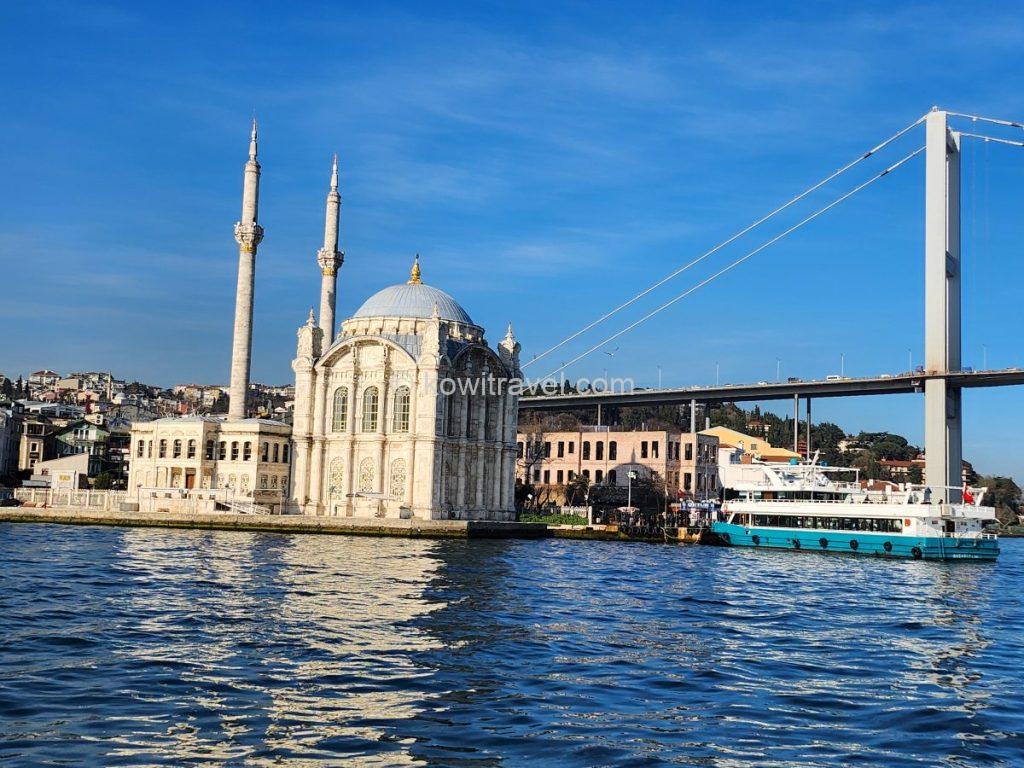
Viewed from a yacht on the waters, the Ortaköy Mosque presents a completely different aspect.
👌Local Encounters: The Anglers and Street Cats of Ortaköy
Strolling along the pier, we encountered local anglers cast-fishing into the deep waters of the strait despite the brisk sea breeze. When we approached, an open smile and a friendly wave bridged the cultural distance.
Using a smartphone translation app, we shared a warm conversation. They proudly showed us their catch of the day: silver fish fresh from the Bosphorus filling a white bucket. Experiencing these moments of local life offers a memorable addition to the journey.
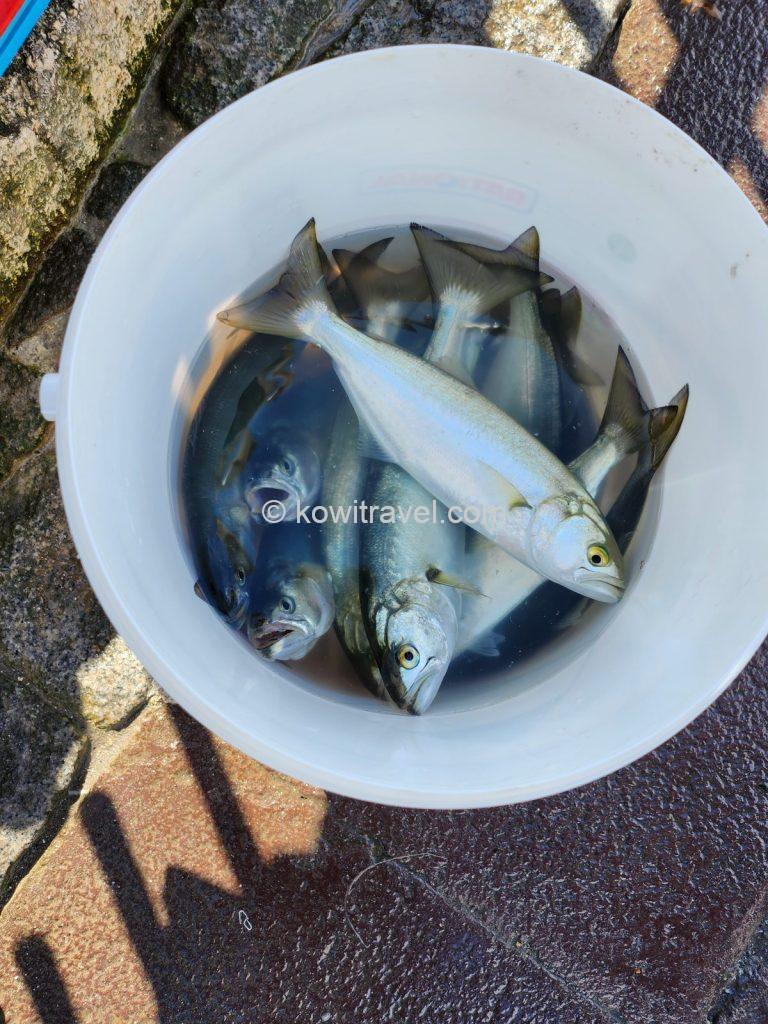
A local angler’s white bucket spotted on the Ortaköy waterfront. The friendly conversation shared via a translation app and the silvery fish inside the bucket vividly convey the fresh vitality of the Bosphorus waters.
Nearby, another delightful local encounter awaited us. Reflecting Istanbul’s reputation as a welcoming city for street animals, a friendly cat approached without hesitation, greeting us warmly.
Petting its thick fur offered a wonderful moment of comfort against the chilly sea air. These spontaneous connections along the side streets add a truly memorable highlight to a walking tour.
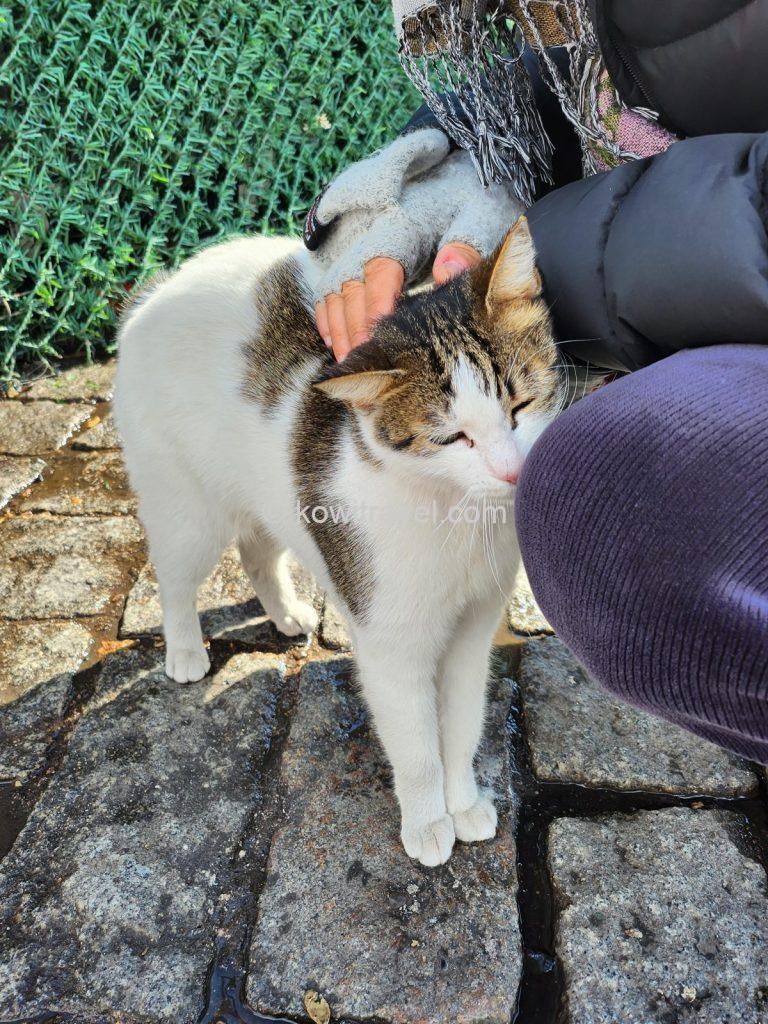
A friendly street cat enjoying some attention along the Ortaköy waterfront. A wonderful companion that brightens a traveler’s journey along the lanes of Istanbul.
💡 Historical Detail:
Dolmabahçe Palace, Dolmabahçe Mosque, and Ortaköy Mosque share a common architectural heritage. All three landmarks were designed by the Balyan family, a dynasty of imperial architects who shaped late Ottoman design. Their work is characterized by a distinct blend of traditional structures with European Baroque, Rococo, and Neoclassical elements, creating a unique imperial aesthetic.
6) A Metropolitan Skyline: The Istanbul Sapphire Observation Deck
Located in the Levent business district, the Istanbul Sapphire Observation Deck showcases the contemporary scale of modern Istanbul, offering a striking contrast to the low-rise historic horizons of the Old City. Rising 54 stories to a height of 261 metres including its antenna spire, it stands as one of the city’s signature modern towers.
Built during a period of rapid economic development in the late 2000s, the project helped transform the Levent district into a contemporary commercial center. Construction began in 2006, leading to its completion in 2010 and official opening in the spring of 2011. The tower created a striking addition to the skyline, introducing a sleek, contemporary aesthetic to the metropolitan landscape.
The observation platform is located on the 54th floor, 236 metres above the bustling city streets.
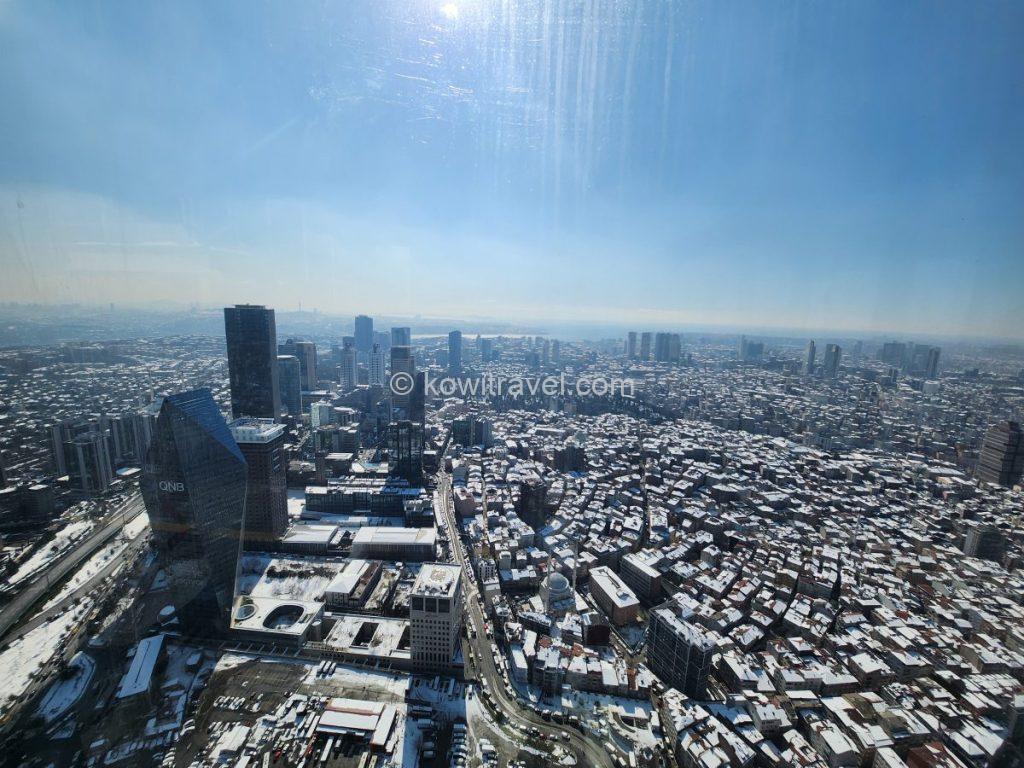
The “Levent Business District,” home to a dense cluster of high-rise buildings that serve as a major commercial and financial hub in Istanbul.
Designed as one of the city’s early ecological skyscrapers, the tower incorporates innovative green building technologies throughout its structure.
The building features a specialized double-skin glass facade that dampens urban noise, manages environmental wind pressures, and optimizes thermal efficiency. Remarkably, every three floors, the architecture incorporates open sundecks and vertical indoor gardens, allowing real trees and plants to thrive high above the city. This design stands as an excellent showcase of sustainable contemporary architecture.
A high-speed elevator carries you up to the observation level in seconds, revealing breathtaking views across the metropolis. The deck offers a complete 360-degree panorama showcasing the boundary between Asia and Europe, the three grand bridges spanning the Bosphorus, and the vast urban landscape home to over 15 million residents.
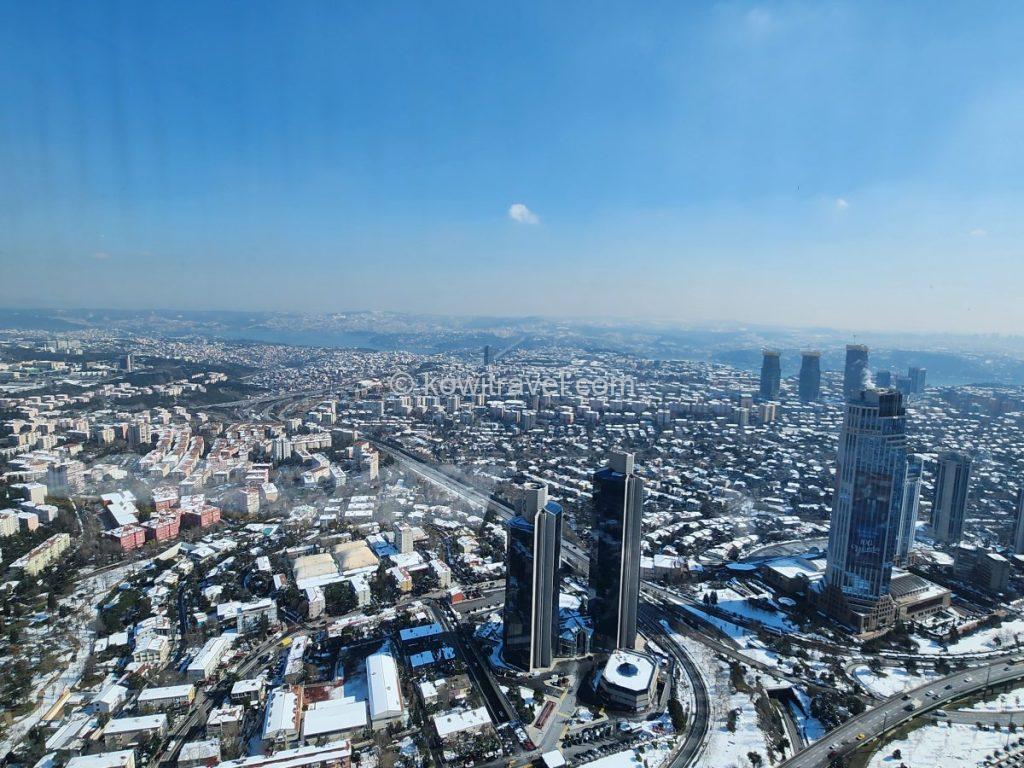
In the distance, the Bosphorus Strait and the bridge connecting Asia and Europe appear in shades of blue, surrounded by the sprawling urban landscape of Istanbul.
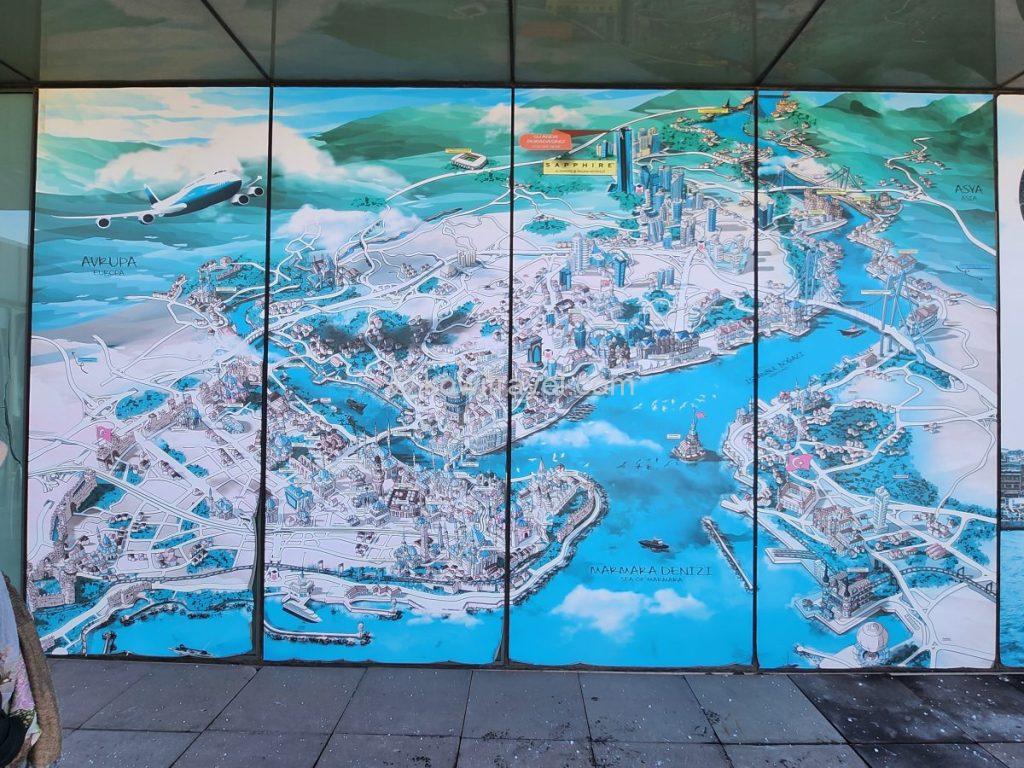
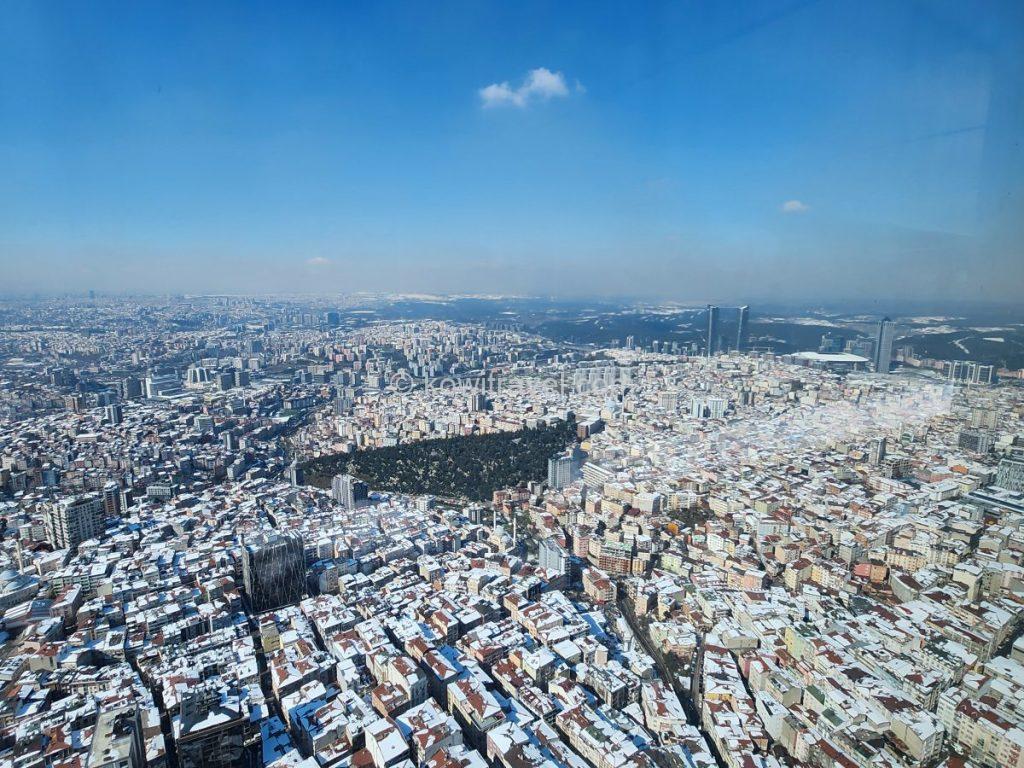
An illustrated guide map of the observation deck (left) and the endless expanse of Istanbul’s residential buildings (right).
This observation deck highlights a dynamic, contemporary side of the country, presenting a memorable contrast to the historic stone arches of the Old City.
- An Aerial Journey: The 4D Skyride Helicopter Experience
A key highlight on the observation level is the 4D Skyride Helicopter Simulation. This virtual reality experience offers a thrilling aerial tour across the city’s major landmarks.
The simulation takes you on a dynamic flight path, gliding over the dome of Hagia Sophia, soaring past the crowds at Taksim Square, and flying between the suspension cables of the Bosphorus Bridge. The experience offers a fun, panoramic perspective of the city’s grand scale.
4. A Quiet Moment: Discovering a Hidden Cafe in Beyoğlu
1) An Unexpected Sanctuary Along the Alleys
Stepping out from the quiet sanctuary of the Church of Saint Anthony, the brisk winter wind immediately caught us along the lanes of İstiklal. After days of exploring the city on foot, we were looking forward to finding a warm, comfortable place to rest.
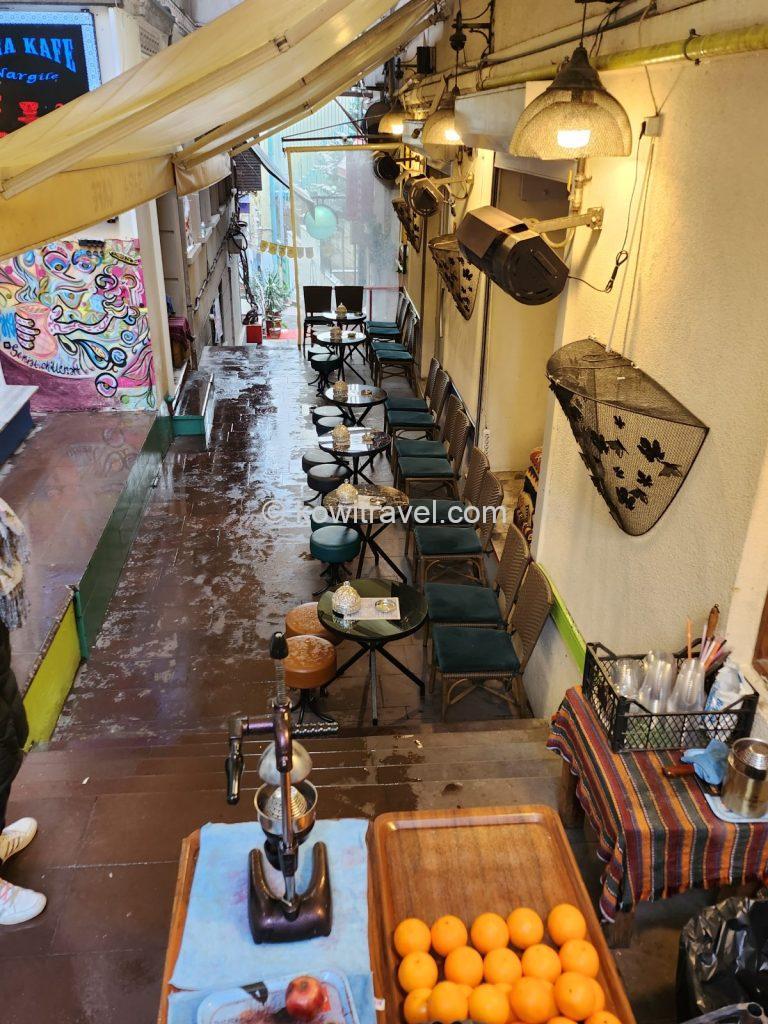
The entrance to a café where the scent of fresh fruit wafts through the air; it is located just a few steps away from the Church of St. Anthony.
Tucked into a quiet side alley right next to the cathedral, we discovered a charming local spot: SARA CAFE NARGILE.
It is a well-crafted spot—a tranquil retreat known primarily to those in the know—that boasts high ratings among both locals and travelers.


The café entrance is found immediately to the right after descending the “Rainbow Stairs,” a signature landmark of Istanbul’s alleyways. These old hillside steps have been painted in vibrant, bold colors, adding a trendy vibe to the area.
With its colorful painted steps, inviting outdoor seating, artistic graffiti, and a warm yellow awning illuminated by glowing lights, it provided the perfect welcoming refuge for weary travelers.
2) The Rich Heritage of a Traditional Turkish Coffee
Settling into a comfortable corner, we ordered their signature item: a traditional Turkish Coffee (Türk Kahvesi, 130 TL). It arrived served in a beautiful cup adorned with elegant traditional motifs.

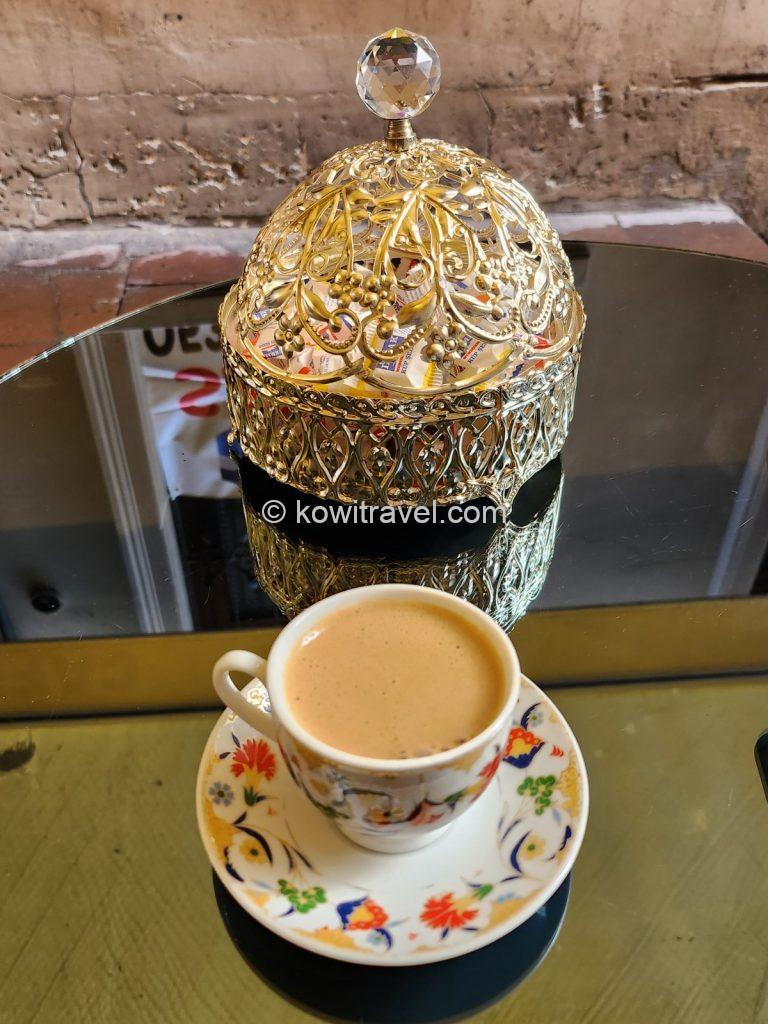
The menu (left) and a cup of frothy traditional Turkish coffee served in a lovely floral-patterned vessel (right). The golden, dome-shaped container is a traditional Turkish sugar holder that also serves as a decorative piece.
This classic coffee is crafted using finely ground beans simmered with water in a traditional copper pot called a ‘Cezve’ without filtering, preserving its rich, signature foam. The table featured an ornate, golden Ottoman-style sugar box. Opening its domed lid revealed neat white sugar cubes, adding a wonderful touch of hospitality to our table.
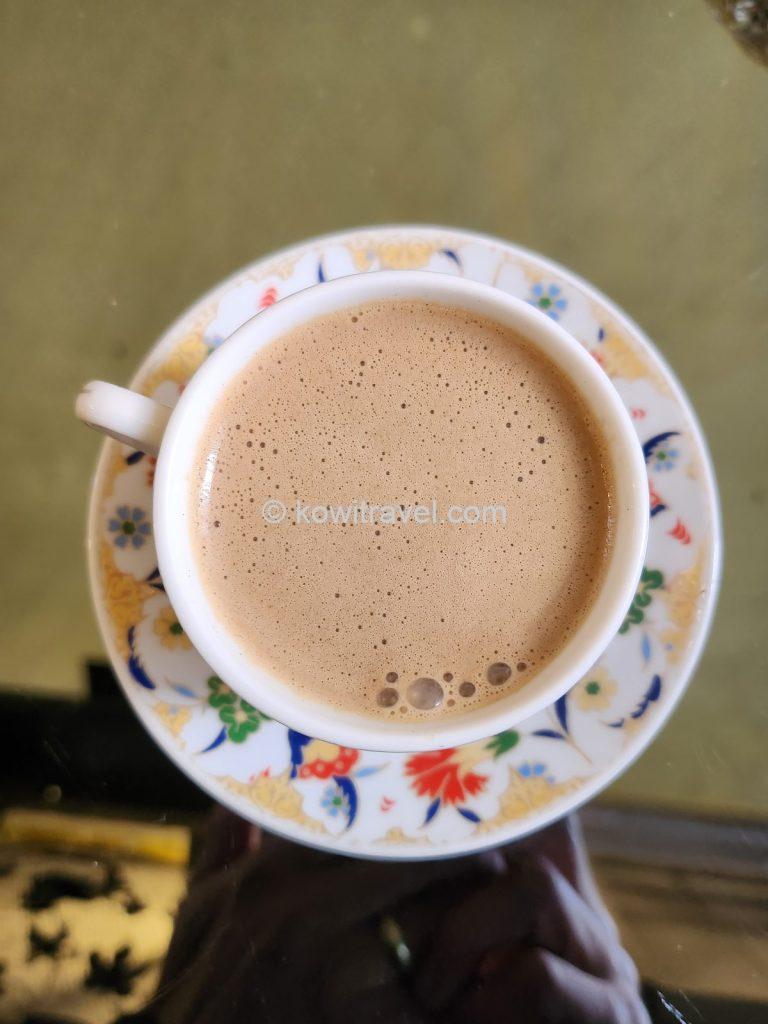
In Turkey, the quality of the brew is often judged by the thickness and richness of the foam atop the coffee.
Allowing the fine coffee grounds to settle gently to the bottom of the cup, we enjoyed our first sip. The bold, full-bodied aroma and deep flavor provided the perfect comfort after our long walk. Resting in this quiet corner while watching the rain fall along the lanes of the New City remains one of the most peaceful highlights of our journey.
5. Romance on the Water: Top 2 Bosphorus Cruise Experiences
1) The Bosphorus Sunset Yacht Cruise
- Watching the City Turn to Gold
This relaxing experience offers the perfect way to unwind after a day of exploring the city on foot.
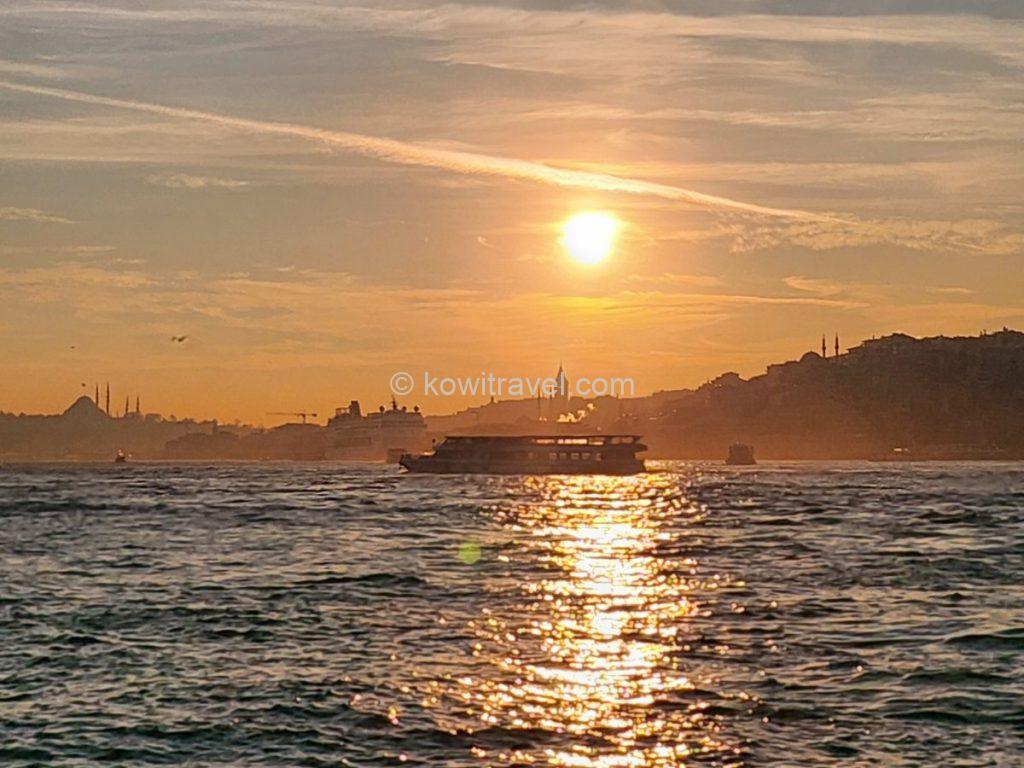
A breathtaking sunset view over the Bosphorus Strait as day turns to dusk. Against the backdrop of the golden glow, the silhouette of the Galata Tower—an iconic symbol of Istanbul—rises sharply in the distance.
As evening approaches, you cruise along the waters dividing Asia and Europe, taking in a beautiful sunset.
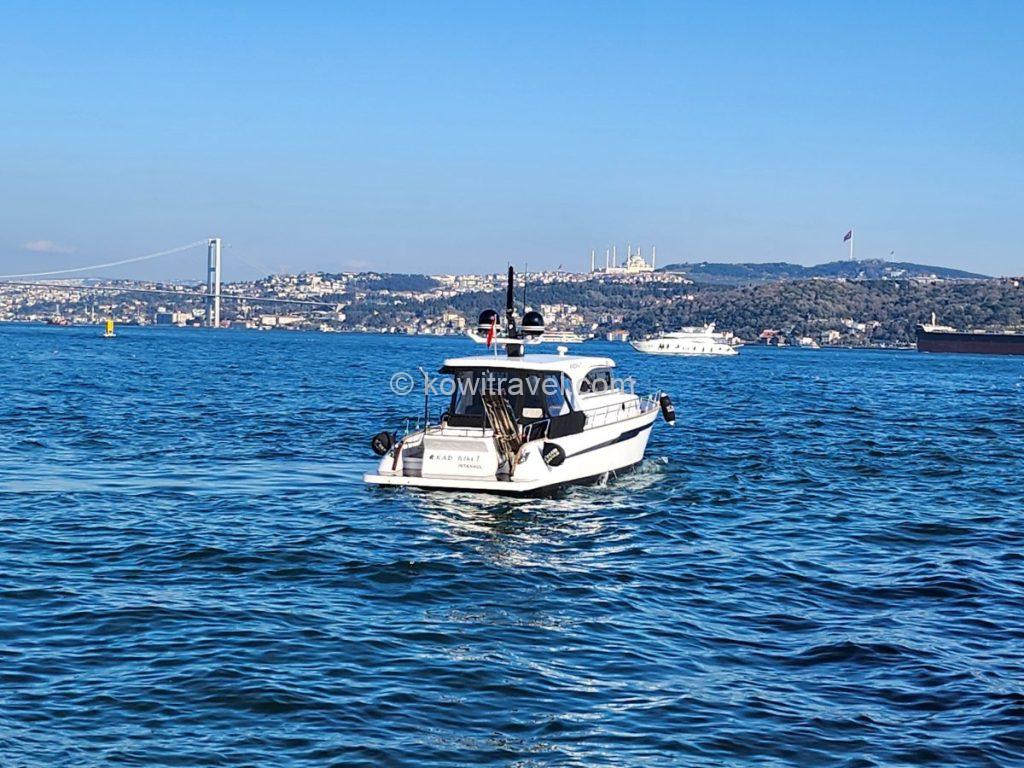
The yacht that will take us to a breathtaking sunset.
The warm evening light frames the silhouette of Galata Tower and the historic minarets of the Old City, creating a picturesque setting that stands out as a memorable highlight of the trip.

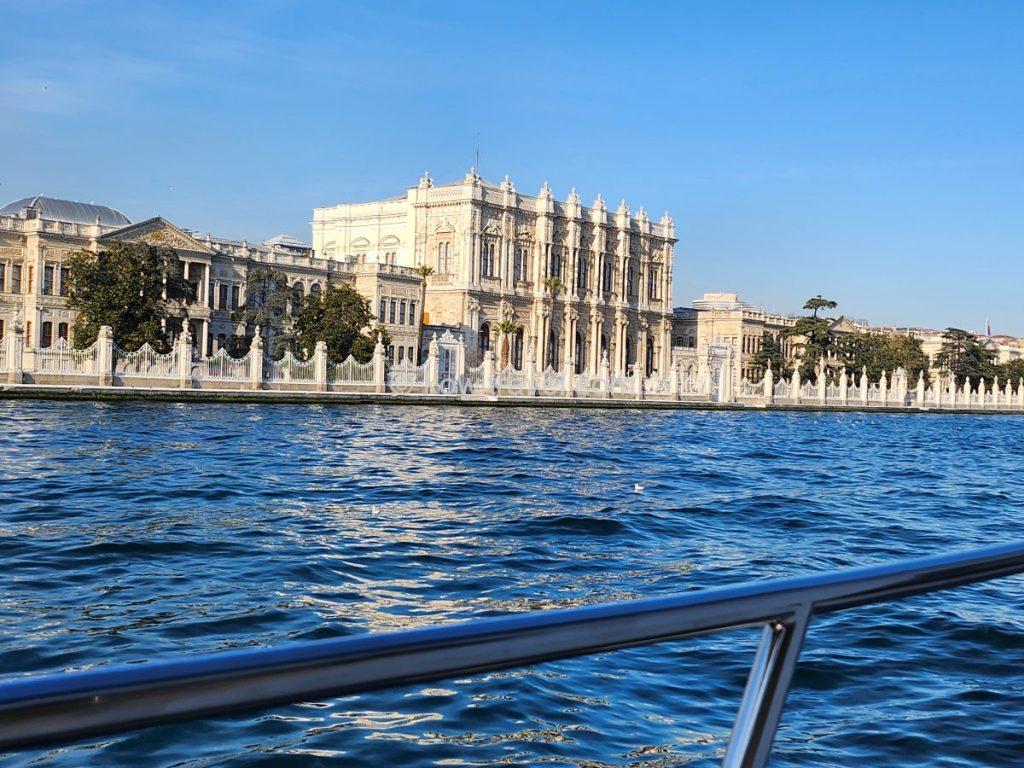
The Bosphorus Bridge reveals its majestic presence in the distance (left), while the Dolmabahçe Palace—visited earlier in the day—offers a completely different perspective when viewed from the water (right).


Küçüksu Palace, a small, exquisitely crafted structure resembling a jeweled box, stands solitary along the Asian shoreline (left); alongside it are Yalı—traditional wooden mansions that served as summer retreats for Ottoman nobility (right).
💡 Travel Tip: Making the Most of the Istanbul E-Pass
- Easy Bookings and Excellent Value
Traveling with the Istanbul E-Pass made our arrangements smooth, allowing us to skip the ticket lines with quick digital reservations. The cruise is fully included with the pass, offering outstanding value for your itinerary. (For independent travelers, standard luxury sunset yacht cruises generally range between €25 and €40 per person.)
- A Comfortable Cruise Experience
The 90-minute journey takes place aboard a spacious, modern yacht. During the cruise, the attentive crew serves traditional Turkish tea (Çay) and sweet snacks, allowing you to relax and enjoy the sea breeze in comfort.
2) The Bosphorus Dinner Cruise
- Illuminated Palaces and Cultural Performances
This is a premier night tour designed to make your final evening in Istanbul truly spectacular and grand.
The tour includes pick-up and drop-off services from designated hotels in the city center, and the operator will send a confirmation email with the specific pick-up time. However, if you are staying at a hotel outside the city center, pick-up service is not included; you must make your own way to the meeting point—the Kabataş Elite Dinner Cruise port—by 8:30 PM.
Since we had spent the day exploring various parts of the New City, we headed directly to the meeting point in time for the tour.
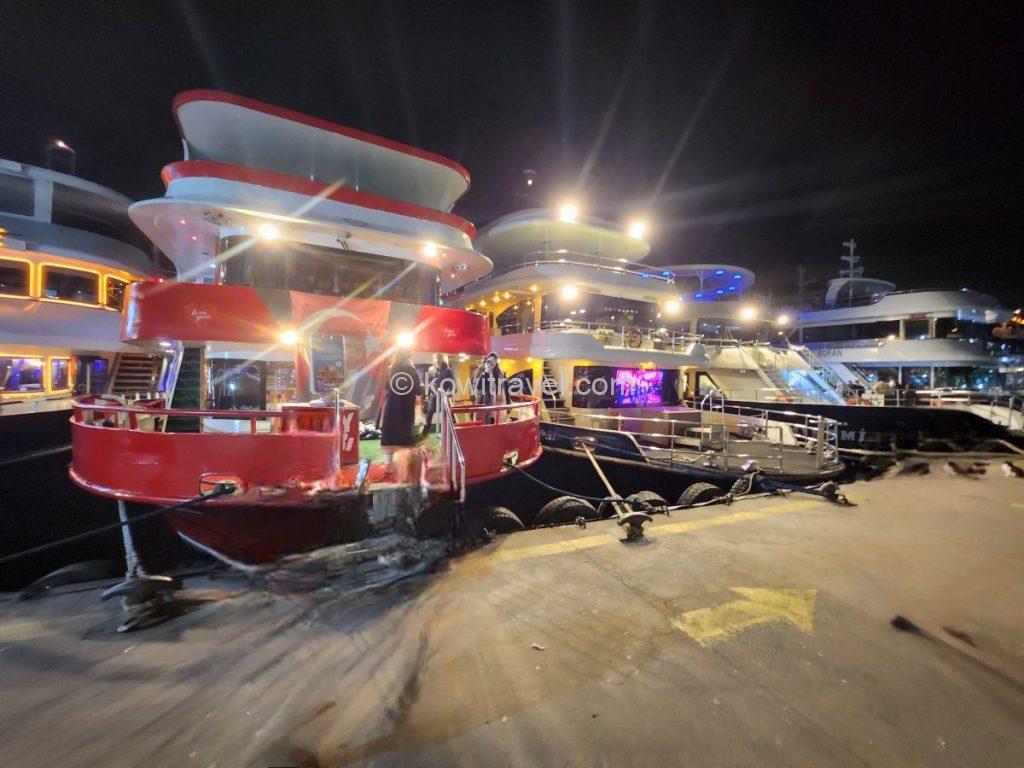
Cruise ships waiting at the dock to embark on the night tour.
As a large cruise ship glides through the deeply darkened Bosphorus Strait, the night view—passing right alongside the Dolmabahçe Palace and Ortaköy Mosque, both illuminated in a golden glow that shines like emeralds—is breathtaking enough to leave you momentarily speechless.
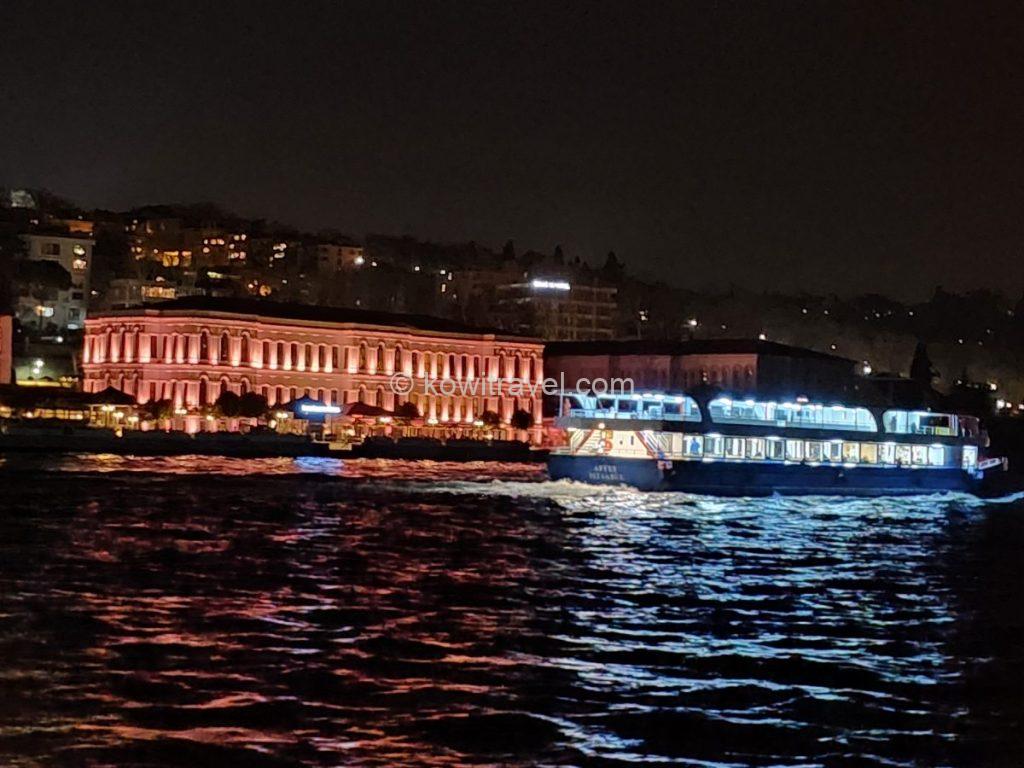
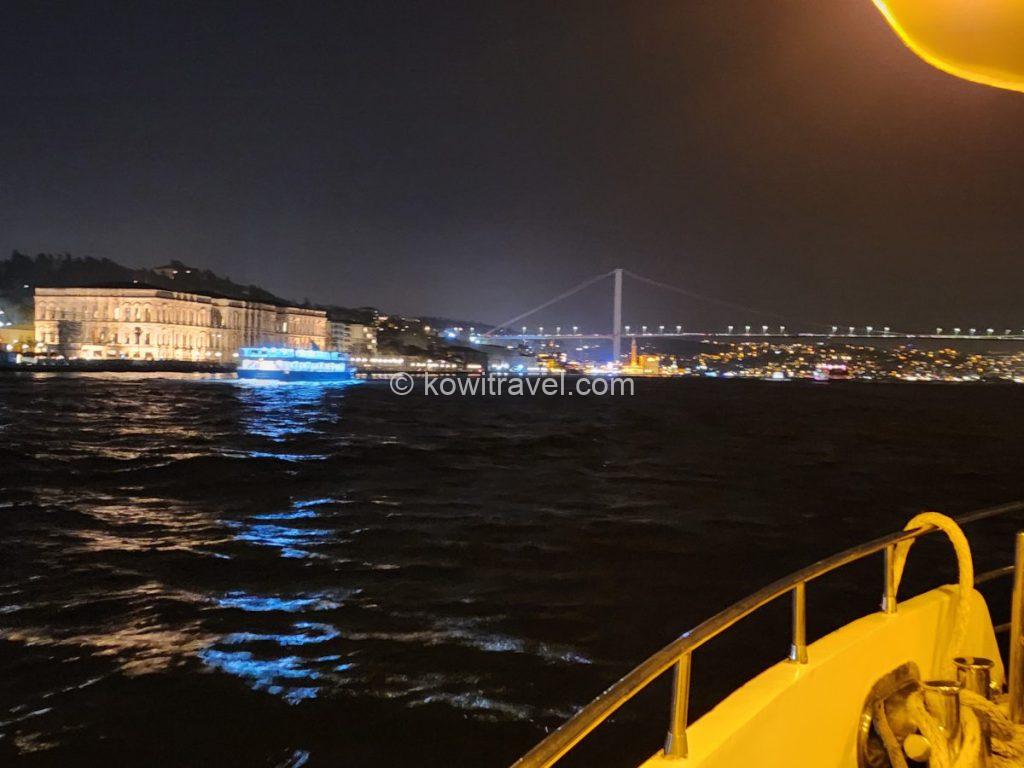
Çırağan Palace, one of the final imperial palaces of the Ottoman Empire, built in 1867 by order of Sultan Abdülaziz (left); and a view capturing three major night-time landmarks: the brilliantly illuminated Çırağan Palace, the Bosphorus Bridge connecting Asia and Europe, and the Ortaköy Mosque glowing like a jewel beneath it (right).


A view of the Bosphorus Bridge from the cruise deck (left), and the magnificent yet romantic night-time vista of the Ortaköy Mosque, considered the premier photo spot for Istanbul’s night scenery (right).
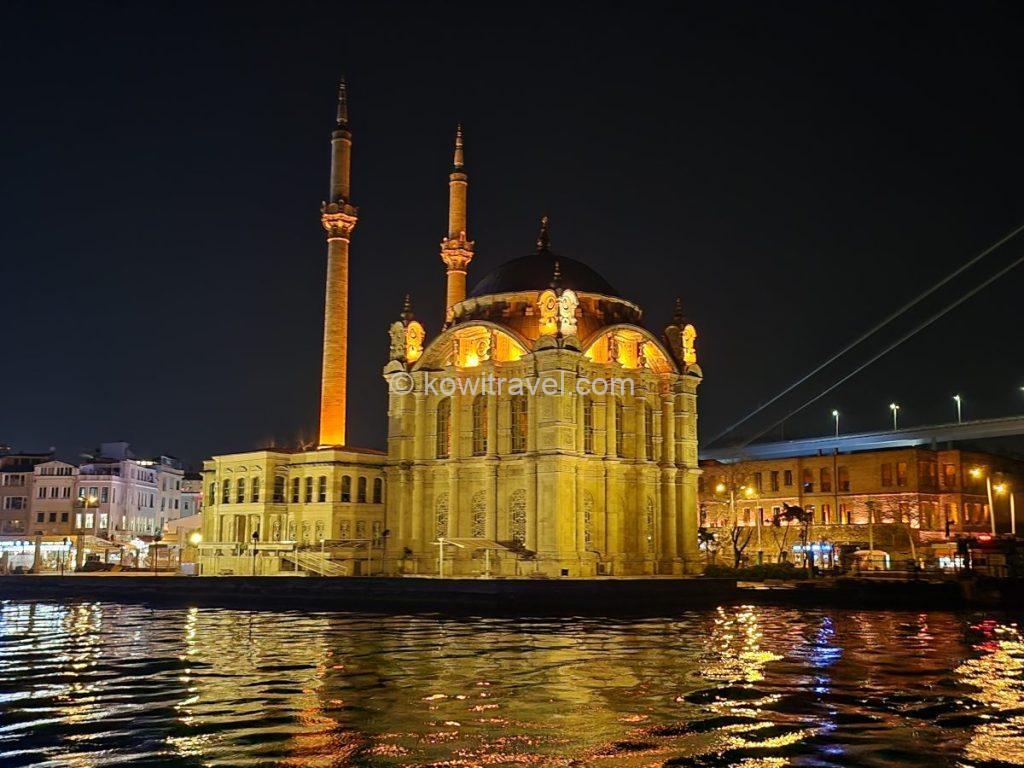

The Ortaköy Mosque (left), and the Dolmabahçe Palace, where warm orange lighting casts a long reflection across the water, exuding a grandeur that seems to embody the dynasty’s former glory (right).
On the ship’s stage, a feast of diverse cultural performances—ranging from dazzling traditional belly dancing that energizes the audience to the mystical “Sema” whirling dance of the Islamic Sufi tradition—delights the senses and offers complete satisfaction.
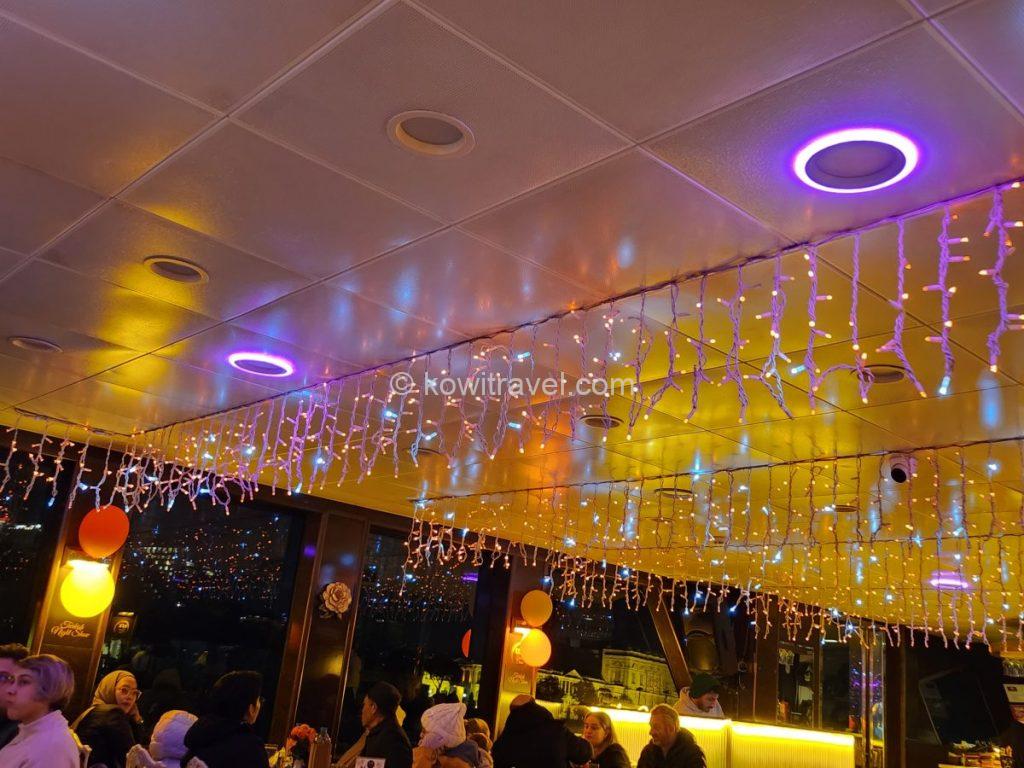

Tourists from around the world enjoy a meal beneath the dazzling lighting inside the cruise ship (left). Pictured on the right is the main course of the dinner cruise: grilled steak topped with cheese, served with Turkish şehriye pilaf.

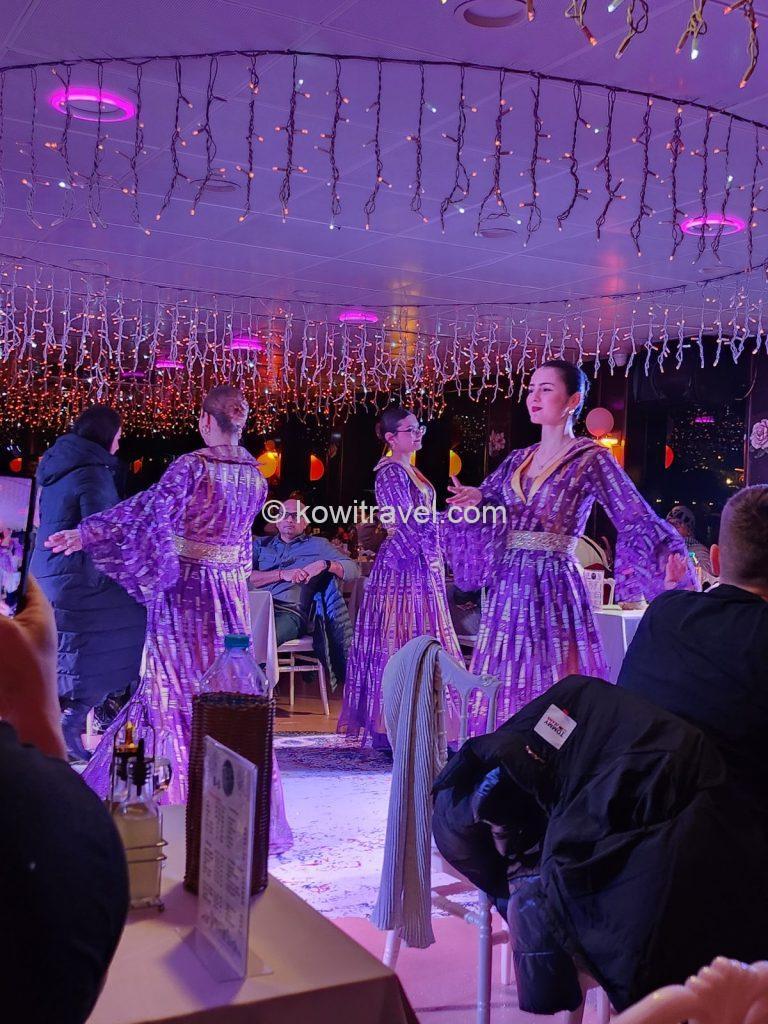
A view of the lively dinner show inside the cruise ship. The cultural performance kicks off with a smooth introduction by the MC, featuring traditional Turkish folk dance performances on the ship’s main stage.
👌Unique Experiences and Chance Encounters on the Dinner Cruise
- The “Instant Framed Photo”—a mix of sales tactic and cherished souvenir : After boarding or during the meal, a professional photographer wanders around, snapping what might be described as a “shot of a lifetime” (sometimes almost by force!). By the time the performance is halfway through, they’ve miraculously printed the photo, framed it, and brought it right to your table. While you can certainly decline, the atmosphere often sweeps you up, leading you to open your wallet for this signature cruise offering—part sales pitch, part keepsake. Even this sales tactic turned into a delightful memory for the night.
- A Heartwarming Encounter with a Mother and Daughter from Morocco : We shared our table with a mother and daughter from Morocco. Conversing with the daughter—who spoke fluent English and was accompanying her mother on her first-ever trip—made for a moment as warm and memorable as the night view of the sea itself.
Viewing landmarks like Dolmabahçe Palace, Ortaköy Mosque, and the Bosphorus Bridge from the middle of the water—seeing them from the opposite perspective compared to the daytime view from land—was a truly romantic experience; it felt like a privilege reserved exclusively for dinner cruise passengers.
💡 Travel Tip: Utilizing the Complimentary Drop-Off Service
- Convenient Arrangements: We arranged this experience easily through our Istanbul E-Pass, which offers excellent access or promotional rates for pass holders. (Standard independent bookings including a full buffet dinner and live performances generally range between €40 and €60 per person.)
- Convenient Drop-Off Service for Peace of Mind: Because dinner cruises conclude late in the evening when regular transit options may be limited, navigating back to your hotel in a new city can sometimes feel challenging. To ensure a comfortable experience, this cruise includes a convenient drop-off shuttle service to major hotel districts like Taksim Square and Sultanahmet. After docking, you can step directly onto a waiting shuttle bus for a smooth ride back, allowing you to fully enjoy your evening on the water.
6. Reflecting on a Month-Long Journey Across Türkiye
As we enjoy the evening lights of the New City and the rolling waters of the Bosphorus, our month-long road trip across Türkiye comes to a memorable conclusion.
Our journey began at the international airport and took us across thousands of kilometers of scenic highways—from the historic lanes of Bursa and the sea breeze of İzmir to the white terraces of Pamukkale, the turquoise waters of Antalya, the unique landscapes of Cappadocia, and the riverside charm of Eskişehir. Yet, this grand driving adventure found its perfect conclusion right here in the heart of Istanbul, as we explored the city on foot and navigated its local transit lines.
Stepping away from the car window allowed us to experience the authentic energy, rich heritage, and local hospitality of the side streets—moments that are best discovered when you take the time to explore slowly.
We would like to express our sincere thanks to all our readers who have followed this travel series and shared their warm encouragement along the way. We hope the route details, practical tips, and transit guides we have gathered offer a helpful companion for your own future journeys across this beautiful country.
Our adventures continue, and we look forward to sharing our upcoming travel series exploring the landscapes of China and Malaysia, bringing you more local stories and authentic experiences from the road.
[ Read Part 7 of our 1-Month Turkey Road Trip : Istanbul Walking Tour Part 1 ]
“This post contains affiliate links. If you make a booking through these links, we may receive a small commission at no additional cost to you.”