#8. Part 1: The Deep Echoes of the Historic Heart, Old City (Sultanahmet)
1. Introduction: Crossing Anatolia to Open the Gateway to Istanbul
Welcome to our Istanbul Walking Tour guide.
Continuing our one-month road trip across the Turkish continent, my wife and I cut through the chilly morning air of Eskişehir and headed toward our final destination, Istanbul. It was a grand journey of about 280km to 300km, a challenging course that took over 4 hours of diligent driving.
- Anadolu Otoyolu (O-4) / Anatolian Highway
This is the most crucial trunk highway connecting the Asian region of Turkey with the European zone. At that time, under the overcast winter sky, white snowflakes began to fall, filling the surroundings with silver lyricism. We could simultaneously feel the vivid driving tension and excitement unique to a rental car road trip.
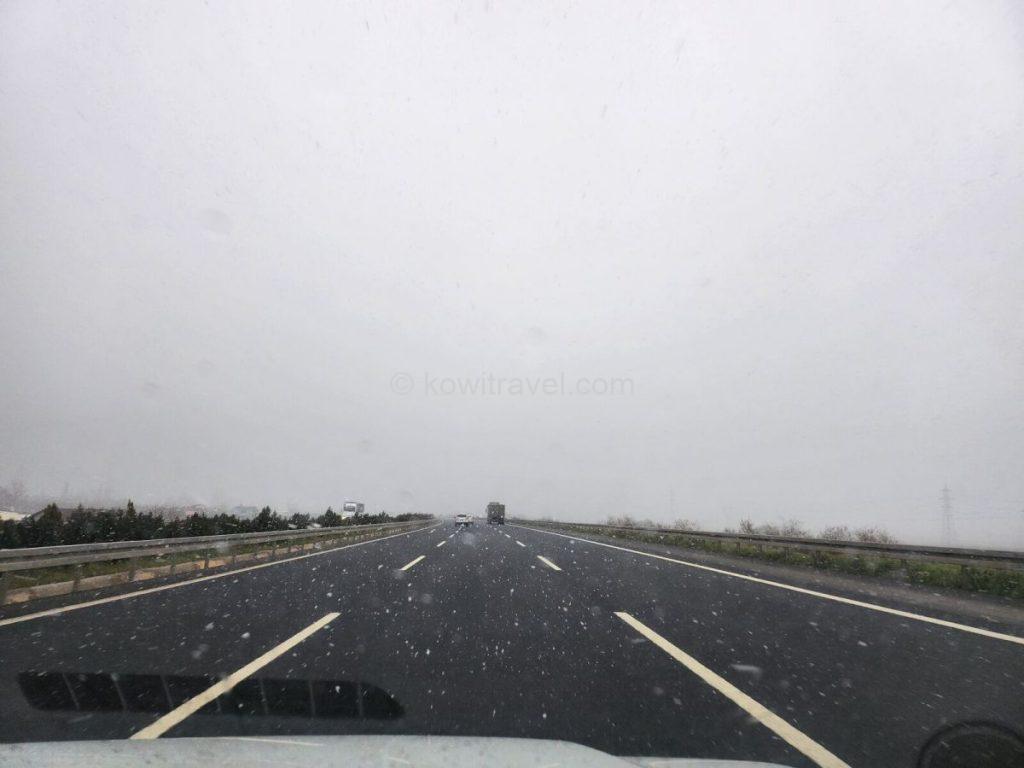
The Anatolian Highway in the snow
- Osmangazi Bridge
This is a mega-suspension bridge crossing the Gulf of Izmit with a total length of 2,682 meters, boasting the title of the 4th longest suspension bridge in the world.
In the past, this was a hellish section that took over an hour as travellers either had to wind around the bay like a snake or board a ferry susceptible to unstable weather. Thanks to this great bridge, we crossed the sea in just 6 minutes. The refreshing sea view unfolding through the grand cable structures was an absolute masterpiece in itself.
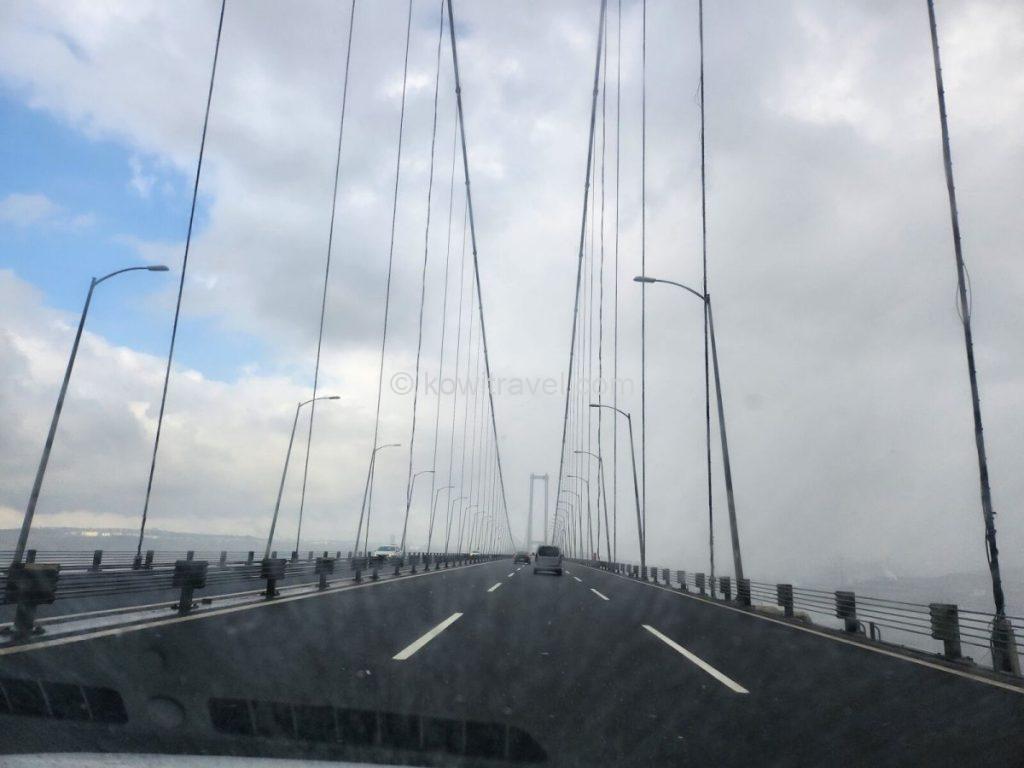
I felt a sense of pride knowing that this revolutionary transportation landmark in Turkey was built by a consortium involving South Korea’s Hyundai E&C and SK Ecoplant.
- Passing Through Gebze
This is a massive satellite city in Kocaeli Province met immediately after crossing the Osmangazi Bridge. Passing through the bustling landscape where giant factories and countless logistics trucks intertwined, we finally realized we had entered the metropolitan area of Istanbul.
- Eurasia Tunnel (Avrasya Tüneli)
This is a double-deck subsea tunnel exclusive for motor vehicles, offering the fastest route from Istanbul’s Asian side to the European Old City. Passing through this tunnel, which was bored through bedrock at a depth of 106.4 meters below the seabed, the elegant silhouette of Istanbul’s Old City unfolded before our eyes like magic.
2. The History and Present of Istanbul
Istanbul is a magnificent city that has stood at the centre of world history for over 2,500 years, strategically nestled on the Bosphorus Strait where Asia meets Europe.
First established as a small port city by Greek colonists in 667 BC under the name ‘Byzantium’, it rose to become the millennium-long capital of the Eastern Roman (Byzantine) Empire in 330 AD when Roman Emperor Constantine the Great relocated the capital here. It ruled as the epicentre of Orthodox Christian culture and the most prosperous metropolis in Europe.
Later, in 1453 AD, the 21-year-old Sultan Mehmed II conquered the impregnable Constantinople, turning it into the capital of the Ottoman Empire. This milestone infused Islamic culture into the city, transforming it into a giant global hub controlling trade routes between East and West, serving as the heart of three successive great empires.
Today, it is a mega-city with a population of 15 million, where a brilliant history coexists with a trendy modern era, divided across the Bosphorus Strait into the Old City district focused on the ancient core and historical ruins, and the Asian district characterized by residential areas and atmospheric alleys.
3. Old City Accommodation – Airbnb Apartment (Fındıkzade)
The base camp we chose for our one-week stay was an Airbnb apartment located near the Fındıkzade tram station in the Fatih district of the Old City. The choice of this accommodation—equipped with two rooms, a spacious living room, and full kitchen facilities—was based on meticulous calculations as walking travellers.
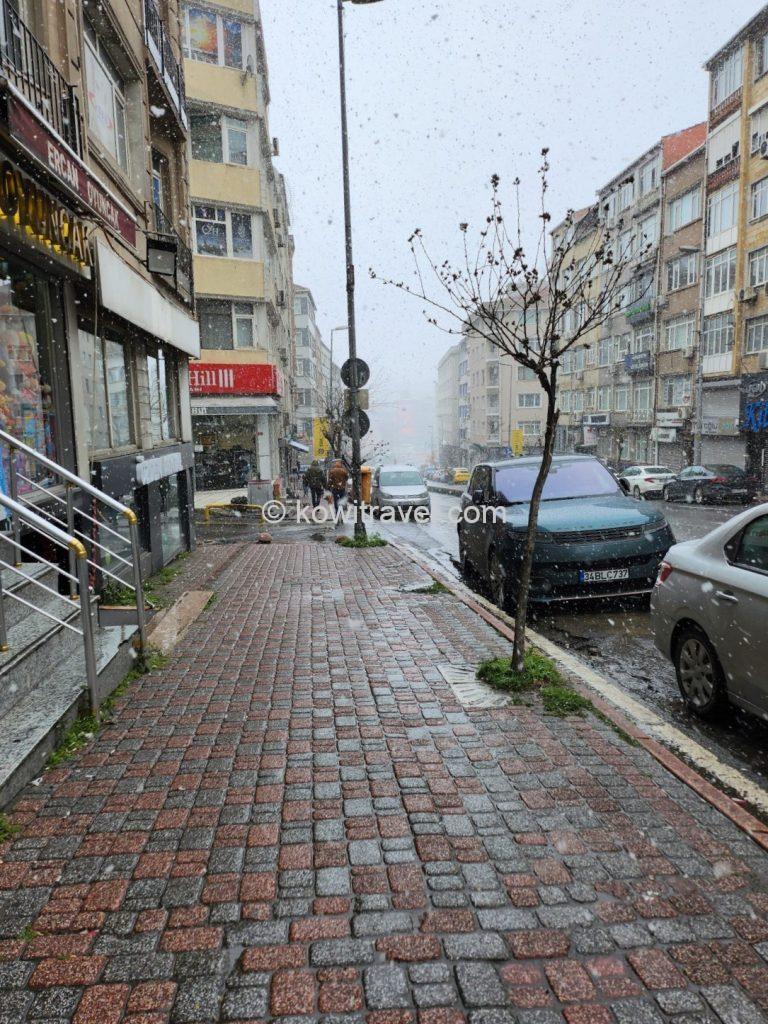
My accommodation is located down the hill; you get off at the Fındıkzade tram station, cross the road, and walk down. Due to abnormal weather patterns, there were many days with snowfall.
1) Infamous Traffic Congestion and Parking Hell
Istanbul’s Old City is a maze of narrow, steep, one-way alleys, making it exceptionally difficult to find a parking space due to the high-density residential nature of the area. If we had insisted on keeping our rental car here, we surely would have wasted all our time and stamina on the road.

True to its status as a massive metropolis, the roads are packed with vehicles.
2) Maximizing Accessibility via Public Transport
Fındıkzade station is a major stop on the T1 tram line, which acts as the main artery of Istanbul’s Old City. While tucked away slightly from the crowded and noisy core of Sultanahmet, it allowed us to reach major historical sites in just a few stops, making it the optimal location to minimize travel distances and launch our walking tours.
3) Returning the Rental Car, and Launching the Walking Tour on ‘Two Feet’
On the morning of our second day in Istanbul, we finally returned the rental car that had been our reliable set of wheels across the rough roads of Turkey for a month. The bittersweet feeling that brushed through my heart as I handed over the keys was short-lived; it was quickly replaced by a subtle tension and bounding excitement at the realization that we now had to explore this colossal city relying solely on our ‘two feet’ and a public transit card.
To encounter the authentic details of local alleys and the living breath of residents—things entirely invisible through a rental car window—we took our first powerful steps into our Istanbul walking tour accompanied by the ‘Istanbulkart’ public transit card we had purchased at the airport on our arrival day.
4. Ultimate Guide to Key Attractions in the Old City Historic District (Sultanahmet & Fatih)
Part 1 explores the Old City Historic District (Sultanahmet & Fatih), a repository of human cultural heritage and the epicentre of the Byzantine and Ottoman Empires 700 years ago, which serves as the core of any walking tour since most spots are within walking distance. Because the destinations are vast and the historical context immense, we have divided this journey into Part 1. Old City and Part 2. New City. Due to our packed itinerary, it was a pity we could not manage to visit the ‘Asian District’.
1) Hagia Sophia Grand Mosque (Ayasofya-i Kebir Cami-i Şerîfi)
Built as a Christian cathedral in 537 AD by Emperor Justinian I of the Byzantine Empire, the Hagia Sophia is famous for the emperor’s exultant declaration upon its completion: “Solomon, I have outdone thee!” implying he surpassed the biblical builder of the Temple of Jerusalem.
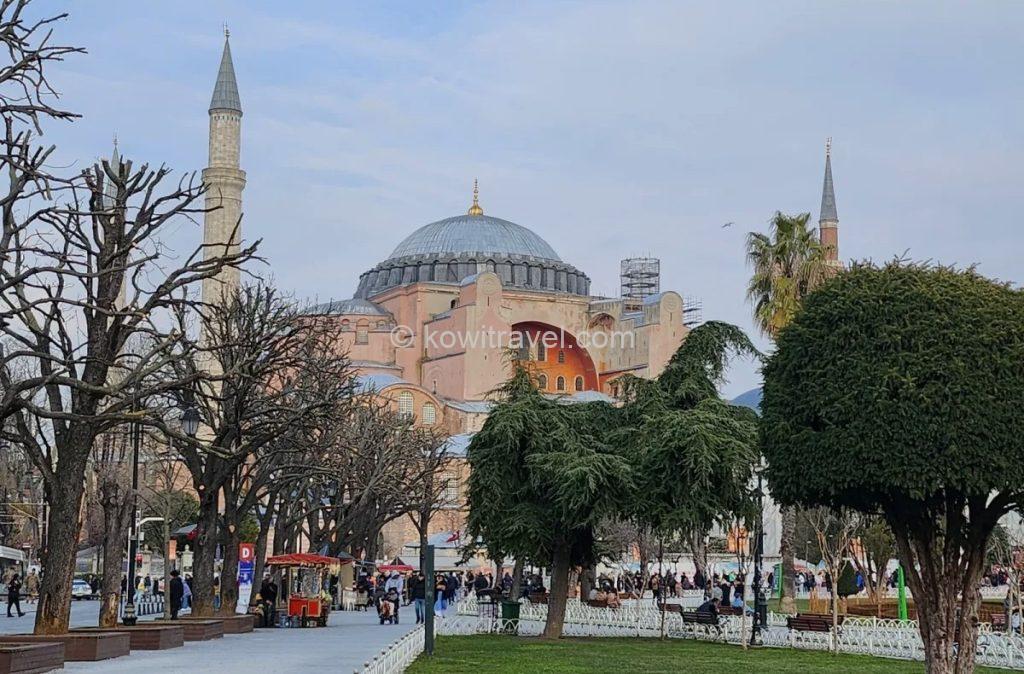
Hagia Sophia Grand Mosque, a site steeped in a tumultuous history.
After the Ottoman conquest of Constantinople in 1453, it was converted into an Islamic mosque by Sultan Mehmed II, utilized as a museum in modern times, and recently returned to an active mosque in 2020, charting a turbulent historical path.
Characterized by a colossal central dome measuring 31 meters in diameter and soaring 56 meters high without any supporting internal pillars, it is hailed as a miracle in human architectural history. During the day, sunlight streams through 40 windows tightly rimming the base of the dome, creating a mystical atmosphere.
Stepping off the T1 tram at Sultanahmet station and walking into the square, the sight of Hagia Sophia was magnificent, but unfortunately, due to extensive internal renovations and restoration works, indoor admission was strictly banned.
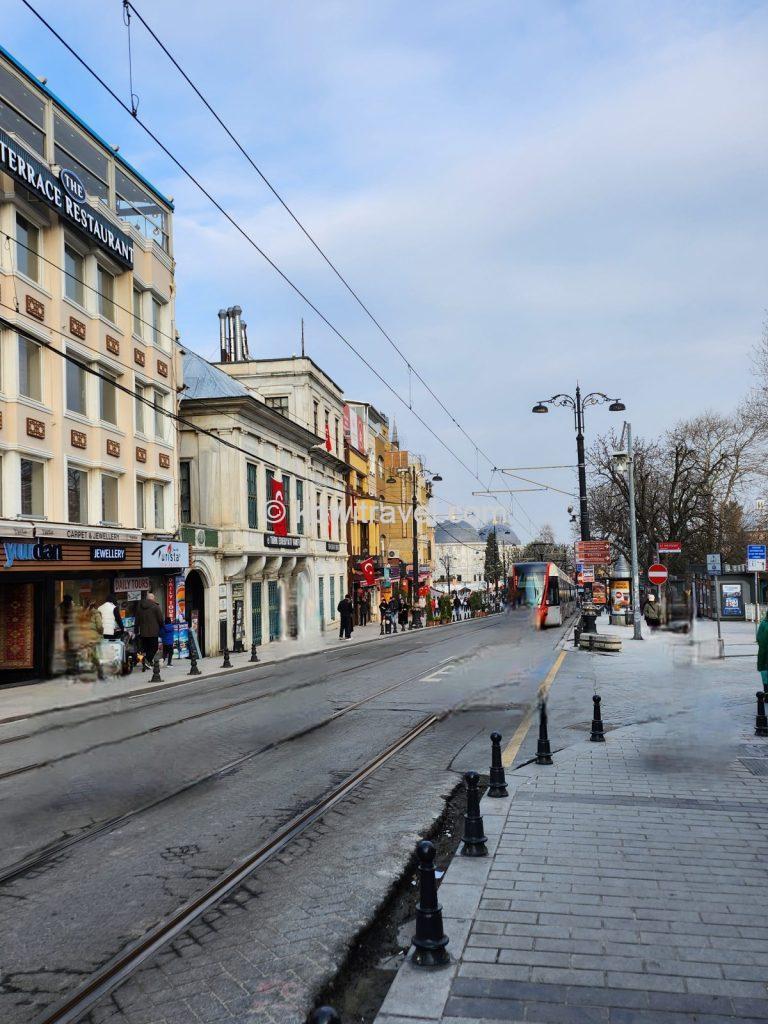
The entrance to the square is right there when you get off at the Sultanahmet station on the T1 tram line.
Though it left a deep pang of regret that we could not personally see the brilliant harmony of the golden Byzantine Christian mosaics coexisting alongside the giant Ottoman Islamic calligraphy discs, simply beholding its grand exterior conveyed the solemn weight of centuries.
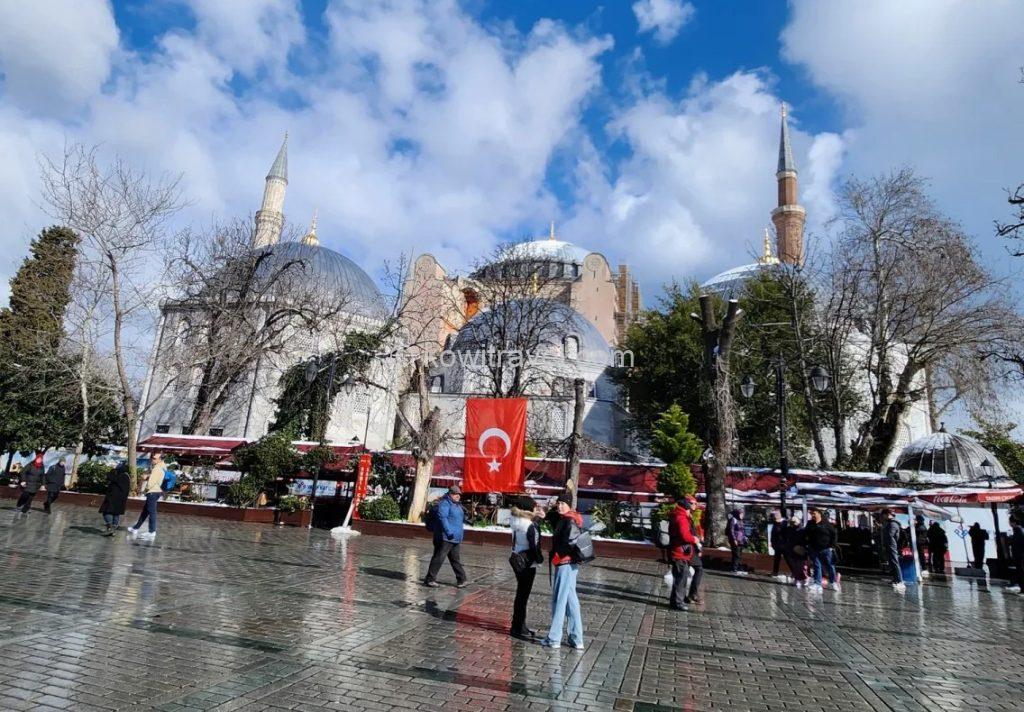
It is a major landmark bustling with crowds of locals and tourists alike, even in the cold of winter.
2) The Blue Mosque (Sultanahmet Camii)
Comforting our disappointment over Hagia Sophia, the Blue Mosque was commissioned by the 14th ruler of the Ottoman Empire, Sultan Ahmed I, who ascended the throne at the young age of 19. Seeking to elevate imperial prestige and reassert Islamic dominance, he built it between 1609 and 1616.
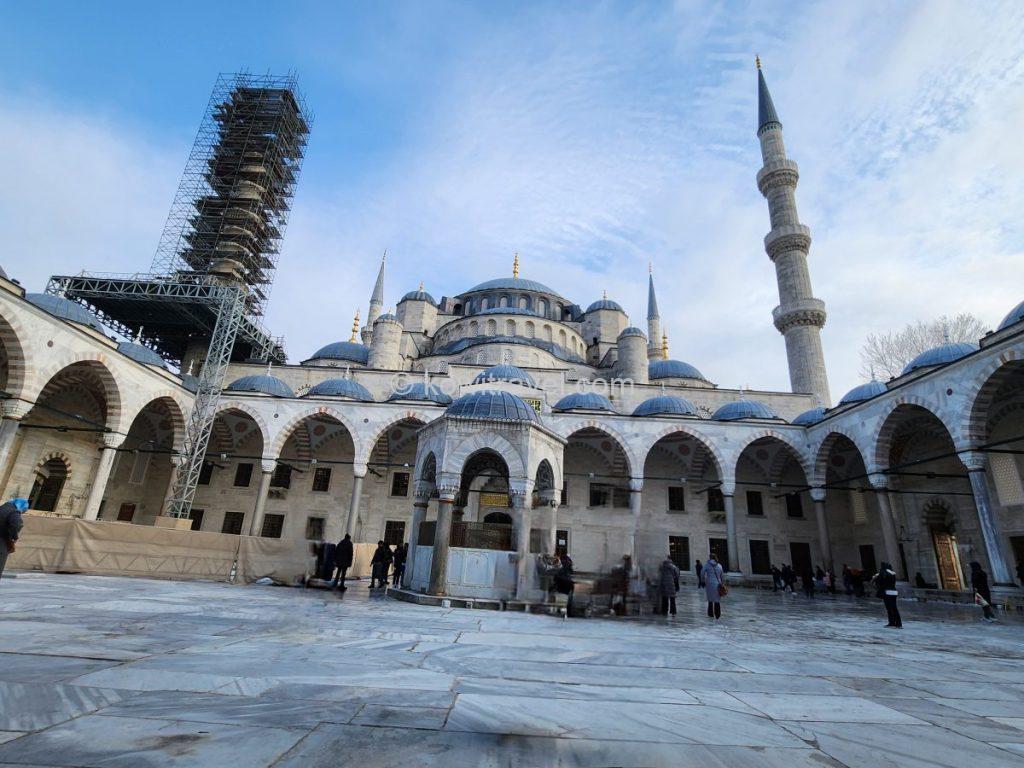
A spacious marble courtyard that one passes through before entering the main building of the Blue Mosque.
It earned its globally renowned nickname, the ‘Blue Mosque’, from the more than 20,000 handmade blue İznik tiles cloaking its interior walls alongside over 200 intricate stained-glass windows.


Numerous chandeliers (left) and the massive domed ceiling (right).
A giant circular chandelier holding hundreds of lamps hangs low over a vast crimson carpet, casting a soft glow that bathes the entire interior in a dreamlike, reverent atmosphere reminiscent of a celestial blue garden. On the outside, a grand courtyard paved in white marble features a symmetrical ritual ablution fountain (Şadırvan) right at its centre.
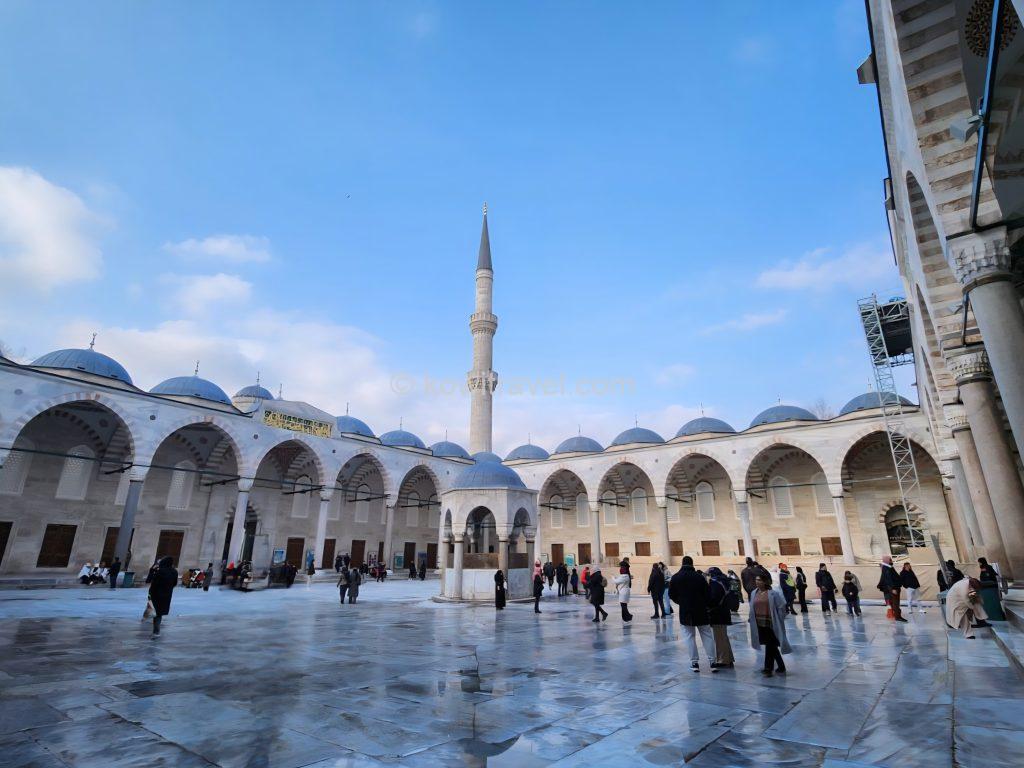
In the center stands a fountain (ablution facility) used for ritual cleansing before prayer; the surrounding arched colonnades and towering minarets add to the grandeur.
On one side of the square flanking the Blue Mosque stands a distinctive octagonal domed structure known as the German Fountain (Alman Çeşmesi).
This Neo-Byzantine masterwork adorned with golden mosaics was manufactured in Germany and gifted to the Sultan by German Emperor Wilhelm II in the late 19th century as a token of diplomatic friendship.
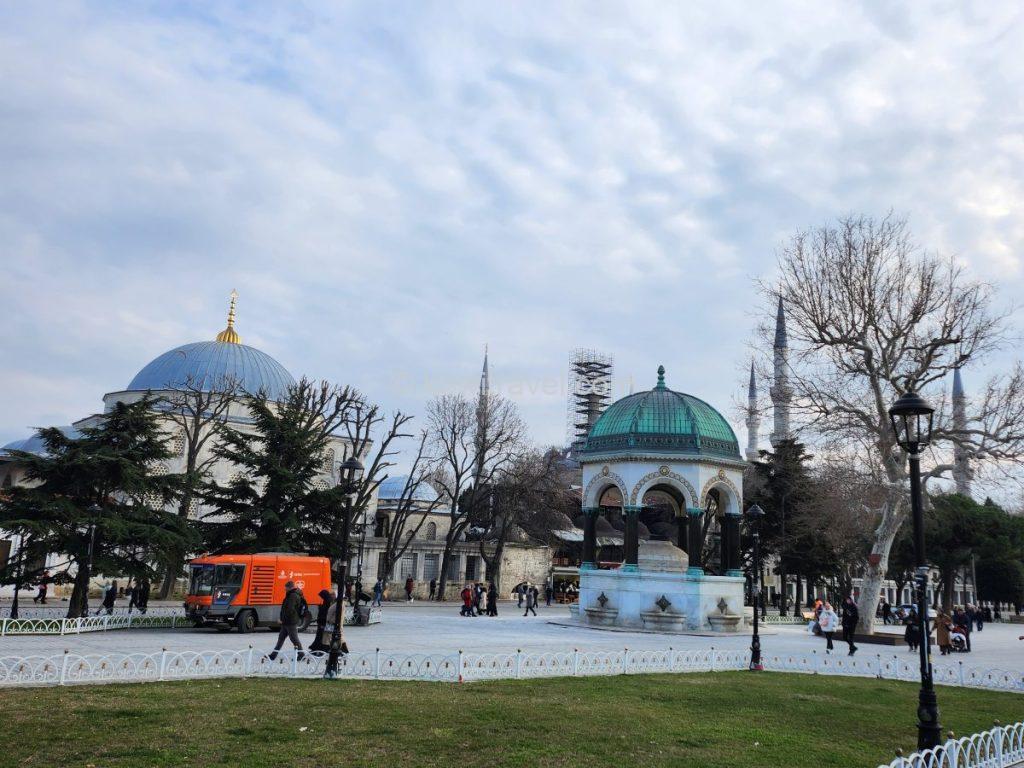
A view looking toward the Blue Mosque from the side of the fountain.
👌Helpful Travel Tip: The Century-Old Rivalry and the Secret of the Minarets
This was the first mosque in Ottoman history to feature six minarets. However, because only the Kaaba in Mecca, the holiest site in Islam, possessed six minarets at the time, it triggered fierce condemnation from Islamic scholars.
Rather than tearing down the structure, Sultan Ahmed I resolved the controversy by funding the construction of a seventh minaret at the Kaaba in Mecca. (An amusing folk legend suggests that the architect misheard the Sultan’s command to build the minarets out of gold (‘Altın’) as the number six (‘Altı’).
3) Topkapı Palace (Topkapı Sarayı)
Commissioned by Sultan Mehmed II in 1465 following his 1453 conquest and completed in 1478, this palace served as the official residence of the Ottoman Sultans and the nerve centre of politics, culture, and administration for nearly 400 years until the court relocated to Dolmabahçe Palace in the mid-19th century.
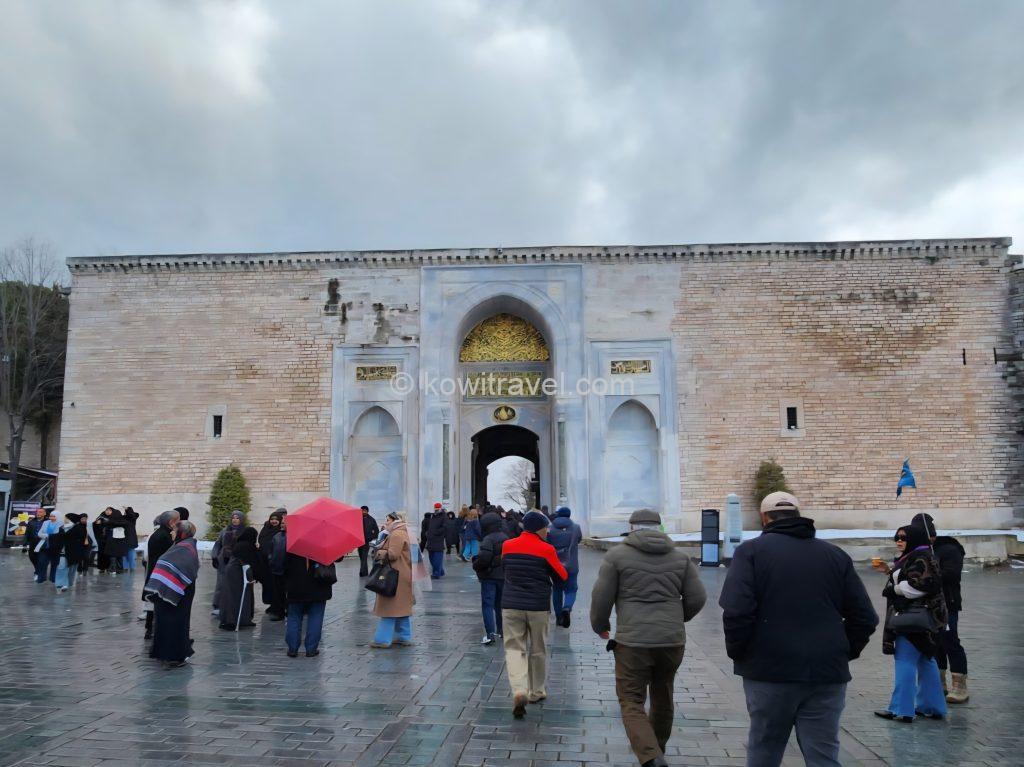
The “Imperial Gate,” the outermost main entrance to Topkapi Palace, where Ottoman Sultans once resided.
Breaking away from Western architectural norms, it features an Eastern structural layout consisting of four sprawling courtyards filled with lush trees and gardens, surrounded by various detached pavilions (kiosks) serving distinct purposes.
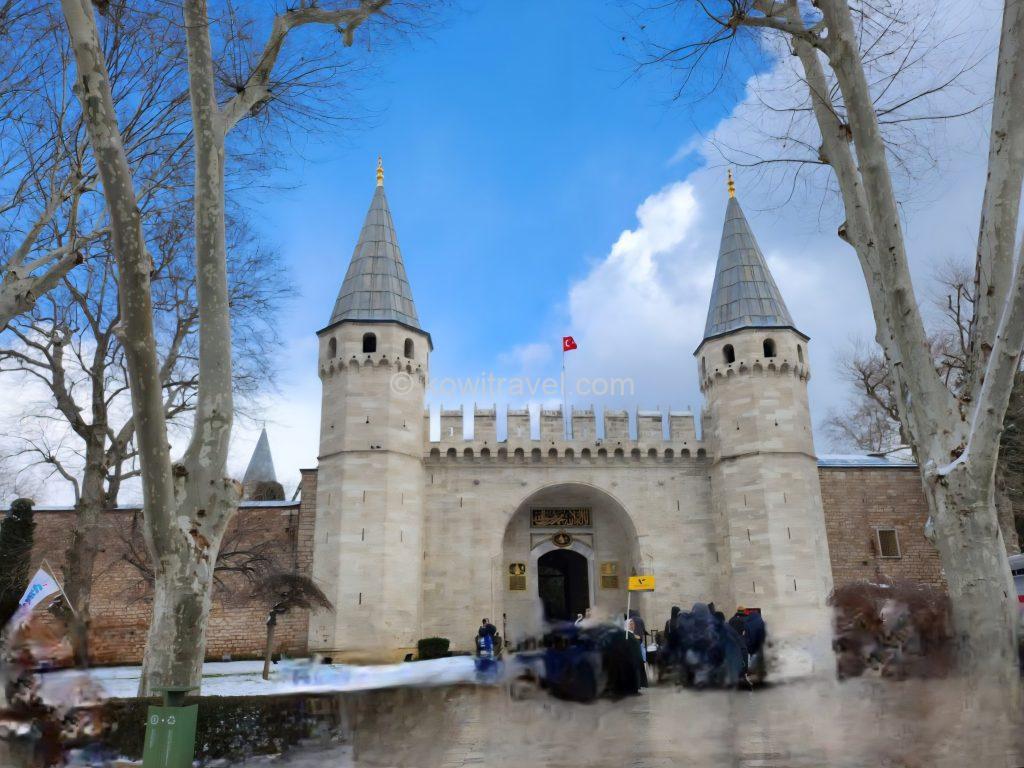
The entrance to the main building of Topkapi Palace, distinguished by its two pointed towers.


The palace’s inner gardens and courtyards.
- Hagia Irene Church: Towering on the right side of the palace’s First Courtyard, this church predates Hagia Sophia and stands as one of the oldest surviving Byzantine churches in Istanbul. Because the Ottomans repurposed it as an armoury and storehouse rather than converting it into a mosque, its structural red-brick Byzantine arches are phenomenally preserved.
Notably, the stark, large black-outlined mosaic cross set against a gold ground in the apse dome dates back to the Iconoclastic period of the 8th and 9th centuries, a sublime feature that sets it apart from other icon-heavy churches.


One of the oldest Byzantine churches in Istanbul, its red brickwork, stone columns, and vaulted ceiling structures remain well-preserved.


It is said to feature a unique architectural style from the Iconoclastic period (8th–9th centuries).
Strolling through the interior courtyards draped in white snow and corridors adorned with exquisite tiles, one comes across the golden-roofed Iftariye Pavilion (İftariye Kiosk)—where sultans broke their Ramadan fasts at sunset—and the incredibly opulent Baghdad Kiosk.
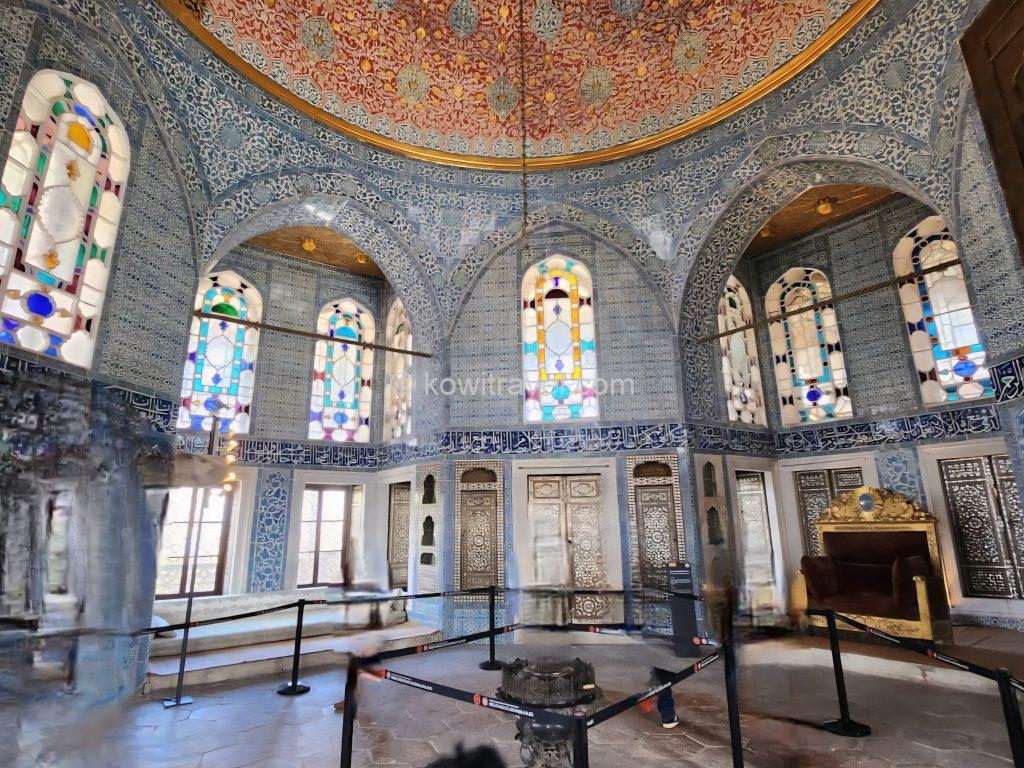
An ornate room featuring intricate mosaic stained-glass windows, blue tiles, and the Sultan’s chair.
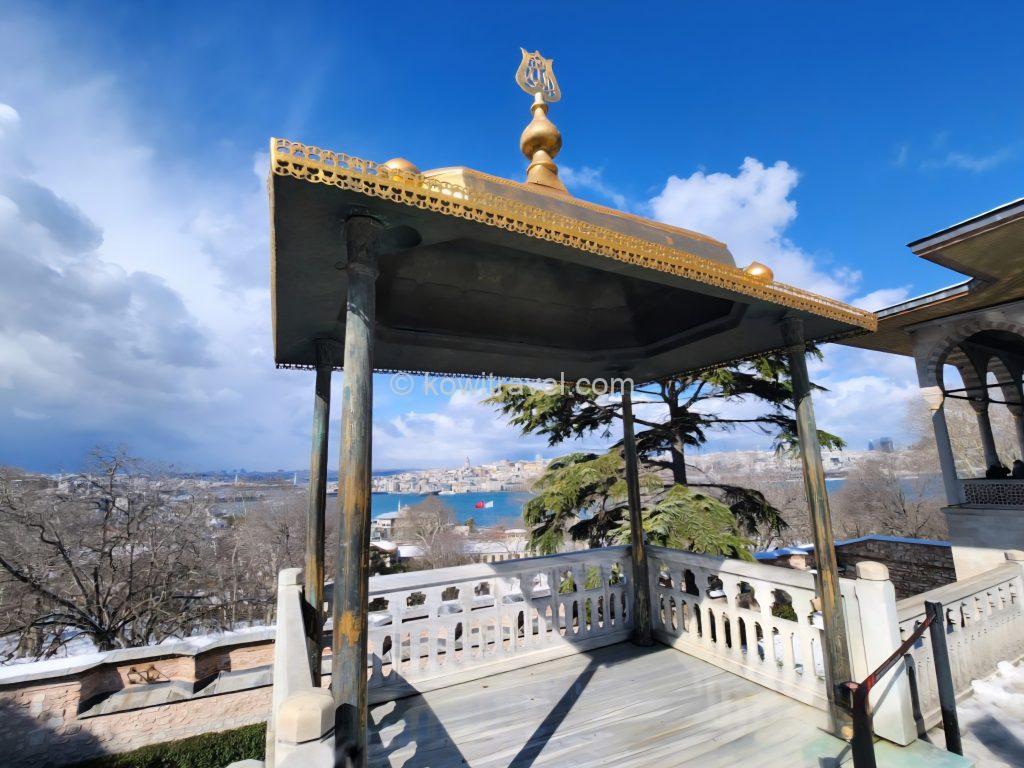
A golden-roofed pavilion offering a panoramic view of the Golden Horn and the city of Istanbul.


The interior of the Sacred Relics Chamber, featuring an intricately carved central marble fountain, Iznik tiles, and a golden domed ceiling.


The palace’s second courtyard (inner courtyard) viewed from the portico (entrance), which features a ceiling adorned with intricate gold decorations and is supported by marble columns.


Through the trees, the Bosphorus Strait, the Golden Horn, and the modern cityscape and bridges of Istanbul spread out in a sweeping view.
The true showstopper is the Department of Sacred Relics (Holy Relics). It strictly guards and exhibits legendary, supernatural artifacts venerated by Muslims worldwide, including the staff of Moses, a footprint of Prophet Muhammad, his holy mantle casing, and a golden reliquary containing part of John the Baptist’s skull and arm, completely overwhelming all who look upon them.

The Sword of Prophet David

An artifact said to be the Staff of Moses—a prophet appearing in both the Bible and the Quran. It is described as dating back to approximately the 13th century BC.


The arm and skull of John the Baptist, and the footprint of Muhammad


A textile from the Ottoman era intricately inscribed with Islamic calligraphy(Left), and a golden sacred object believed to be part of the structure of the Kaaba—Islam’s holiest site in Mecca, Saudi Arabia(Right).
4) Istanbul Archaeology Museums (İstanbul Arkeoloji Müzeleri)
Located down a garden pathway descending from Topkapı Palace’s First Courtyard, this institution was founded in the late 19th century by Osman Hamdi Bey, a brilliant Ottoman painter and archaeologist. Ranked among the top three archaeology museums globally, it houses a collection of over one million national treasure-class artifacts spanning ancient BCE civilizations, Hellenistic eras, and Roman periods unearthed from across the imperial territories.
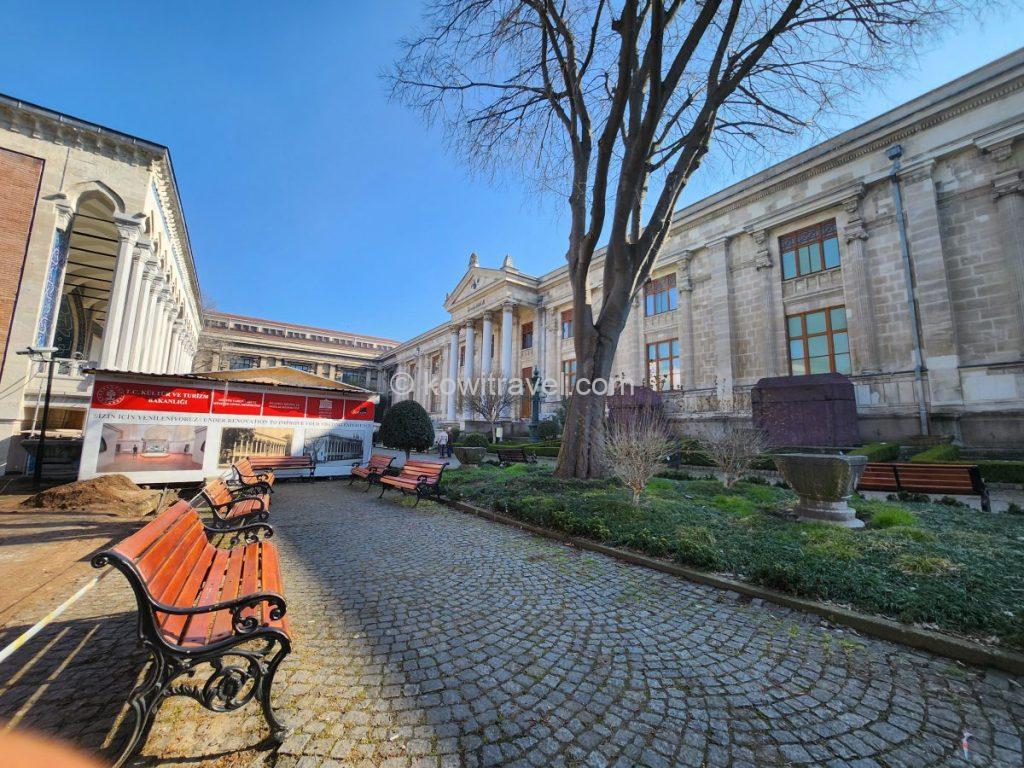
The exterior of the magnificent main building of the Archaeological Museum, constructed in a Neoclassical style, and a neat outdoor garden featuring benches.
- Key Exhibits:
● Anthropoid Sarcophagi: Unique and rare marble sarcophagi discovered in ancient Phoenicia (Sidon, Lebanon) dating back to the 5th century BC, where the actual facial features and physical contours of the deceased are carved onto the lids.
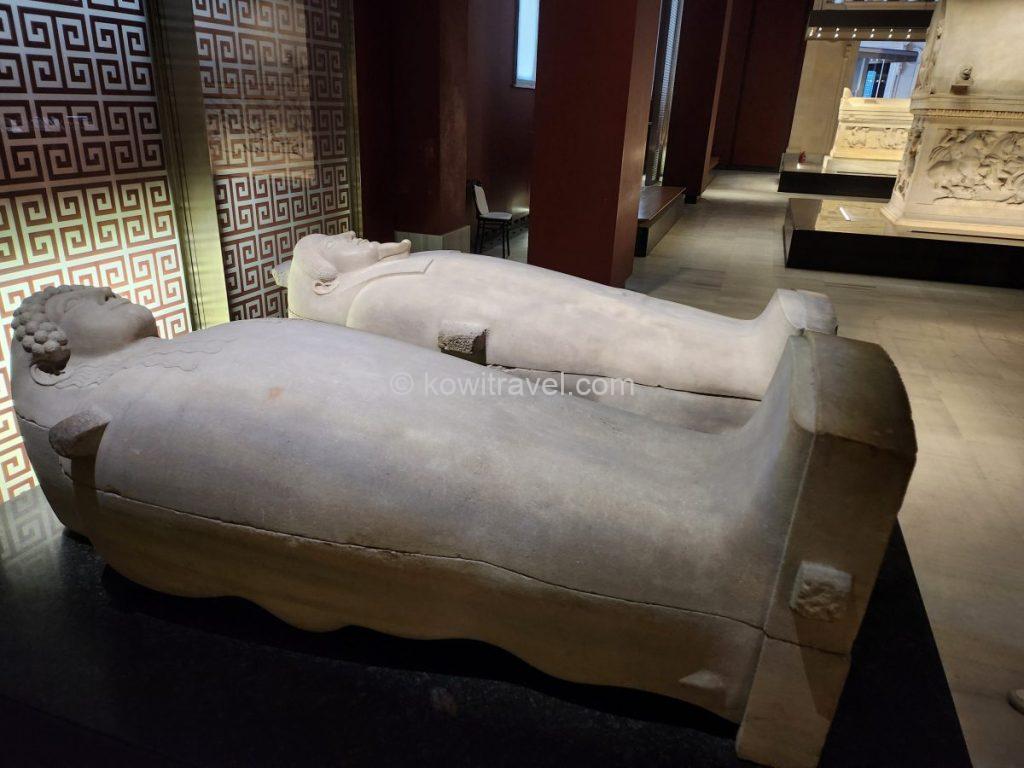
It features a unique form that exquisitely blends Egyptian mummy-coffin traditions with Phoenician and Greek sculptural techniques.
● Funerary Banquet Relief: A marble relief that once decorated tomb walls, intricately depicting a man reclining on a couch enjoying a luxurious feast surrounded by attendants, illustrating ancient perspectives on the afterlife.
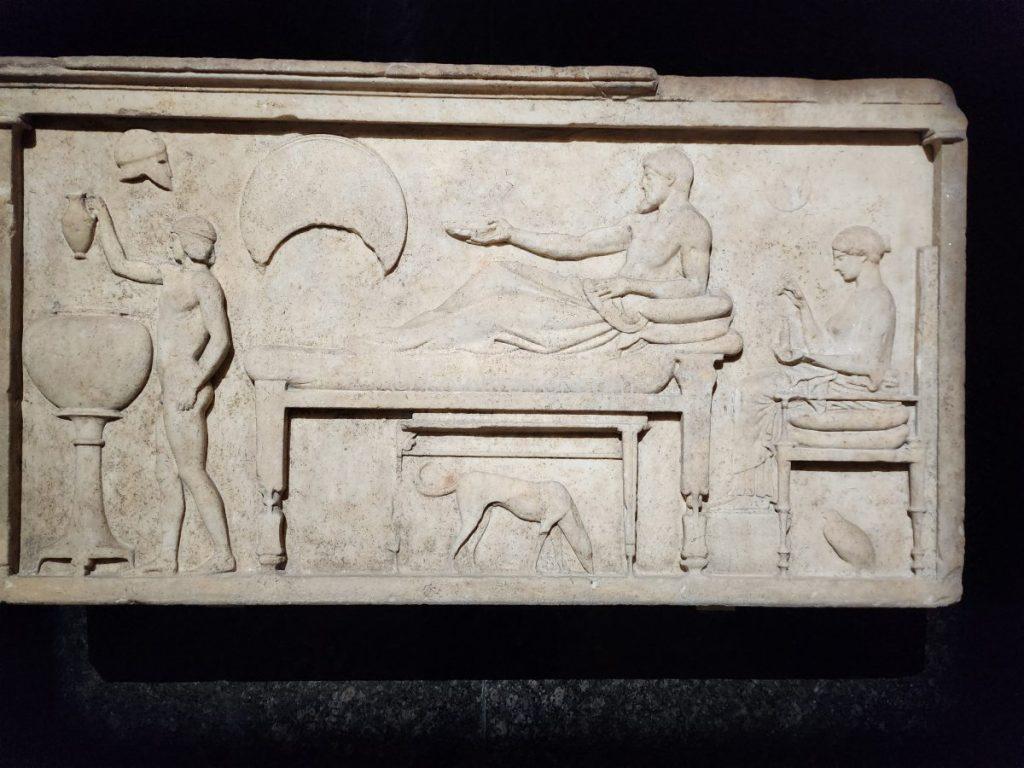
A marble relief that once adorned the wall of an ancient tomb.
● Statue of Nike (Victory): A late 2nd-century BC marble statue. Though its head and arms are lost, the tight, complex rendering of the drapery flowing dynamically and violently against the wind stands as an art-historical masterpiece highlighting the pinnacle of Hellenistic sculpting technique.
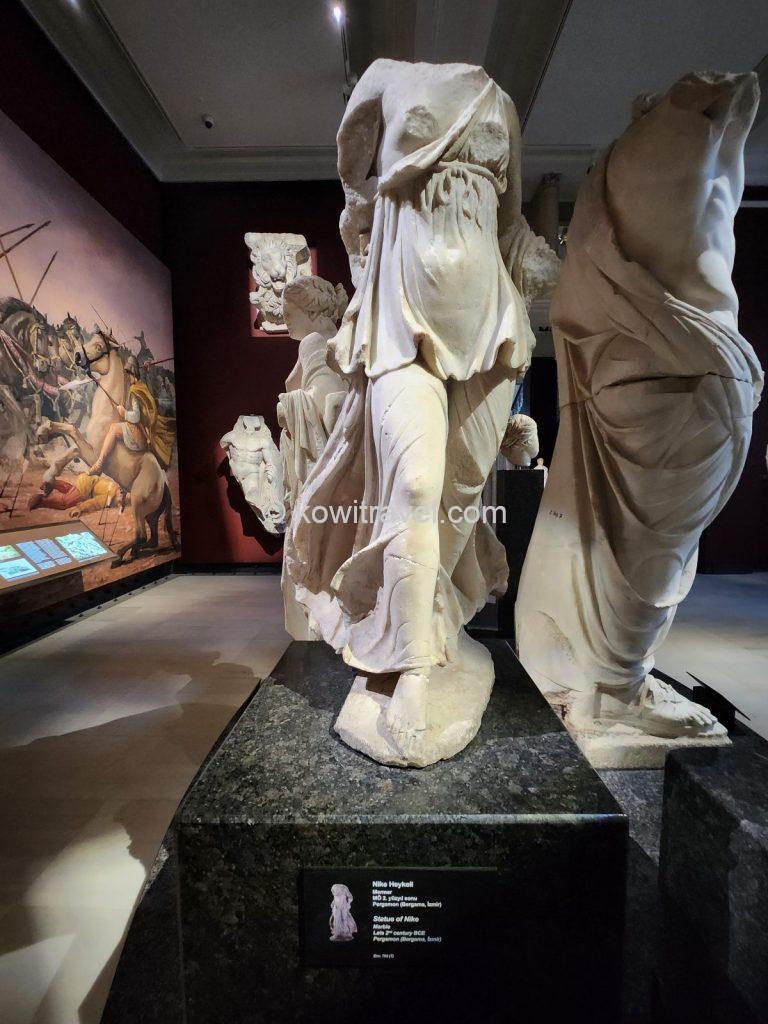
Although the head and arms are missing, the depiction of the intricate folds in the garment—appearing as if fluttering in the wind—is truly remarkable.
● Male Torso and Full-Length Statue of Alexander the Great: Hellenistic statues embodying human muscular definition and anatomical precision in marble. Standing before the full-length statue of Alexander the Great, characterized by a commanding posture and his iconic lion-like hair, the breath of the ancient hero feels tangibly present.
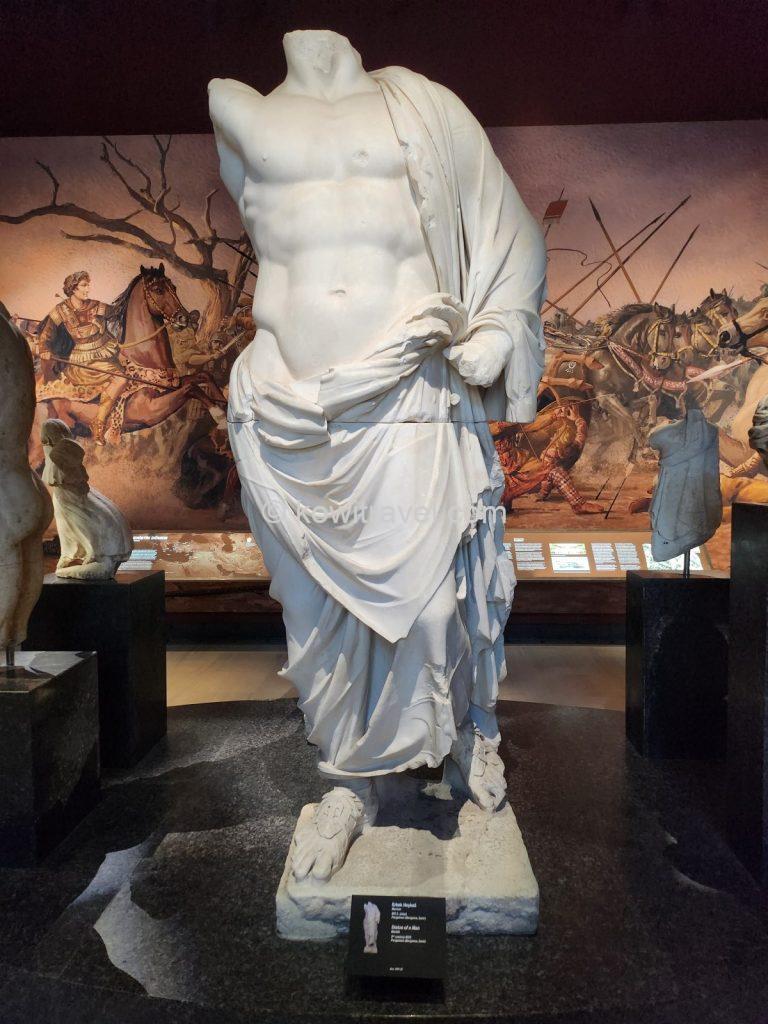
A special exhibition hall displaying a male torso sculpture with anatomically perfect musculature and full-body statues of ancient heroes.
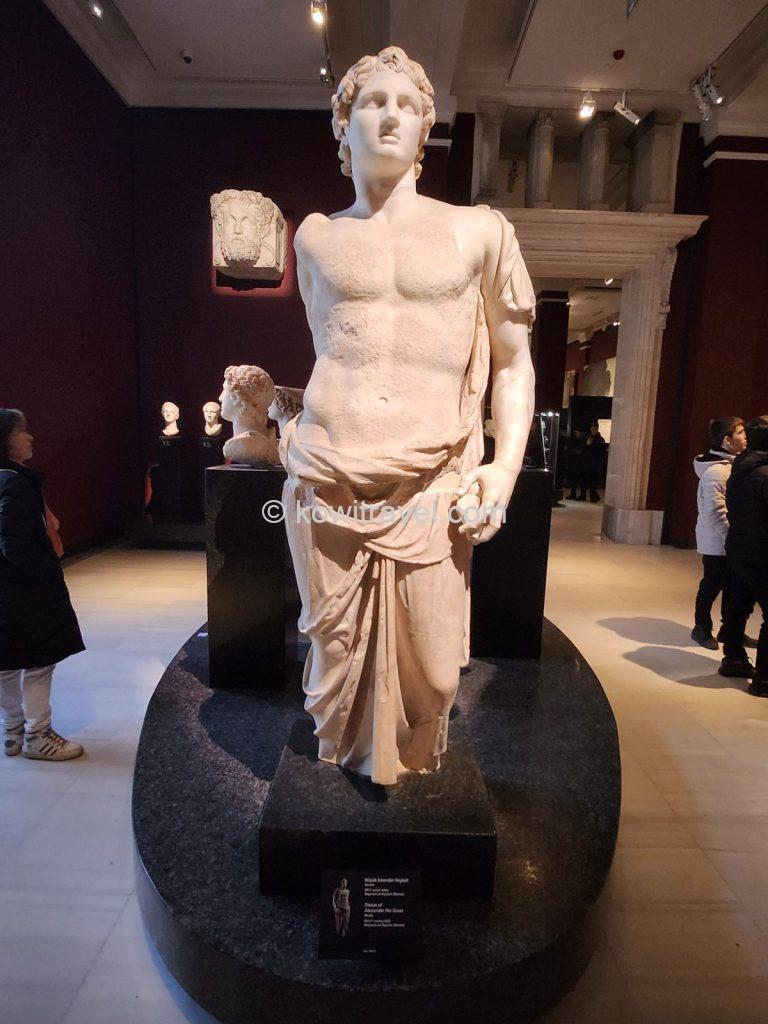
It is considered a masterpiece—the largest and most intact full-body statue of Alexander the Great surviving from the ancient world.
● The Crowning Jewel: Alexander Sarcophagus: The ultimate highlight and the primary raison d’être of the museum. Crafted from Pentelic marble in the late 4th century BC for a king of Sidon, its sides are intricately carved in high relief with 3D-like intensity, depicting Alexander the Great charging on horseback against Persian forces in battle and engaging in lion hunts. Staring at this unbelievable precision through the glass case induces a freeze of profound awe.
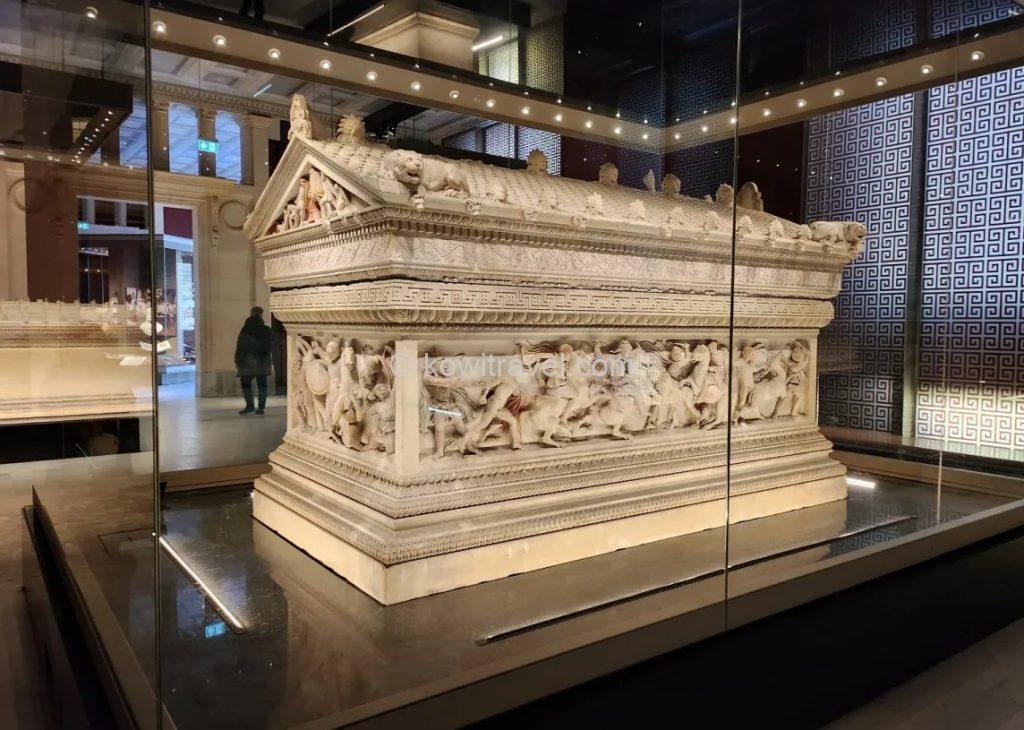
It is regarded as a treasure of the global archaeological community. The sides of the sarcophagus feature highly detailed, high-relief carvings depicting dynamic battle scenes of Alexander the Great fighting the Persian army, as well as lion-hunting scenes.
5) Basilica Cistern (Yerebatan Sarnıcı)
A colossal subterranean water reservoir constructed in 532 AD by Byzantine Emperor Justinian I beneath the grand public square (Basilica Stoa) that had been incinerated during the Nika Riots. Mobilizing roughly 7,000 slaves to excavate a space 138 meters long and 65 meters wide, this critical survival infrastructure held up to 100,000 tons of water, filtering it directly to the imperial palaces and the broader city.
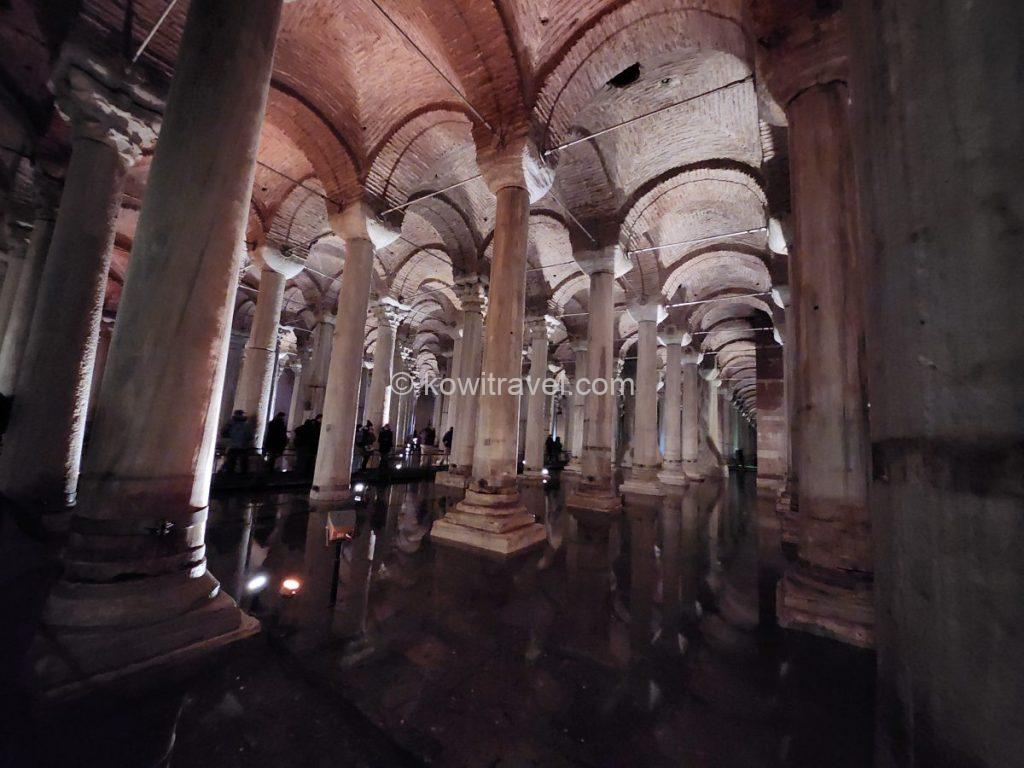
It creates the illusion of a vast underground palace.
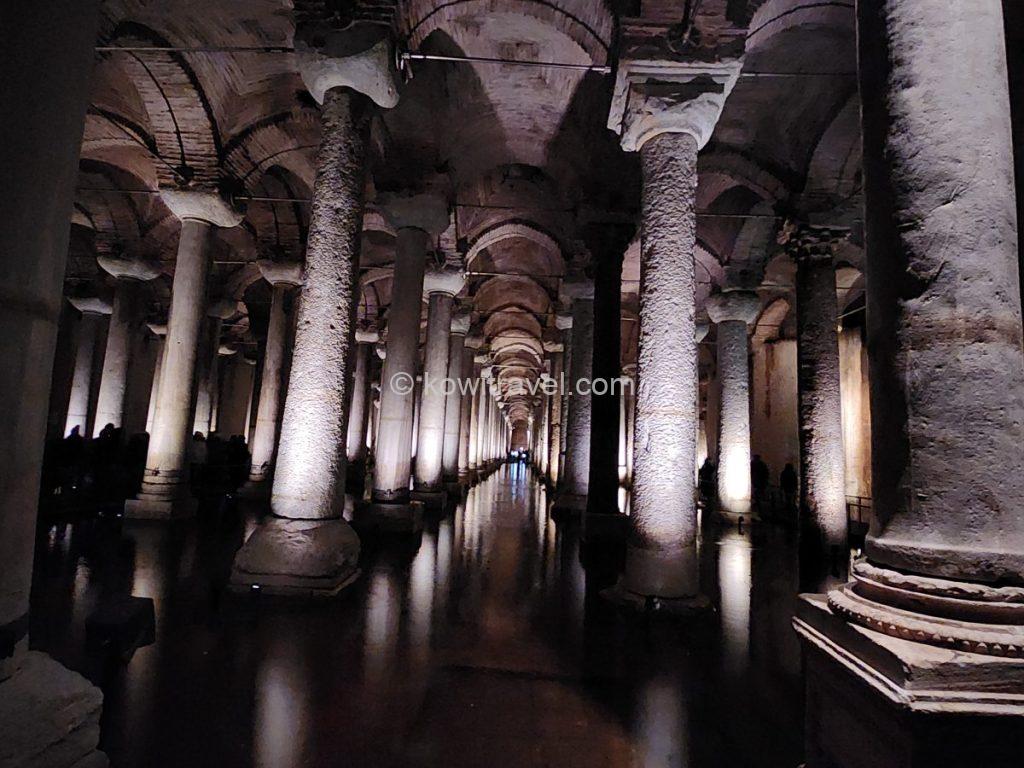
A total of 336 columns—featuring Doric, Ionic, and Corinthian styles typical of Greco-Roman temples—support the brick-arched ceiling.
Following the Ottoman capture of the city in 1453, this subterranean reservoir slipped into total oblivion because Islamic traditions dictated utilizing running rather than stagnant water.
It was rediscovered roughly a century later in 1545, when a French scholar researching Byzantine ruins tracked down peculiar accounts from local residents who claimed they could “draw water and even catch freshwater fish by cutting holes into their basement floors,” revealing this hidden empire once again.


Reflections of the lighting on the water’s surface create an even more magical atmosphere.
Benefiting from a recent comprehensive renovation, the cistern is illuminated by fantastic modern lighting that shifts between red and blue, casting an ethereal reflection of the marble column network across the water’s surface. Threading through this forest of 336 marble pillars recycled from ancient Greco-Roman temples, visitors hit the deepest recesses to find the iconic upside-down Medusa head sculpture deployed as a column plinth.
Bathed in light, Medusa’s bizarre visage casts an enormous snake-haired shadow onto the wet masonry, completely catching one’s breath.
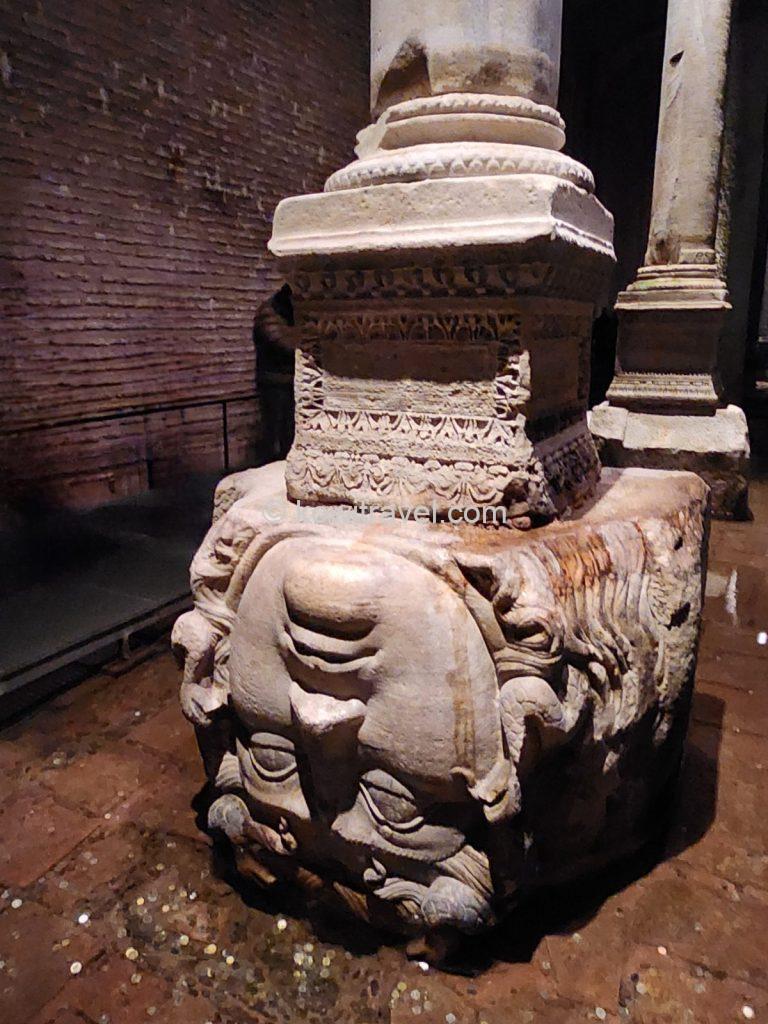
These stones were brought in by Byzantine architects to match the required column heights; legend has it that they were intentionally placed upside down or sideways to avert the gaze of Medusa, as people feared turning to stone upon meeting her eyes.
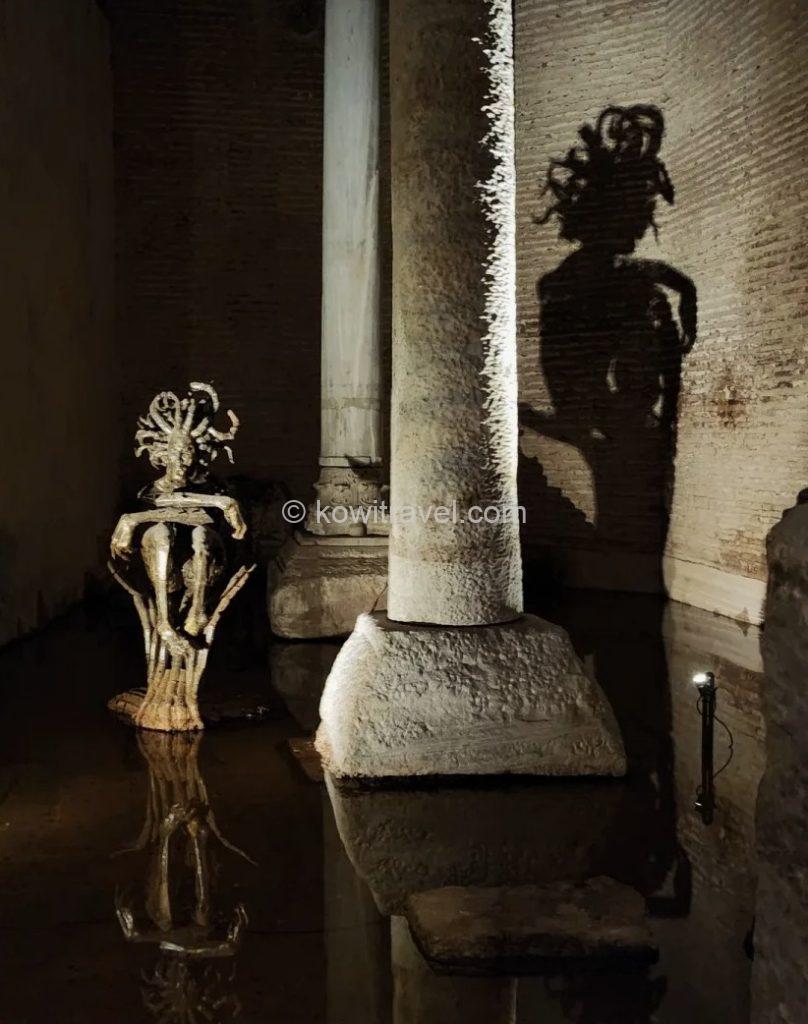
The dramatic lighting casts a massive, eerie shadow of Medusa—with her snake-like hair—onto the rear wall.
Directly adjacent stands the Crying Pillar (Hen’s Eye Pillar), which remains permanently slick and tearful; its surface is meticulously carved with tear drops and peacock feather patterns to honour the thousands of slaves who suffered and perished during construction, soberly reminding us of the human tragedy behind the architectural grandeur.
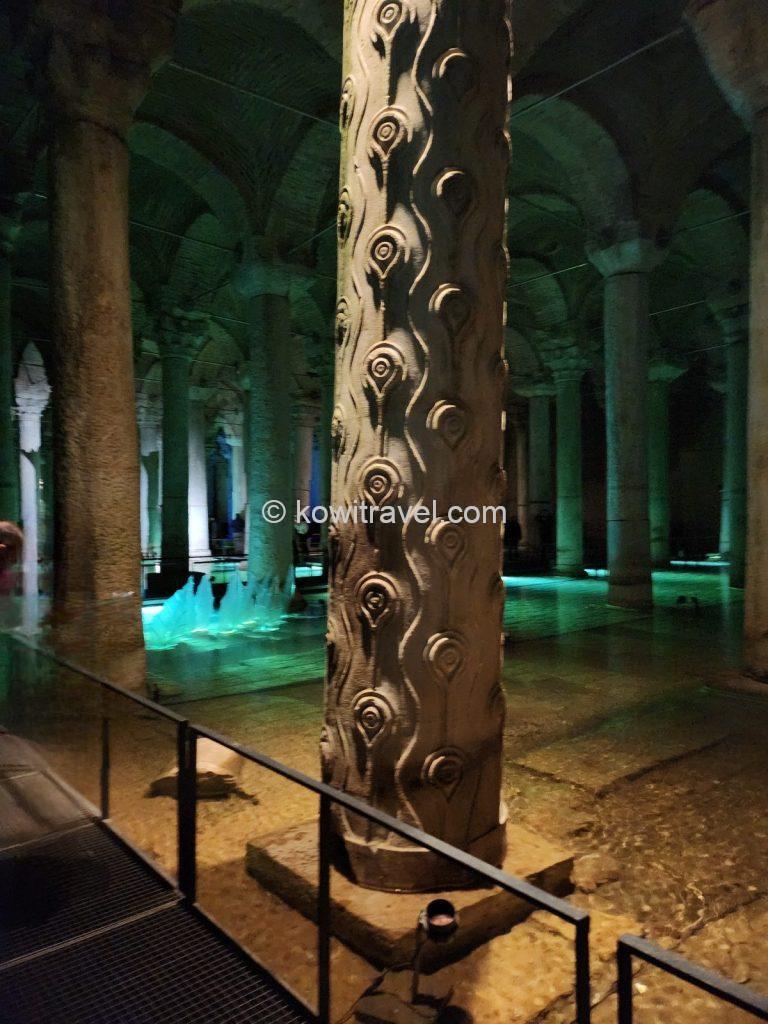
A sad tale is told that this site was built to honor the tears and souls of the countless slaves who perished during its construction; there is also a popular belief that if you insert your finger into the hole in one of the columns and turn it while making a wish, that wish will come true.
6) Grand Bazaar (Kapalıçarşı) & Egyptian Bazaar
● Grand Bazaar
Commissioned by Sultan Mehmed II in 1455 to revitalize urban commerce, this is one of the largest and oldest covered traditional markets in the world. Expanding over centuries, it evolved into a giant commercial empire spanning dozens of gates and web-like labyrinthine corridors.
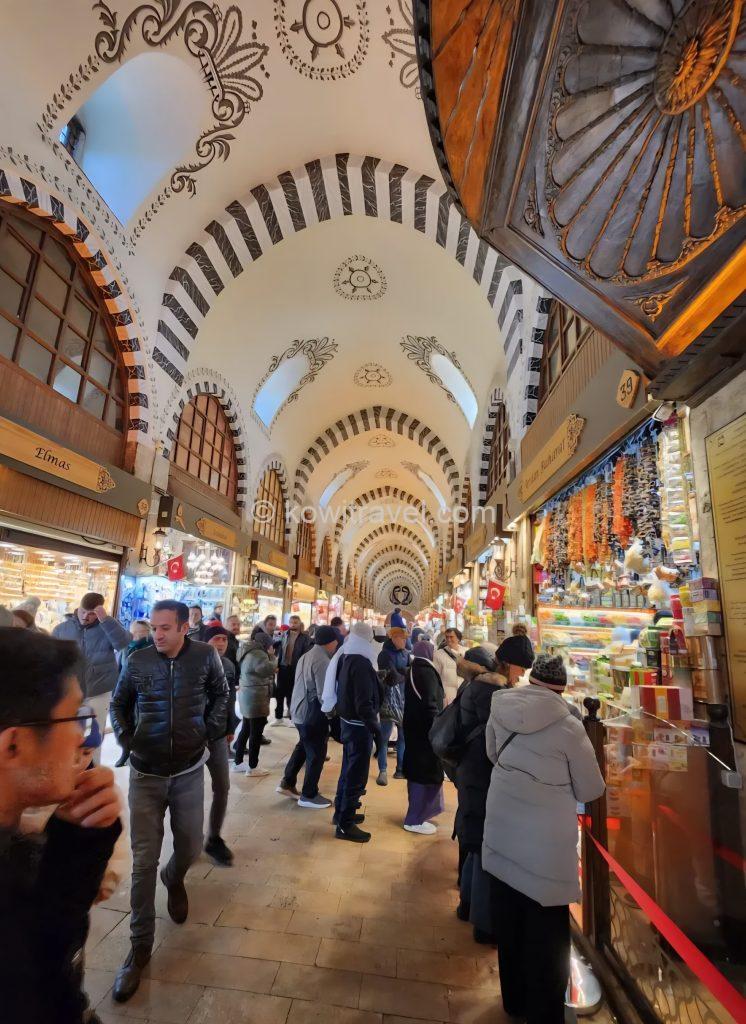
Like bazaars in other cities, this indoor passageway features high arched ceilings and distinctive striped patterns. Shops line both sides of the walkway, and the area is always bustling with crowds.
The moment you step into the lanes stretching out in all directions, your eyes are stolen by gorgeous Ottoman arch paintings lining the ceilings, blindingly vibrant embroidered Turkish carpets, and painted ceramic plates.
Exchanging glances and bargaining with local merchants who playfully yell out “Kore (Korea)?” offers a vivid experience, letting the raw energy of the silk road merchants flow directly into your body.
● Egyptian Bazaar (Mısır Çarşısı / Spice Bazaar)
Positioned right next to the Eminönü New Mosque, the Egyptian Bazaar is Istanbul’s definitive traditional marketplace, named because it historically funded its construction and specialized in spices and goods imported from Egypt during the Ottoman era.
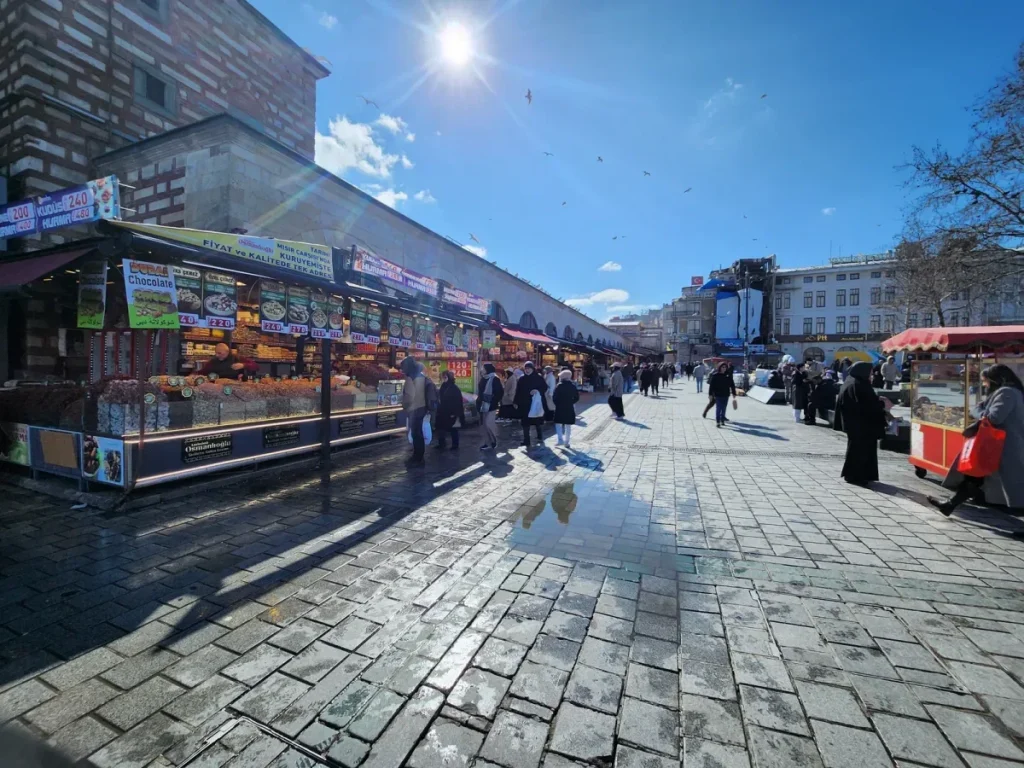
An outdoor shopping area stretching along the exterior wall of the bazaar building on a clear, sunny winter day.
On a bright and clear winter day, the open-air stalls running along the exterior walls of the bazaar display stacked mounds of nuts, dried fruits, and Lokum (Turkish Delight). We dove into the bustling market crowds and purchased some local Lokum and Baklava.
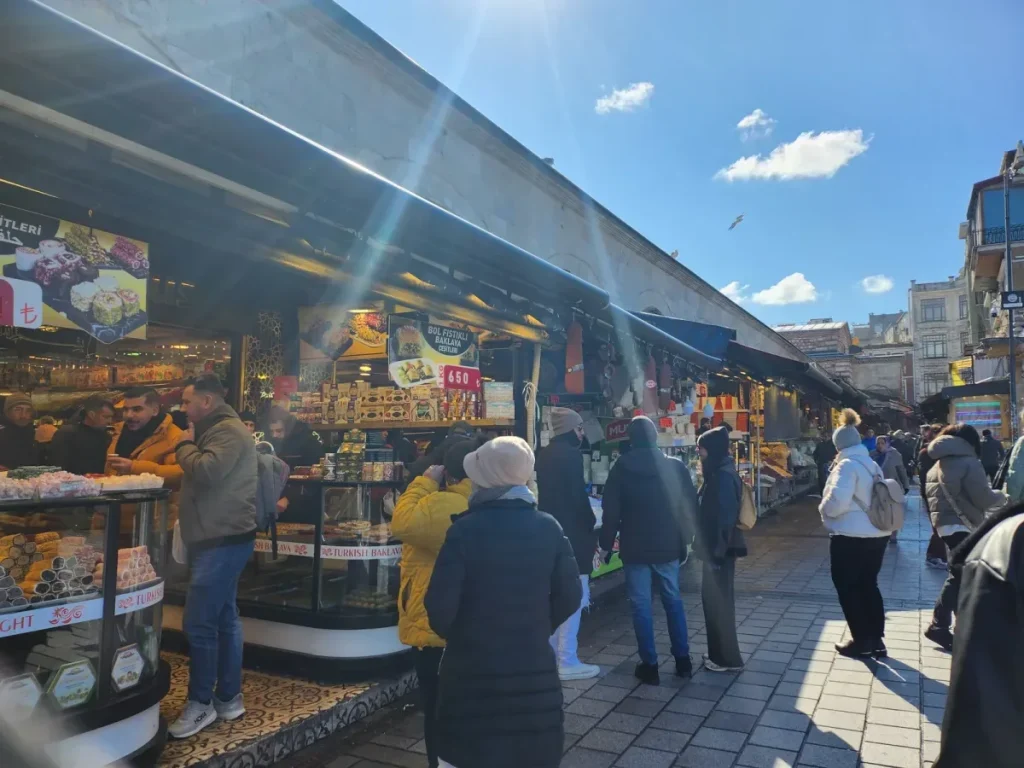
The scene offers an exotic atmosphere, featuring Turkish delights like baklava and lokum, alongside a colorful array of spices and nuts.
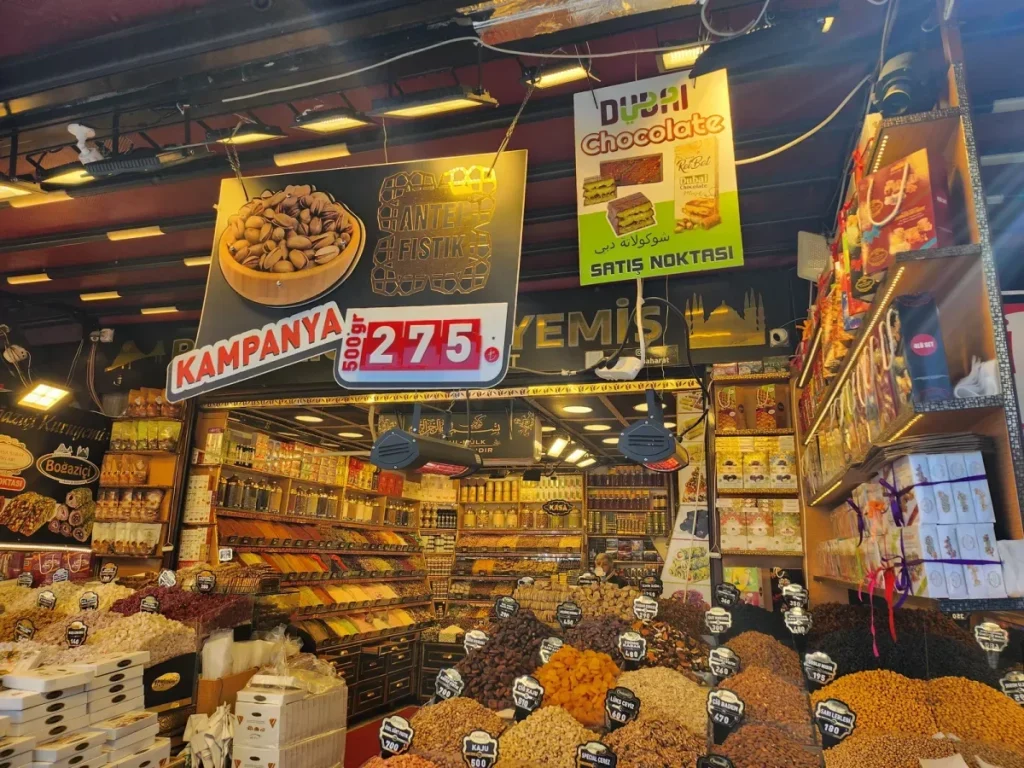
A vibrant display inside one of the shops; a yellow sign advertising “Dubai Chocolate”—a global viral sensation—also catches the eye.
Visiting almost any bazaar in Istanbul introduces you to two legendary delicacies that capture both your eyes and palate: Lokum, famously known as Turkish Delight, and Baklava, boasting a devilishly sweet profile.
While Lokum behaves like a soft, chewy jelly that clings delightfully in the mouth while releasing subtle hints of rosewater or honey, Baklava layers paper-thin pastry over 40 sheets thick, delivering a sharp shatter crunch followed by an explosion of rich pistachios and sweet syrup.
Lokum has a low moisture content making it shelf-stable for several months at room temperature, whereas Baklava is drenched in syrup and is best consumed within 1 to 2 weeks.
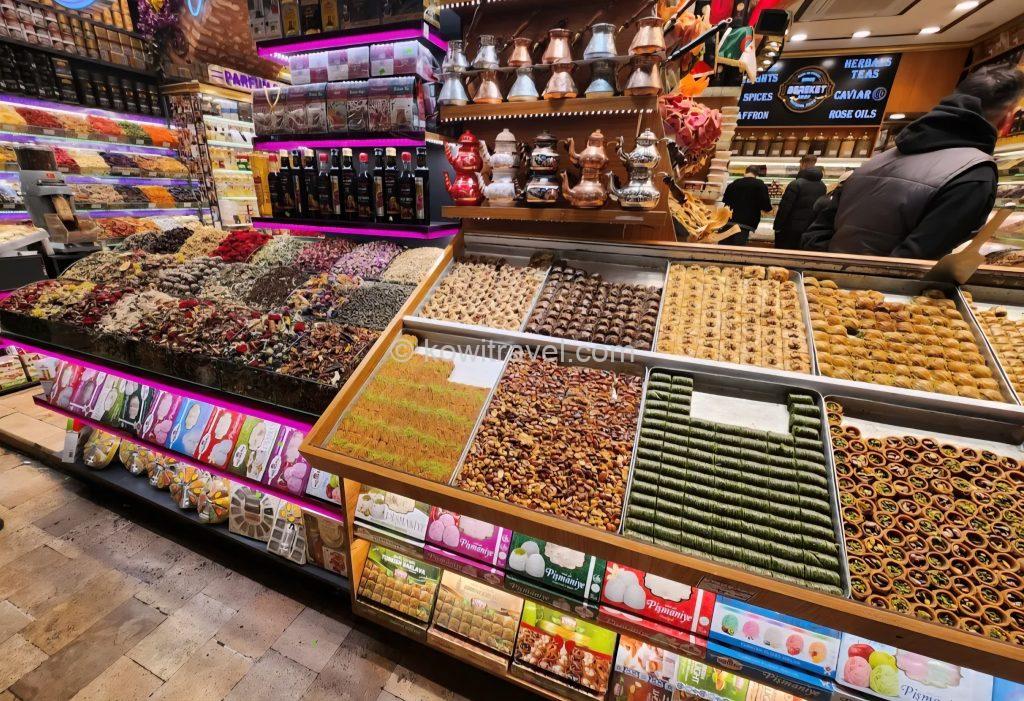
Baklava topped generously with nuts, flaky layered pastries, and colorful Turkish delight (lokum) are appetizingly displayed.
7) Eminönü Square and Galata Bridge (Eminönü & Galata Köprüsü)
Exiting the labyrinth of the Grand Bazaar and strolling down a gentle slope brings you directly to Eminönü Square, the maritime transit hub of the Old City swept by open sea breezes. This is the very spot where the Galata Tower, rising over the New City across the Golden Horn, frames itself most beautifully against the horizon.
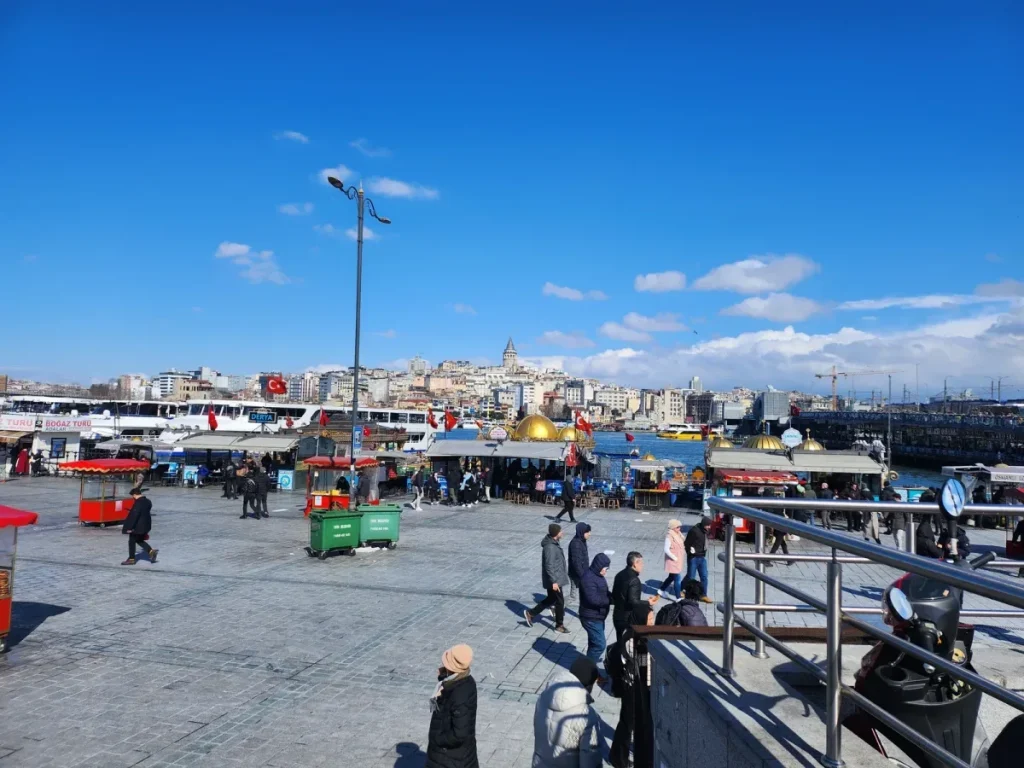

The square at the Eminönü ferry terminal (left) and the Galata Bridge—shared by trams and cars—can be seen on the right; the square is bustling with locals and tourists (right).
The ultimate symbol of Eminönü is the row of ornate, traditional Ottoman-style wooden boats rocking continuously on the waves. The salty, savory aroma of Balık Ekmek (fish sandwiches)—fresh mackerel grilled right on the decks by fishermen tossing them into sliced loaves of baguette bread with crisp onions and lettuce—perfumes the entire square.
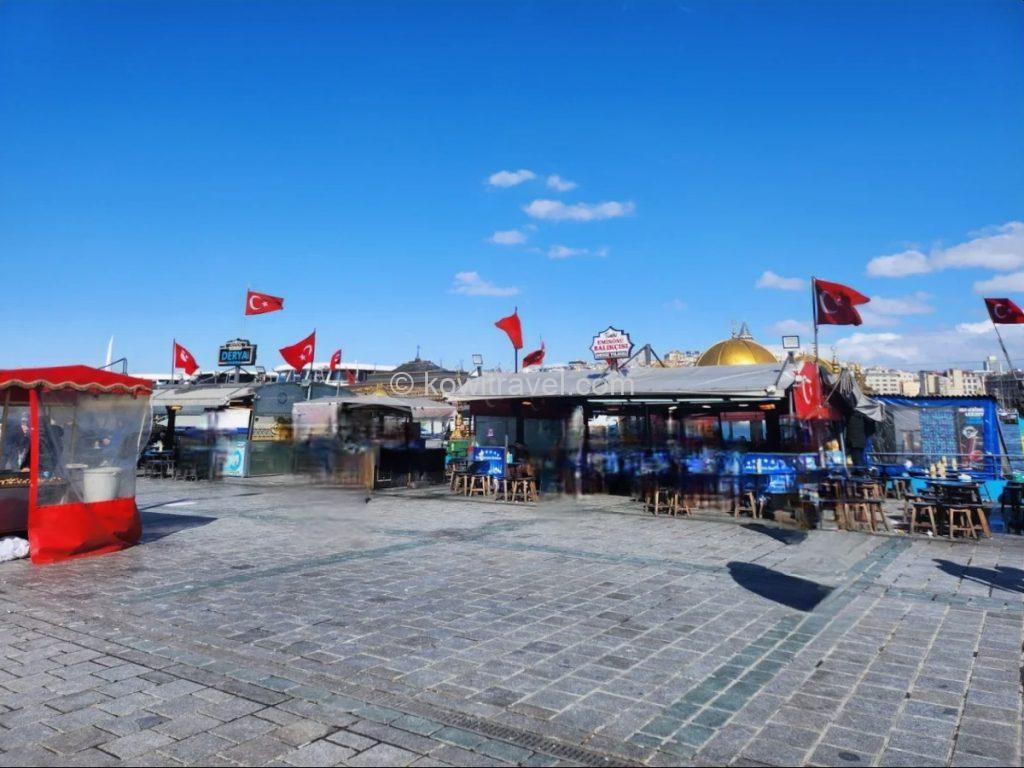
Boats and food stalls selling Balık Ekmek (mackerel kebabs), one of Istanbul’s signature street foods.
Mingling with the blue sea, flapping red Turkish flags, and swarms of wheeling seagulls, it stands as the absolute best spot to savour the raw, unpolished romance of maritime Istanbul.
8) New Mosque at Eminönü (Yeni Camii)
Standing directly across from Eminönü Square, just a crosswalk away, this magnificent mosque translates directly to the ‘New Mosque’. Commissioned in 1597 by Safiye Sultan, mother of Sultan Murad III during the late Ottoman era, construction was plagued and halted by court intrigues and financial drains.
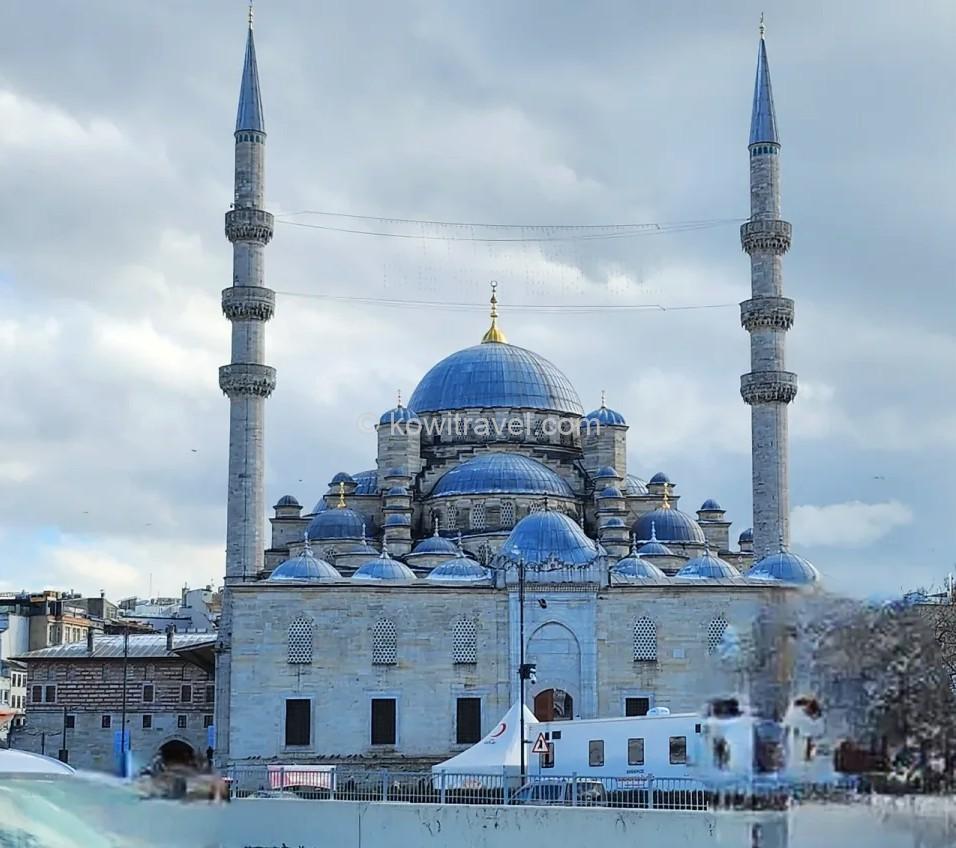
An exterior view of the New Mosque (Yeni Mosque) from the entrance of Eminönü Square.
It was finally completed 66 years later in 1663 by Turhan Hatice Sultan, mother of Sultan Mehmed IV, giving it a legacy as a mosque built by powerful queen mothers.
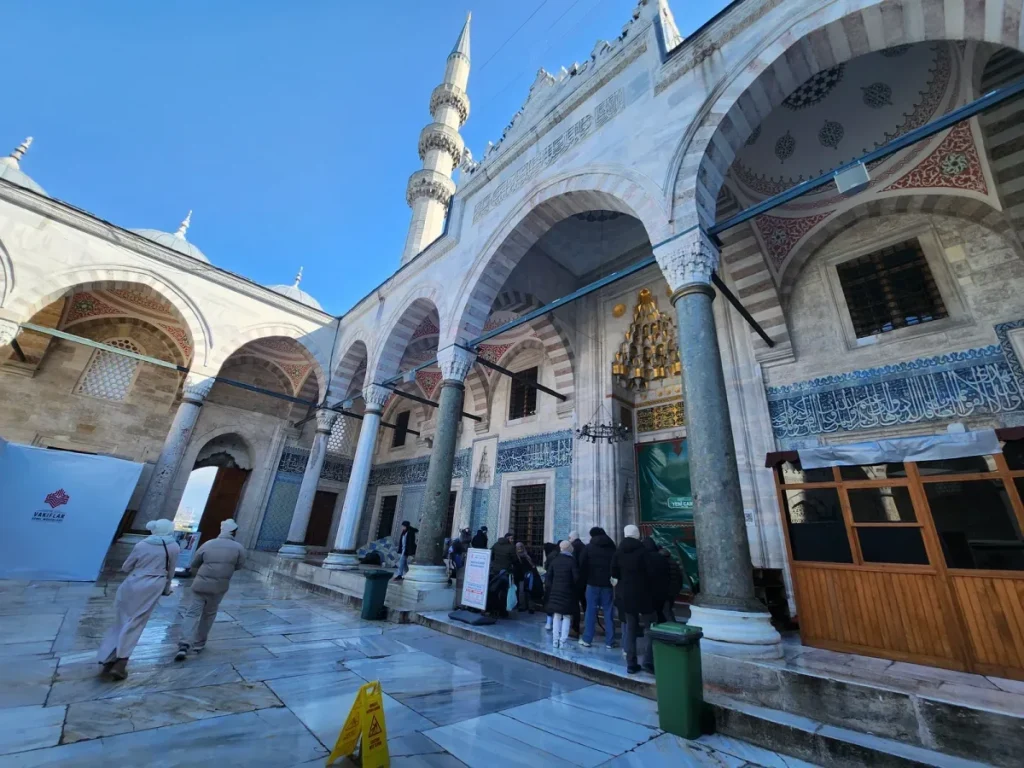
The entrance to the marble courtyard, which one passes through when crossing the street from the square to enter the main mosque building.
Sitting flatly on the waterfront, this temple acts as a reliable beacon for Eminönü Square. Crossing the street to enter the sacred compound, the monumental entrance to the marble-colonnaded courtyard leaves visitors gasping; its upper portal features exquisite emerald-green tiles, golden muqarnas (stalactite carvings), and white marble pillars in immaculate geometric symmetry.
Stepping inside the great prayer hall, a vast ring of chandeliers suspended low emits a warm, ambient light that beautifully illuminates the detailed arabesque fresco scrollwork threading the interior domes.
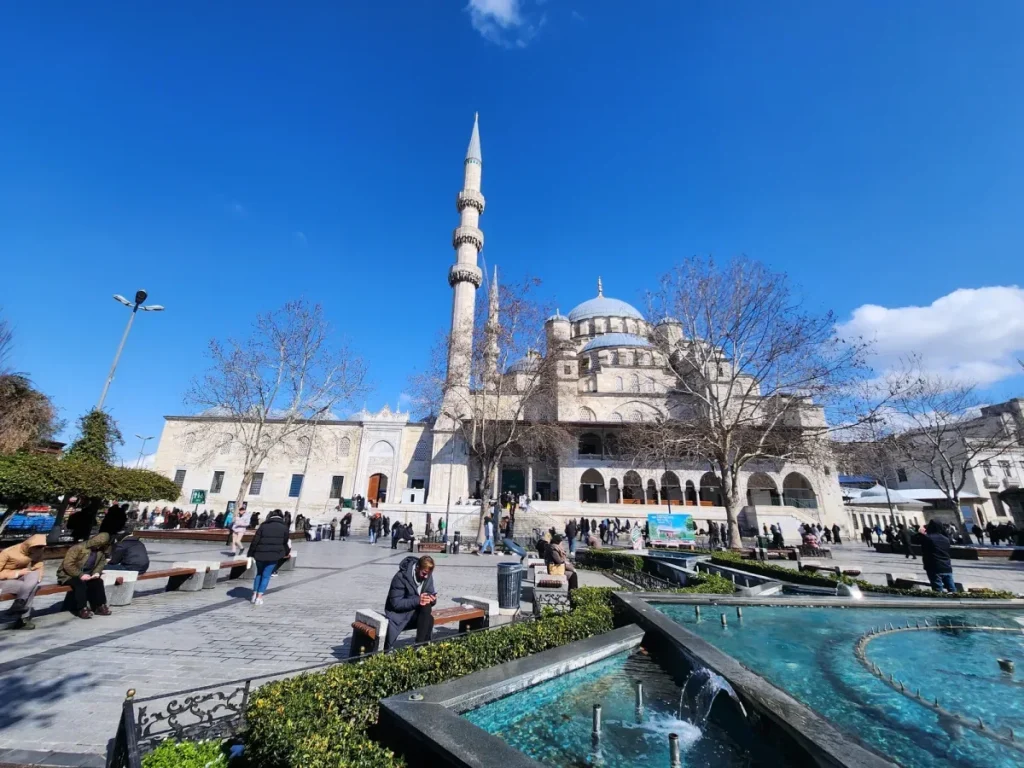
The square and fountain in front of the New Mosque.
9) Fatih Mosque (Fatih Camii)
Escaping the chaotic crowds of Eminönü and ascending deep into the residential heights of the Old City hills brings you to this majestic sanctuary. It was constructed in 1463 over the ruins of the Byzantine Church of the Holy Apostles to honour Sultan Mehmed II, ‘The Conqueror’ (Fatih), who took Constantinople in 1453 and laid the foundations of the empire.
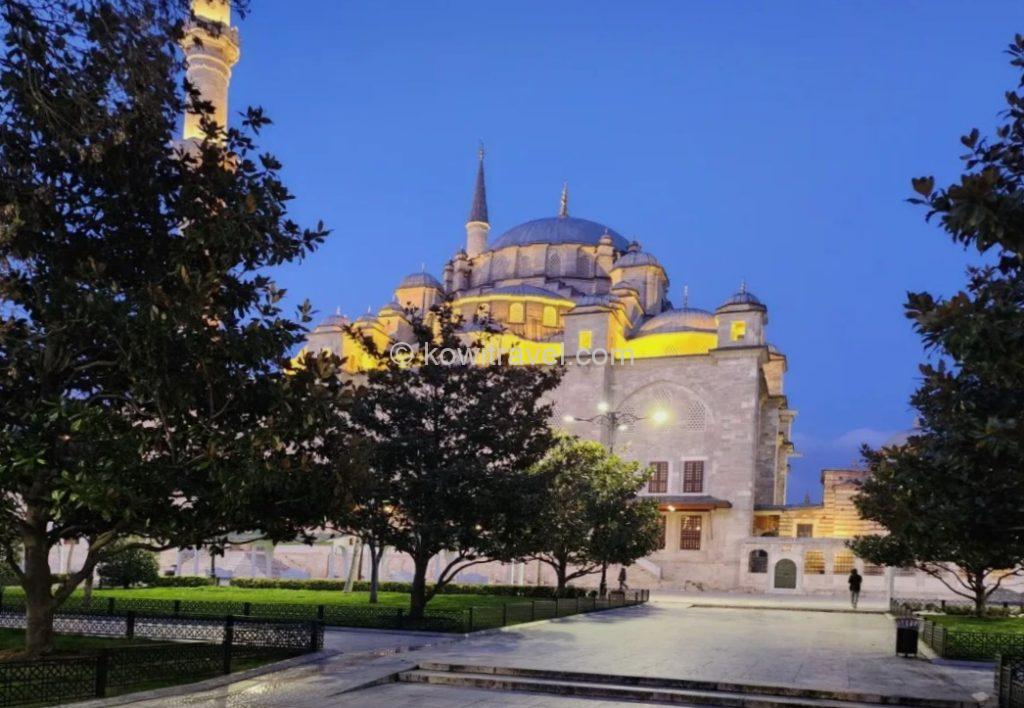
The exterior of the mosque, bathed in a soft golden glow, viewed beyond the well-tended green lawn and walking paths.
After being completely levelled by a catastrophic earthquake in 1766, it was beautifully rebuilt in 1771 in an Ottoman classical style infused with Baroque elements.
Unlike the chaotic tourist core, this mosque sits squarely in the heart of a local Muslim residential neighborhood, meaning that when night falls, all ambient city noise drains away, leaving an intense silence and tranquility. Walking past the dark garden paths lit by soft golden spotlights and stepping into the grand prayer hall, the sheer structural volume is overpowering.
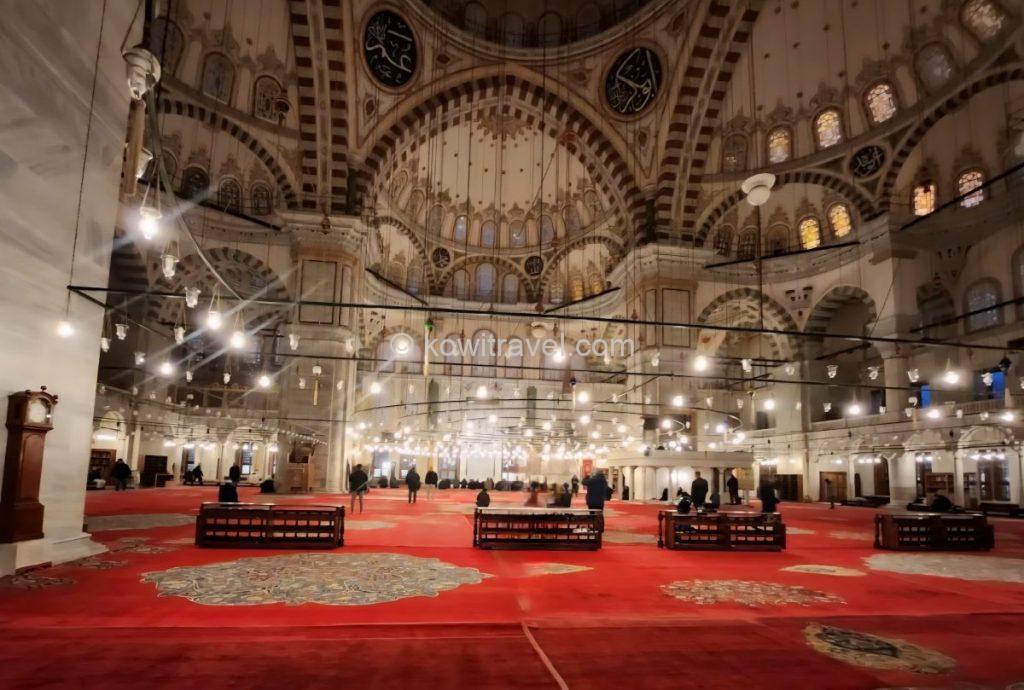
The interior main prayer hall of Fatih Mosque, featuring patterns on the massive columns (known as “elephant feet”) that support the central dome and a vast expanse of red carpeting.
The heavy lines of the colossal pillars (traditionally called elephant feet) bracing the central dome and the crimson carpet patterned with large medallions stretching infinitely across the floor channel the living breath and raw majesty of the Conqueror through the nighttime stillness.
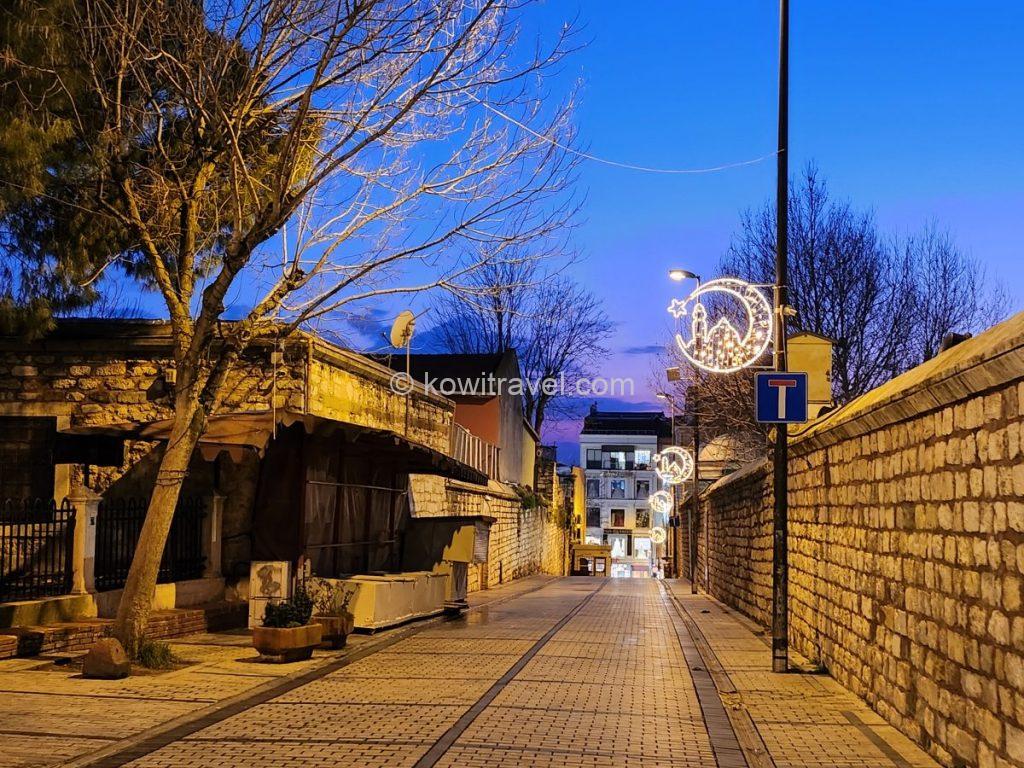
The tranquil night view of Hattat Nafiz Street, seen after leaving the prayer hall.
10) The Walls of Theodosius (Walls of Constantinople)
A triple-layered defensive fortification system built in the first half of the 5th century AD during the reign of Byzantine Emperor Theodosius II, stretching 6.5 kilometers across the entire western flank of the Old City from the Sea of Marmara to the Golden Horn.
Composed of a massive inner wall, an outer wall, and a deep defensive moat, this impregnable fortress protected the Byzantine Empire by repelling countless Islamic military campaigns for a millennium, until it finally breached under the monstrous Urban bombard cannons deployed by Mehmed II in 1453, standing as a living witness to human military history.
After surveying the stone masonry ruins bearing the chips and scars of centuries of warfare, reaching our next destination, the Kariye Museum, required a pleasant 5-minute walk covering roughly 400 meters through the quiet, traditional residential alleys threading just inside the line of the walls.
11) Kariye Museum / Chora Church (Kariye Camii)
Originally originating as a monastery church constructed outside the city fortifications (Chora translates to ‘countryside’ or ‘in the fields’) in the early 4th century, it was absorbed inside the municipal boundary when the Theodosius walls expanded.
It underwent massive structural expansions between the 11th and 14th centuries, which saw the completion of its masterwork mosaics. When it was converted into a mosque following the Ottoman conquest, the religious images were covered over with plaster.


The mosque’s arched entrance and information sign (left), along with its unique exterior structure and wall details (right).
Ironically, this act meticulously preserved the original Byzantine mosaics and frescoes in the most pristine state globally when it was restored as a museum in modern times.
The golden concentric rings of biblical ancestors detailed in the ceiling domes and the intense facial shading of the Christ Pantocrator (Christ Almighty) mosaic above the portal—holding the Gospels in his left hand and extending a blessing with his right—are completely striking.
The interior spaces pocketed with narratives like the turning of water into wine at the Marriage at Cana present the ultimate zenith of Byzantine religious art.


The front view of the prayer hall interior: the wooden pulpit used by the prayer leader for sermons (left) and the sacred images and frescoes adorning the domed ceiling (right).


A mosaic of Jesus Christ and the Virgin Mary above the entrance (left), and intricately carved Byzantine-style marble columns and arches (right).


A mosaic on the domed ceiling featuring biblical figures and angels arranged intricately around a small central circle.
Finishing our study of these historical icons, a gentle 15-minute downhill walk along the characteristically steep, atmospheric alleys of the Old City led us naturally to our next destination, Balat Street.
12) Balat Street (Balat)
An area hugging the northwestern shores of the Golden Horn within the Old City, Balat is a historic neighborhood that traditionally housed Sephardic Jewish refugees fleeing the Spanish Inquisition alongside Greek Orthodox communities during the Ottoman era.
Climbing its steep grid slopes reveals century-old historic wooden houses painted in bright, vibrant shades of candy red, pastel yellow, and deep blue. T
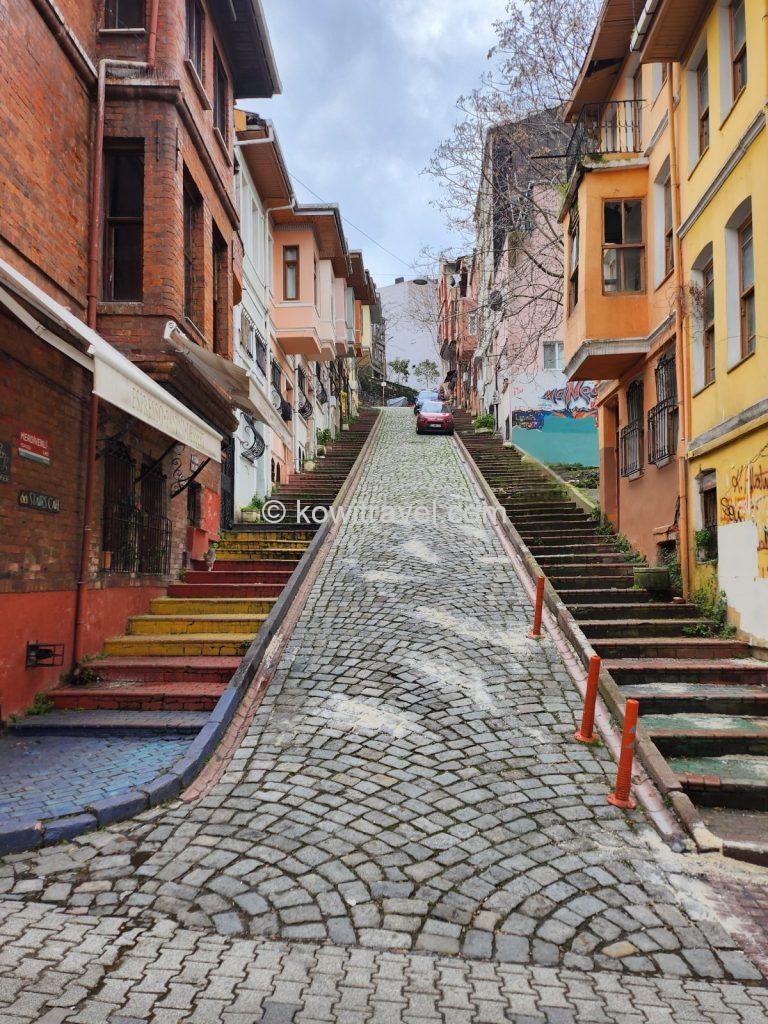
“Merdivenli Yokuş” (Staircase Alley), a famous landmark in the Balat district—considered one of Istanbul’s most atmospheric and exotic neighborhoods.
he endearing aroma of daily life—evidenced by clotheslines heavily strung with laundry stretching between opposing windows—coexists with hip local cafes and art galleries retrofitted into ancient foundations. This blend offers the most unique, exotic camera compositions and a tireless walking experience in the Old City.
Soaking in the colorful sights of the lanes and descending completely onto the flat coastal roadway of the Golden Horn, a 5-minute walk heading east along the waterfront lands you right before a highly unique, monumental church building.
13) St. Stephen Bulgarian Orthodox Church (Bulgar Ortodoks Kilisesi)
Completed in 1898 under imperial decree from the Ottoman Sultan for Bulgarian Orthodox Christians seeking religious independence from the Greek Patriarchate.
Because the soft marshy ground of the Golden Horn waterfront could not support a heavy stone foundation, the designers turned to an engineering marvel: fabricating the structure 100% out of prefabricated cast iron.
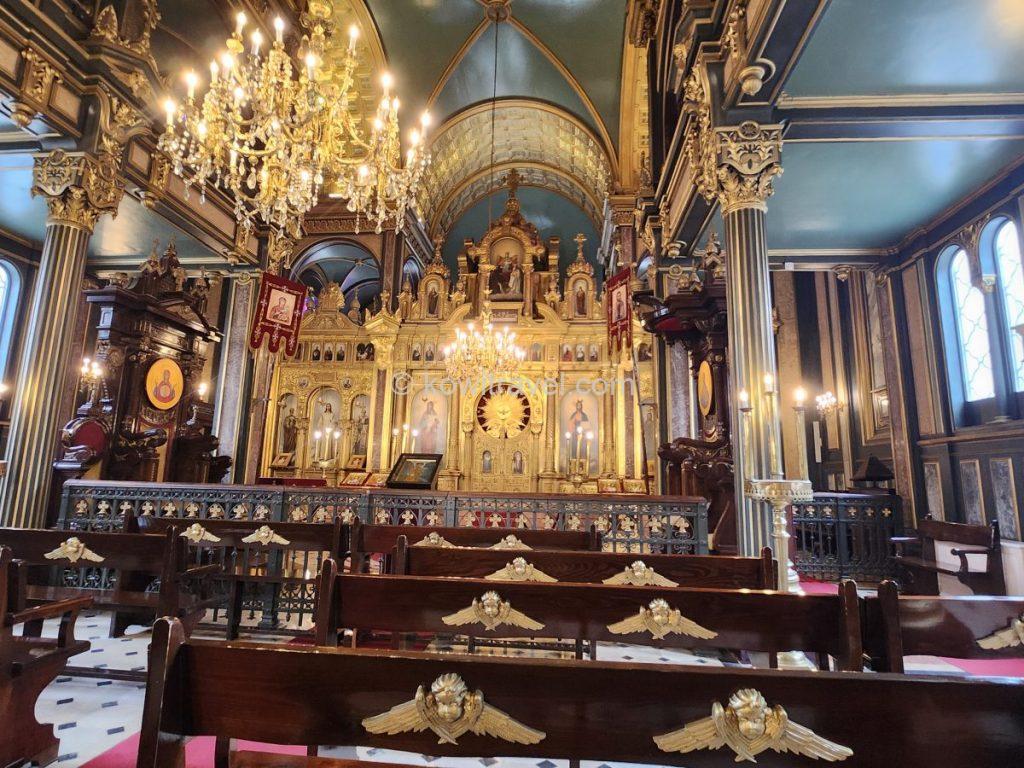
A view of the altar from the entrance inside the church.
Every iron rib, frame, and wall segment was cast in Vienna, Austria, floated down the Danube River on transport ships to Istanbul, and bolted together on-site in a matter of months, cementing its status as an architectural wonder.
It boasts a pristine white facade harmonizing Neo-Gothic and Neo-Baroque aesthetics that pairs beautifully with the blue waves of the Golden Horn. Stepping across the threshold reveals iron pillars and walls clad in shimmering, heavily gilded iconostases, emitting a warm, majestic glow that makes it difficult to believe the temple is forged entirely from iron panels.
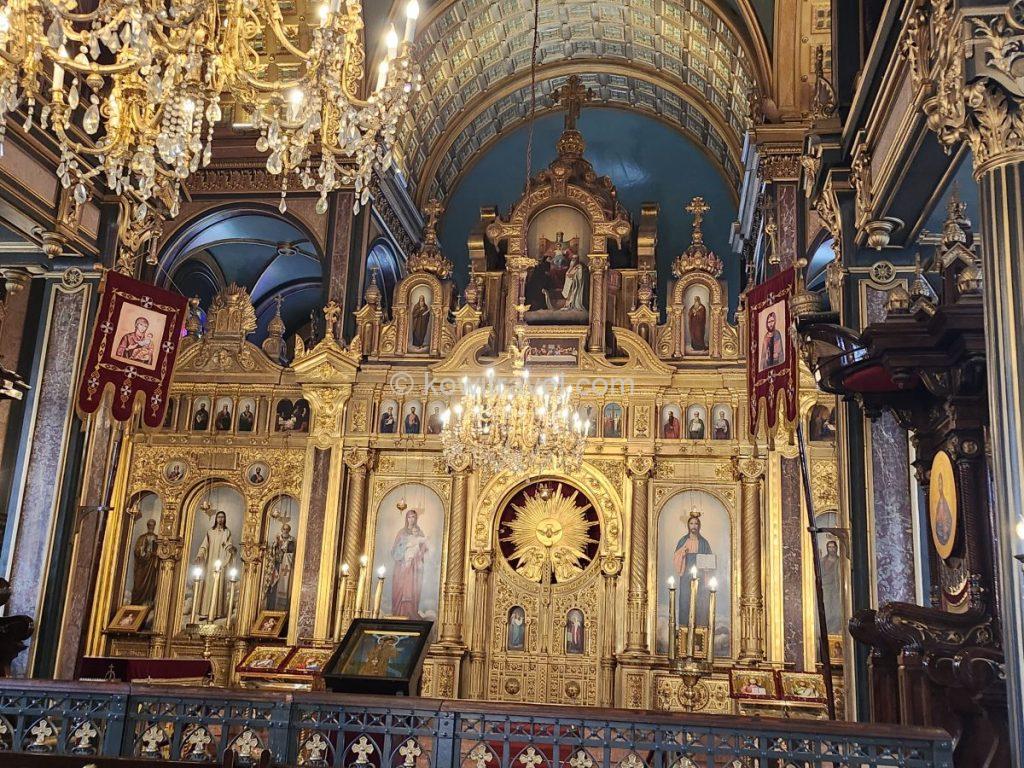
The golden iconostasis (icon screen) at the front of the church, separating the altar from the worship area.
Leaving the iron cathedral on the shoreline and diving back into the ancient inland lanes heading east for about 8 minutes brought us directly to the absolute focal point of Orthodox Christianity.
14) St. George’s Cathedral, Ecumenical Patriarchate of Constantinople (St. George’s Cathedral)
Serving since 1600 AD as the spiritual headquarters for over 300 million Orthodox Christians globally, this cathedral holds an identical ecclesiastic status to the Vatican in Roman Catholicism, making it one of Christianity’s highest holy sites.
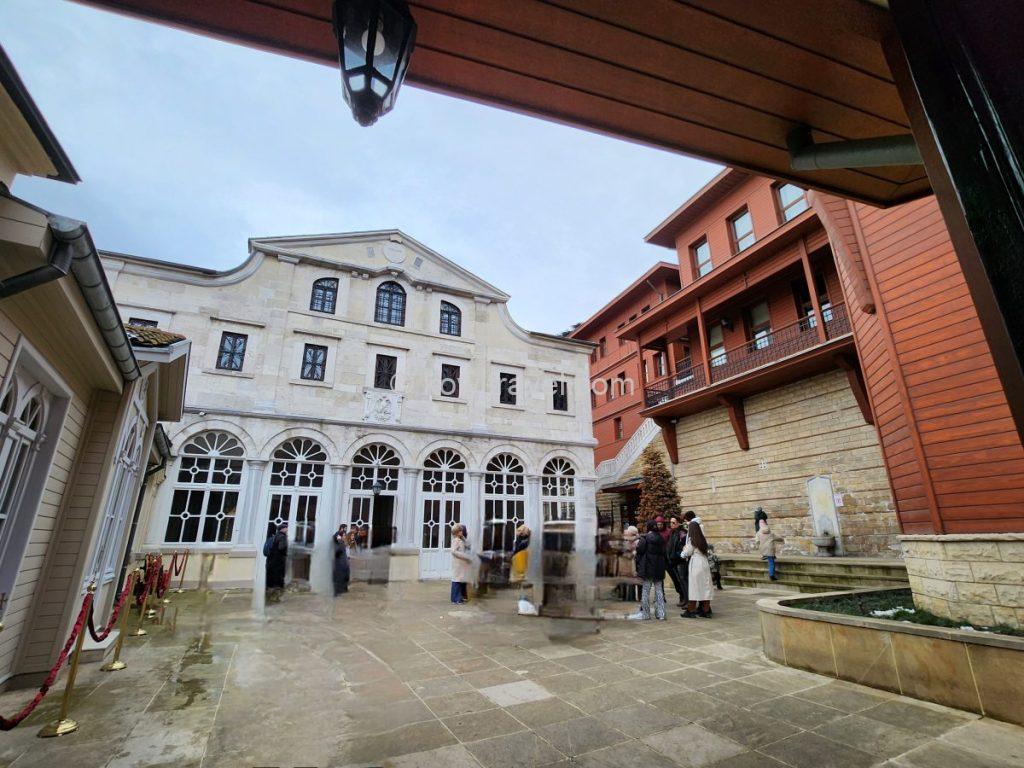
The courtyard and exterior of the Ecumenical Patriarchate of Constantinople and St. George’s Cathedral.
Under Ottoman imperial rule, Christians had to thread carefully and avoid flaunting their faith, which meant they could not build a grand monumental cathedral; hence, it carries the somber history of being nestled modestly within a secluded alley of the Old City’s Fener neighborhood.
While the facade resembles a standard stone hall, passing through security and entering the main sanctuary reveals a breathtaking contrast. A fragment of the Column of Flagellation where Christ was bound, the holy relics of 5th-century saints, and a towering, centuries-old gilded wooden iconostasis fill the room.
The heavy, mystical silence and spiritual energy enveloping the chamber strike deep into the heart of a walking traveller.


The intricate, massive golden iconostasis and pillars installed at the front of the cathedral (left), along with the overall structure and majestic atmosphere of the interior, evoke a sense of solemnity (right).
Concluding our deep historical and religious trek across the northwestern Old City here, we hopped on a bus from the main road outside the cathedral to Eminwnu. Utilizing the T1/T5 lines bridging the Old and New Cities, we finally crossed the water to Karaköy, heading straight to our afternoon mosaic lamp workshop.
👉Walking Route Map from the Walls to Karaköy

15) Karaköy Mosaic Lamp Workshop (Highlights in Istanbul Workshops)
Leaving the Old City behind and crossing the Galata Bridge, we climbed into the hilly streets of Karaköy—the trendy design workshop hub of the New City—and entered the ‘Highlights in Istanbul Workshops’ studio for our 3 PM reservation.
The studio hummed with creative energy under a ceiling dripping with brilliantly lit Ottoman glass lamps and a sleek ‘Highlights in Türkiye’ neon sign. Long wooden tables were beautifully arrayed with trays holding more than 50 shades of glass tiles and beads, welcoming international travelers.


The base class fee was approximately 35 euros per person; this covered not only the lamp materials but also the lamp body, brass base, light bulb, glass tiles in over 50 colors, and all necessary tools. It also included unlimited Turkish tea (çay), coffee, sweet Turkish delight, cookies, and a protective bubble-wrap packaging service.
Sipping on unlimited, aromatic Turkish tea (Çay) and nibbling on sweet Lokum and cookies provided throughout the session, we meticulously assembled our one-of-a-kind desktop custom mosaic lamps under the expert guidance of the artisan.
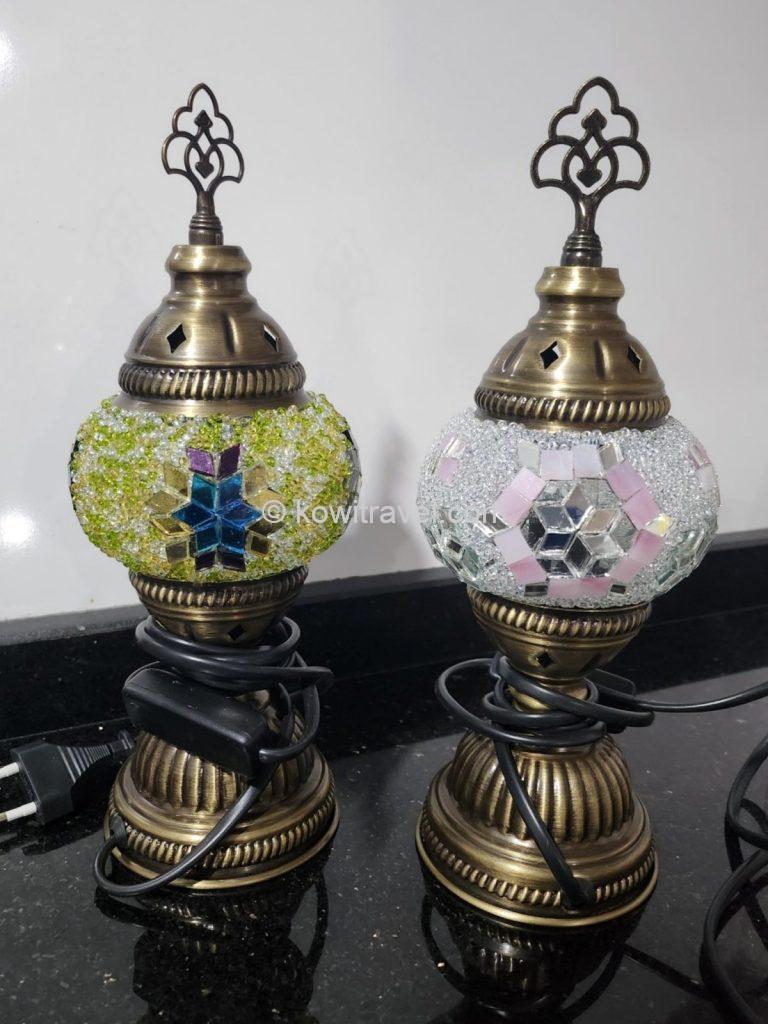
A mosaic lamp created during the class.
This beautiful set of lamps, combining the traditional light of Turkey with our personal memories, arrived safely at our home thanks to the studio’s secure bubble wrapping. Today, they continue to cast a warm, magical glow across our living space every evening, acting as a superb travel trophy reminding us of our 7-day footsteps in Istanbul.
5. Essential Tips for an Istanbul Walking Tour
1) Saving Money and Time via the Istanbul E-Pass
The ultimate MVP that elevated the entire quality of our Istanbul trip was the Istanbul E-Pass. Depending on your length of stay, you can easily purchase a 2-day, 3-day, or 5-day pass directly on your mobile device to fit your travel window.
👉 Official Istanbul E-Pass Website
Unlike independent tourists who must stand under the scorching sun or piercing wind waiting in line for hours to buy individual attraction tickets, E-Pass holders rendezvous with a certified professional guide at designated times and march right through the dedicated group fast-track lines.
This entirely eliminates time wasted in lines, making your walking itinerary exceptionally efficient.
Ruins that would look like random stones or chalky murals are brought to life as the certified guide breaks down the core history and secrets at an accessible level. Furthermore, current walking tours in Istanbul often provide smartphone QR-coded multimedia audio devices.
Setting the device to your native language syncs perfectly with the guide’s trail, automatically triggering vivid historical narratives at key spots, maximizing immersion even for those unfamiliar with ancient history. Walking through sites while listening to these breakdowns proves that you see as much as you know, enriching your journey.
We purchased the 5-Day E-Pass, and to sum it up, we visited far more attractions and enjoyed a wider variety of experiences than the cost of the pass would suggest. If you plan to stay in Istanbul for at least five days, I highly recommend purchasing the 5-day pass.
The website provides detailed information on the various sights, attractions, and activities available; by selecting the ones that appeal to you and incorporating them into your itinerary, I am confident you will have a truly enjoyable and fulfilling trip.
2) Navigating the Istanbul Transit Card (Istanbulkart) and Transfers
● Maximizing the T1 Tram, the Pulse of the Old City
The undeniable champion of an Istanbul walking tour is the T1 tram line, slicing smoothly down the center of the avenues. Prime historical hot spots like Sultanahmet station (Hagia Sophia/Blue Mosque), Eminönü station (Galata Bridge/New Mosque/Egyptian Bazaar), and Beyazıt station (Grand Bazaar) are linked seamlessly on this single line.
👉 Tram T1 Route Map Official Website
● Purchasing and Topping Up
It is incredibly simple and convenient; you can purchase and top up the ‘Istanbulkart’ using cash or a credit card at the yellow automated ticket kiosks called ‘Biletmatik’ located at the entrance of almost every tram stop and metro station.


An Istanbul transit card and a top-up machine.
● Transfer Perks and Nuances
This single card unlocks access to trams, buses, metros, and even the public commuter ferries operating across to the Asian side. Since it offers steep transfer discounts within a specific time window, it is a non-negotiable asset for walking tourists. While regulations technically recommend a one-card-per-person policy, it is entirely possible to tap a single card multiple times to pay for a group traveling together.
6. Honest Reviews of Robust Local Food Encountered on the Road
Because we mostly utilized the kitchen facilities in our Airbnb apartment to cook our own meals, we did not go on any curated ‘Instagram-famous’ restaurant tours.
However, during our 7-day walking marathon where we explored every nook and cranny until our feet blistered, we popped into whatever street-food stalls or market-alley diners we stumbled upon when hunger struck.
These meals served as an unflagging fuel source for our trek and a valuable window into the daily lives of locals.
1) Balık Ekmek (Fish Sandwiches) at Eminönü Square
Stepping into Eminönü pier square, the first thing that hits your nose is a mixture of salty sea air and savory, sizzling oil.
This is Istanbul’s definitive signature street food: fresh mackerel grilled continuously over open grates right on rocking, gilded Ottoman-style boats, tossed into sliced Ekmek bread along with crisp onions and lettuce.
Squeezing a generous amount of lemon juice from the table bottle and dusting it with a pinch of salt before taking a bite reveals an exceptional harmony—the crispy-crusted bread gives way to juicy, rich mackerel and crunchy, sharp greens.


The kebab eateries at the pier (left) and a mackerel kebab (right).
Sitting on low plastic stools at the outdoor dining common, watching the blue Golden Horn with squawking seagulls forming a live soundtrack, this single meal was a delightful romance that completely dissolved the fatigue of walking.
2) The Döner Kebab Platter at the Egyptian Bazaar Dining Alley
Before our mosaic lamp workshop at 3 PM, we secured an outdoor table in a quiet local dining alley bordering the Egyptian Bazaar to appease our hunger.
The traditional Turkish meal served to us—Döner Kebab Pilav Üstü (Döner over Rice)—was a nutritionally perfect spread.

Instead of being wrapped in bread, the dish is served with rice, meat, and vegetables arranged separately on a plate to be eaten with a fork; it was delicious.
The main feature consists of meat shaved thin like ribbons after being slow-cooked on a massive vertical rotating spit, shedding excess fat while frosting beautifully on the edges. Shaved over a mound of Pilav (savory Turkish rice glistening with butter), it came paired with crispy french fries and fresh sliced tomatoes.
Tearing off pieces of Lavaş (the thin wheat flatbread draped over the meat like a blanket) and wrapping the juicy meat, buttered rice, and tomatoes together like a small parcel fills the palate with incredible depth.
I can never forget the warm, peaceful moment when a tiny stray kitten silently slunk up to our table, wrinkling its nose and meowing for a scrap, leading us to share bits of meat. (True to Istanbul fashion, the moment it realized the food had run out, it turned on its heel and marched away without a single backward glance. So chic! ^^)
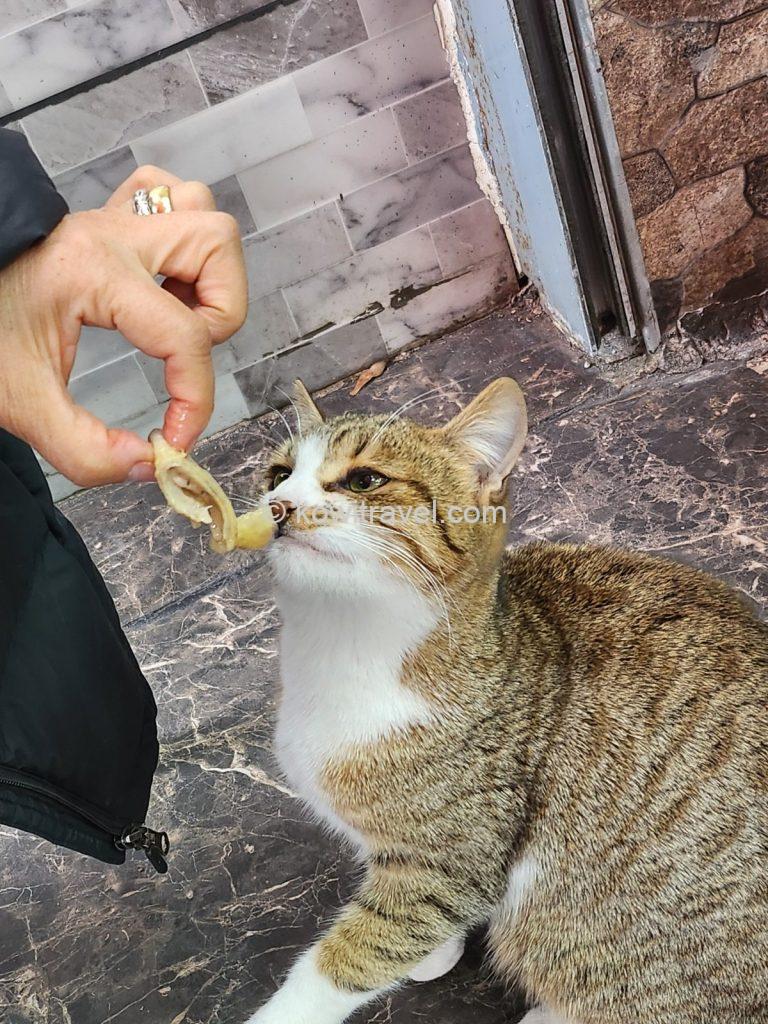
A stray kitten that approached without hesitation to accept some food—it was absolutely adorable. ^^
To top it off, the golden Mercimek Çorbası (lentil soup) served with the platter was exceptional. Setting a fresh lemon wedge directly into the soup and dipping pieces of the warm baguette bread provided in the table basket delivers a rich, earthy, yet bright flavor.
It acted as a comforting shield, warming our core which had grown slightly chilled from walking through Istanbul’s breezy winter air.
“Watch the vivid video of our Istanbul journey on YouTube!”
(Please turn on Y0uTube CC(subtitles) and select your langiage in settings!)
7. Preview of the Next Journey: Part 2
The vast majority of Istanbul’s heavy-hitting tourist landmarks are densely clustered right here in the Old City zone where we spent our days walking. None of the 15 essential spots detailed above can be simply breezed through, as each holds immense layers of historical depth; doing them justice requires a minimum of 1 to 2 hours per site. Accounting for transit times between ruins and a sustainable walking pace, our practical experience proved that even a packed day caps out at a maximum of three main destinations.
Consequentially, mastering these gem-like historic spots in the Old City requires a dedicated itinerary spanning at least 5 leisurely days. To piece together this grand urban puzzle efficiently, breaking your maps clearly into ‘Old City’, ‘New City’, and the ‘Asian District’ results in a far more rewarding, time-saving, and joyful adventure.
In the upcoming Part 2, we will cross the Golden Horn to the north, moving into the ‘New City Beyoğlu District (Beyoğlu & Taksim)’. This area preserves the sturdy footprints of medieval Genoese traders and the old consulate buildings of Western powers, pulsating with Istanbul’s most exotic, refined, and contemporary energy. Our dynamic walking chronicle will continue, featuring the observation deck views from Galata Tower, the historic red tram rolling down the romantic Istiklal Street, the stunning Ortaköy Mosque, Dolmabahçe Palace, a Bosphorus dinner cruise, the Sapphire skyscraper views, and a sunset yacht tour. Stay tuned!
[ Read Part 7 of our 1-Month Turkey Road Trip : Eskisehir Trip 3-Day ]
” This post includes affiliate marketing links. If you make an accommodation booking through these links, I may earn a small commission at no additional cost to you.”
- [1-Month Türkiye Road Trip] #7. Romance and Art Along the Porsuk River: A 3-Day Guide to Eskişehir, the Venice of Türkiye
- [1-Month Türkiye Road Trip] #6. A 6-Day Complete Guide to Cappadocia like an Alien Planet (Winter Car Rental Route, Accommodation, Must-Visit Places)
- [1-Month Türkiye Road Trip] #5. A 3-Day Trip to Antalya, the Blue Pearl of the Mediterranean
- [1-Month Türkiye Road Trip] #4. Denizli and Pamukkale 3-Day Travel Guide: Recommended Accommodations & Must-Visit Itinerary
- [1-Month Türkiye Road Trip] #3. The Ultimate 3-Day/2-Night Izmir Travel Itinerary
- [1-Month Türkiye Road Trip] #2. Journey to Bursa: A City of History, Green Landscapes, and Heartwarming Encounters
- [1-Month Türkiye Road Trip] #1. Arrival at Istanbul Airport, 1 Night in Taksim Square, and Car Rental Review
Leave a Reply