![[Türkiye 1-Month Road Trip] #6. The Ultimate Cappadocia Travel Guide – Recommended Accommodations, Must-Visit Spots, and Stories](https://kowitravel.com/wp-content/uploads/2026/09/cappadocia-travel-191.jpg?v=1790164021)
#6. Exploring Cappadocia : 6 Days in an Otherworldly Landscape at the Edge of the World
Welcome back to the 6th story of our 1-month Turkey car rental road trip series.
Today, leaving behind the warm and gentle Mediterranean resort city of Antalya, I would like to introduce our spectacular 6-day/5-night journey in Cappadocia—a wondrous world where an unrealistic nature that feels like an alien planet coexists with strong human vitality.
For those preparing for a winter Turkey road trip, I will generously share details on snow removal and road conditions, must-visit attractions, hidden local restaurants, and unforgettable episodes encountered during the trip.
Shall we embark on the ultimate Cappadocia travel with us now?
1. Departure from Antalya, Journey via the Islamic Holy City Konya
1) Winter National Highway Drive and Road Snow Removal Conditions
As we left Antalya and drove deeper into the northeastern inland, the landscape outside the window dramatically transformed into a white winter wonderland.
To be honest, since it was a winter car rental trip, I was extremely worried about driving on icy roads. Fortunately, the main national highways in Turkey were well-plowed, allowing us to drive with peace of mind. The drive cutting through the wide-open, snow-covered landscape felt like a special privilege that only car rental travelers could enjoy.
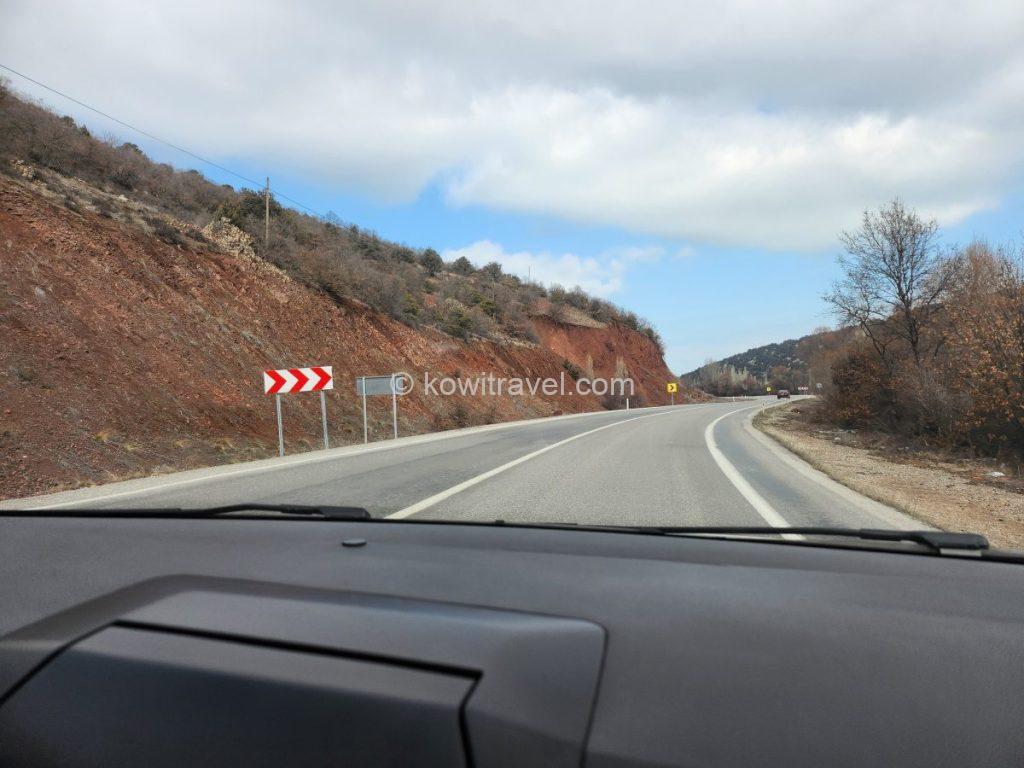
A national highway leading from Antalya to Konya. The reddish hue of the mountain face on the left is due to the region’s limestone geology—common along Turkey’s southern Mediterranean coast and the Taurus Mountains. As calcium carbonate in the limestone dissolves and washes away with the rain, residual impurities like iron and aluminum accumulate, forming the red clay seen in the photo. This soil is known as terra rossa (Italian for “red earth”).
👌Travel Destination Spoiler / Useful Knowledge
Antalya and the southern Mediterranean coast of Turkey, as well as the Toros Mountains area, feature well-developed limestone terrains. Limestone composed of calcium carbonate dissolves and washes away in rainwater (karst process), and the remaining insoluble impurities such as iron and aluminum accumulate to form red clay. This is called Terra Rossa (meaning ‘red land’ in Italian).
The grand journey from Antalya to Cappadocia is as follows:
* Total Travel Distance: Approx. 500–515 km
* Travel Time: Approx. 6 hours 30 minutes – 7 hours (Winter standard)
* Recommended Stopover: Konya – Approx. 3 hours 30 minutes from the start of the drive
Therefore, to avoid overexerting ourselves, we decided to take a short break in Konya, our intermediate stopover, before moving on.
2) Intermediary Stopover: Rest at Mevlana Square in Konya
The place we chose as the mid-point of our long journey was Konya, known as the most religious and conservative city in Turkey.
Konya, a flatland where the horizon extends endlessly and the largest wheat producer in Turkey, is said to have been the capital of the Rum Seljuk Empire, which flourished from the 11th to the 13th centuries. Brilliant medieval Islamic architectural heritage built during this period remains throughout the city.
Unlike resort destinations like Istanbul or Antalya, it is known as the most conservative and pious city in Turkey.
Furthermore, Konya is where the master poet and thinker Mevlana Rumi lived and was buried, and it is the birthplace of mystical Sufism and the ‘Whirling Dervishes (Sema)’. Every year, countless pilgrims from all over the world visit to seek this message of peace and love.
Mevlana Square, where we stopped after parking the car for a while, exuded a heavy solemnity in the winter chill. The majestic Selimiye Mosque and the turquoise tiled dome—the symbol of the Mevlana Museum, a sanctuary of Islamic mystical Sufism—contrasted beautifully against the crisp blue winter sky, making it feel incredibly exotic.
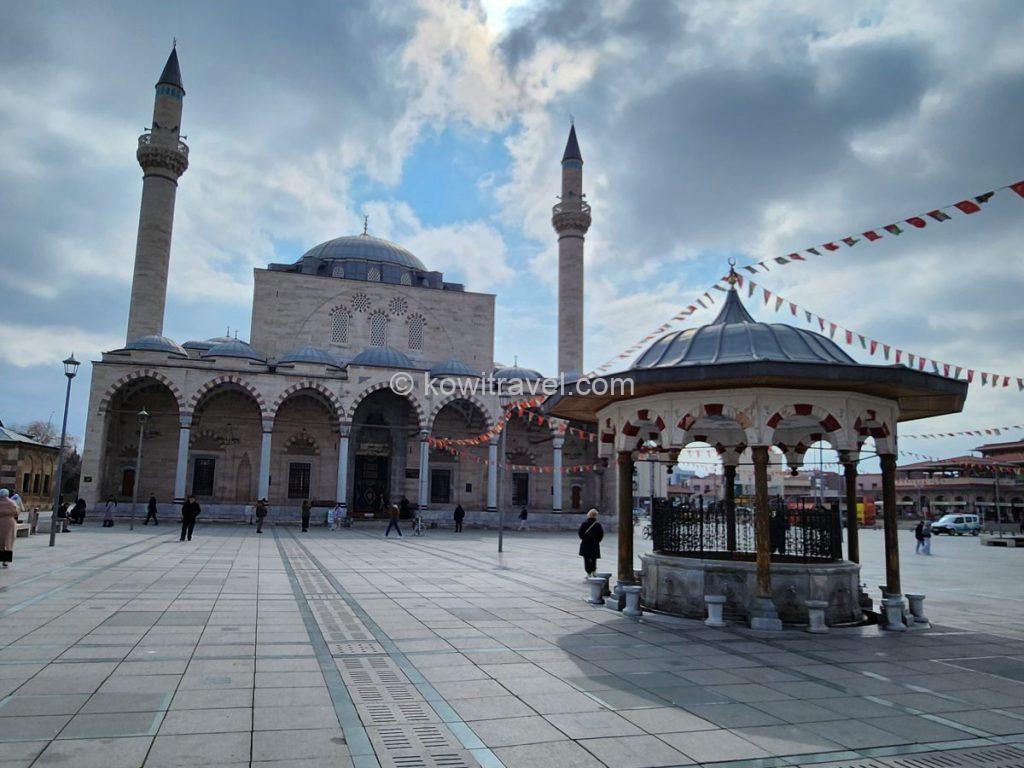
The Selimiye Mosque (Selimiye Camii), standing majestically right next to the Mevlana Museum, along with the fountain in the center of the plaza.

The exterior of the Mevlana Museum, home to the tomb of Mevlana Rumi—famous for the Sufi dance (Sema dance). The distinctive turquoise-tiled dome (Green Dome) visible behind the roof serves as the museum’s iconic landmark.
It was a wonderful stopover that felt like walking into the deep history of Turkey while catching our breath.
2. Arrival in Cappadocia
After leaving Konya, we drove non-stop for about 220 km along a smooth 4-lane national highway. By the time we approached Nevşehir after nearly 3 hours of driving, heavy snow was falling. It seemed a lot of snow had fallen previously as well, given the substantial piles cleared to the roadside.
- Travel Tip : If you drive for about 1 hour and 40 minutes after leaving Konya, Aksaray is located at the mid-point, so you may refuel or take a light rest there before continuing.
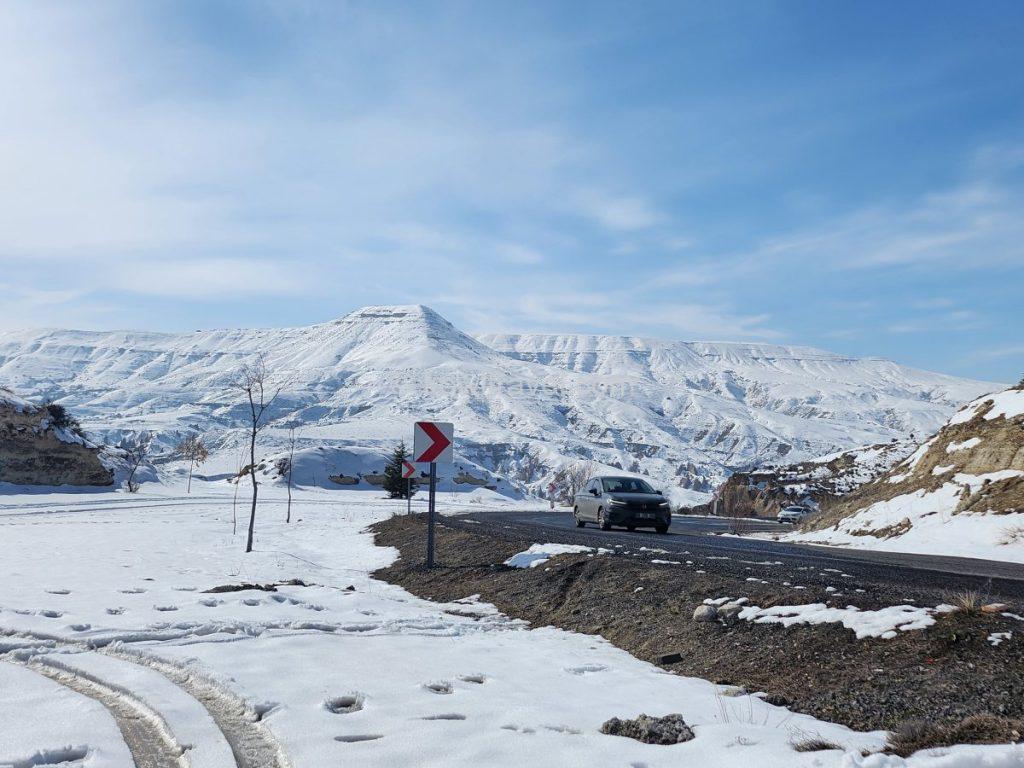
A view of a road captured against the backdrop of Cappadocia’s vast, snow-covered mountains.
Passing through Nevşehir amidst the heavy snowfall, we drove past Uçhisar Castle and through Göreme—the true central town for travelers packed with hotels, restaurants, and bus terminals—before safely arriving at Çavuşin, where our accommodation was located. Çavuşin is a very close neighboring village located about 4–5 km north of the busy Göreme town, just a 5-minute drive away.
Millions of years ago, Cappadocia was a volcanic region with large-scale eruptions. Volcanic dust—the aftermath of explosions around lava rocks formed by magma eruptions—settled and hardened into tuff. Because tuff has a weaker hardness compared to other igneous rocks, it eroded easily over time, creating the unique ‘fairy chimneys’ (mushroom rocks) characteristic of the Cappadocia region.
Since these rocks possess the unique property of being easily carved out with simple tools, numerous early Christians hid here to escape persecution by the medieval Roman Empire and invasions by Islamic forces.
It became a sanctuary for Christians, who dug deep into the rocks to build complex underground cities capable of housing tens of thousands of people, such as Derinkuyu and Kaymaklı. Furthermore, they carved out cave churches decorated with sophisticated frescoes to preserve their faith.
Today, in recognition of its historical and natural value, Göreme National Park and the Rock Sites of Cappadocia were designated as a UNESCO World Heritage Site in 1985, becoming a world-class tourist attraction boasting one of the most exotic landscapes on Earth.
Also, as the holy land of hot air balloon tours, the sight of hundreds of balloons rising above the unique rock formations every dawn is an essential itinerary item for a Cappadocia trip and is ranked number one on bucket lists worldwide.
1) A 3-Night Stay at ‘Route Cappadocia’, a Cave-like Lodge in Çavuşin Village
After a long drive, we finally arrived safely at our first accommodation in Cappadocia, ‘Route Cappadocia,’ located in the village of Çavuşin.
Situated slightly away from the hustle and bustle of Göreme town, this place offers a relatively serene and peaceful atmosphere, making it perfect for enjoying the cozy winter sentiment. It is a stone house with a cave concept, complete with a charming garden and terrace.
The cave-vibe bedroom, surrounded by rough and stylish stone walls, was incredibly cozy and warm, making us forget the sub-zero temperatures outside. The snowy landscape piled up in the yard was romance itself.
A menu for ordering food and a travel information board about surrounding attractions were available inside, and thanks to the friendly host, we spent a comfortable time feeling right at home throughout our stay.
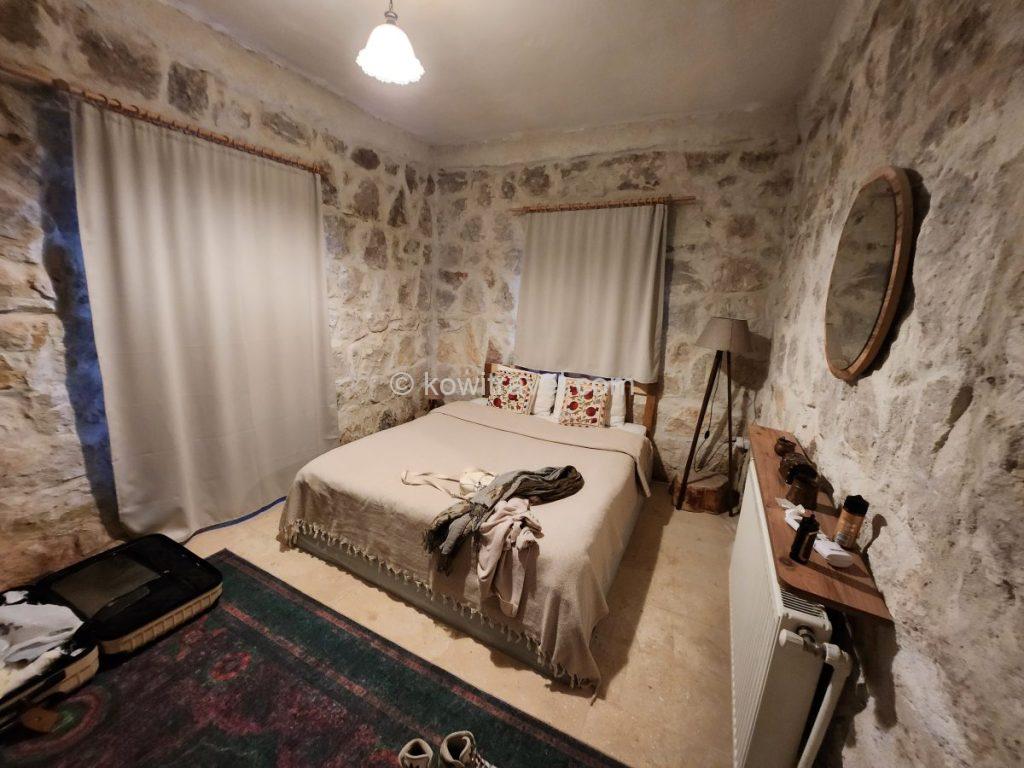
The interior of the accommodation, enclosed by the rugged yet stylish stone walls characteristic of Cappadocia. Soft lighting and embroidered pillows on the bed create a warm, inviting atmosphere.
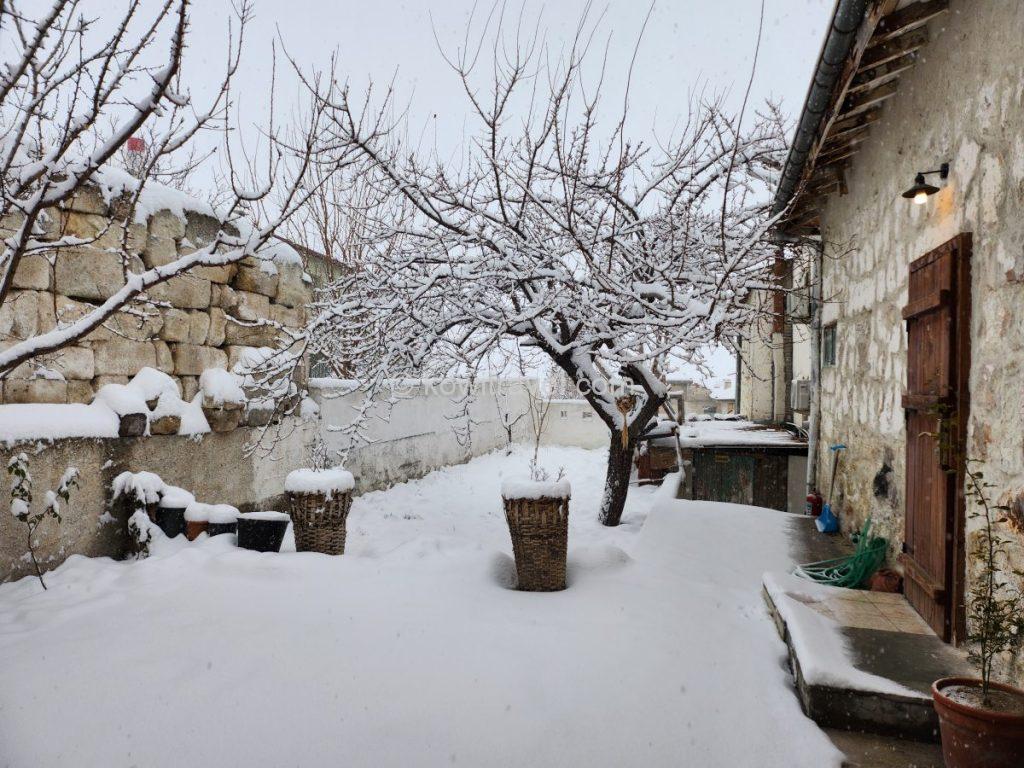
The stone exterior of the accommodation and the romantic winter scene of white snow piled up in the courtyard. It captures the tranquil and magical ambiance of Cappadocia in winter.
It is registered not only on Vrbo but also on major hotel booking sites like Booking.com and Tripadvisor, allowing you to compare prices.
👉 [Check real-time availability for Route Cappadocia on Tripadvisor]
2) Night of Day 1: A Walk Through the Fairy Tale-like Göreme Town Night View
After safely unpacking at our lodge, night had already fallen. To officially begin our Cappadocia journey, we drove our rental car to the town with fluttering hearts to enjoy the night view of Göreme.
After parking the car on one side of the town, we carefully walked up the hilly cave hotel alleyways inside the center of Göreme to enjoy the view.
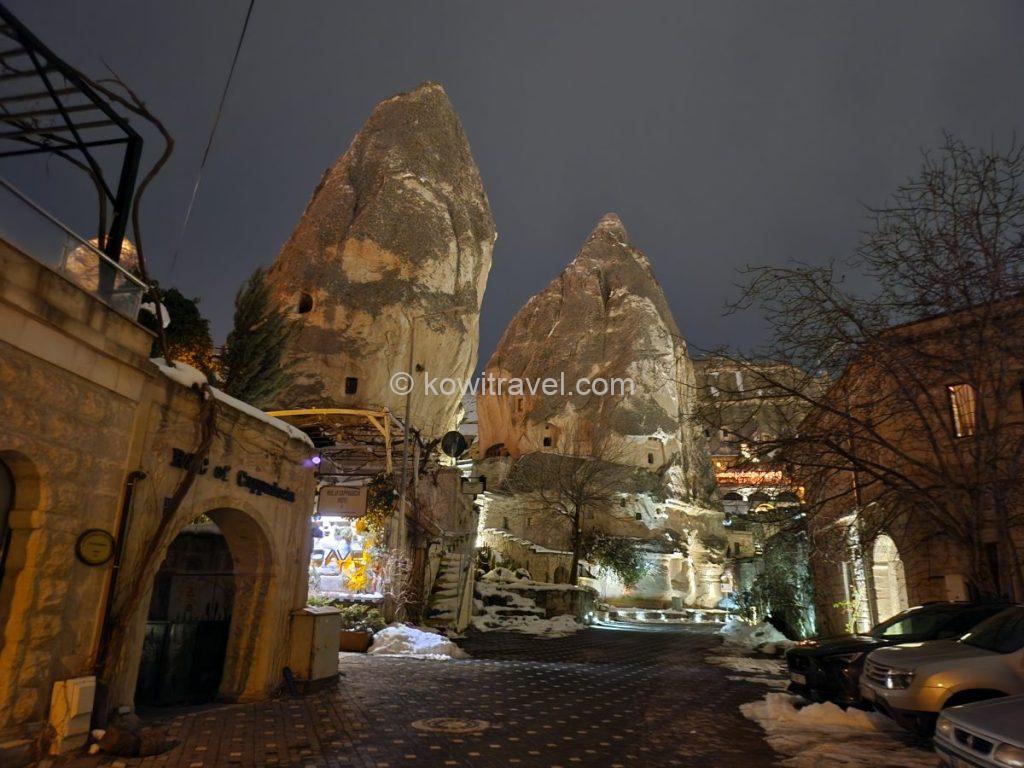
A lane lined with hillside cave hotels in the heart of Göreme
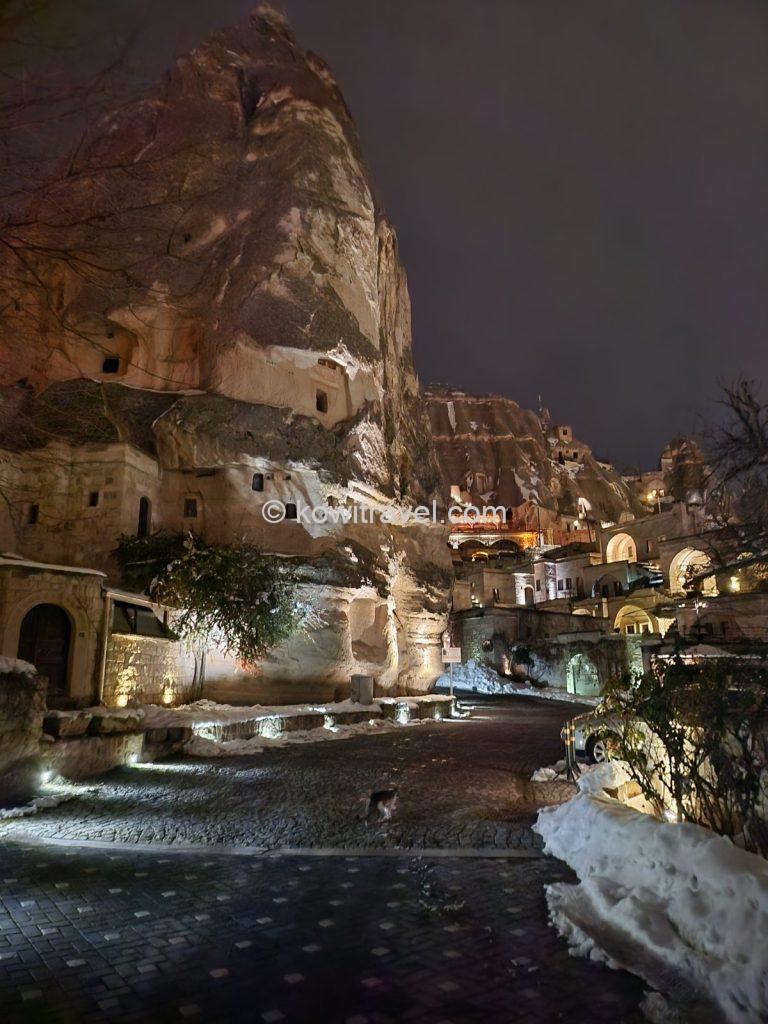
The scene is incredibly romantic, featuring cave accommodations carved directly into massive “Fairy Chimney” rock formations and warm orange lighting reflecting off the snow.
The night scene we suddenly encountered was so unrealistic that it felt mystical and dreamlike. The cave accommodations carved right into the massive ‘Fairy Chimneys’ rocks, the unique rock formations lit by warm orange lights, and the illumination reflecting off the white snow were incredibly romantic.
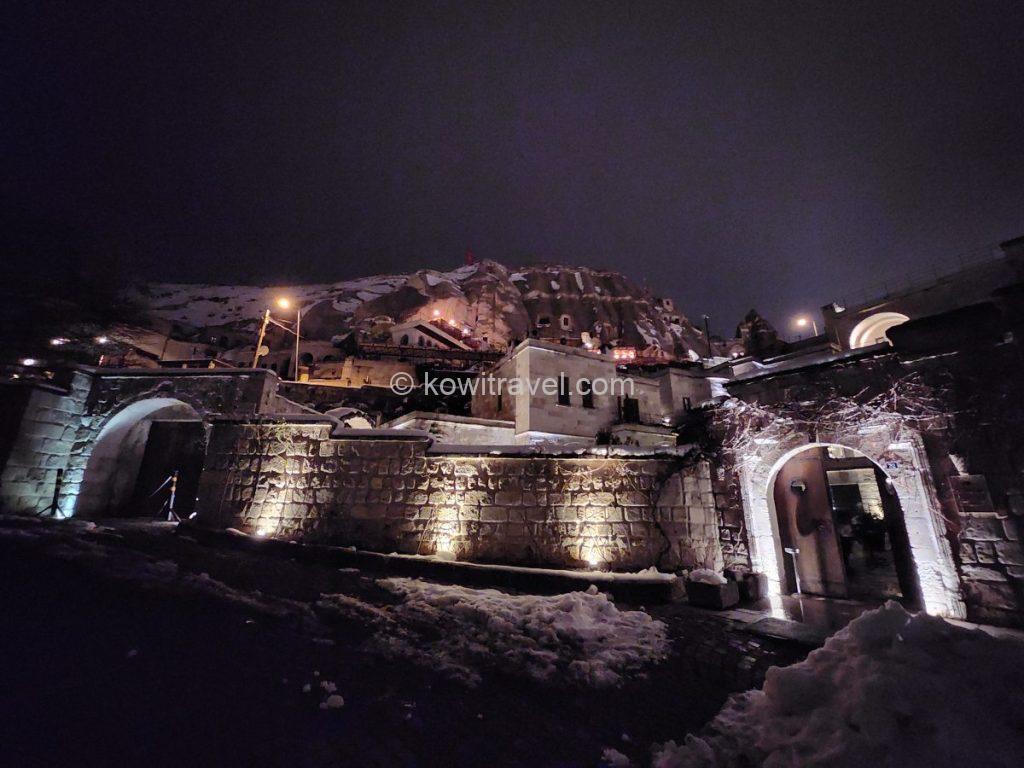
The exterior of a typical high-end Cappadocian cave hotel, where walls and terraces have been constructed by utilizing the natural rock formations.
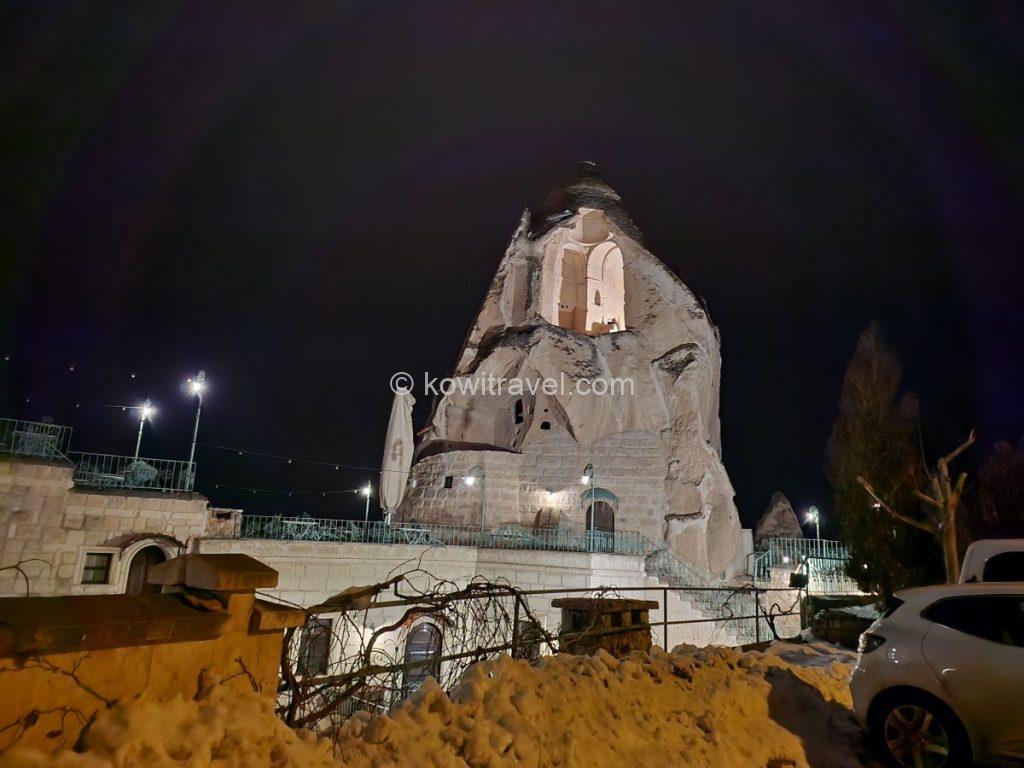
It is an impressive sight to see a massive rock spire illuminated from below, glowing majestically against the night sky.
Walking among them made us feel as if we had stepped onto another planet.
Because it was a dark night and the sloped paths were slippery due to the accumulated snow, we couldn’t climb all the way to the Sunset Point. However, looking down at the Göreme town night view from this cave hotel alleyway elevated the romance of our winter Cappadocia trip to its peak from the very first day.
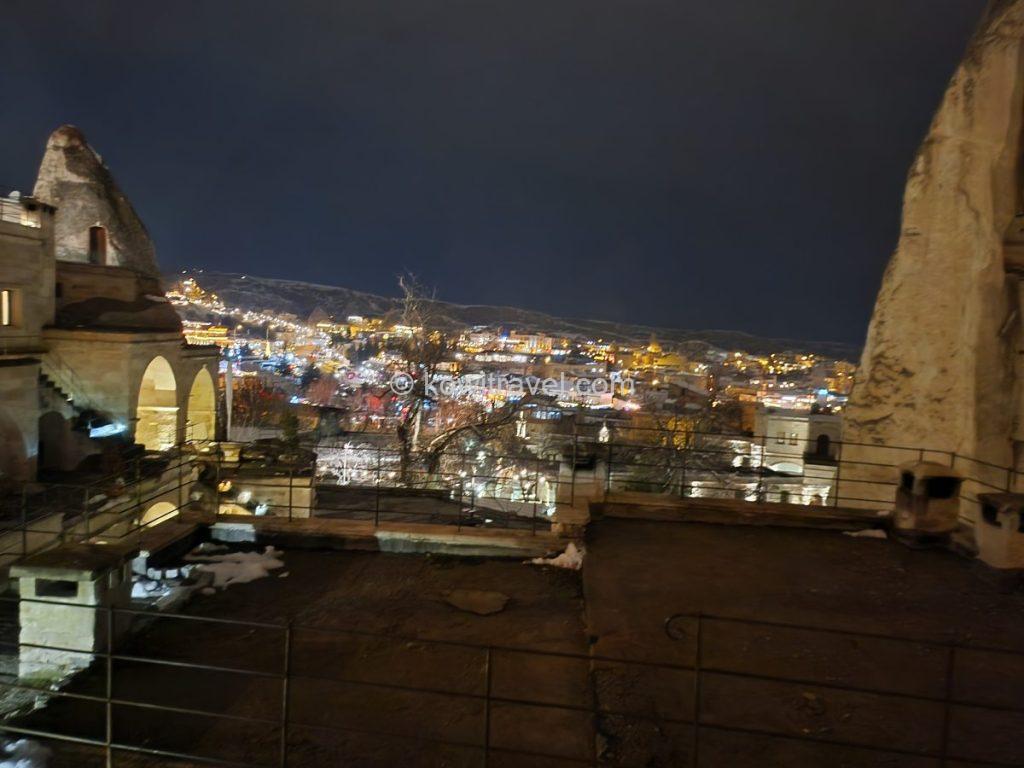
A panoramic view of the town, seen from a high-altitude terrace or the hillside path leading up to Göreme’s Sunset Point

A view of the charmingly illuminated village of Göreme nestled beneath distant, massive, snow-capped rock mountains; the smooth, frozen snow on the road adds a vivid touch to the experience of a winter trip to Turkey.
3. Core Must-Visit Attractions and Routes in Cappadocia
The reason we allocated a long period of 5 nights and 6 days to our Cappadocia trip was that there were so many attractions, but also primarily to experience the ‘Balloon Tour’—the highlight of Cappadocia. Every morning, we kept an eye on the app that provides real-time balloon flight status, waiting anxiously while exploring various corners of Cappadocia.
1) Exploring the Giant Underground City of Derinkuyu and the Dizzying Episode of the Lost Car Key
On our second day in Cappadocia, we headed to the giant underground city of Derinkuyu.
From Çavuşin to the Derinkuyu Underground City, it takes about 40–45 minutes by car, covering a distance of approximately 38–39 km. The route passes near Göreme and Uçhisar, heading straight south. You will take the national highway, which has wide lanes and is relatively quiet, making it not too difficult to drive.
It usually takes about an hour to fully explore the Derinkuyu Underground City.
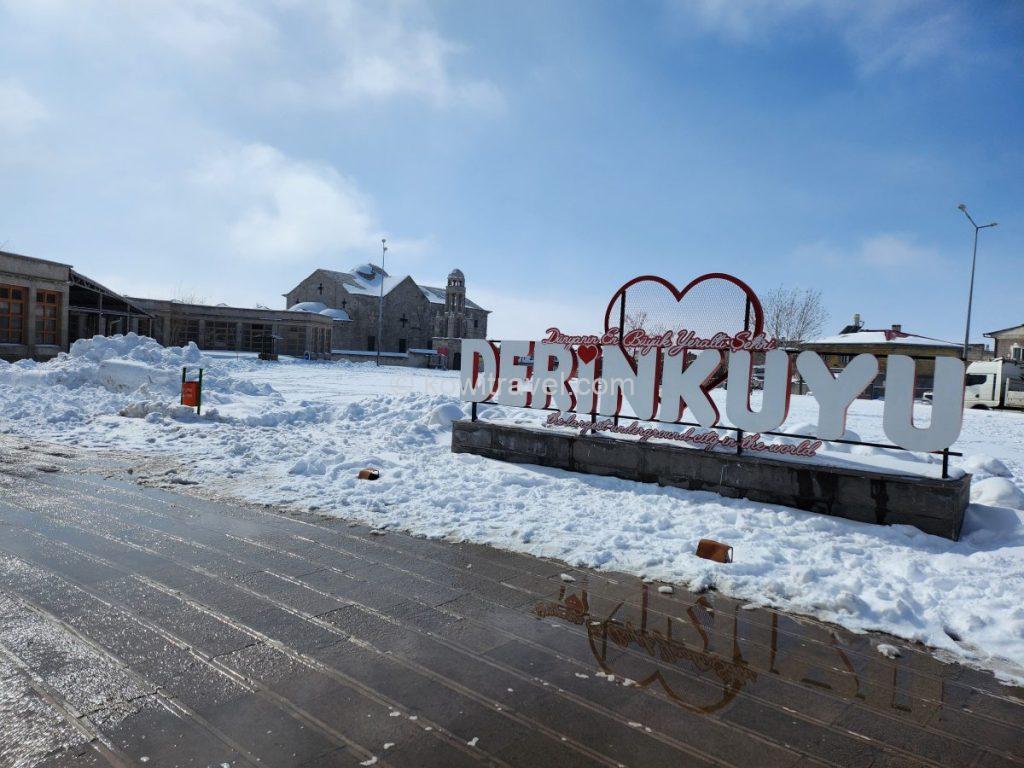
The official signature sculpture installed in the plaza of the Derinkuyu Underground City.
As the largest and deepest underground city discovered in the Cappadocia region, Derinkuyu (meaning ‘deep well’ in Turkish) began to be excavated gradually from the BC era.
However, around the 7th to 8th centuries during the Byzantine era, it was massively expanded by Christians who fled here to escape Islamic forces and religious persecution by the Roman Empire, serving as their religious refuge.
Reaching a total depth of about 85 meters (equivalent to 18–20 underground floors), this underground city was not a simple cave. It was fully equipped with urban functions, featuring residential areas, kitchens, and food storage, as well as churches, religious schools, wineries, and stables.
This complete self-sufficiency allowed residents to stay underground for long periods without going up to the surface.


The official ticket office and the narrow, steep entrance leading into the Derinkuyu Underground City.
It is said to have been a massive residential space capable of accommodating about 20,000 residents along with their livestock and food supplies at its peak. It was truly astonishing and hard to believe that it was built with ancient technology without any specialized modern equipment.


Vast underground living spaces where Christians once hid to escape persecution.
Currently, for safety reasons, it is open to the general public only up to the 8th underground floor (about 30–40 meters deep).
Bending low and heading down the narrow stone steps, you encounter a massive millstone-shaped door that could only be rolled from the inside to block enemy intrusion, along with giant stone pillars.
It was a solemn moment that made us reflect on the desperate and arduous lives, as well as the wisdom, of the ancients who formed a community and protected their faith in this dark, narrow underground world to escape persecution.
(Insert photos: Derinkuyu monument, underground city interior, and millstone door)
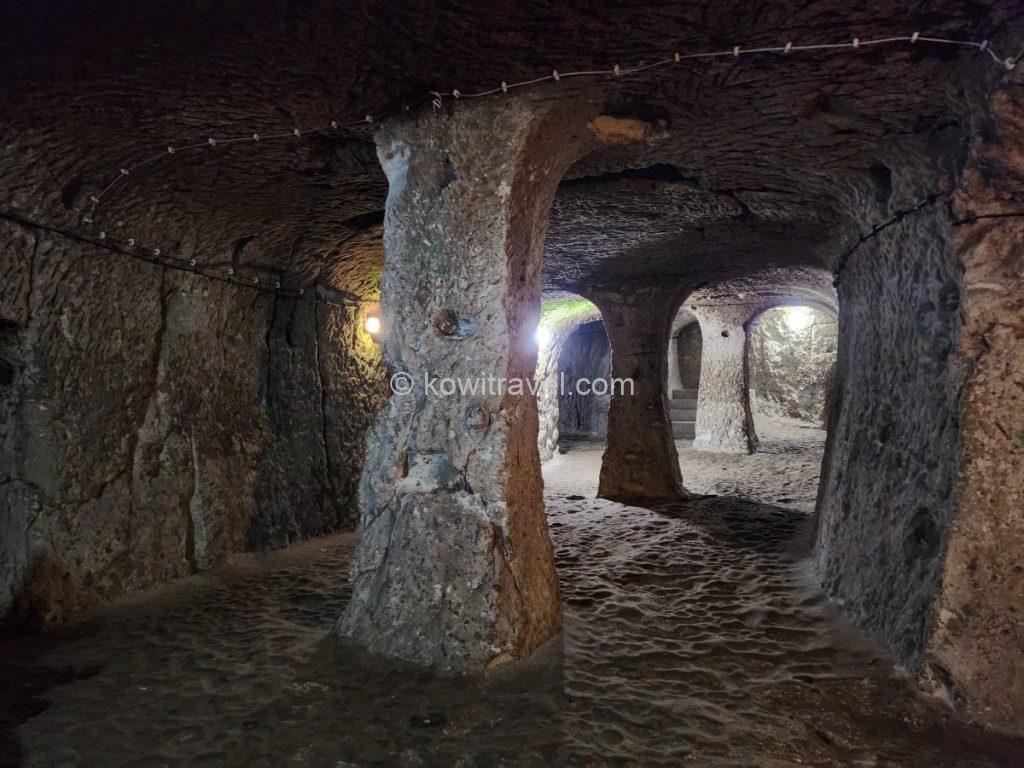
Thick rock pillars supporting the underground city and complex, maze-like passageways branching off in various directions.
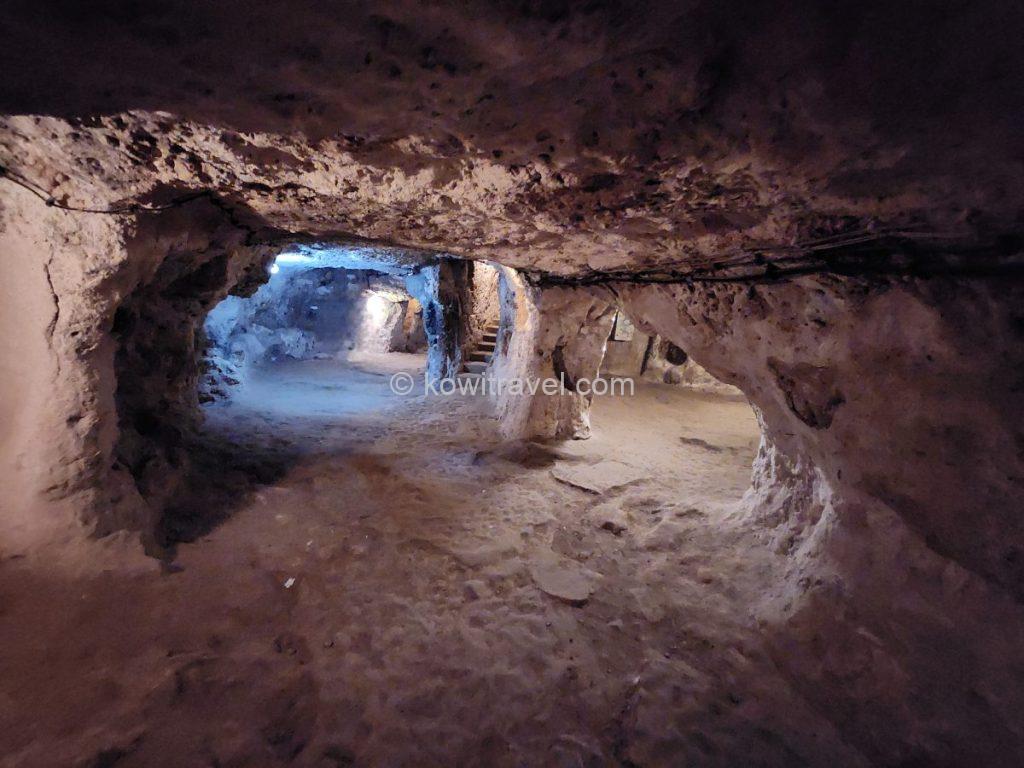
A wider living area or plaza-like zone; the ceiling is low and rounded, and a narrow staircase connecting the upper and lower levels is visible in the background.


The “stone door,” a key attraction of the Derinkuyu Underground City. It is a massive, millstone-shaped door designed to be rolled shut from the inside to block invading enemies; the central hole reportedly allowed for monitoring the enemy or thrusting spears at them.
Located on one side of the square right in front of the underground city ticket office is the Agios Theodoros Trion Church. It is a historic stone Greek Orthodox church built in the 19th century for the Greek settlers (Greek Orthodox believers) who lived in this region.
It is said to possess excellent acoustic effects and remains of beautiful frescoes depicting angels Gabriel and Michael. However, after the population exchange between Greece and Turkey in 1923, the church was left vacant and abandoned.
Due to years of neglect and some graffiti damage, the doors are currently locked, so the interior cannot be viewed. It is now used as a course lightly explored from the exterior.
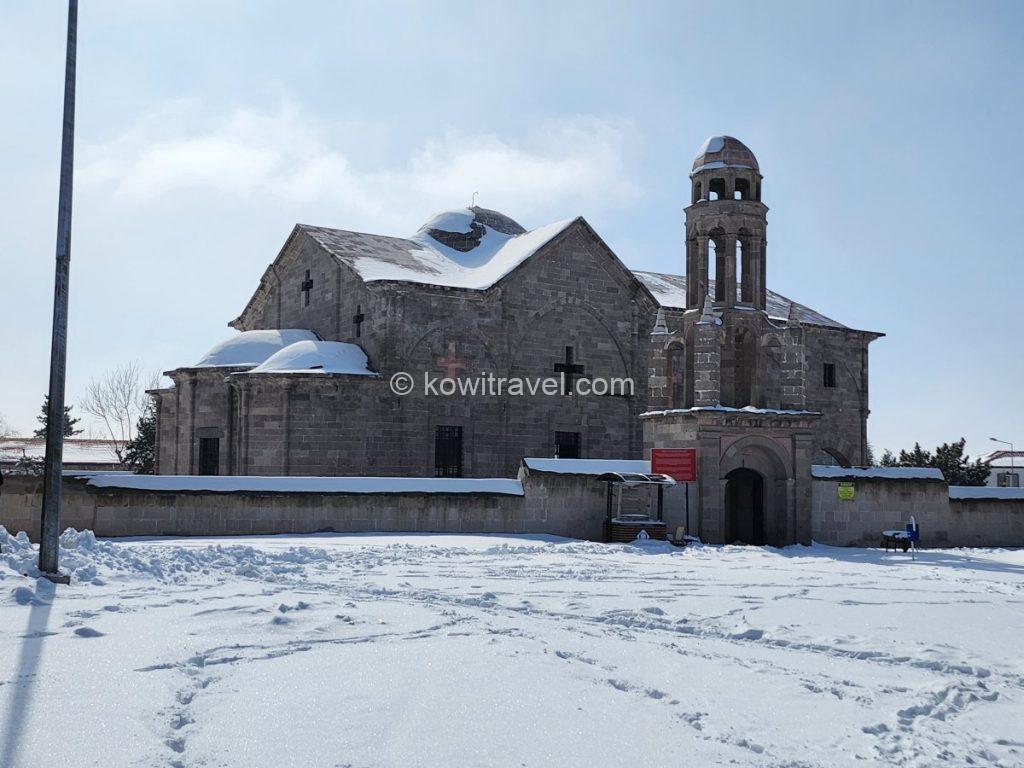
A historic Greek Orthodox church built in the 19th century. Constructed sturdily from stone characteristic of Cappadocia, its magnificent bell tower—dusted with fresh snow—creates a serene, beautiful scene against the winter sky.
After finishing our exploration of every nook and cranny of the complex labyrinth-like underground city, we felt hungry, and it happened to be lunchtime.
We headed to a local restaurant near the parking lot called ‘Akdeniz Kebap Salonu.’ It was a modest local diner with a direct view of a snow-covered mosque minaret. The combination of charcoal-scented Adana kebab, tangy meze (side dishes), and ayran we tasted here was unique and good to eat.

A local restaurant located right near the Derinkuyu Underground City ticket office and parking lot.
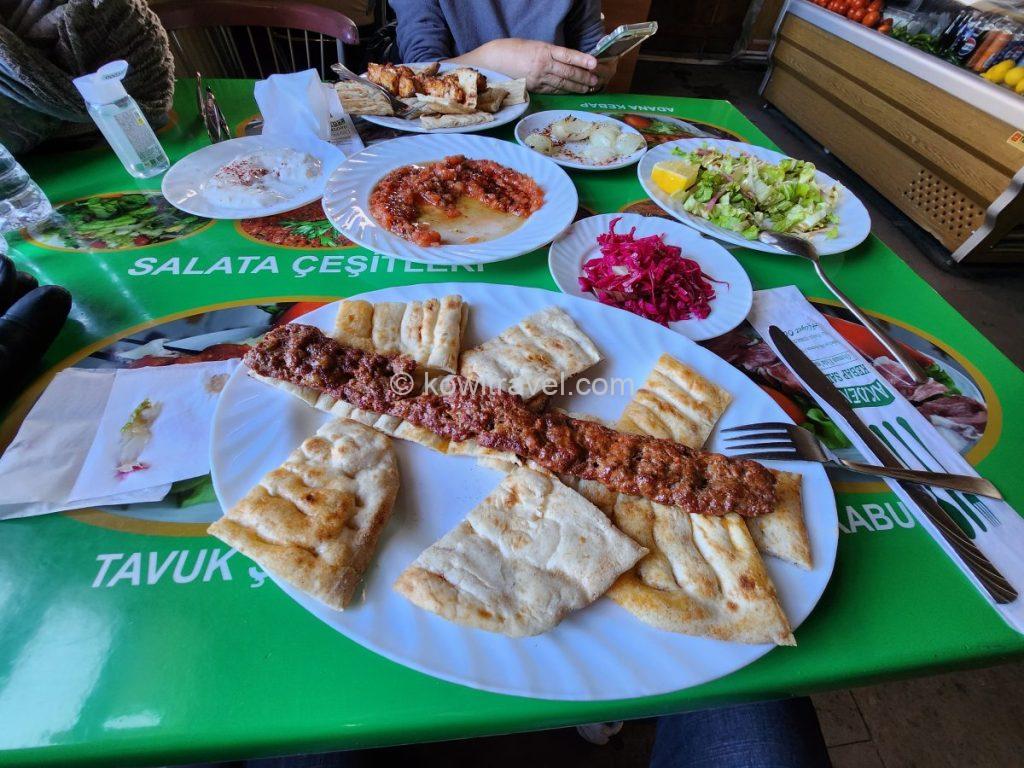
Adana Kebab, a signature Turkish grilled meat dish. Seasoned minced meat is skewered and charcoal-grilled, then served atop Turkish pide bread to be eaten wrapped together.


The interior of the restaurant and a prominent nearby mosque. Its massive dome and two tall, pointed minarets create an exotic look, contrasting sharply with the brilliant blue winter sky of Cappadocia.
When we arrived at the parking lot and realized that the rental car key, which my wife thought she had securely placed in her jacket pocket, had completely vanished, we felt utterly helpless, wondering, ‘Could this really be happening?’
👉 Episode: Unforgettable Kindness of Turkish People Encountered at a Dizzying Moment
However, leaving the restaurant after finishing our meal, we had no idea that the biggest crisis of our Cappadocia trip—a dizzying and absurd situation that I still cannot forget—was waiting for us.
While I was explaining the lost key situation to the parking attendant who approached thinking our car was leaving, a middle-aged man who looked like the attendant’s neighborhood friend stepped in.
Speaking half-English and half-Turkish, and occasionally using a translator, he said, “Think carefully. Where did you go first after parking the car? The restroom? Which restroom? The mosque restroom?” Despite the strict segregation of men and women in Islamic culture, this Muslim gentleman went inside the women’s restroom with my wife and searched every corner thoroughly.
Meanwhile, I retraced our steps back to the restaurant and checked meticulously, but it was in vain. Left with no choice, we decided to check the last remaining place—the underground city. After explaining the situation to the ticket office and getting their permission, I went back inside.
Searching that narrow, deep underground city with countless fork roads using my phone flashlight, sweating profusely in the dead of winter, I ultimately came back up to the surface empty-handed. Thinking about what would happen next, it was clear this was a major problem.
The day was about to turn dark soon, the winter cold was severe, and it wasn’t a distance from which a replacement key could arrive quickly from Istanbul to Cappadocia.
That meant the car would eventually have to be towed, we would have to wait shivering in this cold until the tow truck arrived, how would we return to our lodge, and even with Full Cover insurance, key loss and the subsequent towing fees wouldn’t be covered…
Thinking about all of this, the sky felt completely dark. It was truly hopeless, and my head felt like it was going to explode.
As I stood there in despair, the Muslim man who used the translator rushed over and asked, “Did you find the car key?” Having completely lost my mind, I didn’t even have the mental capacity to answer. But then this man began saying something to the surrounding shopkeepers in their language.
At that moment, an uncle at a souvenir shop across the street waved his hand while saying something—and there, dangling from his finger, was our car key! He said, “It was dropped on the snow, so I picked it up and kept it safe.”
We were so drained that we couldn’t even rejoice immediately, but the image of those street uncles rejoicing even more than us is still vivid in my mind.
We were deeply grateful, yet exhausted, and it felt like a dream that was hard to believe. We expressed our desire to reward him, whether in cash or through another means, but the uncle repeatedly waved his hands and declined, saying, “I just did what needed to be done.”
Ultimately, to repay that warm heart, we substituted our gratitude by purchasing a few cute souvenirs from his stall. Even thinking about it now brings a tingling sensation to my chest; it was a dream-like moment where we felt the kind, pure affection and hospitality of the Turkish people with our entire bodies.
2) ‘Three Beauties Rocks’ and the Panoramic Observatory
After brushing off our startled hearts and heading back toward our lodge along the national highway, we discovered an observatory located on a hill at the entrance to Ürgüp village. Since the observatory and parking lot were well-arranged right next to the road, providing great accessibility, we parked the car and stepped out.
It was just past 4 PM, and the winter sunset was beginning. As it turned out, this was the panoramic observatory featuring Cappadocia’s signature ‘Three Beauties Rocks (Üç Güzeller)’.
Three Beauties Rocks (Üç Güzeller / Three Beauties)
In Turkish, it is called ‘Üç Güzeller,’ which translates to ‘Three Beauties’ in English, and it is known to Korean travelers as the ‘Three Sisters Rocks’ (or Family Rocks). Geographically, it is located on a hill at the roadside entrance to Ürgüp village, east of Göreme town.
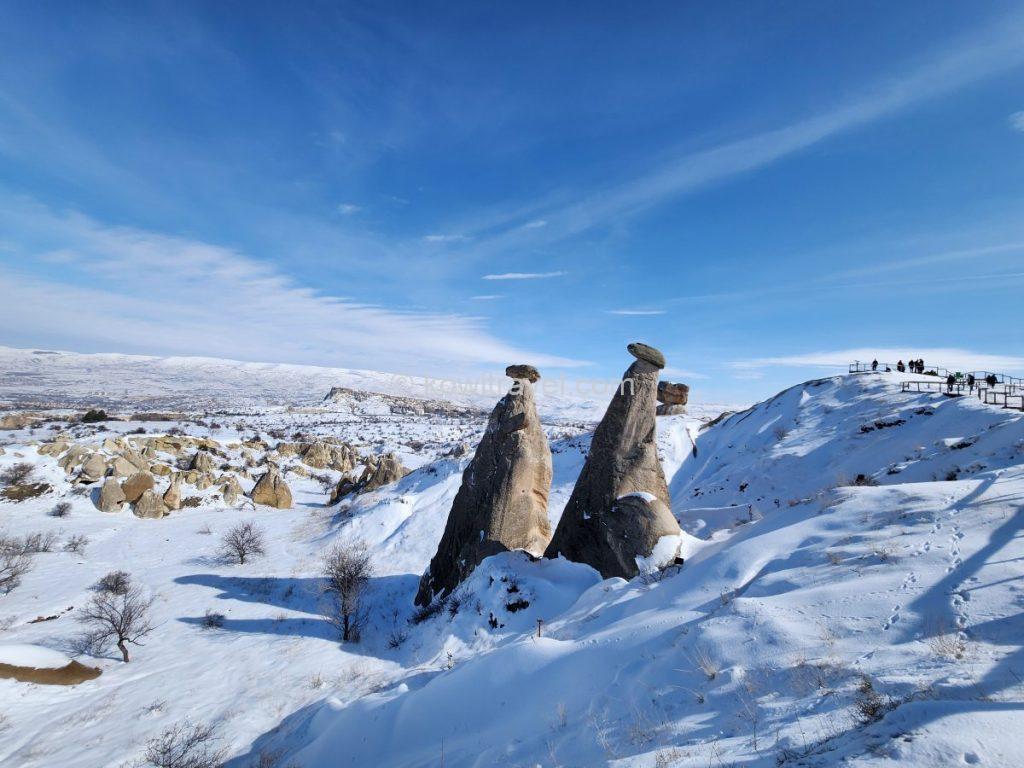
A winter view of the “Three Beauties”—three mushroom-shaped rock formations standing side-by-side as the most famous symbol of Ürgüp—and the mysterious, sprawling volcanic tuff landscape surrounding them.
It takes about 10–12 minutes (approx. 6.5 km) by car from the center of Göreme. The observatory and parking lot are well-situated right next to the road, offering excellent access. When planning your travel itinerary, placing this stop on the way back to Göreme after visiting Derinkuyu is highly efficient for saving time.
Geologically, the soft white tuff volcanic ash layer at the bottom eroded easily due to wind and rain, while the dark, hard basalt layer at the top withstood the erosion and remained intact, maintaining a unique shape that looks like a ‘mushroom wearing a hat’ or a ‘person wearing a cloak.’
Having undergone differential erosion over a long period, the appearance of the three rocks standing side-by-side is unique and beautiful, making it the most frequent feature on Cappadocia travel souvenirs and postcards.
It is said that three famous legends passed down locally are intertwined with these rocks.
- There is a tragic story of a princess whose father, the King of Ürgüp, could not forgive her for running away and having a child with a shepherd. He sent an army after them, and just before being captured, the princess prayed, “Please turn me into stone instead.” Heaven answered, turning the princess (center), her husband (left), and her child (right) instantly into stone rocks.
- Another folklore involves fairy princesses who fell in love with shepherds of the human world. They fled from the king’s anger and hardened into rocks.
- In the Western world, it is often compared to the image of the ‘Charites’ (The Three Graces), who symbolize beauty and elegance in Greek mythology.
The spectacle of mushroom rocks covered in soft white snow and the massive canyon burning red and golden under the setting sun was truly magnificent. We could even clearly view the giant silhouette of Mount Erciyes piercing through the clouds far across the horizon.


A panoramic view of the massive valley straddling the border between Ürgüp and Göreme, seen from the observation deck and parking area.
If it weren’t for a car rental trip, we would have missed this leisure, a moment for which we felt incredibly grateful.
(Photo: Silhouette of the Erciyes snow mountain across the horizon and volcanic terrains)
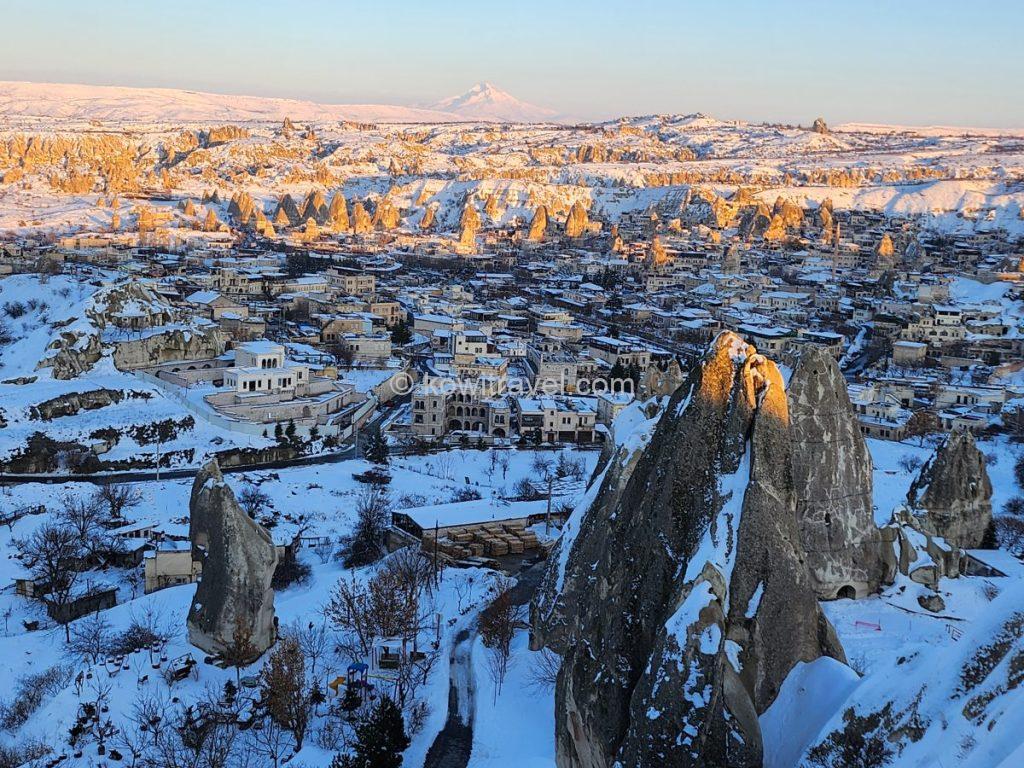
As the afternoon passes 4:00 PM, the low-hanging winter sunlight strikes the snow-covered cliffs, creating a magnificent panorama tinged with hues of red and gold.
3) UNESCO World Heritage Site: Göreme Open Air Museum and the Dark Church
The UNESCO World Heritage Site Göreme Open Air Museum, which we visited on our third day in Cappadocia, was the home of ancient Christians who protected their faith by carving out rooms tier by tier into barren rock mountains.


Signage and the official price list at the ticket booth of the Göreme Open Air Museum.
It is a place where dozens of monasteries and churches, carved into rock mountains by Christians who hid to escape persecution from Rome and Islam from the 4th to the 11th centuries, are gathered.
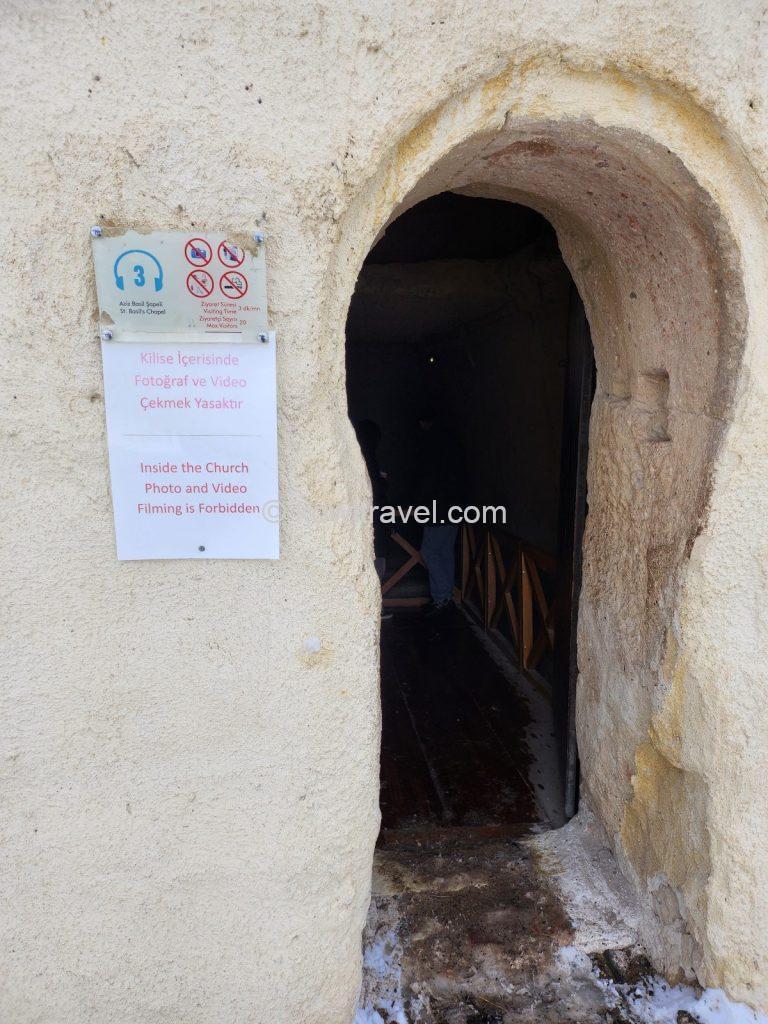
The arched entrance to St. Basil’s Chapel, located at the museum’s entrance.


A rock formation housing cave churches—a key attraction within the museum. It served as a living space for Cappadocia’s early settlers; the interior of this massive rock, standing as tall as a six- or seven-story building, was carved out to create fully functional areas such as a dining hall, kitchen, bedrooms, and a church.
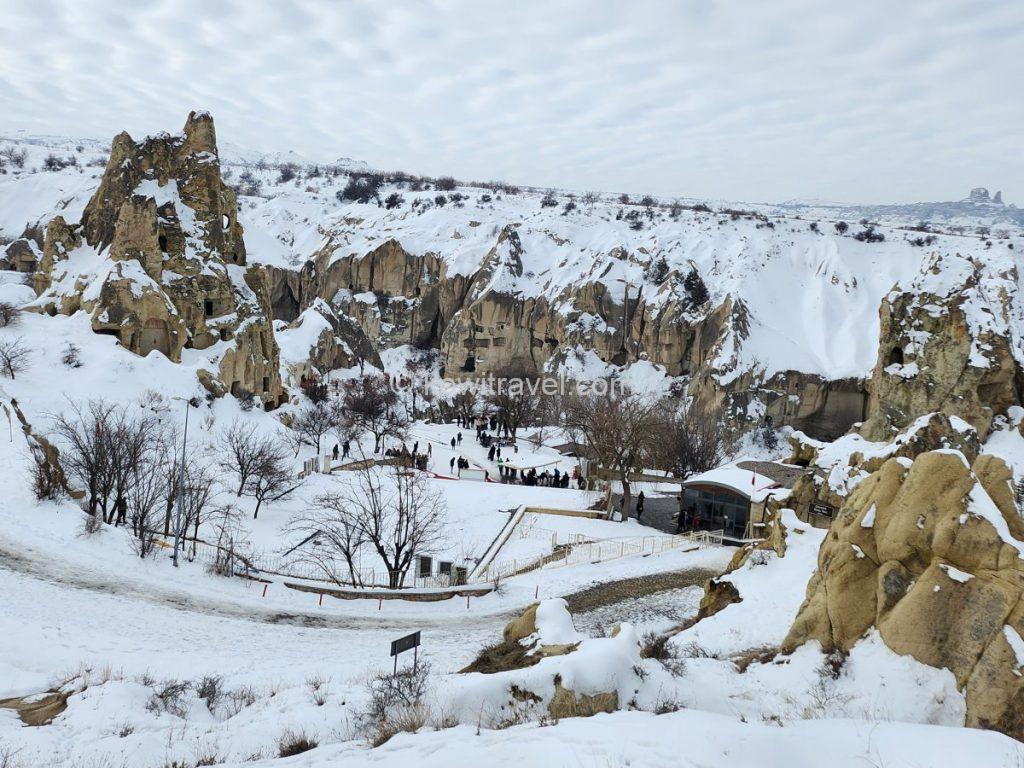
A panoramic view from the hill at the entrance of the open-air museum. The snow-covered valley in winter creates a serene, mystical atmosphere, as if time itself has stood still.
Stepping inside the rock caves allows you to see frescoes in an excellent state of preservation. In particular, the ‘Last Supper’ fresco inside the ‘Dark Church’ was so vivid and sophisticated that it was hard to believe hundreds of years had passed, sending chills of awe through my entire body.

The interior of the “Dark Church”, which boasts the best-preserved frescoes in all of Cappadocia. The arched wall shown in the photo features a vivid fresco of “The Last Supper,” one of the most famous scenes in Christian history.


A dining area where monks once gathered for meals. The long, integrated stone table and benches, carved directly from the rock, are striking. On the wall at the far end of the table, a fresco depicting the life of Jesus or a biblical scene remains preserved, bearing the marks of time.
4) Fairy Chimneys and the Unique Frame View of Pasabag Valley
Following that, we visited Pasabag Valley, a cluster of mushroom rocks where the most bizarre and beautiful mushroom-shaped formations are concentrated among Cappadocia’s characteristic rock formations, commonly referred to as ‘fairy chimneys.’
Because monks used to perform solitary spiritual practices high atop these rocks in the past, it is also called the ‘Monks Valley.’ The cluster of mushroom rocks (fairy chimneys) that look like they are wearing hats creates a spectacular sight.
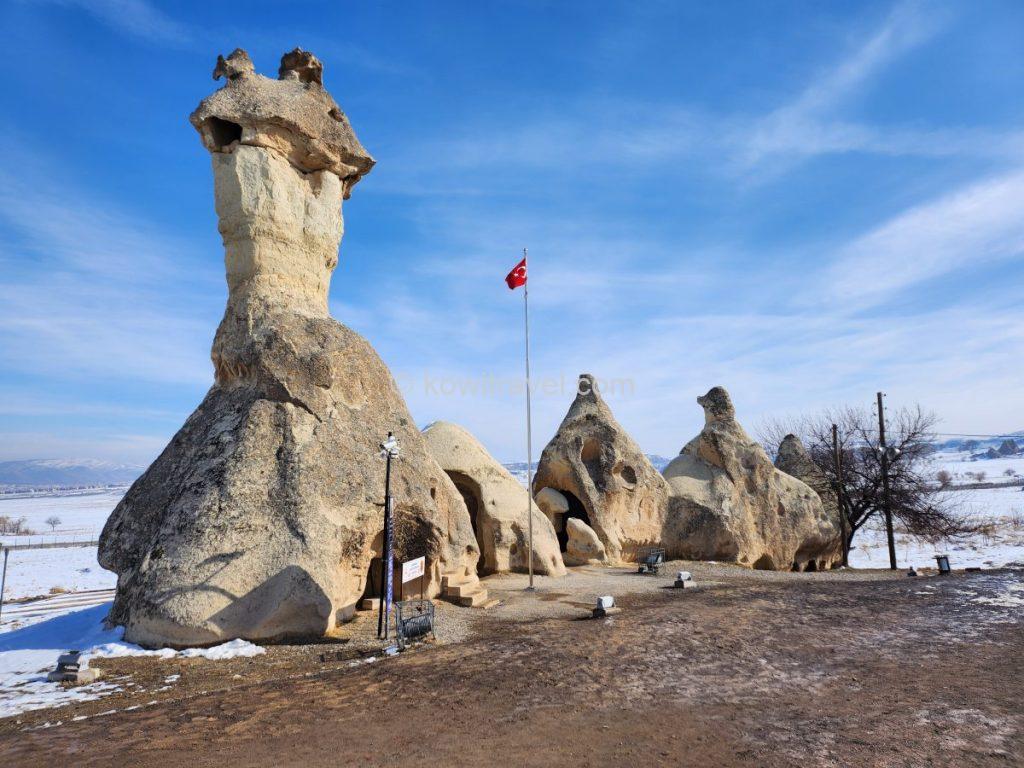
Pasabag’s most iconic rock formations—massive pillars that split into two or three “heads” at the top. It is a popular photo spot.
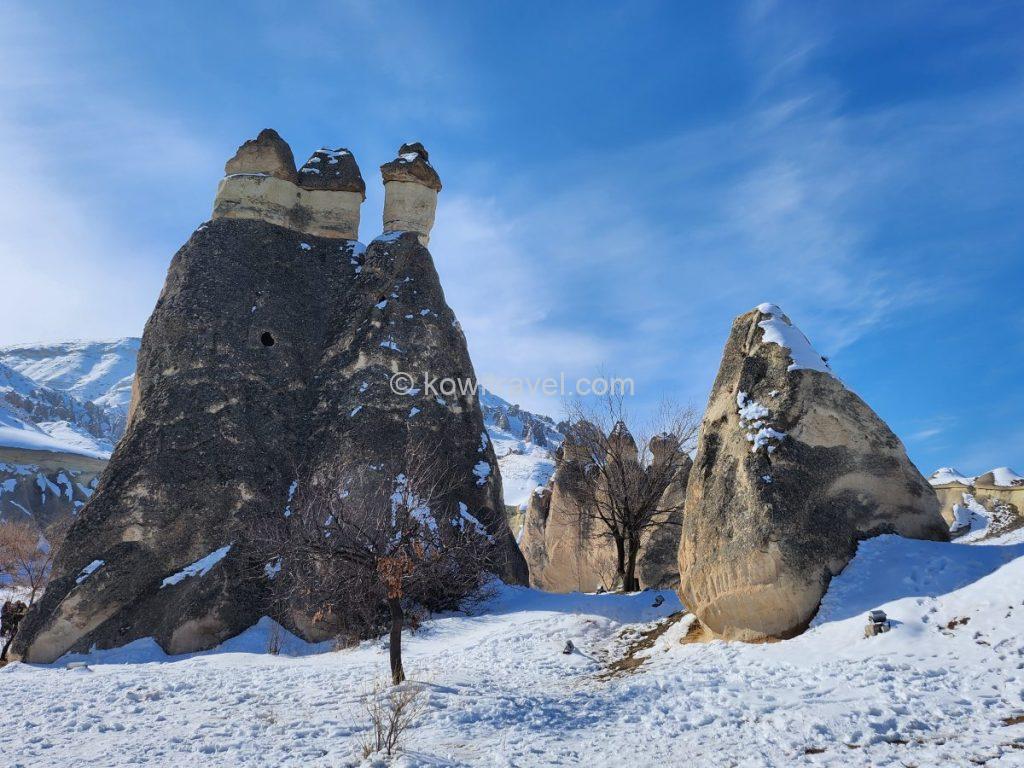
Clusters of numerous “mushroom rocks” (fairy chimneys)—which look as though they are wearing hats—create the illusion of stepping into a fairy-tale village.


A view of Pasabag Valley and the snow-covered plaza. The contrast between the white snow and the blue winter sky evokes the feeling of a scene from a fairy tale.

A close-up of the “hat” (cap) rock at the summit, photographed from beneath the mushroom-shaped rock. The weathered, rough texture of the tuff and the distinct boundary between the rock and the hard basalt layer resting atop it are clearly visible.
In particular, the ‘Frame View,’ capturing the mushroom rocks outside using a window hole inside a cave room as a frame, is the ultimate photo zone for getting the shot of a lifetime.
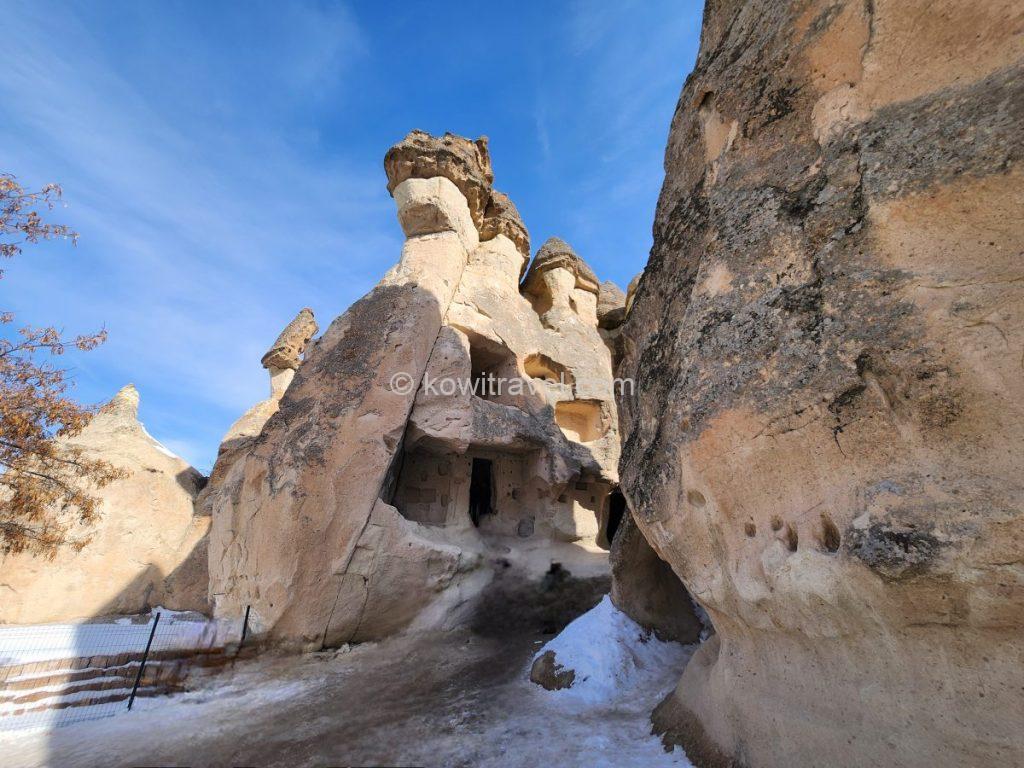
Entrances and windows of cave dwellings (or hermitages) carved by hand into the base of the massive mushroom-shaped rock. These spaces served as retreats where ancient Christian monks practiced their faith in seclusion from the outside world.
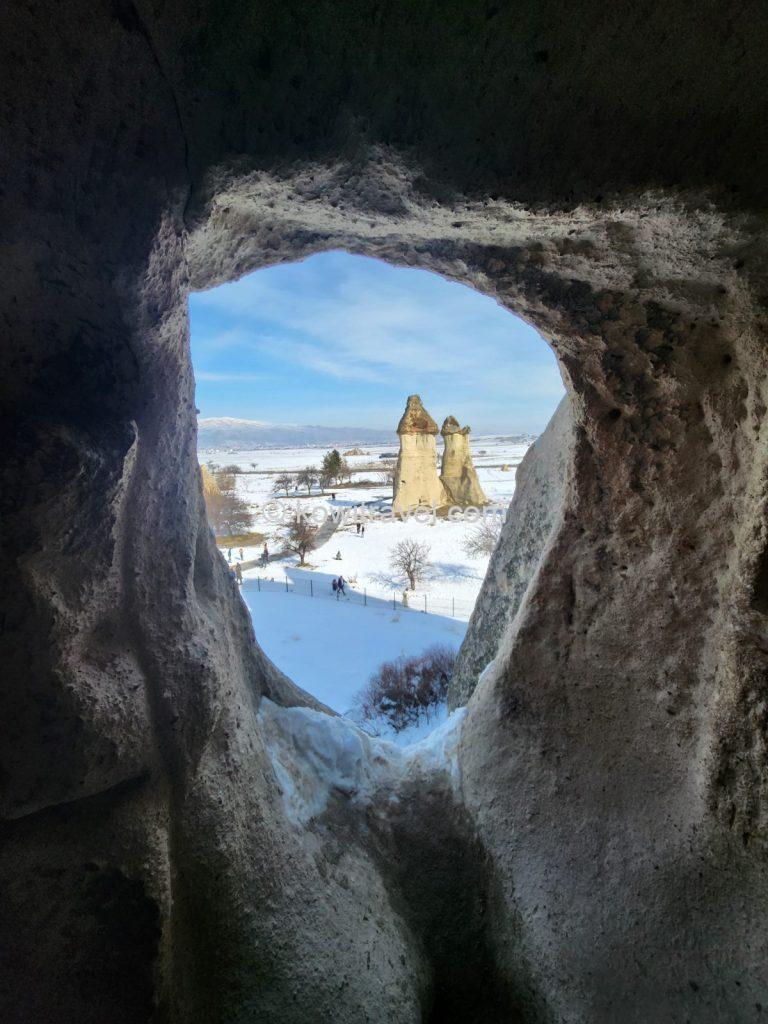
A view looking out through a window inside one of the cave dwellings. The oval-shaped opening acts as a natural frame, creating a picturesque scene of other mushroom-shaped rocks rising solitarily from the snow-covered white plains.
We were also able to see firsthand the traces of the massive rock hole where Saint Simeon lived in seclusion and practiced spiritual devotion for his entire life during the 5th century.
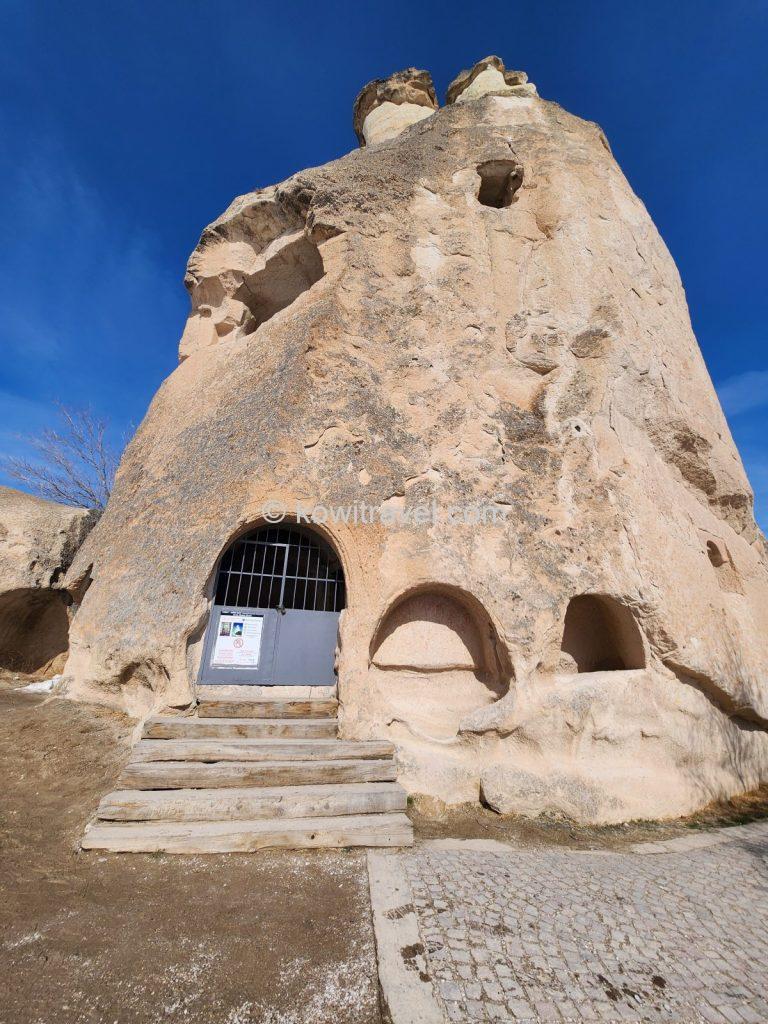
The rock formation housing “St. Simeon’s Hermitage,” the most historically significant site in Pasabag Valley. Shown here are the entrance, secured by an iron gate, and the accompanying steps.
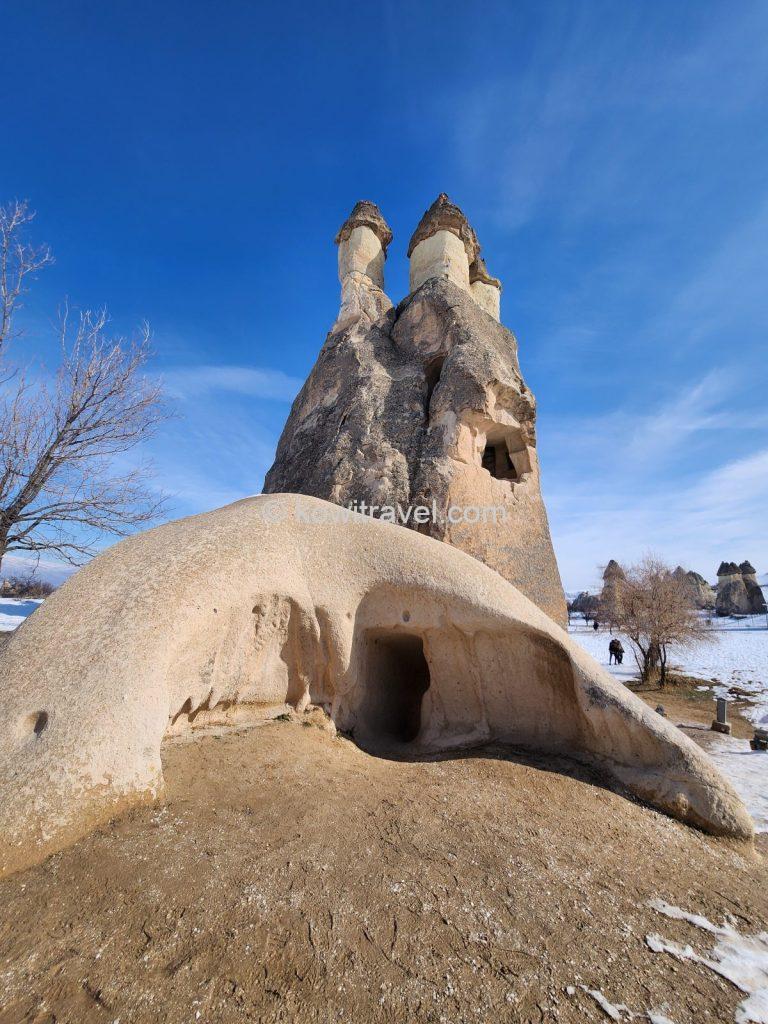
Openings leading into the interior of the rock formation; these served as entry points for the monastery where Christian monks once moved up and down via ladders, praying in isolation.
5) Zelve Open Air Museum with Its Raw Charm
Right next to Pasabag Valley lies the Zelve Open Air Museum, a massive cave village that served not only as a religious refuge for Christians but was also actually inhabited by people until the 1950s.
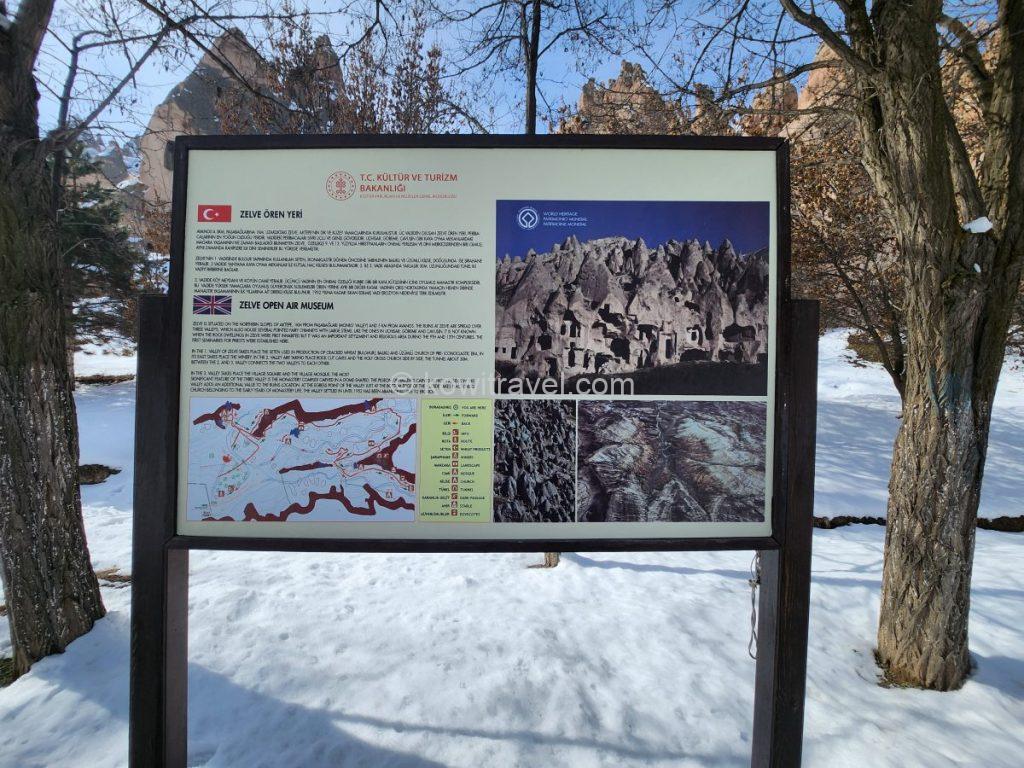
The official information board at the entrance to the Zelve Open Air Museum. It provides detailed information—in both Turkish and English—about the history and layout of Zelve Valley, along with a map of the walking trails.
Boasting a scale much grander than Göreme and carrying a raw charm, this valley resembles a giant cave apartment complex where actual residents lived until the 1950s. Along three massive valleys, churches, residential areas, flour mills, and pigeon houses are intertwined like a spiderweb across the entire rock mountain, offering a sense of the unrefined, desolate, and grand scale of nature far exceeding that of Göreme.
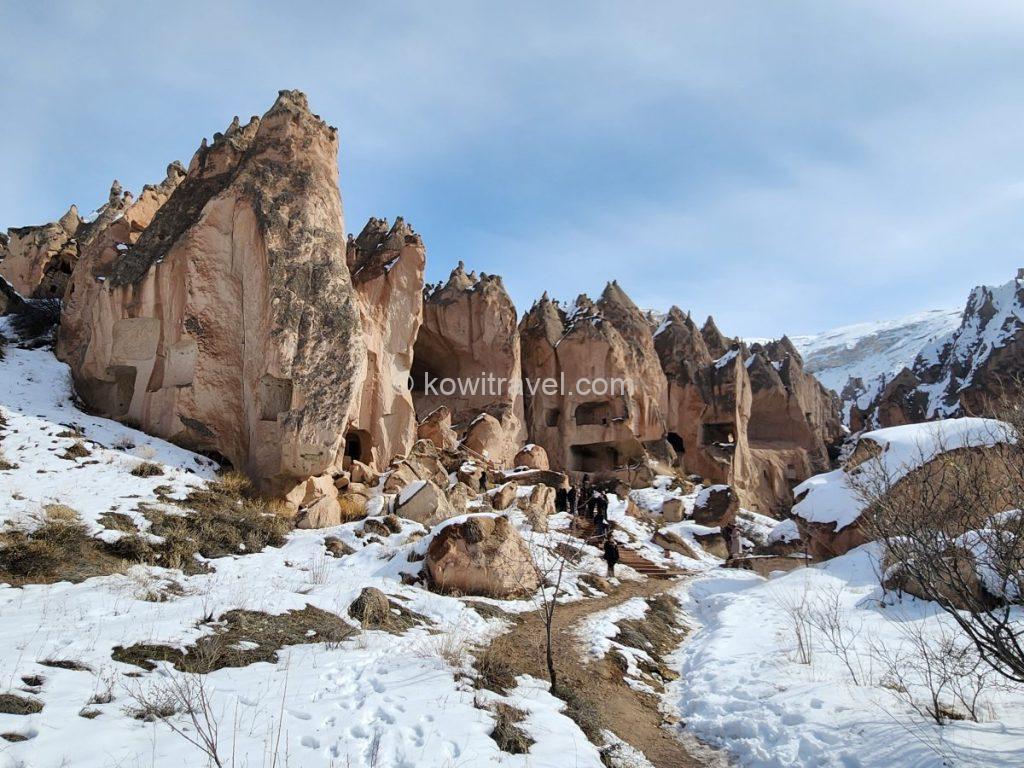
A panoramic view of the cliff dwellings and walking trails in Zelve Valley. Across the sheer rock faces of the valley—which consists of three massive ravines—numerous openings are densely carved into the stone, marking spaces that once served as homes, churches, and storage areas.


A view of the cliff dwellings from a distance and the three-dimensional layout of the entire Zelve village seen from above the valley
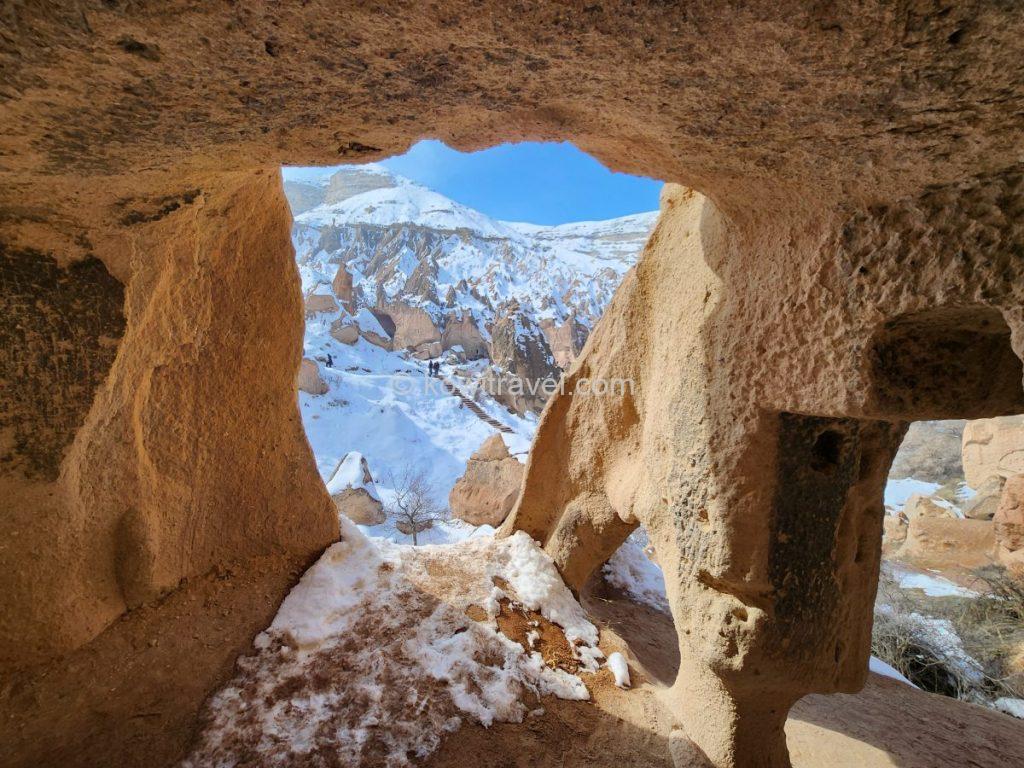
A view of Zelve Valley from inside a cave


The entrance to a cave dwelling carved into a massive rock cliff and an arched passageway inside the cave
6) Uçhisar Castle (Uçhisar Kalesi)
It is said that ‘Uçhisar’ means ‘third fortress’ or ‘border castle’ in Turkish. True to its name, it is a massive natural rock mountain fortress towering at the highest elevation in Cappadocia, about 1,300 meters above sea level.
It is said to have been used as a military fortress from the ancient Roman and Byzantine Empire eras through the Seljuk Turk period.
While it looks like a single massive rock mountain from the outside, the interior is carved out densely like a honeycomb, creating numerous rooms, passages, warehouses, and even residential spaces and shelters—a surface version of an ancient underground city.
It is said that when enemies invaded, people hid inside the rock, locked the doors, and defended themselves.
Because it has the highest elevation in all of Cappadocia, climbing to the top of the fortress opens up an unobstructed 360-degree panoramic view extending over the Göreme Valley, Pigeon Valley, and the villages.
It is particularly famous as a sunset and sunrise spot where travelers from all over the world gather to watch the spectacular sight of hundreds of hot air balloons rising at dawn or the landscape turning crimson at sunset.
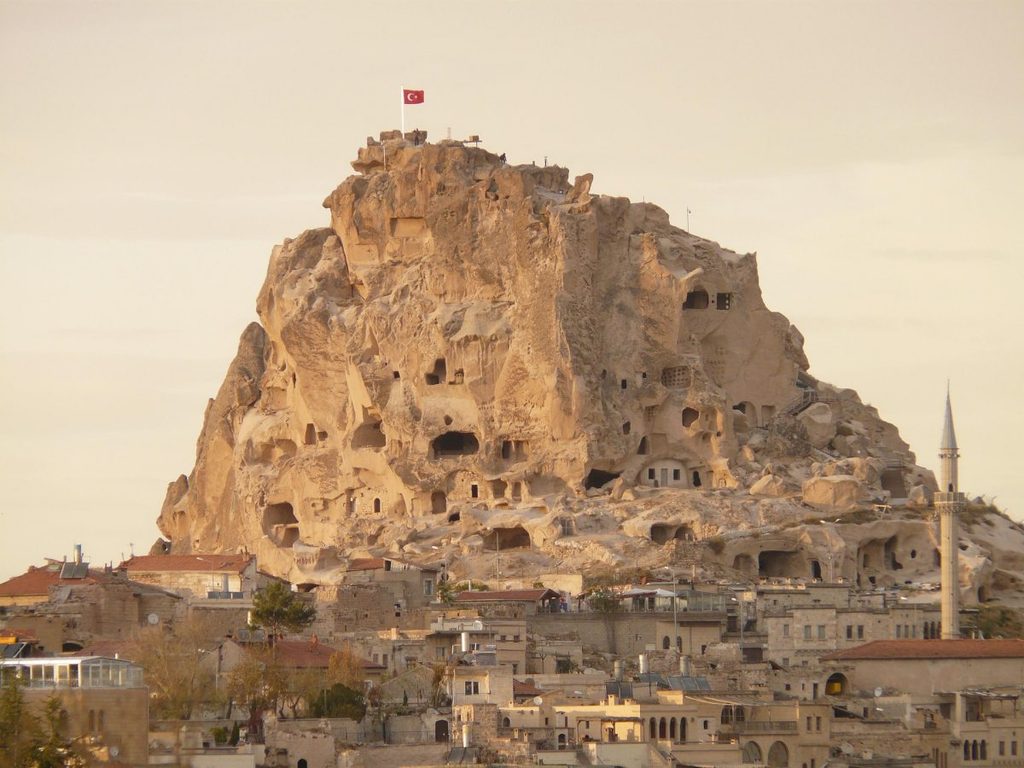
Uçhisar Castle bathed in a soft golden glow at sunset
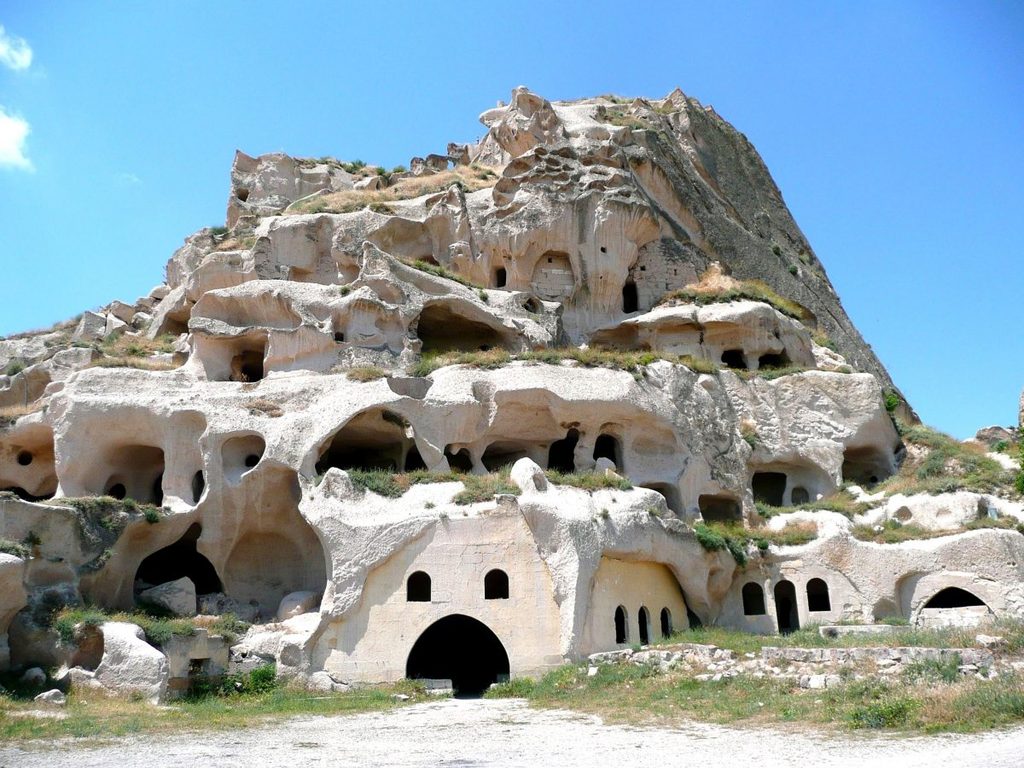
Cave dwellings located at the base of the citadel
7) Sunset Point
Cappadocia’s Sunset Point is an observatory usually located on the ridge where Red Valley and Rose Valley meet. It is the most famous sunset spot in Cappadocia, offering a ‘spectacle of a crimson sunset’ where the white tuff rocks seem to burn, changing from pink to red depending on the angle of the sunlight.
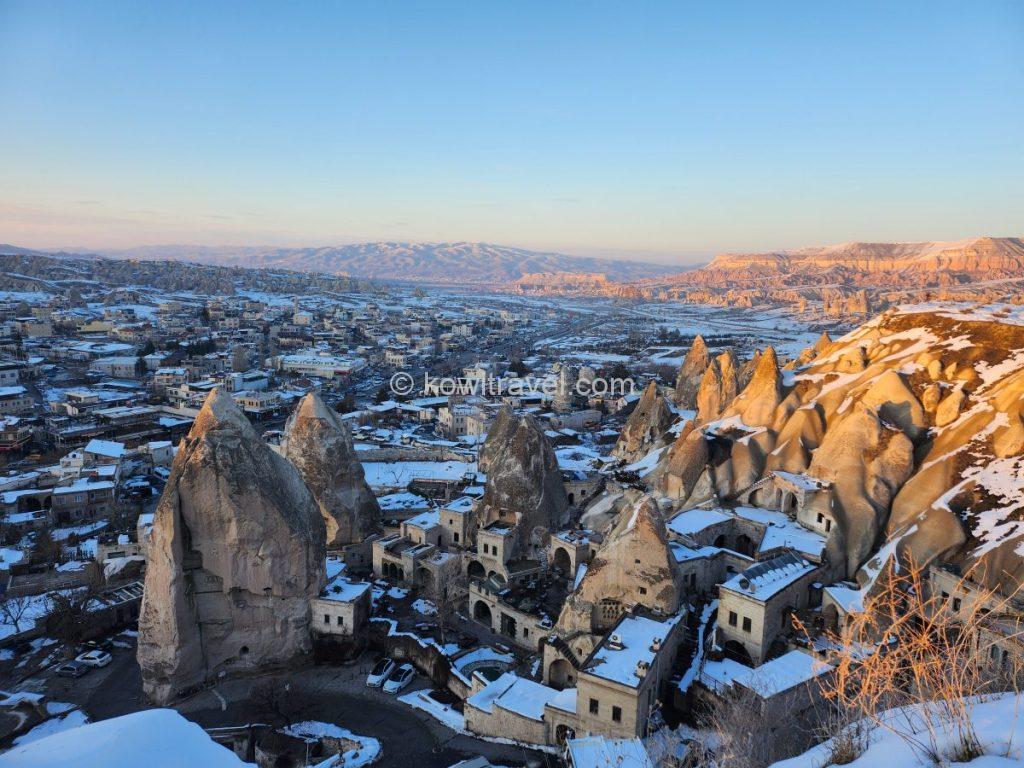
A view of the village of Göreme and Rose Valley (in the background to the right) from a sunset viewpoint in Cappadocia.
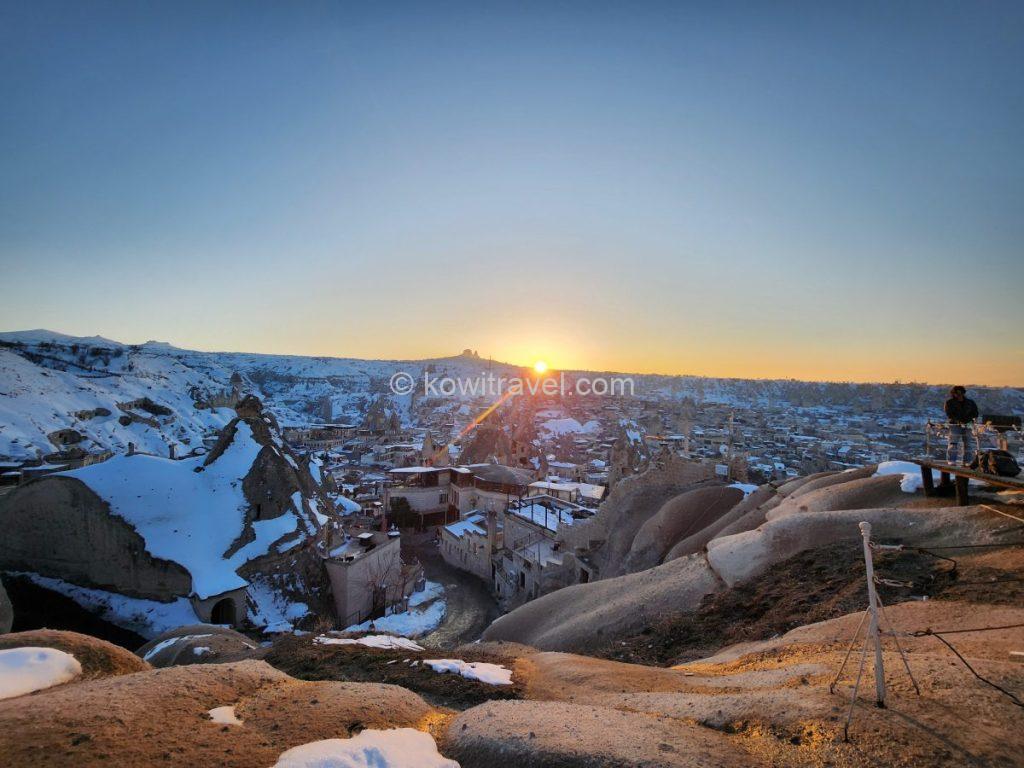
A breathtaking sunset moment viewed head-on from the sunset point; the sun hangs just above the horizon, radiating an intense flare, while the silhouette of the Uchisar Castle looms tall over a distant, snow-capped ridge.
Because Red Valley consists of sandstone and volcanic ash sedimentary layers with high iron content, it appears clay-colored or beige during the day.
However, when the golden light hitting at a 45-degree angle begins to shine 1–2 hours before sunset, it instantly stains into a deep pink and brilliant crimson, giving the feeling of being on an unrealistic planet.
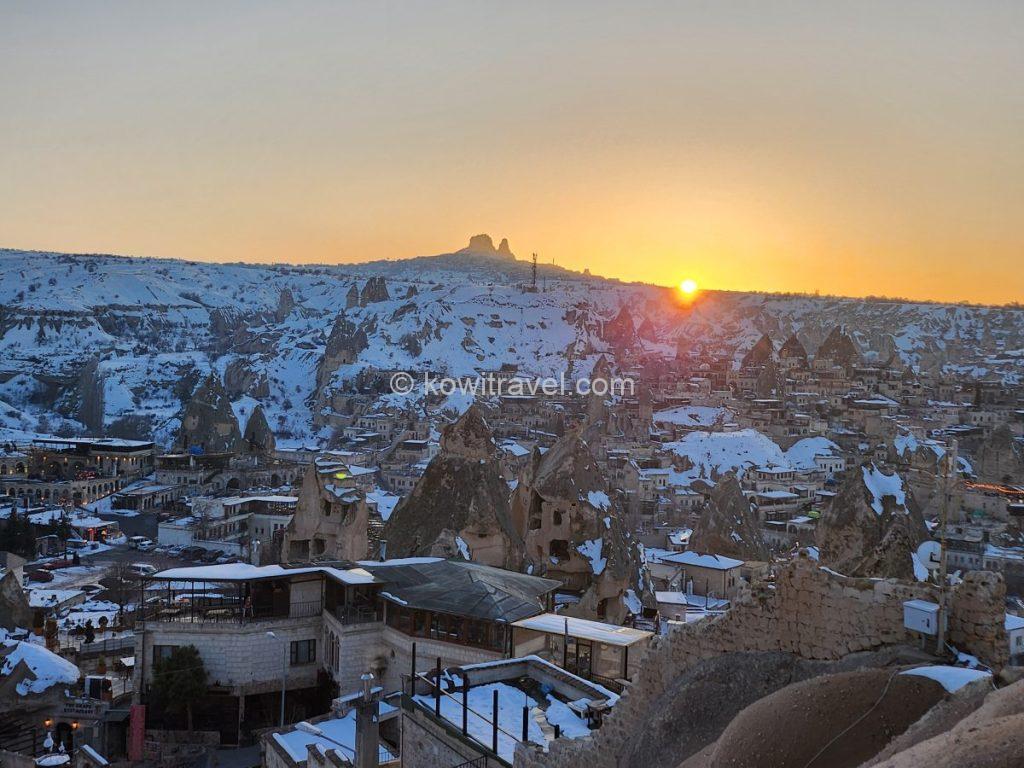
The scene captures a peaceful, serene atmosphere as the village of Göreme—nestled cozily beneath the distant silhouette of Uchisar Castle—is bathed in the golden glow of the sunset.

The rocky cliffs of Rose Valley glow a brilliant, deep red as they catch the direct light of the setting sun. The striking contrast between the white snow and the red rock strata highlights the unique geological mystique of Cappadocia.
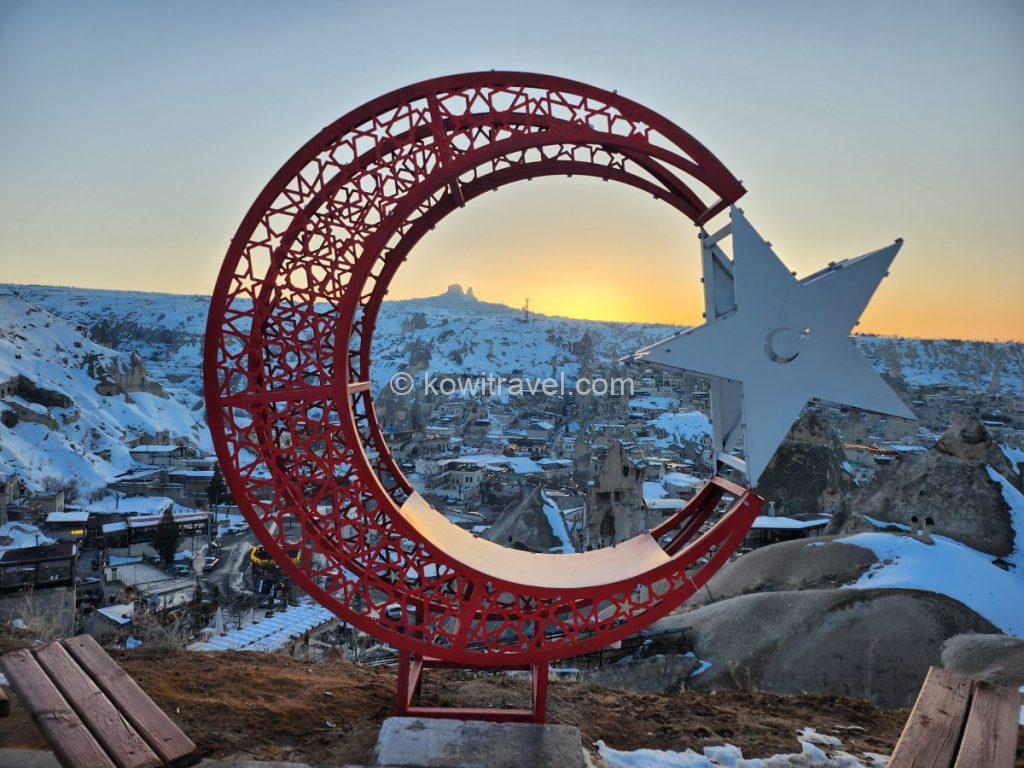
A sunset view framed behind the red metal sculpture featuring the Turkish flag design—a signature photo spot at the Cappadocia sunset viewpoint.
If you walk up purely via a hiking trek from the lower side (from the direction of Çavuşin or Göreme), the admission is free. However, if you enter through the upper sunset observatory ticket office (vehicle access road), please note that a fee is charged for parking and admission.
- Tip: I recommend arriving at least 1 hour to 1 hour 30 minutes before the scheduled sunset time. Rather than the moment the sun completely drops below the horizon, the ‘Golden Hour’ during the 40 minutes right before it sets—when the golden light shines diagonally onto the rocks—is far more beautiful.
- Furthermore, due to the high-altitude basin terrain characteristics, Cappadocia’s temperature drops rapidly and bitter winds blow the moment the sun sets. Therefore, if you visit during the winter, it is advisable to prepare a padded jacket, a scarf, and hot packs. Since the ground is slippery, you should wear sneakers or hiking shoes for safety.
4. A 2-Night Stay in Ürgüp
After completing a fulfilling 3-night stay in Çavuşin, we moved our accommodation to the Ürgüp area, where the daily life of locals can be felt, to enjoy 2 more nights.

A night view of the town of Ürgüp, seen from the Temenni Tepesi observation point.
Unlike Göreme, where you experience Cappadocia’s rough and vast wilderness with your entire body, Ürgüp is a historical city possessing a dignified and elegant charm—a place that feels like a comma in your Cappadocia journey.
As one of the first places in Cappadocia to flourish in a urban form, Ürgüp is a holy land of Christian history where early Christians carved out rocks to build churches and hiding spots to escape Roman persecution.
It is also a highly meaningful city religiously, being the place where Saint John the Russian passed away.
It was also a place where numerous Greeks and Turks coexisted peacefully until the Greek-Turkish population exchange in 1923.
Walking through the city center and outskirts, you can easily encounter not only typical Ottoman styles but also beautiful and sophisticated Greek-style stone architectures, giving off a very exotic atmosphere.
Furthermore, it features a terrain where gentle hills and wide-open flatlands harmonize, and the roads are well-maintained, resulting in far less fatigue when driving a rental car or strolling through the town on foot compared to Göreme. It is a lively local city embedded with the actual lives of local residents.
👉 Recommended Places in Ürgüp
1) Pancarlık Valley
When thinking of valleys in Cappadocia, many travelers primarily recall Red Valley or Pigeon Valley near Göreme. However, if you stay at an accommodation in Ürgüp, I highly recommend exploring ‘Pancarlık Valley,’ located just a 5-minute drive south.
Compared to other famous tourist destinations like Pasabag, Pancarlık Valley is renowned for its cone-shaped, pointed rocks clustered closely together in one place. It features a structure where a massive horizontal sedimentary fault cliff stands like a folding screen behind it.
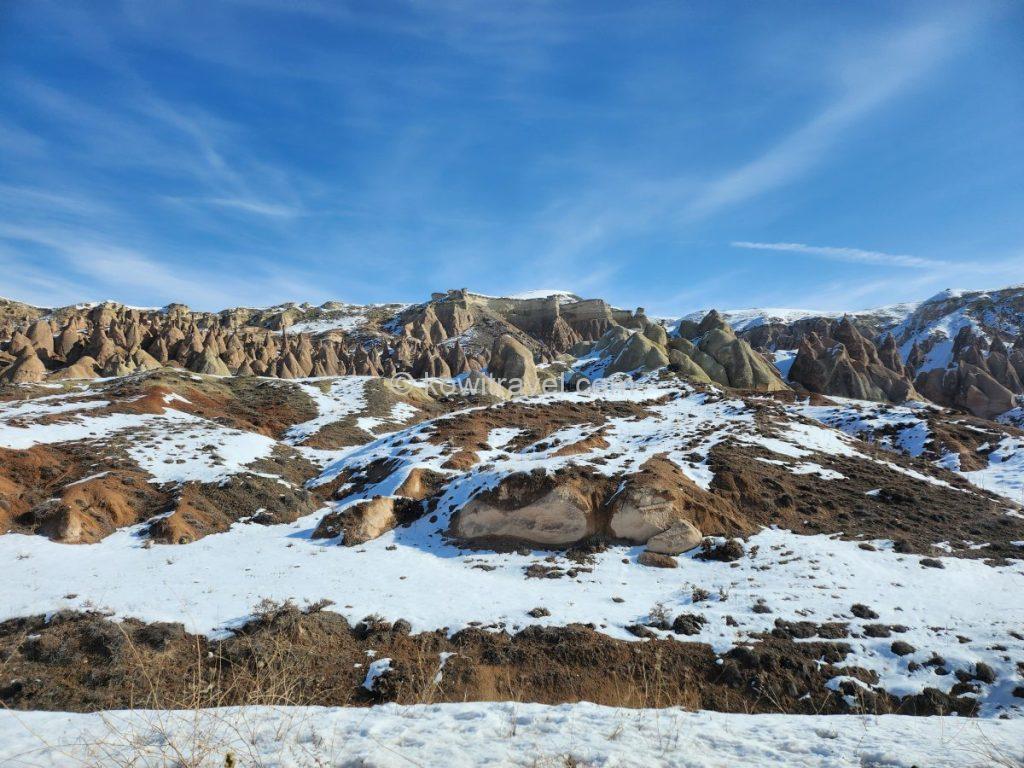
The unique geological formations and landscape of Pancarlık Valley.


A cluster of the valley’s characteristic gentle, rounded, cone-shaped rock formations standing closely together along the hillside.
Since it is a hidden local gem rarely reached by group package tours, there were few tourists when we visited, allowing us to quietly appreciate the pure white snowfield untouched by anyone and the serene nature provided by the giant fault cliff.
In particular, this place connects directly with a gentle uphill road facing an open empty parking lot that slopes down smoothly on the opposite side of the parking area. This makes the itinerary perfect for exploring the valley and returning to Ürgüp town to continue exploring local restaurants.
2) Night View from Temenni Tepesi (Wish Hill)
Temenni Tepesi, referred to as the ‘Wish Hill,’ is a massive rock hill rising right in the middle of Ürgüp town. Towering at about 1,140 meters above sea level and rising about 80 meters from the surrounding flat city ground, it is a landmark that can be easily seen from anywhere in Ürgüp town.
A fairytale-like moment just after sunset—during the “blue hour”—as houses and hotels, blanketed in white snow, begin to light up one by one with warm, inviting glows.
It is said that ‘Temenni’ means ‘wish,’ ‘prayer,’ or ‘sacred place’ in ancient Sumerian and Turkish. A tradition of making wishes while tying pieces of cloth to the tomb atop this hill has been passed down since ancient times, giving it the name ‘Temenni Tepesi (Wish Hill).’ To ascend to the observatory, you pass through a unique tunnel carved through the rock, measuring about 80–100 meters in length.


A night view of Ürgüp seen from the open observation deck at the summit of Temenni Tepesi.
At the summit of the hill sits a monumental tomb (Kümbet) built in 1288 to honor Izzeddin Kilij Arslan IV, a sultan of the Rum Seljuk Empire. The summit is famous as a sunset spot offering a single-view grasp of the Ürgüp town landscape, as well as Cappadocia’s characteristic rock formations (fairy chimneys) and valleys.
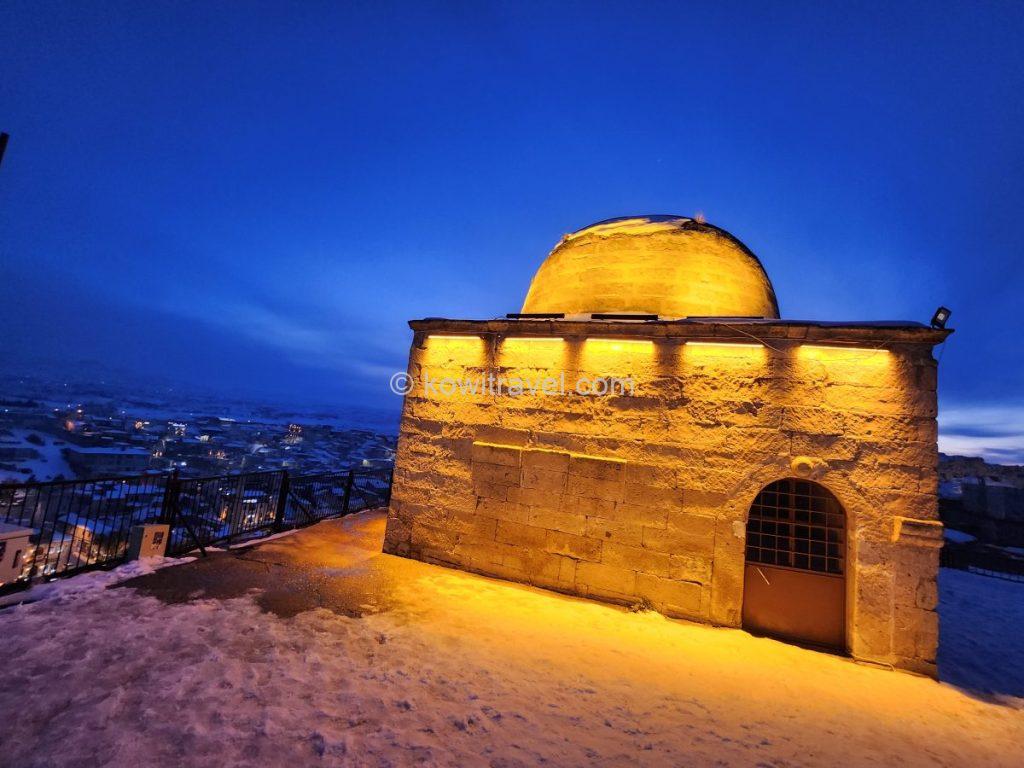
A historic site known as the tomb of Kılıçarslan IV, a sultan of the Rum Seljuk Empire.
Standing at the summit, a panoramic night view of Ürgüp town filled with cozy and warm lights unfolds beneath your feet, presenting a vibe different from the fairy-tale town atmosphere of Göreme. Walking up the frozen snowy hill was completely worth the effort—it was a perfect finale to our Cappadocia trip.
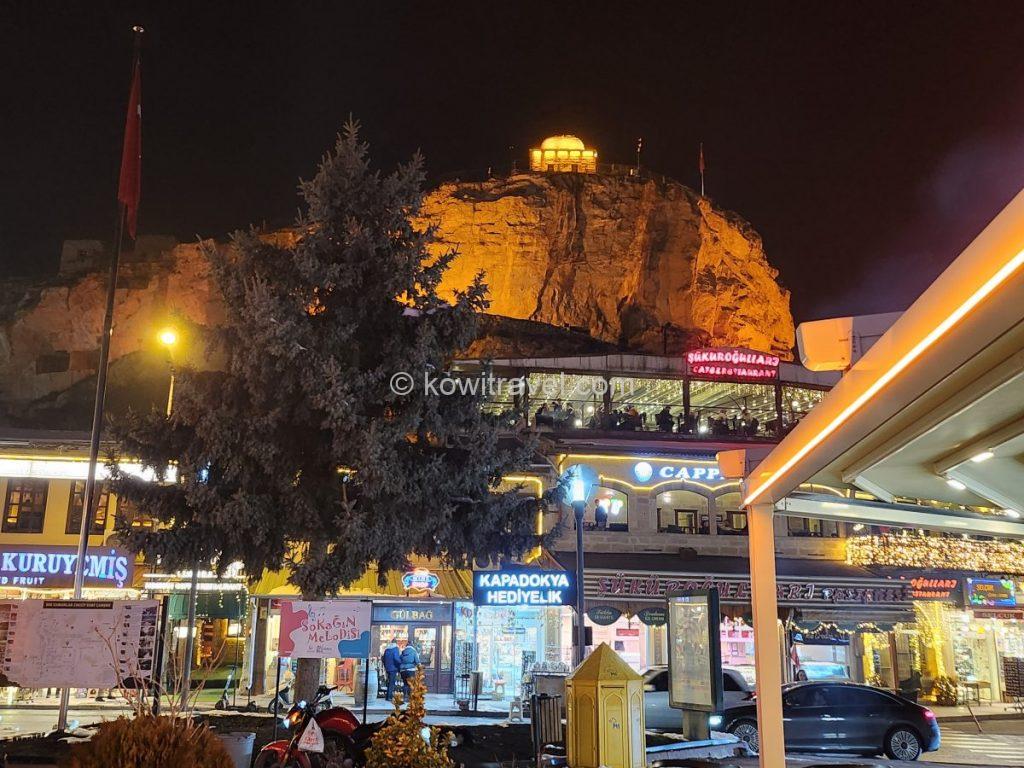
A night view of Temenni Tepesi looking up from the center of Ürgüp.
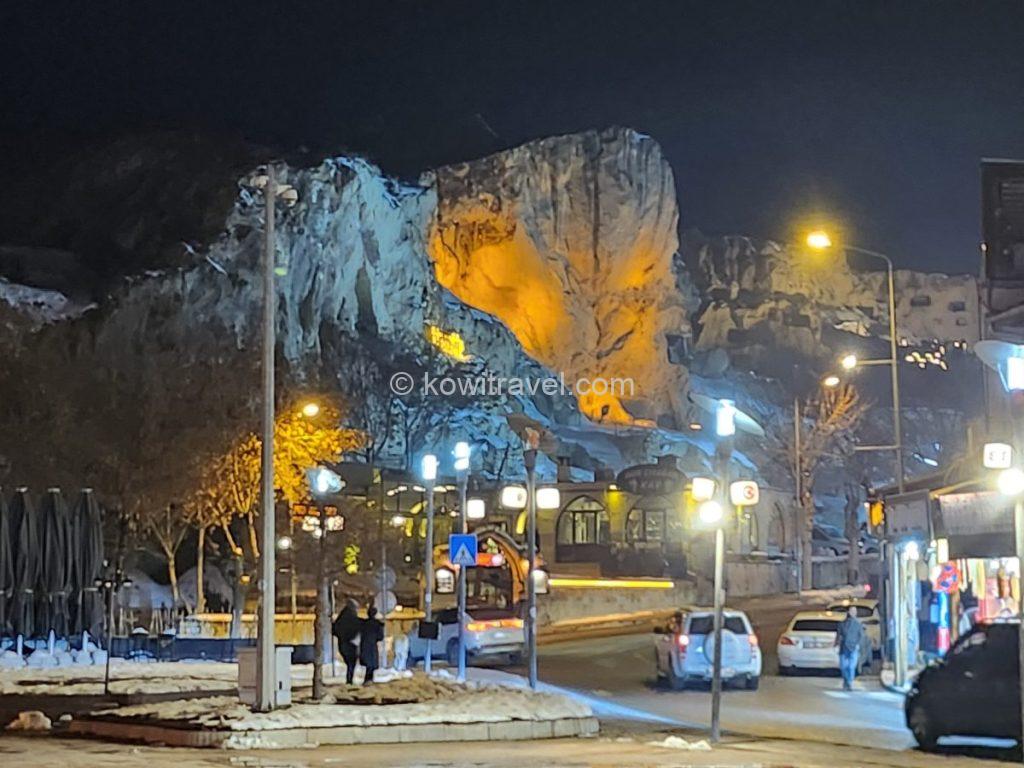
A night view of a unique rock-face street in downtown Ürgüp; soft yellow lights illuminating the recesses in the rock create an atmosphere that is both distinctive and cozy.
5. An Anxious Wait, and the Hot Air Balloon Tour Cancellation
In fact, one of the reasons we stayed in Cappadocia for a long time was to ride the hot air balloon. The day after arriving in Cappadocia, we visited a balloon tour agency that had excellent ratings from customers, received detailed guidance, and made a reservation.
With an anxious heart, we frequently checked the official website of BalloonScanner, a real-time hot air balloon comparison and inquiry platform for Cappadocia, on our smartphones every day. Unkindly, however, the balloons did not fly, and each day was a continuation of anxiety and waiting.
On the evening of our 4th day of travel, when we had almost given up, we finally received a joyful notice from the agency we booked with, saying, “It looks like the balloons will finally fly tomorrow morning!”
With fluttering hearts, we went to bed early, and at 4 AM the next morning, we boarded the vehicle that came to pick us up in front of our Ürgüp accommodation.
In addition to us, the vehicle picked up about 4 other travel teams, stopping at each lodging one by one, before arriving in front of the balloon office in Göreme town around 6 AM.
After receiving instructions to wait inside the car, we waited for about 30–40 minutes while eating light snacks provided by the travel agency.
With an anxious heart, we kept refreshing the real-time balloon confirmation app on our smartphones to watch. However, the green light indicating flight availability suddenly flipped to red, which signified a flight ban.
At that moment, a gut feeling flashed through me: ‘Ah, we came all this way cutting through the early morning wind, but it’s not happening today either.’
Soon after, the guide approached and delivered the thunderbolt news that the flight was ultimately canceled due to the wind. Because it came after such a long period of waiting, how hollow that moment felt…
The most critical and decisive factor that determines a hot air balloon cancellation is indeed the ‘wind speed.’
This is because hot air balloons have no propulsion and only adjust their altitude up and down, relying entirely on the wind to move. In particular, safe flights are permitted only in gentle winds of 11 km/h or less. Even if the ground is calm, if the wind speed hundreds of meters above ground exceeds the standard, a red flag is dropped simultaneously on all balloons on standby.
Above all, it is difficult to stand the balloon envelope upright, and it can lead to landing accidents where the balloon crashes into the ground or rocks at tens of kilometers per hour. Therefore, because safety is the top priority, the Civil Aviation Directorate issued a decisive cancellation order right before boarding.
We kept checking the website and app every day for 5 days, hoping for a glimmer of hope, but we couldn’t extend our Cappadocia schedule indefinitely just for the balloon. Ultimately, with hearts full of regret, we had no choice but to give up on the balloon tour.
Although we felt hollow because the balloon was canceled, even that became a intense memory of our winter Cappadocia trip.
For your reference, below are the website and mobile app that inform you of the real-time daily approval status from the Turkish Directorate General of Civil Aviation (SHGM) starting from 4 AM, as well as the remaining slots by date, so it will be helpful to take note.
6. Concluding the Journey
Starting from Antalya on the Mediterranean coast, cutting through the snow-covered inland of Turkey, the episode of feeling completely devastated after losing the car key in Derinkuyu only to be saved by a miracle-like kindness, and the regret of facing the balloon cancellation amidst the tension of 4 AM—all of these will be kept as precious memories experienced during our Cappadocia trip.
This 6-day/5-night Cappadocia trip will be remembered as an unforgettable experience that allowed us to experience not only the wonders of nature but also the warm purity of humans and the dynamic nature characteristic of a car rental road trip with our entire bodies.
“Watch the vivid video of our Cappadocia journey on YouTube!”
(Please turn on YouTube CC(Subtitles) and select your language in settings!)
7. To the Next Destination, ‘Eskişehir’!
Originally, our plan after completing all Cappadocia itineraries was to move to Safranbolu, a historic village located to the north, or Bolu, famous for its snow flowers. However, due to climate change, forecasts kept warning that heavy blizzards were continuously pouring over the northern region.
As we had to drive the rental car ourselves, we thought it would be reckless to insist on mountain roads covered in heavy snow for safety reasons. Ultimately, for our safety, we abruptly changed our destination to ‘Eskişehir.’
Since the final destination of our Turkey tour after Bolu was Istanbul anyway, whether we went via Bolu or via Eskişehir didn’t make a big difference in the overall route. Rather, the national highway going up from Eskişehir to Istanbul was shorter in distance and had much better road conditions, making it far safer for rental car travelers like us and a necessary yet wise adjustment given the circumstances.
[Read Part 5 of our 1-Month Turkey Road Trip : Antalya Trip 3-Day/2-Night ]
“This post includes affiliate marketing links. If you make a accommodation booking through these links, I may earn a small commission at no additional cost to you.”