![[Türkiye 1-Month Rental car Road Trip] #4. Denizli and Pamukkale Travel Guide : Recommended Accommodations & Must-Visit Itinerary](https://kowitravel.com/wp-content/uploads/2026/09/Denizli-travel-21-1.jpg?v=1789205662)
#4. A Complete Guide to Denizli and Pamukkale: Where Myth, History, and Thermal Springs Intersect
The fourth chapter of our 1-month road trip across Türkiye leads us to the southwestern region of the country, where we explored Denizli and Pamukkale—world-renowned destinations where breathtaking natural wonders seamlessly coexist with ancient Roman ruins.
Departing from Izmir, the most efficient route is to drive via Aydın toward Denizli by utilizing the well-maintained toll highways (O-31 and E87). The total driving distance spans approximately 240 km and takes about 2 hours and 30 minutes.
The roads are generally in excellent condition, making for a smooth and comfortable driving experience. We highly recommend stopping by the city of Aydın midway for a quick rest and a delicious local meal.
Situated in the inland basin of southwestern Türkiye, Denizli is a bustling metropolis with a population of approximately 650,000. Serving as the capital of Denizli Province, it is a thriving industrial hub famous for its textile and manufacturing sectors.
For international travelers, it effectively acts as the main gateway city to Pamukkale, located just 20 km to the north.
On the other hand, Pamukkale—which translates directly to “Cotton Castle” in Turkish—is a surreal geological wonder. Over thousands of years, calcium-rich thermal spring waters bubbling up from deep underground have cascaded down the hillside, cooling and depositing calcium carbonate to form brilliant white travertine terraces and striking emerald-hued pools.
Over the course of our memorable 3-day journey in Denizli and Pamukkale, we visited the fascinating historic ruins of Hierapolis, soaked in the soothing waters of Pamukkale, and experienced traditional Turkish bath culture called ‘Hammam’ at a premium thermal hotel.
Here is our curated summary of these unforgettable moments, packed with practical insider tips.
📌 Pamukkale and Hierapolis Travel Guide: Table of Contents
- 1. Recommended Accommodation in Denizli – Aydınoğlu Suites: A Cozy, Spacious Apartment Near Downtown Parking
- 2. Exploring Hierapolis & Pamukkale: A Self-Drive Ancient Thermal City Tour
- ① South Gate Entrance & Ticket Office
- ② The Frontinus Gate
- ③ The Agora and the Temple of Apollo
- ④ The Plutonion: The Mythological Gate to the Underworld
- ⑤ The Roman Theatre
- ⑥ The Antique Pool (Cleopatra’s Pool)
- ⑦ The Hierapolis Archaeology Museum
- ⑧ The Pamukkale Travertines: Nature’s Brilliant White “Cotton Castle”
- 3. A Day Pass Experience at Richmond Pamukkale Thermal Resort: Indoor/Outdoor Thermal Pools and a Heartwarming Traditional Turkish Hamam
- 4. Next Destination: Heading to Antalya, the Turquoise Pearl of the Mediterranean
1. Recommended Accommodation in Denizli – Aydınoğlu Suites: A Cozy, Spacious Apartment Near Downtown Parking
After a diligent drive from Izmir, we arrived in Denizli. Our cozy home for this 2-night 3-day journey was Aydınoğlu Suites (Aydınoğlu Apt. No.12), which we booked via Vrbo. Nestled right in the heart of downtown Denizli (Sırakapılar), its accessibility to local amenities and parking was absolutely flawless.


Accomodation for Denizli and Pamukkale travel

Living Room. Filled with artisanal Turkish scarves and rugs showing the host’s fine taste

Kitchen & Dining Area. Well-equipped with essentials including a washing machine and a refrigerator

Bathroom. Spotlessly clean and perfectly organized for a comfortable stay
👉 [Click Here to Check Real-Time Rates and Book Aydınoğlu Suites Denizli on Vrbo]
- Spacious and Independent Layout: Featuring a generous 2+1 layout (two private bedrooms and a wide living room), the apartment felt incredibly spacious. Having distinct, independent spaces allowed us to unwind and feel completely at home throughout our stay.
- Authentic Local Vibes: The living space was beautifully adorned with traditional Turkish hand-woven scarves and vibrant rugs. These thoughtful craft pieces, paired with the unique traditional patterns on the kitchen tile backsplash, lent an authentic local warmth to the property.
- The Ultimate Host, ‘Can’: Staying here made us realize exactly why this property maintains a stellar 4.9+ rating from global guests. With his warm hospitality, gentle demeanor, and impeccable eye for detail, Can made sure we felt genuinely welcomed. His proactive communication left a lasting impression on us.
2. Exploring Hierapolis & Pamukkale: A Self-Drive Ancient Thermal City Tour
Because Hierapolis and Pamukkale share the exact same archaeological zone, travelers can fully explore both historical attractions with a single admission ticket. Pamukkale’s white terraces cascade down the lower slopes, while the ancient ruins of Hierapolis—dating back to the 2nd century BC during the Roman Gordian era—sit majestically right on the plateau above the travertines.
Originally established as a classic spa city by the Attalid Dynasty of Pergamum on top of the natural hot springs,
Hierapolis translates literally to “Holy City.” It flourished elegantly as a center for thermal therapy, healing, and leisure. In 133 BC, the city was bequeathed to the Roman Empire, sparking an era of even greater prosperity.
Although heavily devastated by a catastrophic earthquake in 60 AD, it was masterfully rebuilt into a premier wellness retreat frequented by Roman emperors.
The site was systematically excavated by German archaeologists starting in 1887. In recognition of its peerless natural beauty and deep historical significance, it was proudly designated a UNESCO World Heritage Site in 1988.
① South Gate Entrance & Ticket Office (South Gate)
On the morning of our second day, we drove our rental car directly toward the South Gate. For those embarking on a self-drive road trip, entering via the South Gate is highly recommended; the layout is far more efficient than the North Gate and grants much faster access to the central ruins.

Hierapolis South Gate Parking & Ticket Office with a massive grid-patterned shade canopy

Passing through the clean ticket barriers, we walked along a manicured wooden boardwalk until we met the imposing South Byzantine Gate (the southern city wall), meticulously engineered from massive interlocking blocks of stone. Passing through this grand Roman bulwark feels like stepping through a time machine, instantly dropping you into a thriving ancient spa city.
② The Frontinus Gate
Constructed in the late 1st century AD to honor Roman Emperor Domitian, this architectural marvel is widely recognized as the Gate of Domitian. Serving as a monumental triumphal archway for the city, its three grand stone arch passages remain visually spectacular.
③ The Agora and the Temple of Apollo
Walking past the weathered ruins of the ancient Agora—once a bustling marketplace and civic forum—you will find the historic remains of the Temple of Apollo, the patron deity of Hierapolis. This ancient religious epicenter was deliberately erected directly above the plutonic cave fissures that emit toxic volcanic gases.

Panoramic view of the fallen stone towers and marble foundations scattered across the green lawns of the Agora

Though repeatedly fractured by subsequent earthquakes and historical conflicts, leaving only the foundations and structural bases visible today, it remains deeply moving. Seeing the lone Ionic marble columns standing against the dramatic backdrop of the snow-capped Taurus Mountains evokes a sublime, poetic atmosphere that words can hardly do justice.
④ The Plutonion: The Mythological Gate to the Underworld
Right beside the temple lies the most mysterious spot of our entire itinerary: The Plutonion. Ancient settlers discovered that this natural cave opening continuously emitted lethal concentrations of carbon dioxide gas.
Believing it to be the breath of Hades (Pluto), the god of the underworld, they revered it as the actual “Gate to Hell.” Standing there today, you can still witness white thermal vapors and gas mist rising from the water, offering a thrilling sense of mythological history.

Real panoramic view of the Plutonion (Gate to Hell) ruins, the most mysterious spot of our trip

Historical information board standing at the entrance of the toxic cave detailing the CO2 gas emissions

According to the historical signage, ancient Romans observed bulls and other sacrificial animals suffocating instantly upon entering the cave zone. Consequently, this courtyard served as a theatrical arena for chilling sacrificial rituals watched by up to 800 spectators. Interestingly, only the castrated priests of the goddess Cybele were believed to possess divine immunity to the vapors, allowing them to walk into the toxic cave unscathed, while ordinary citizens were strictly forbidden from approaching the threshold.
⑤ The Roman Theatre
A short uphill walk rewards you with the crown jewel of Hierapolis: the majestic Roman Theatre. Stepping onto the highest tier of the cavea and looking down offers an open view that is bound to take your breath away.
Capable of hosting up to 15,000 spectators, the theater features an extraordinarily well-preserved two-tiered stage backdrop (scaenae frons) adorned with intricate marble pillars and friezes of ancient gods.
Standing here, you quickly realize why ancient historians praised it, stating, “In all of the East, there is no other theatre that matches this level of structural perfection.”

A majestic view of the Roman theater, the crowning jewel of the Hierapolis open-air archaeological site. Standing at the very top center of the seating area and looking down, one is overwhelmed by a sense of grandeur and a dizzying feeling of openness that sends shivers down the spine.

The two-story stage wall, featuring meticulously restored Corinthian and Ionic marble columns. Seeing the statues of ancient gods standing on pedestals between the columns makes it immediately clear why this theater boasts the best state of preservation in the East.

A panoramic view combining the left wing of the semicircular seating area and the stage with the vast Denizli Plain and the snow-capped Taurus Mountains stretching out in the background.
⑥ The Antique Pool (Cleopatra’s Pool)
The Antique Pool (famously dubbed Cleopatra’s Pool) is a centerpiece attraction of Hierapolis. Although it was temporarily closed for a comprehensive 16-month restoration project during our visit, it has happily completed its renovations and is now fully reopened to the public.
Legend holds that Queen Cleopatra of Egypt was so captivated by the sheer beauty and curative properties of these waters that she journeyed here personally to swim, lending the pool its glamorous name.
The natural, mineral-rich thermal waters maintain a blissful temperature of 35–36°C year-round. Because it is naturally carbonated, tiny champagne-like bubbles gently effervesce against your skin, making it world-famous for rejuvenating the skin and alleviating joint pain.
⑦ The Hierapolis Archaeology Museum
To escape the midday sun, we made our way into the Hierapolis Archaeology Museum, housed inside the massive stone structure of a converted 2nd-century Roman Bath. Stepping inside the vaulted stone chambers, the sheer scale of the monolithic marble sarcophagi is deeply humbling.
The museum displays genuine artifacts excavated directly from the Roman Theatre and the Plutonion.
Coming face-to-face with the authentic Statue of Hades—gazing sternly from his throne with the three-headed hellhound Cerberus intricately carved by his feet—sent a genuine chill down our spines, beautifully completing the mythological story we had just encountered outside at the Gate to Hell.

A grand 2nd-century marble Garland Sarcophagus excavated from nearby Laodicea, carved with Medusa heads

Internal exhibition hall displaying large sarcophagi adorned with reliefs of Greek mythology and ancient funerary art

Masterful marble statue of Triton, the son of Poseidon, discovered at the Roman Theatre showing incredible musculature

The absolute highlight of the museum: the authentic Statue of Hades enthroned with the three-headed dog Cerberus at his feet. It is the museum’s centerpiece and an absolute must-see.

Outdoor courtyard of the museum highlighting the solid double and triple stone archways of the original Roman Bath
⑧ The Pamukkale Travertines: Nature’s Brilliant White “Cotton Castle”
After fully immersing ourselves in the antiquities of Hierapolis, we finally headed down to the legendary white travertines of Pamukkale.
Formed over millennia as hot, calcium-saturated mineral water cascaded down the cliffside and crystallized, these pristine white limestone terraces look like a vast, snow-covered mountain range shimmering under the Mediterranean sun.

A shady rest area under lush green trees with picnic tables and benches before the barefoot entry point

The official barefoot zone entry point where travelers must remove their shoes to touch the warm flowing thermal waters

A small stone channel slicing through the white travertine walls where crystal-clear thermal water rushes down

A picturesque view of colorful paragliders drifting across the sky above the undulating white limestone cliffs

The classic signature view of Pamukkale showcasing cascading terraced pools filled with sky-blue mineral water

The wooden boardwalk path cutting along the edge of the limestone cliffs offering an expansive view of the valley and snow peaks
To protect this delicate, world-heritage natural wonder from erosion and discoloration, all visitors are strictly required to remove their footwear before stepping onto the white travertine structures.
Near the shoe-removal steps and outdoor benches, you will spot numerous local stray dogs peacefully napping and soaking up the warm sun.

Friendly stray dogs with colorful ear tags lounging comfortably on the warm stones of Pamukkale
In Türkiye, these street dogs carry small green, orange, or yellow plastic tags on their ears. This tag serves as an official stamp of care from the local government, certifying that the animal has been successfully processed through a community health program: including TNR (Trap-Neuter-Return) surgery, up-to-date rabies vaccinations, and routine veterinary check-ups.
Despite their large size, they are remarkably gentle, friendly, and accustomed to human interaction, so you can safely enjoy their calm company!
👌 Essential Insider Safety Tip for Visiting Pamukkale!
As you walk barefoot along the limestone pathways where the thermal water flows, the underwater marble slabs, stones, and rocks can be exceptionally slippery due to natural algae growth and fine calcium deposits.
Slipping barefoot can easily lead to injuries. To prevent accidents, we highly recommend purchasing and bringing stick-on anti-slip foot pads (sole grips) before your trip!
Applying these adhesive pads directly to the soles of your feet provides excellent traction, allowing you to safely and comfortably navigate the wet limestone terraces. (Of course, if you don’t have them, simply walk very slowly and mindfully!)

Foot pads designed to prevent slipping on the thermal water surface.
👌 Practical Tips for Visiting Hierapolis & Pamukkale!
Leisuredly exploring both the ancient ruins of Hierapolis and the adjacent Pamukkale travertine terraces takes approximately 3 to 4 hours. Because the site is sprawling with very little shade, steep inclines, and uneven stone paths, it requires substantial walking.
Comfortable walking shoes, sunglasses, sunscreen, a hat, and bottled water are absolute essentials. We highly recommend visiting early in the morning, just as we did.
For reference, electric golf carts (shuttle/buggy tours) operate from behind the South Gate ticket office, covering key points of interest. This is an excellent option for the elderly, young children, or anyone unable to walk long distances.
The rental cost is generally around €40 to €50 per hour, which includes a driver, and the carts can accommodate up to 5 passengers (excluding the driver).
After thoroughly exploring every corner of Hierapolis and spending quality time in the thermal waters of Pamukkale, we passed back through the southern defensive gates and headed to the parking lot.
Though our legs were a bit sore after trekking through the vast ancient city, stepping back into our rental car parked right by the South Gate fully confirmed that organizing our route via the South Gate was the absolute best decision. Driving back down the hill, we concluded our unforgettable journey at Hierapolis and set off for our next destination.
3. A Day Pass Experience at Richmond Pamukkale Thermal Resort: Indoor/Outdoor Thermal Pools and a Heartwarming Traditional Turkish Hamam
To soothe our muscles after walking miles across the rocky archaeological park, we headed over to the 5-star Richmond Pamukkale Thermal Resort, situated just a short drive from the main site.
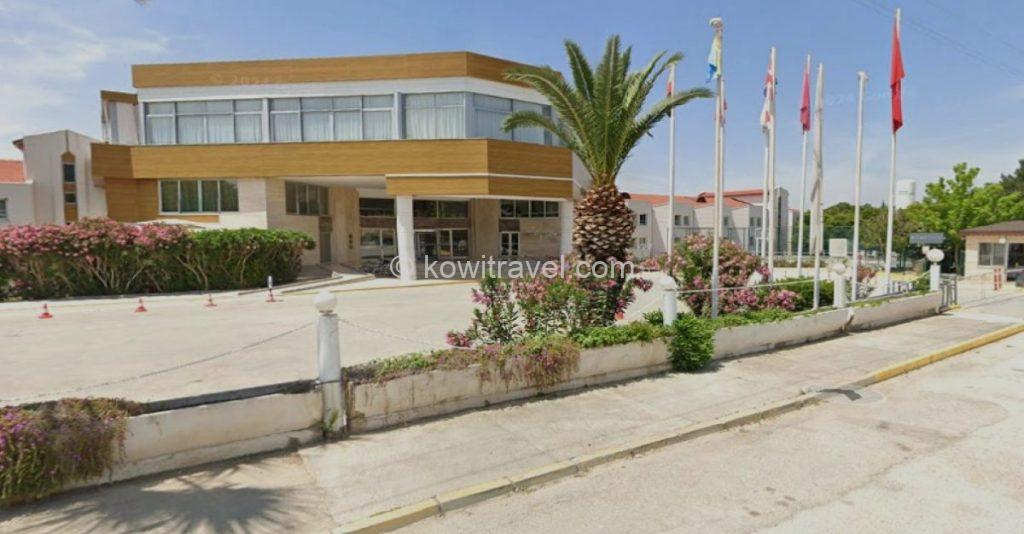
Entrance of Richmond Pamukkale Thermal Resort
While we weren’t staying overnight at this resort, we purchased a highly convenient Spa Day Pass, which granted us full access to their premium wellness and hot spring amenities.
While hotel guests can use the facilities for free, non-guests—like us—cannot purchase access through booking agencies; instead, you must check directly via the hotel’s official website or by phone on the day of your visit or the day before to confirm availability for a “Day Use Pass for Spa” and then pay on-site.
Click to the Richmond Pamukkale Thermal Resort website

The path leading to the entrance of the Chimond Hot Spring Hotel facilities.
Simply hand over your passport at the hotel front desk, make the payment, and you can comfortably use the various thermal amenities. Once finished, you can retrieve your passport back from the desk.
The day pass allowed us to move freely between their heated indoor and outdoor thermal pools, as well as their therapeutic saunas. Soaking in the steaming outdoor thermal pool late into the evening while looking up at the starlit sky felt like absolute paradise.
However, the definitive highlight of our spa day was immersing ourselves in the authentic Hamam (Turkish Bath) culture.
We lay down on the Göbektaşı—the massive, heated central marble platform—and let the deep, radiating heat completely dissolve our travel fatigue. It was there, while sharing quiet smiles and casual conversations with friendly local bathers, that we caught a genuine glimpse into the warm, communal lifestyle of the Turkish people.
It provided a perfect, rejuvenating period to our 3-day itinerary.

The central heart of the hammam: the massive, heated octagonal marble platform known as the ‘Göbektaşı’

Elegant side view of the hotel hammam featuring individual carved marble basins (Kurna) and historic tulip tiles
👉 Click the video below to experience the vivid atmosphere of Denizli & Pamukkale
(Please turn on YouTube CC(Subtitles) and select your language in settings!)
4. Next Destination: Journeying to Antalya, the Turquoise Pearl of the Mediterranean!
Leaving behind the soothing thermal waters of the Cotton Castle and the profound mysteries of ancient Hierapolis, we tune up our rental car and hit the open road once more.
In our upcoming post, our 1-month road trip brings us to a majestic coastal paradise where the sparkling Mediterranean sea meets centuries-old historic quarters. Get ready for our 3-Day Guide to Antalya, packed with pristine beaches, local culinary hotspots, and breathtaking coastal drives. Stay tuned for the next adventure! 😊
👉 [Turkey Road Trip #3] Read the Ultimate 2-Night 3-Day Izmir Travel Guide
“Disclosure: This post contains affiliate links. If you make a booking through these links, I may earn a small commission at no additional cost to you.”