#11. A Hidden Garden of Freestanding Stone Pillars Passing Beyond the Fortress Walls
🚨TL;DR: Yuanjiajie & Ten-Mile Gallery at a Glance
● The Route: Upper Yuanjiajie Trail ➡ Bailong Elevator (Descent) ➡ Suyuansimen Hub ➡ Ten-Mile Gallery Monorail.
● The Icon: Stand eye-to-eye with Qiankun Zhu, the real-world inspiration behind Avatar’s floating Hallelujah Mountains.
● The Pro Move: Skip the brutal 3-hour hike down. Take the Bailong Elevator—it drops you 326m in just 90 seconds.
1. From Yangjiajie to Yuanjiajie
💡TL;DR: The Geological Shift
● Yangjiajie: Features massive, wall-like formations (“Sandstone Peak Walls”).
● Yuanjiajie: Showcases independent, freestanding vertical pillars (“Sandstone Peak Forest”).
● The Vibe: Moving between them is like watching a live timeline of nature fracturing giant stone fortresses into isolated giants.
This second part of our independent travel to Zhangjiajie covers the final leg of our walking tour through the Forest Park, taking us through Yuanjiajie, the Bailong Elevator, and the Ten-Mile Gallery.
The steep stone steps led me down, leaving behind the rugged history and minority heritage of the ‘Tujia Tang’ fortress in Yangjiajie.
After a short ride on the park’s eco-shuttle bus from the transit station, I entered the Yuanjiajie Scenic Area—the true centerpiece of the Wulingyuan National Park expedition and the very stage that draws travelers from all over the world to Zhangjiajie.
While Yangjiajie showcased the colossal, wall-like formations of the “Sandstone Peak Walls,” Yuanjiajie represents the absolute pinnacle of the “Sandstone Peak Forest”.
Here, those very walls have fractured over millions of years into independent, freestanding vertical pillars. Transitioning from Yangjiajie to Yuanjiajie allows you to experience a striking geological timeline firsthand, witnessing nature’s transition from massive fortresses into a hidden garden of stone giants.
👉 [Check out an overview of Zhangjiajie National Forest Park on Trip.com]
2. Must-Visit Routes in Upper Yuanjiajie
📌 TL;DR: This upper rim trail is a textbook showcase of sandstone erosion. You’ll cross the world’s highest natural arch bridge, spot the 100-Yuan note peak illusion, and stand face-to-face with the towering vertical pillar that inspired Pandora.
[Click to Read] Deep Dive: Geology, Arch Formation & Lock Traditions
2. 1) The First Bridge Under Heaven – A Natural Arch Between Two Cliffs
Entering the perimeter of Yuanjiajie and navigating the rain-slicked cliffside planks and steep stairs, you encounter a miraculous architectural wonder of nature that defies human design.


A cliffside walkway (plank road) and steep stairs leading toward “The First Bridge Under Heaven”.
This is The First Bridge Under Heaven, a celestial bridge shaped entirely by the elements.
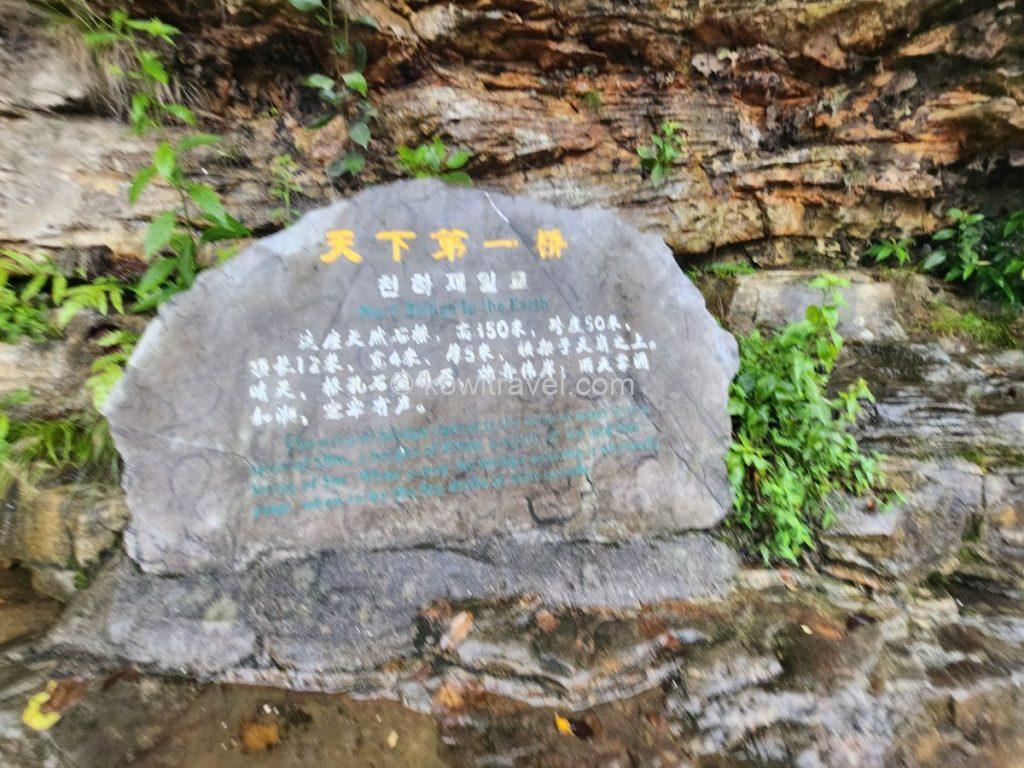
A unique information sign carved directly into the stone.
True to its name, which translates to “The Absolute First Bridge Under the Heavens,” it stands taller and more imposing than any human-engineered structure. It earned this title by being the highest natural stone arch bridge in the world.
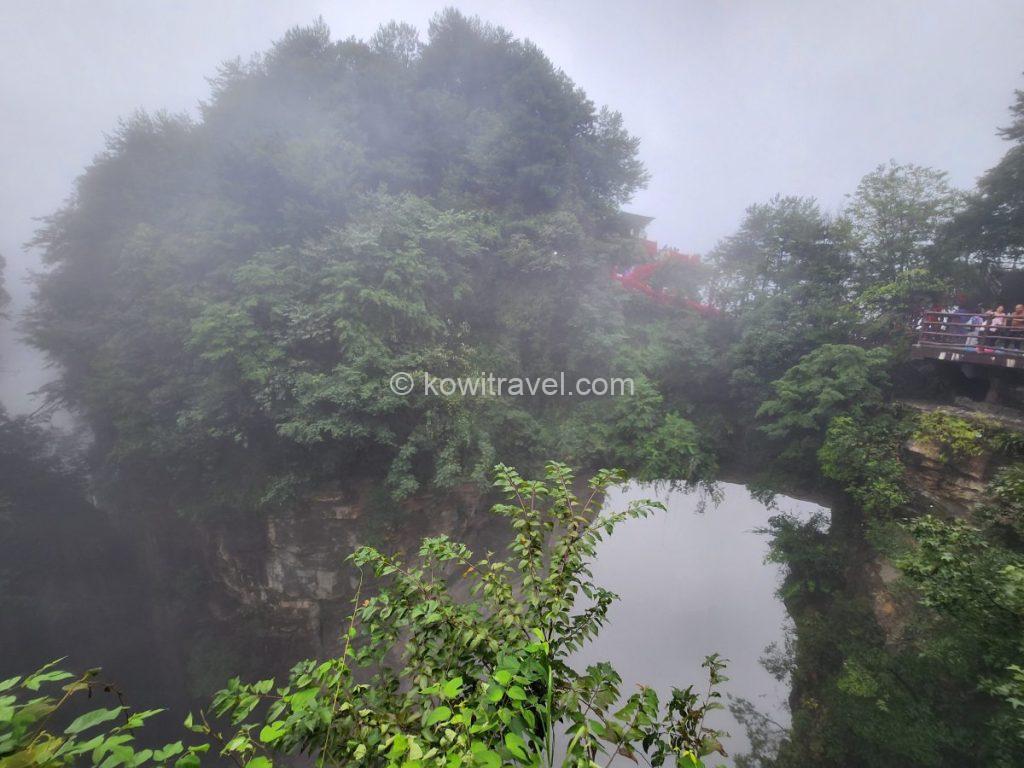
An incredible, breathtaking sight: the tops of two massive rock pillars are naturally connected, forming a bridge.
Geologically, this formation was once part of a single, massive sandstone platform.
Over millions of years, torrential rainwater wedged into the vertical joints, systematically eroding the weaker sandstone layers beneath. This concentrated erosion hollowed out a massive cave over time.
As the cavern expanded, it left the lower section completely void, while the exceptionally dense sandstone at the very top remained intact.
This created the miraculous natural arch bridge we see today.
The vertical drop from the bridge to the canyon floor below measures an astonishing 350 to 400 meters. The natural bridge span itself is approximately 5 meters thick, 2 meters wide, and 20 meters long.
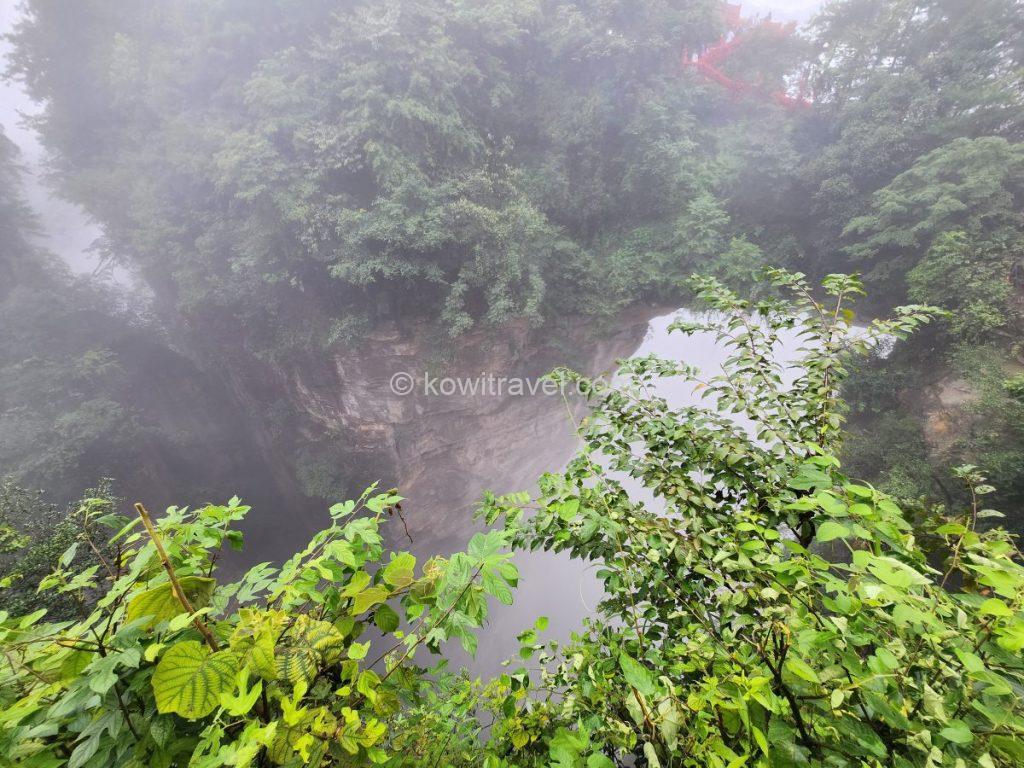
With a dizzying abyss below and swirling mist beneath it, the formation truly feels like a bridge suspended in the sky.
Initially, it felt like just another standard cliffside walkway. However, stepping onto the opposite viewing platform to look back at the full landscape, a quiet gasp of admiration naturally escaped my lips.
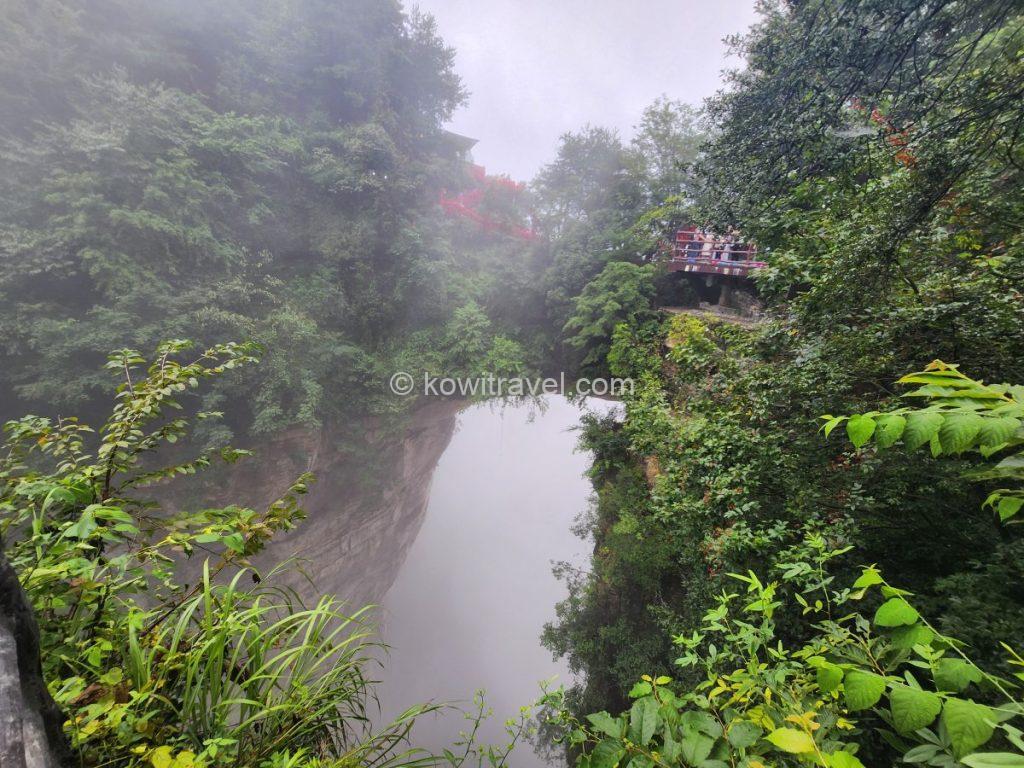
I was filled with a sense of awe at the sheer grandeur of nature—it was almost too incredible to believe, even while looking right at it.
The bridge area features a dedicated ‘Dongsimyn’ (Tongxin Suo) zone where couples hang padlocks and toss the keys into the abyss to wish for eternal love and health.
The railings are completely draped in vibrant red wish ribbons and padlocks, holding the quiet prayers of countless travelers who sought the blessings of Zhangjiajie’s ancient natural energy for their families.
The striking contrast between the white mountain mist, the deep green pines, and these crimson ribbons created a uniquely poignant and surreal atmosphere.
Carrying the quiet impression of the natural bridge with me, I followed the wooden signposts pointing toward Qiankun Zhu and Mihuntai.
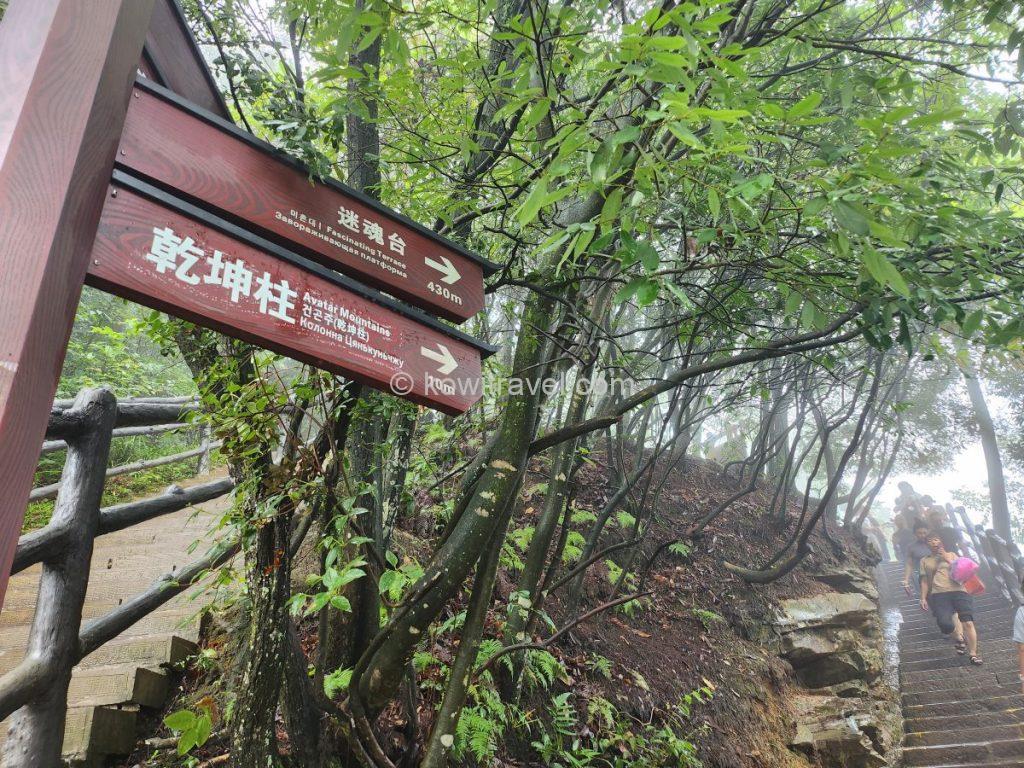
Signposts pointing toward Mihuntai (Terrace of Bewilderment) and the “Stone Pillar Supporting Heaven” (Gongonju) serve as a compass for the route.
2. 2) Mihuntai – The Enchanting Terrace of Stone Giants
Mihuntai translates to “The Terrace That Enchants the Soul,” a romantic name coined by local Tujia residents and visiting poets. It reflects a shared sentiment: anyone who stands here and looks down into the chasm will find themselves completely spellbound, staring blankly in sheer awe.
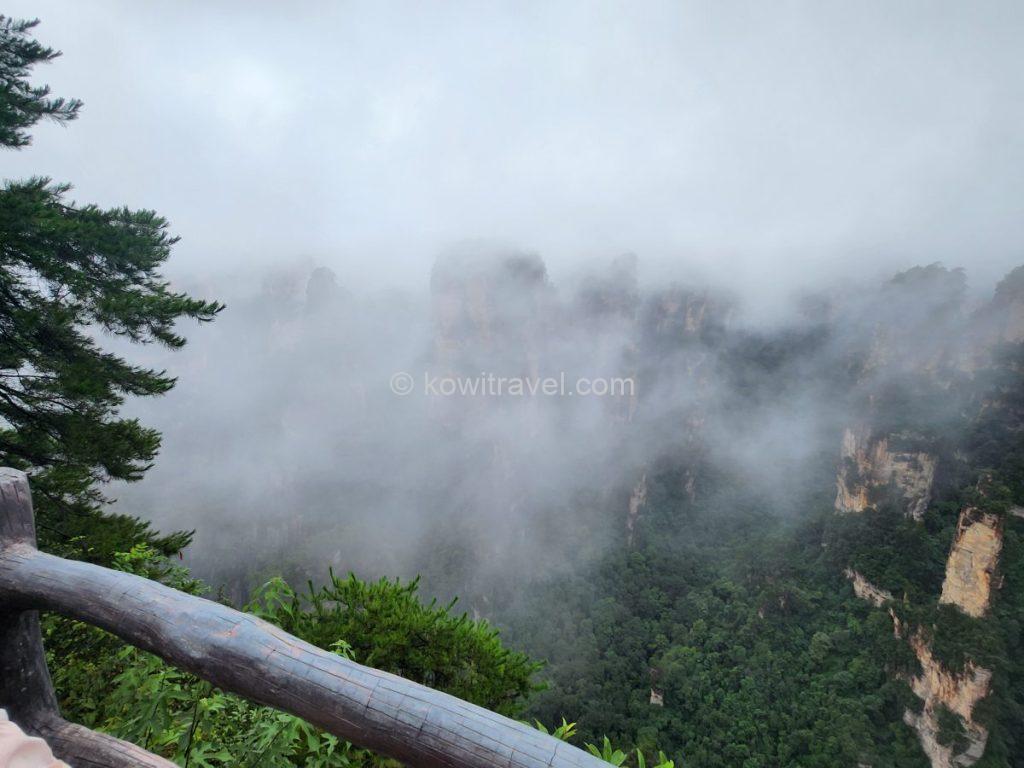
Strange, striking rock formations as seen from the Mihondai observation deck.
This natural terrace offers the most pristine view of the Sandstone Peak Forest. It showcases the advanced evolutionary stage where the horizontal sandstone walls of Yangjiajie (featured in Post 10) have fractured cleanly over millennia into a dense, sprawling forest of independent stone spires.
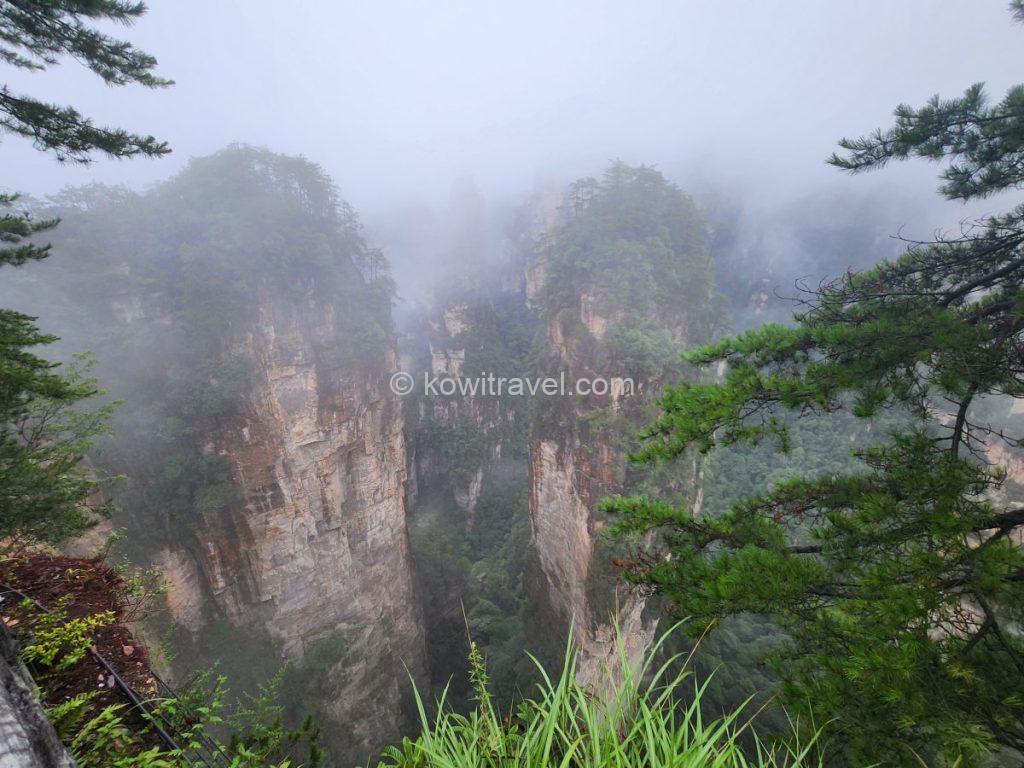
The stone pillars, partially veiled by mist, create a mysterious and dreamlike atmosphere.
Dozens of monumental vertical pillars shoot upward from the floor of the deep canyon, each displaying unique heights and contours that maximize the structural depth of the landscape.
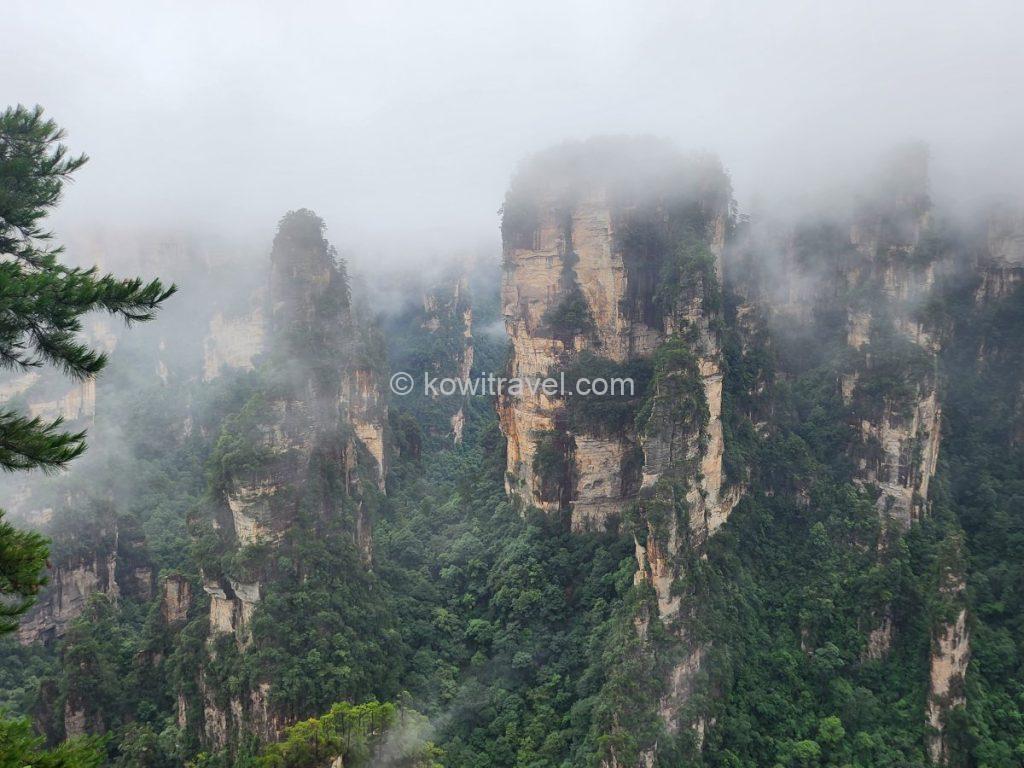
The magnificent sight of the massive rock pillars revealed as the mist begins to lift.
Among the numerous lookouts scattered across the Zhangjiajie National Forest Park, Mihuntai is widely celebrated as the most visually spectacular and majestic panorama.
Visiting right after a rainstorm or during a clear morning reveals a dramatic show: low-lying fog rushes through the canyon currents, allowing only the crown crests of the giant pillars to pierce through the sea of clouds like isolated islands.
It is the ultimate real-world glimpse into the surreal floating world of Avatar.
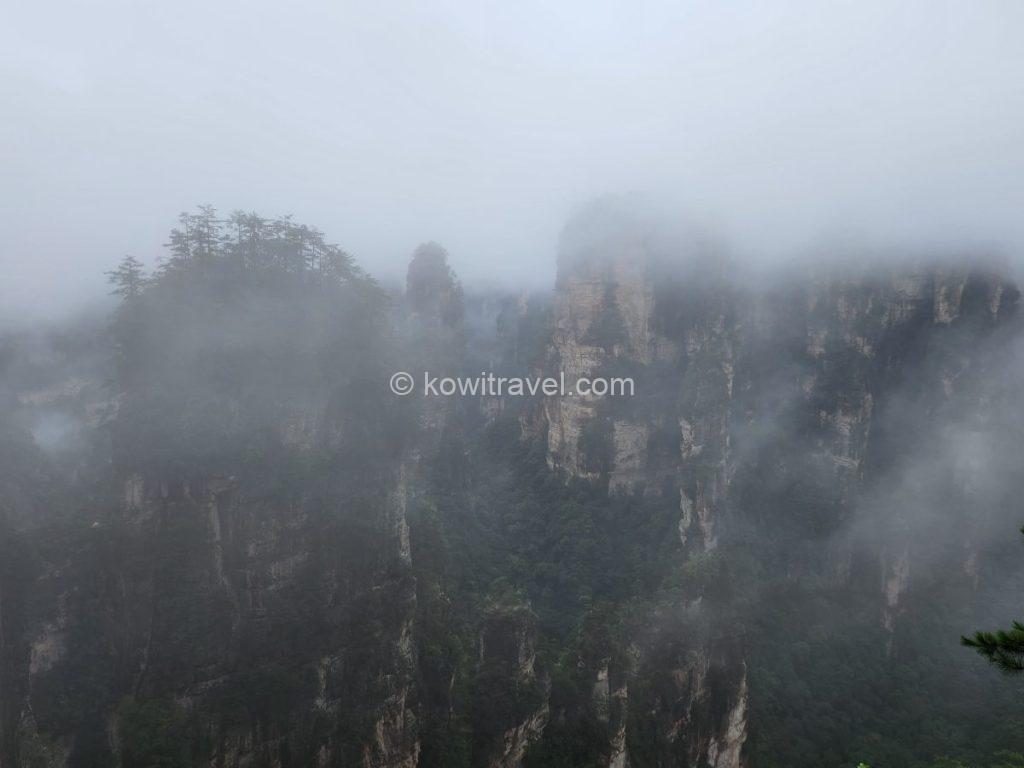
A cluster of stone peaks hidden amidst the mist.
2. 3) The 100-Yuan Bank Note Peaks
The first unique rock formation you encounter along this specific segment of the rim trail is introduced on official park signage as “The 100-Yuan Bank Note” .
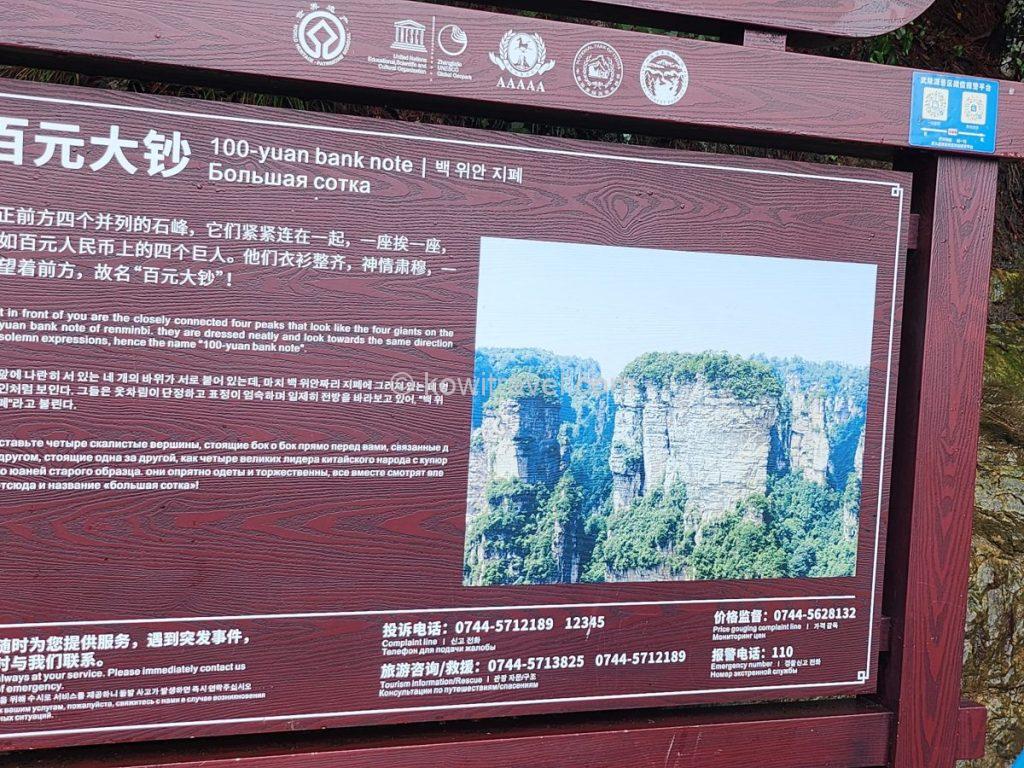
An information sign for The 100-Yuan Bank Note Peaks
The term Dachao translates literally to high-denomination currency or a large bank note, giving this scenic spot a witty and memorable modern title.
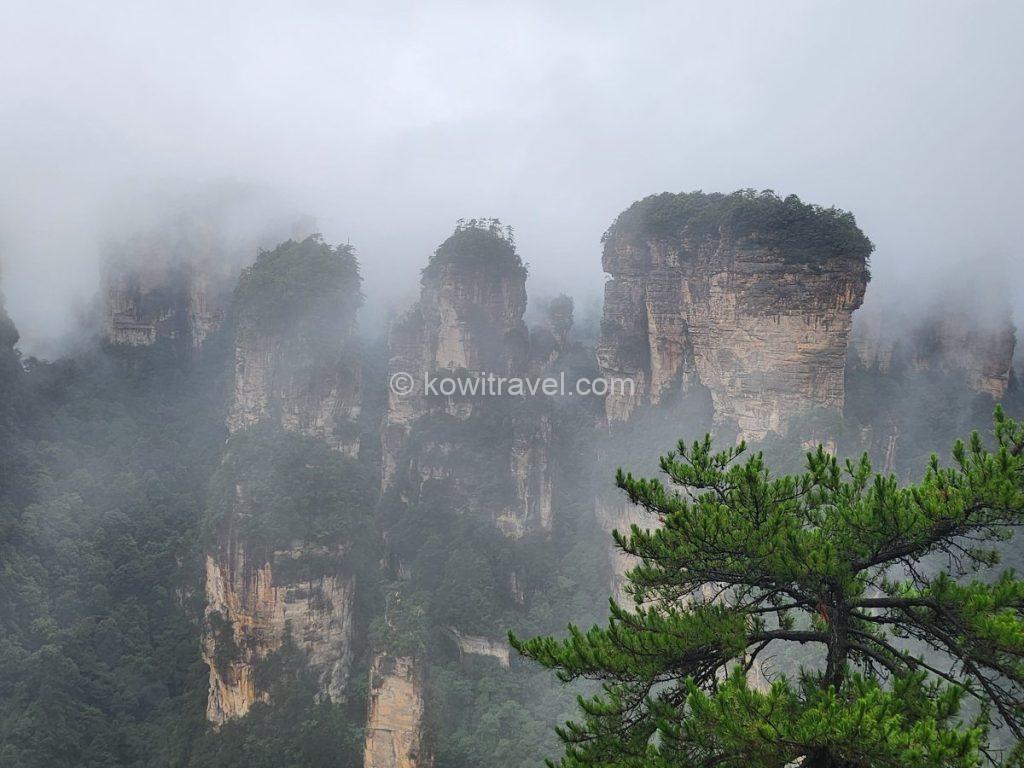
The rock formations clustered together on the right are known as The 100-Yuan Bank Note Peaks
The reverse side of China’s legacy 100-yuan note featured the solemn profiles of four monumental leaders who guided the Chinese Communist Party and the revolution: Mao Zedong, Zhou Enlai, Liu Shaoqi, and Zhu De.
Gazing out from the Mihuntai path, you see four massive sandstone peaks clustered tightly together in a flawless row emerging from a shared foundation.
Because their solemn, layered profile bears an uncanny resemblance to the profiles of the four leaders printed side-by-side on the currency note, it became celebrated under this modern tourism name.
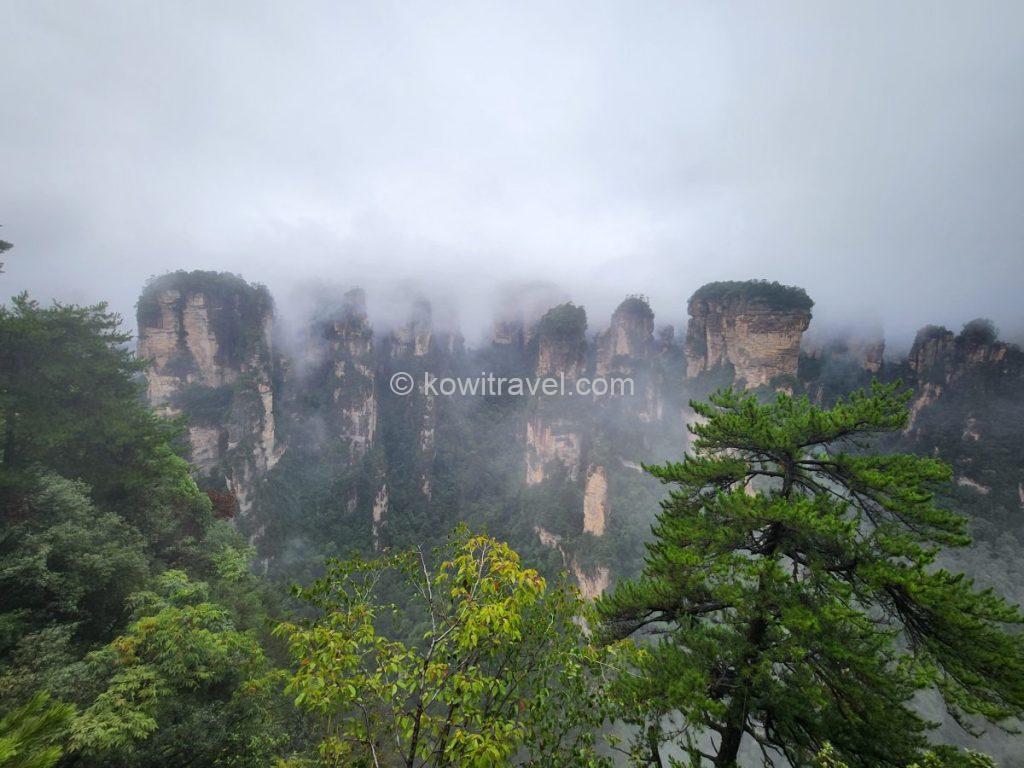
A view of “The 100-Yuan Bank Note Peaks” and the surrounding cluster of rock pillars from a distance.
Unlike standalone columns like Qiankun Zhu, the 100-yuan note formation represents a connected landform where three or four peaks emerge from a monolithic mother-rock, standing shoulder-to-shoulder like an imposing stone curtain.
It captures a rare, transitional phase in geological evolution, caught precisely between the horizontal walls of Yangjiajie and the completely splintered vertical pillars of Yuanjiajie.
2. 4) Crossing Lianxin Bridge, the Suspension Bridge Linking Two Hearts Over the Void
Absorbing the diverse vistas of the Mihuntai zone and navigating the cliffside planks, a massive iron suspension bridge spanning across a dizzying chasm appears before you. The official name of this modern structure is Lianxin Bridge, meaning the bridge that connects hearts.
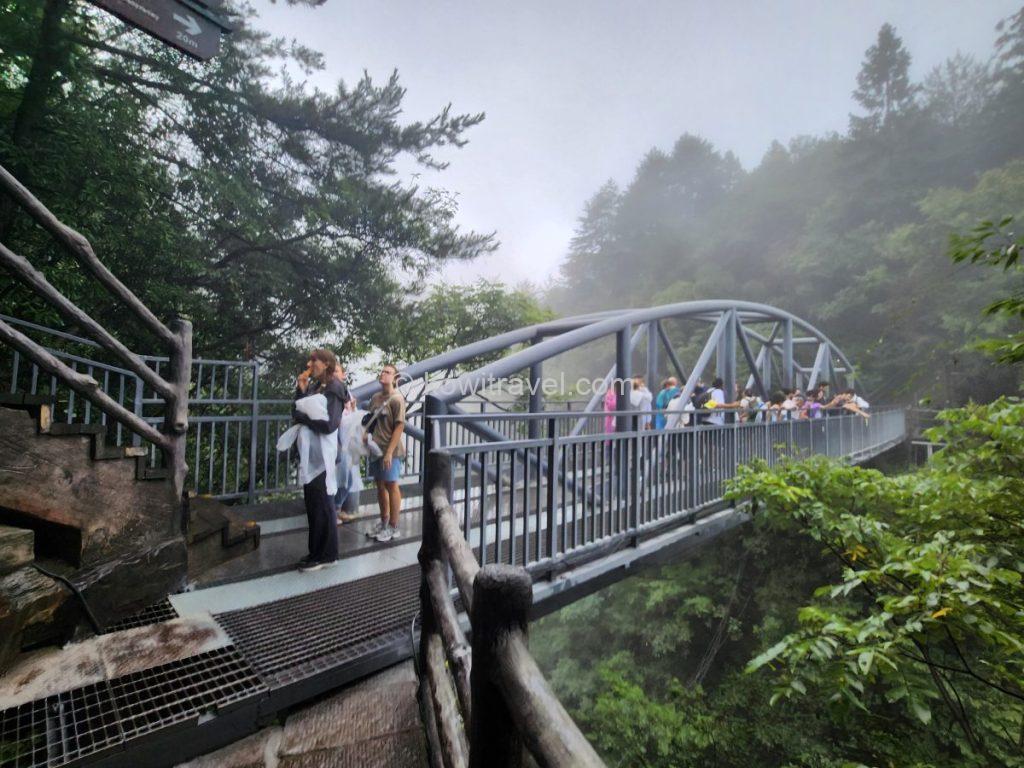
An arched steel bridge, constructed to allow tourists to safely and quickly cross the deep chasm between two cliffs along the Yuanjiajie trail.
While nature provides the First Bridge Under Heaven further back, Lianxin Bridge stands as a testament to human engineering—linking two sheer cliff faces and allowing travelers to safely traverse the absolute heart of the rugged gorge.
Stepping onto the bridge walkway, the open iron mesh flooring reveals the thousands of feet of open void directly beneath your boots, delivering a genuine, heart-pounding rush of vertigo.
Surrounded by independent travelers from all over the world clad in rain ponchos, leaning over the railings and murmuring in shared amazement, I crossed the chasm, deeply feeling the raw vertical slits carved by nature.
Moving past this bridge and following the forested trail to catch my breath, the true protagonist of Yuanjiajie—the standalone pillar of Qiankun Zhu—began to unfold through the trees.
2. 5) Qiankun Zhu – The Pillar of Heaven Anchoring Pandora
💡TL;DR: The Avatar Monolith Fast Facts
● The Scale: Reaches 1,074 meters above sea level with a sheer 150-meter vertical drop.
● The Visual: Top-heavy and asymmetrical, hanging perfectly upright for eons.
● Insider Tip: When the shifting mountain mist rolls in from the canyon floor, the entire pillar looks like it’s literally floating in mid-air.
After hiking along the damp path for a little over ten minutes past the Lianxin Bridge, a welcoming signpost reading ‘Qiankun Zhu 10m’ appeared, and the defining landmark of this journey materialized through the mountain mist.
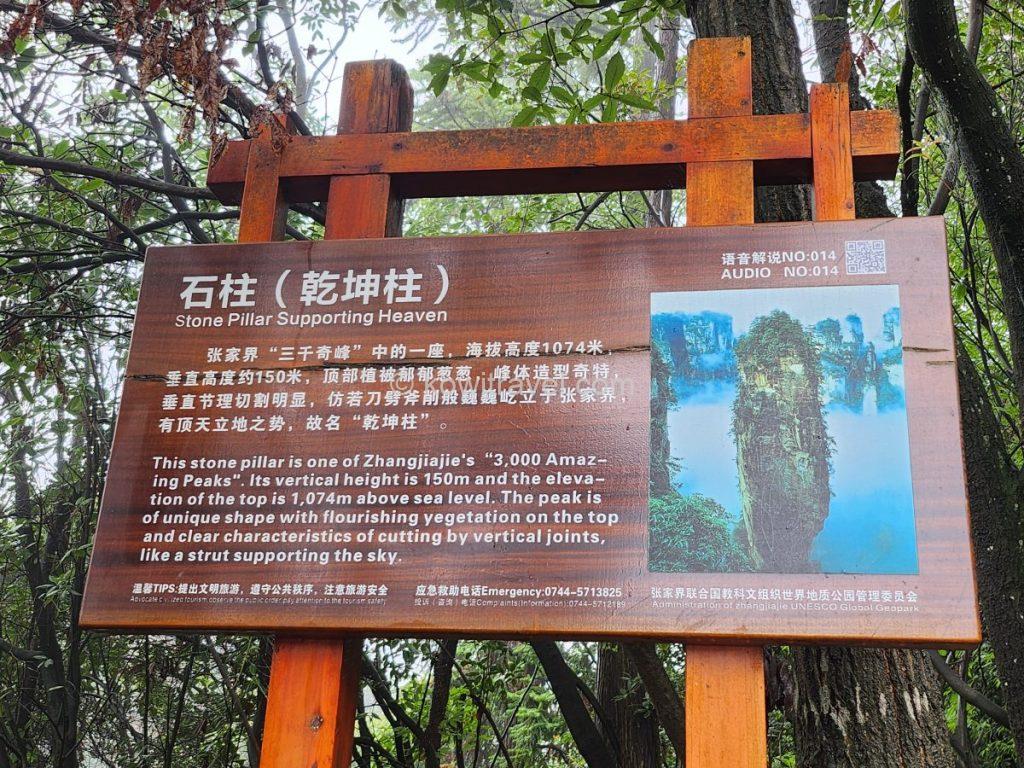
An information sign for the “Stone Pillar Supporting Heaven” (Gongonju)—the centerpiece of Yuanjiajie.
This is Qiankun Zhu (The Southern Sky Pillar), the exact vertical monolith that served as the primary inspiration for the floating Hallelujah Mountains in James Cameron’s *Avatar*.
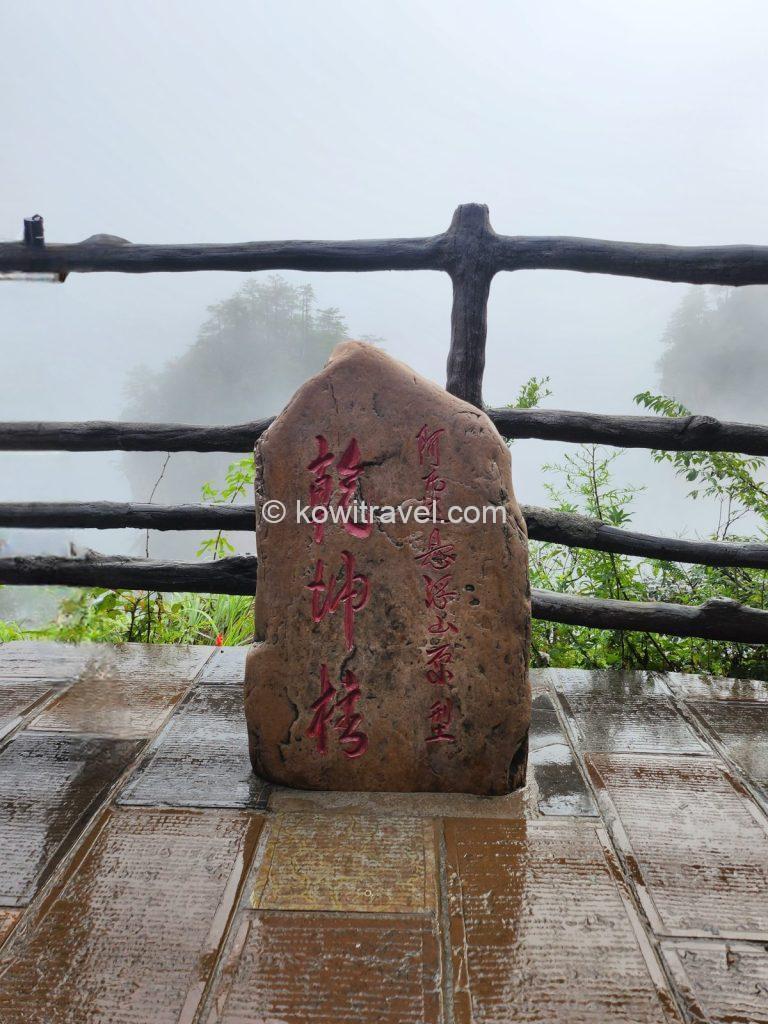
This commemorative marker identifies the spot as the official, prime vantage point—a “certified photo zone”—offering the perfect head-on view of the actual “Stone Pillar Supporting Heaven” that served as the inspiration for the film Avatar.
As detailed on the official geopark sign, this giant reaches an elevation of 1,074 meters above sea level and boasts a sheer vertical height of 150 meters.
Completely detached from any surrounding rock walls, it stands as a flawless monument to a freestanding, ‘Isolated Pillar’.
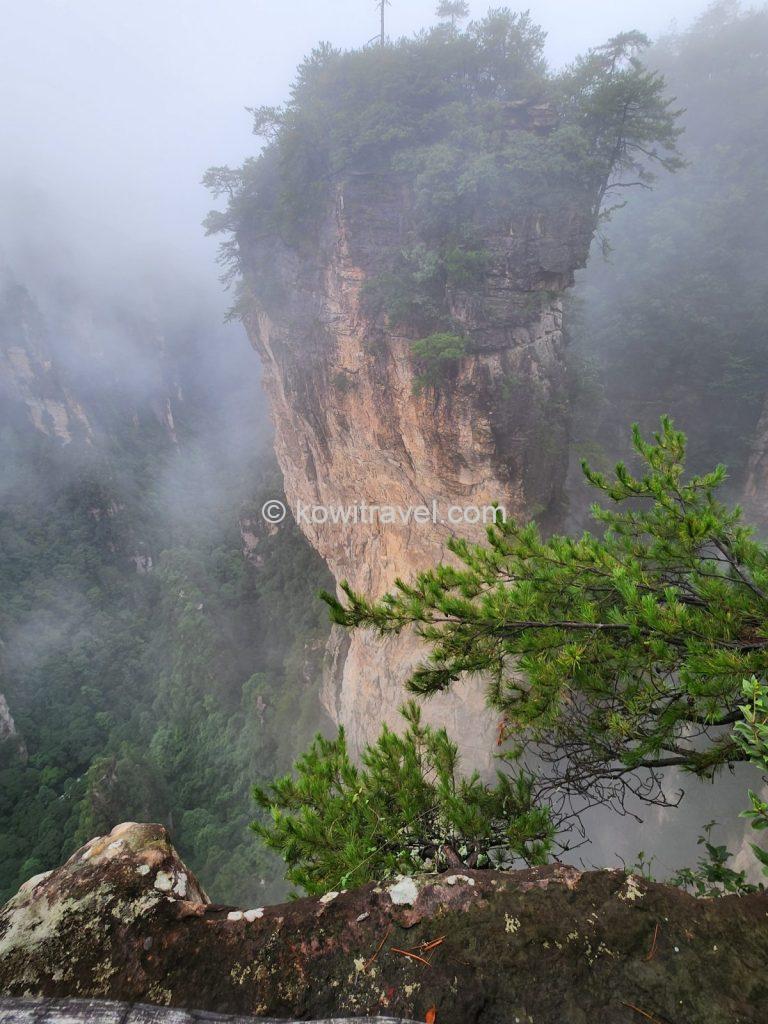
The most breathtaking scenery encountered during an independent travel to Zhangjiajie. The “Stone Pillar Supporting Heaven” is so magnificently grand that it defies description, instantly bringing the movie Avatar to mind.
The pillar features a fascinating asymmetrical silhouette; the summit is noticeably bulky and top-heavy, holding massive blocks of stone, while the column tapers significantly toward its lower base.
Looking at it up close, a deep sense of reverence for the mystery of nature takes over—making you wonder how this top-heavy giant has managed to remain perfectly upright without collapsing over hundreds of millions of years.
Fortuitously, thick mountain mist was billowing up from the canyon basin during my visit, making the giant pillar appear to float entirely in mid-air, looking precisely like the mythical Hallelujah Mountain.
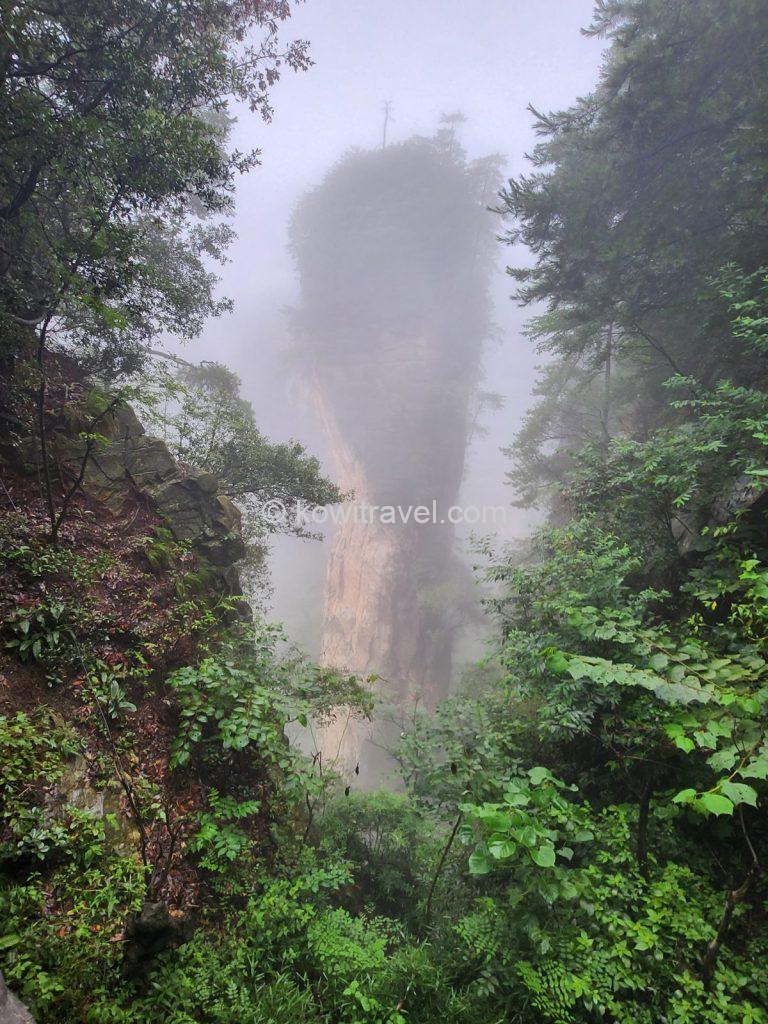
Its silhouette, partially obscured by mist, adds a mystical quality, making it appear as though it is floating in mid-air.
Lying witness to the real Qiankun Zhu, with its massive roots hidden by a shifting shroud of fog and only its bulky crown suspended in the heavens, you instantly understand where the film’s creative team drew their cosmic inspiration.
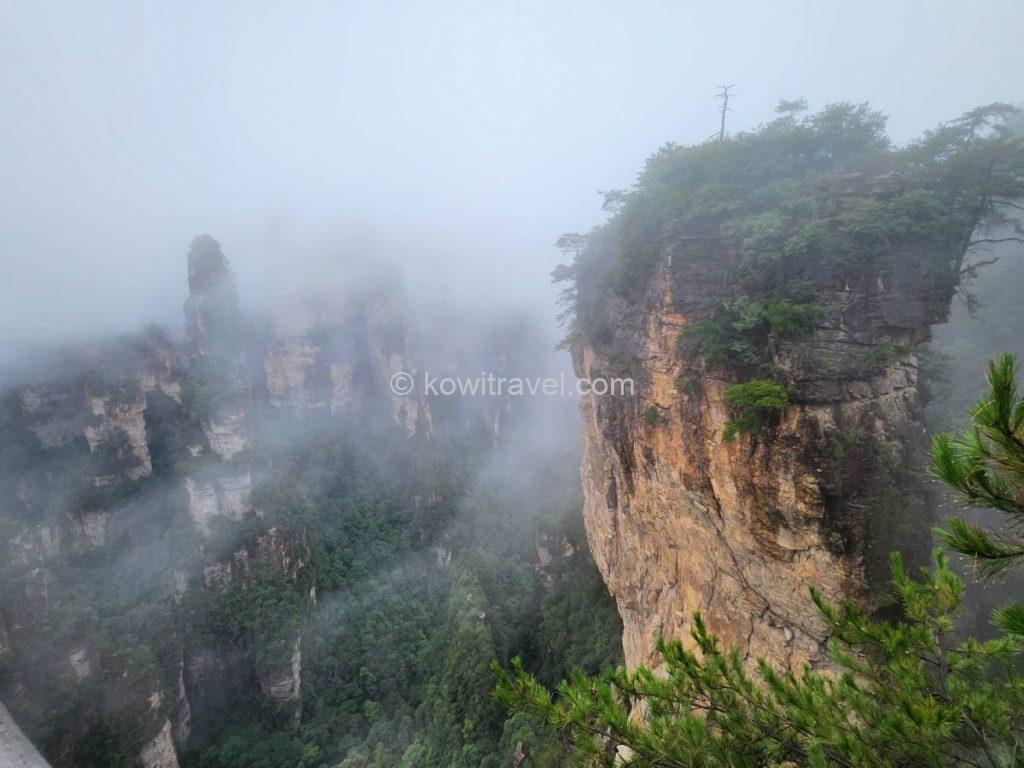
It made me realize, once again, just how magnificent nature is.
Confirming this pristine masterpiece of vertical fracturing with my own eyes made all the physical fatigue of this demanding independent trek feel completely rewarded.
👌Travel Tip
Unlocking the Secret of the ‘Stone Peak Forest’ Lookout. Right alongside the Avatar monolith, I stepped onto the protruding terrace of the main Mihuntai Observation Deck.
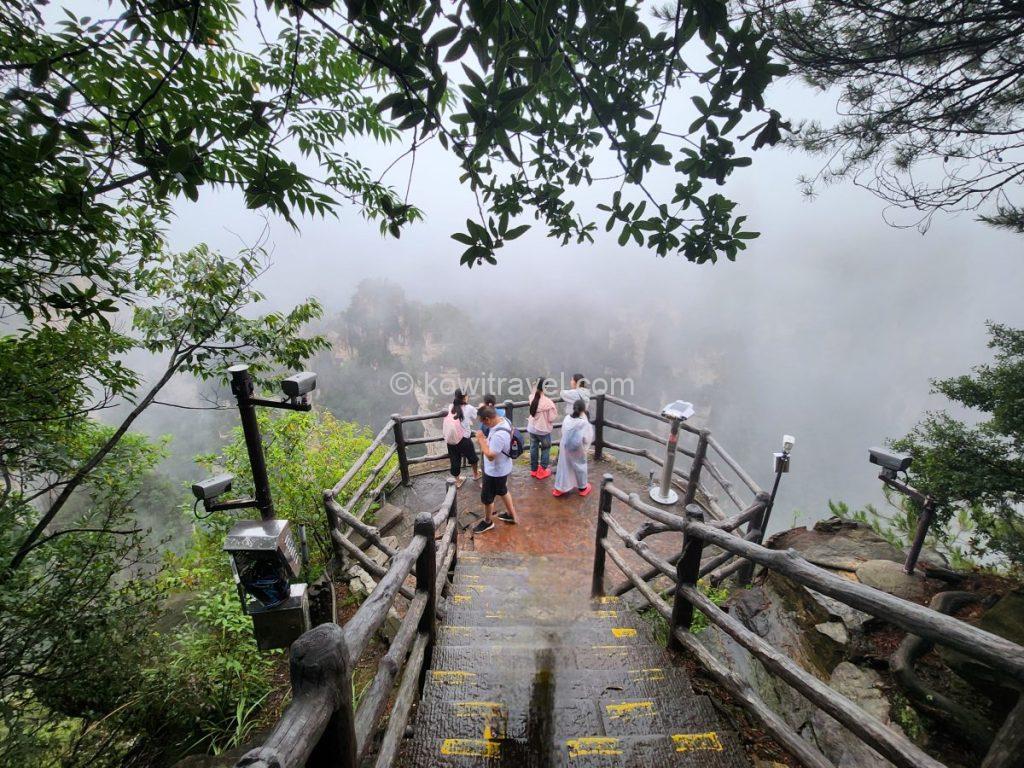
The main observation deck at Mihondae, located next to Geongonju, is designed as a terrace that extends beyond the railing. It offers the most three-dimensional view of the forest of stone peaks rising above a sea of mist.
Looking over the edge, an incredible view of thousands of stone columns unfolding like an ocean lay before me, where I encountered the specific geological marker coded ‘AUDIO NO: 061’ titled Stone Peak Forest.
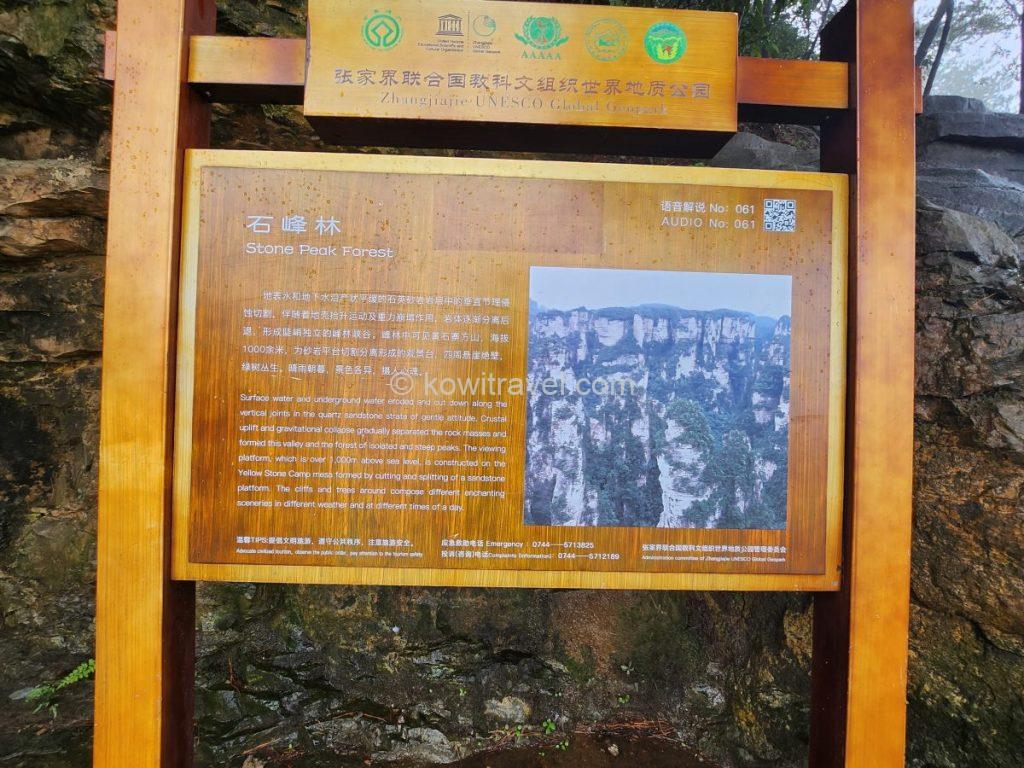
An information board that cleared up my initial confusion regarding the “stone peak forest” (rock formations)
Interestingly, the English text on this marker explicitly mentioned “Yellow Stone Camp” (Huangshizhai)—the very territory we had been forced to drop from our itinerary due to the heavy rainstorms earlier.
Looking deeper into the geological context, this sign wasn’t just generic textbook information; it was explaining that the massive wall of pillars directly facing us across the open canyon was, in fact, the majestic backside of the Huangshizhai Stone Peak Forest.
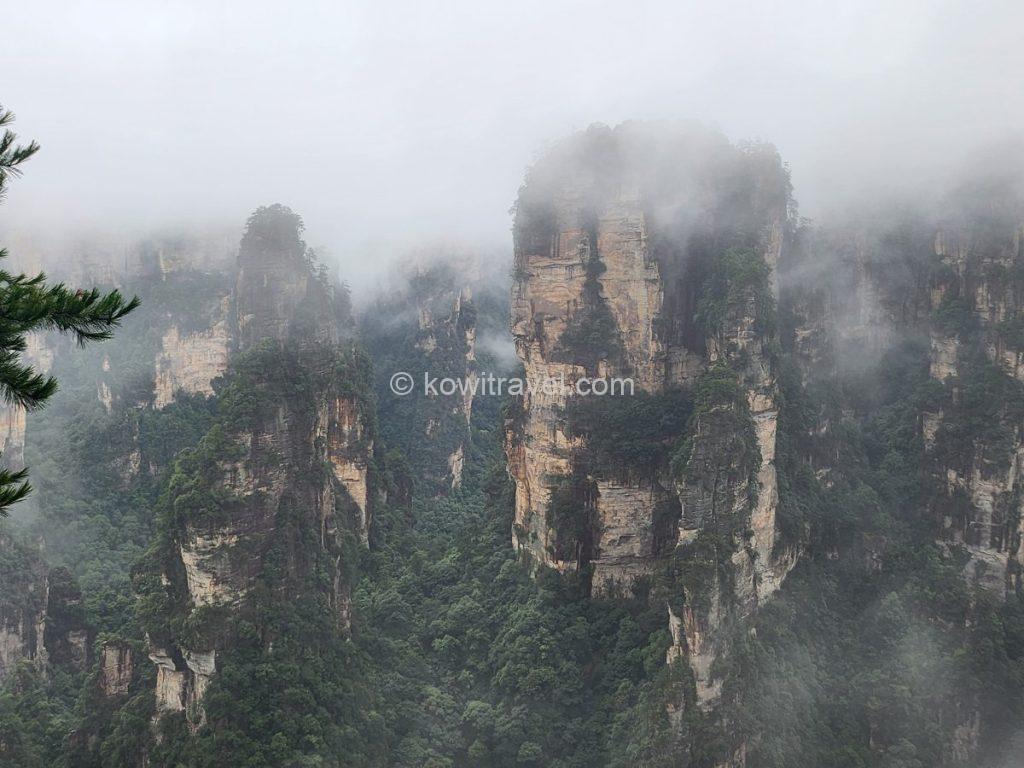
Majestic rock formations (a “forest” of stone peaks) spread across a deep gorge
Realizing that I was looking at the very heart of the range I thought I had missed completely washed away my lingering regrets, leaving me deeply fascinated by how interconnected this ancient landscape truly is.
3. Defying Natural Limits: Descending via the Bailong Elevator
💡TL;DR: Bailong Elevator At a Glance
● The Records: World’s tallest (326m), fastest, and highest-capacity outdoor sightseeing elevator.
● The Experience: Drops from the upper peaks to the valley floor in a blistering 90 seconds.
● The Shock Factor: Shoots out from a dark underground rock shaft directly into a sweeping, open sea of stone spires.
Having thoroughly explored the diverse geological evolution of the upper Yuanjiajie platform on foot, we headed toward the upper terminal of the Bailong Elevator to descend to the lower valley floor.
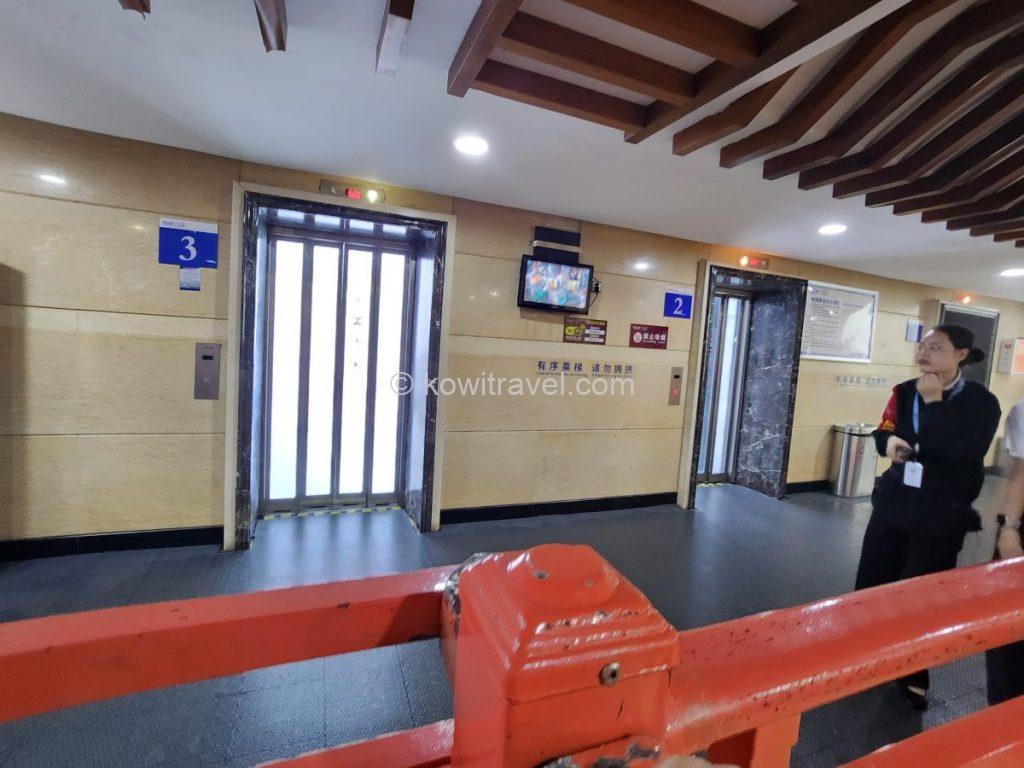
Inside the boarding area for the Bailong Elevator
To be completely honest, witnessing the Bailong Elevator in person left me in a state of absolute shock. The sheer audacity to conceive an elevator built directly into the face of a wild, primeval sandstone cliff was stunning enough, but the fact that they successfully executed that vision was even more striking.
[Click to Read] The History, Environmental Controversy & Paradoxical Eco-Benefits
The Bailong Elevator is not merely a tall elevator; it officially holds three distinct titles certified by the Guinness World Records in 2015:
- The world’s tallest outdoor (exposed) double-deck sightseeing elevator.
- The world’s tallest double-deck shuttle sightseeing elevator.
- The world’s fastest passenger elevator with the largest carrying capacity.
The structure reaches a total vertical height of 326 meters. It operates three independent, 100% transparent double-deck glass cars simultaneously.
Each car can carry an impressive load of 46 to 50 passengers, rocket-launching down the sheer vertical cliff face in just 1 minute and 32 to 58 seconds.
When riding from the lower station, the ascent begins in absolute darkness, moving inside a vertical shaft carved deep within the mountain’s solid rock core.
As the car climbs at high speed through the dark shaft, it suddenly bursts out into the open air—instantly transitioning into a sweeping, dazzling sea of jagged stone pillars. This dramatic reveal of Yuanjiajie’s raw grandeur is completely spellbinding.
The outdoor tracks for this exposed section are secured firmly to the sandstone cliff face using massive structural steel frames.
The elevator’s name, Bailong Tianti , translates to “The Sky Ladder of a Hundred Dragons,” a title inspired by local legends of a white dragon that ascended to heaven from the Wulingyuan gorge.
A joint venture involving British investment began construction in 1999 with a budget of approximately 25 billion USD.
However, because it involved cutting into the pristine sandstone cliffs of a designated UNESCO World Heritage site to erect a massive artificial structure, the project faced intense criticism and fierce opposition from international environmental coalitions and scientists.
Though construction concluded and the attraction triumphantly opened in April 2002, severe controversies regarding environmental degradation and safety hazards—specifically concerns over tectonic instability and landslide risks during potential earthquakes—immediately resurfaced.
Consequently, just a few months after its grand opening, the central government issued a mandatory decree forcing the elevator to completely halt operations for roughly ten months.
It was only after installing advanced seismic sensors, completing extensive structural reinforcement, and undergoing rigorous environmental re-assessments that it was allowed to reopen, ultimately becoming the mechanical heart of Zhangjiajie tourism.
Before the construction of the Bailong Elevator, traveling from the lower valley floors (like Golden Whip Stream) to the upper mountain summits of Yuanjiajie required a treacherous, physically demanding climb up steep rock stairs that took a minimum of two to three hours.
Thanks to this engineering feat, elderly travelers and families with young children can now ascend to the summit of Yuanjiajie in just two minutes.
More importantly, it generated an unexpected, paradoxical environmental benefit.
In the past, visitors wanting to see the sunrise had to stay overnight in illegal, unregulated hotels and makeshift guesthouses scattered across the mountain summit.
The advent of high-speed, single-day transit allowed the government to completely demolish these unauthorized structures, ultimately restoring and protecting the park’s pristine summit ecology.
Caught precisely between the fierce criticisms of environmental degradation and the grand praises of the Guinness World Records, the Bailong Elevator stands as a monument of modern history.
The 90-second transition of bursting through a dark stone shaft into the brilliant world of Avatar remains one of the most thrilling highlights of any journey through Zhangjiajie.
Seeing this massive silver metal frame embedded directly into a vertical sandstone cliff face that was carved by nature over hundreds of millions of years is awe-inspiring—standing as a true triumph where human ingenuity meets natural limits.
Waiting for our turn at the modern indoor boarding gates, excitement built for the sudden shift in perspective ahead: pivoting from looking down upon these stone giants to looking straight up at them from the canyon floors of Suyuansimen and the Ten-Mile Gallery.
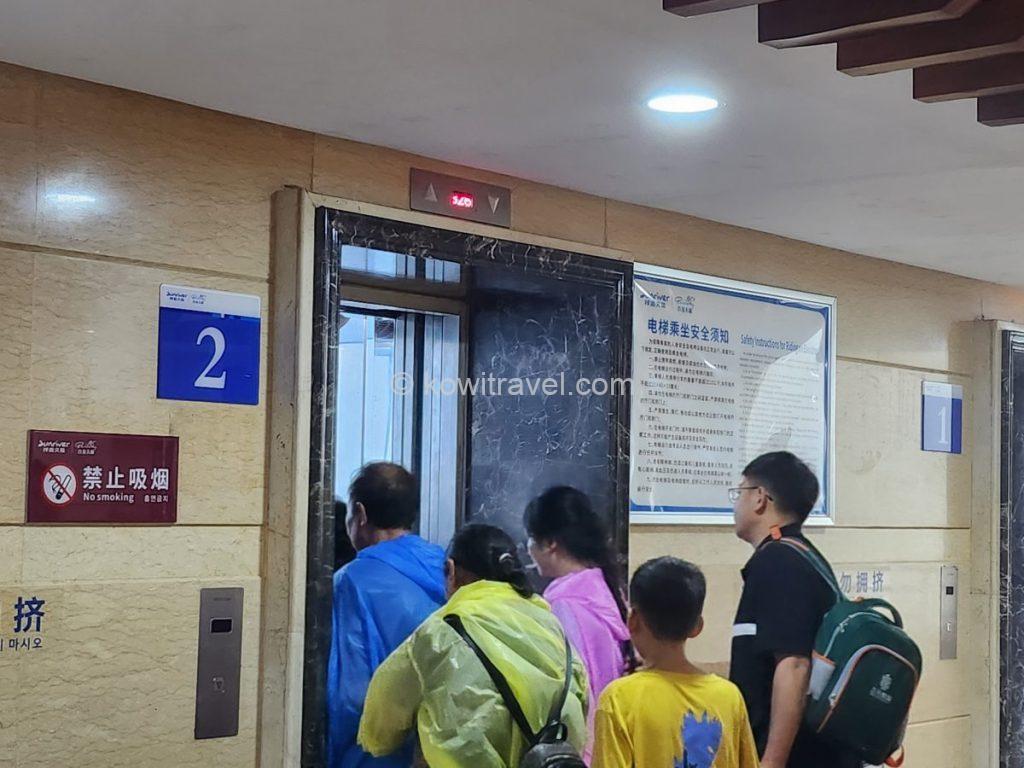
Waiting to board—the area is bustling with countless tourists, despite the inclement, rainy weather
4. Standing at the Gorge Floor: The Grandeur of ‘Shenbing Jihui’
Stepping out from the lower exit plaza of the Bailong Elevator after a swift slide down the vertical cliff face, I faced the canyon floor.
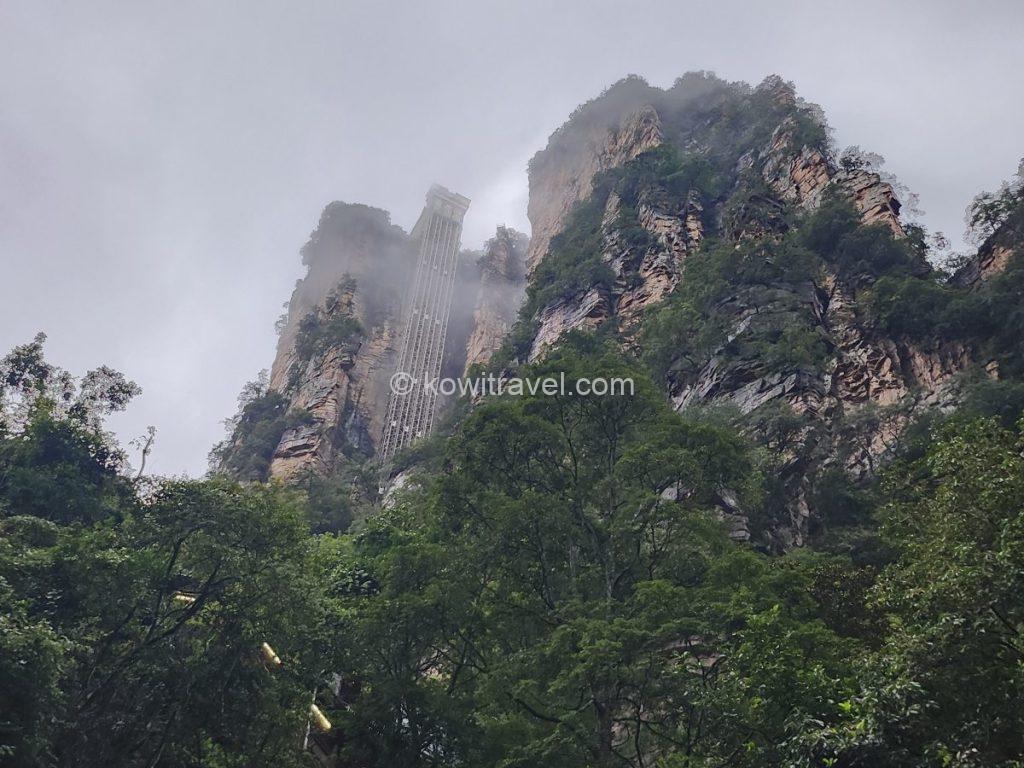
The exterior of the Bailong Elevator as seen from the gorge below
The moment you step outside into the clearing, you experience a complete inversion of perspective: the monumental sandstone columns that you were looking down upon from the summits just moments ago now tower directly over your head, reaching straight into the sky.
The spectacular cluster of giant stone pillars dominating the lower plaza is known as Shenbing Jihui (The Gathering of Heavenly Soldiers).
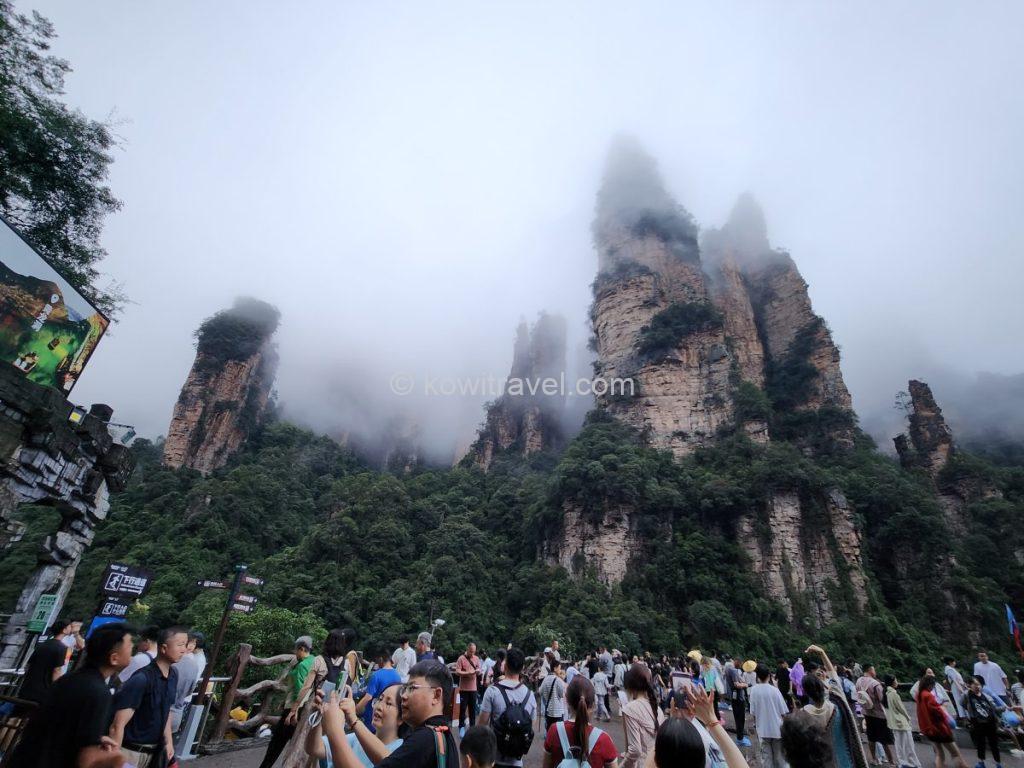
Upon exiting the elevator, you are greeted in the plaza by the ““The gathering of mystical soldiers descended from the heavens“—a vast cluster of colossal stone pillars
The name literally translates to “The gathering of mystical soldiers descended from the heavens.” This title holds a deep connection to the tragic local legend of Xiang Dakun (Emperor Xiang), the historic hero of the indigenous Tujia people whose lore weaves through the entire geography of Zhangjiajie.
During the early Ming Dynasty, Xiang Dakun, a fierce leader of the Tujia people, declared himself ‘Tianzi’ (The Son of Heaven/Emperor) and led a massive rebellion against the imperial forces. However, facing the overwhelming military might of the central government’s armies, his lines were systematically pushed back, eventually leaving them cornered at the very edges of these sheer cliffs in Yuanjiajie and Tianzishan.
In a moment of absolute desperation, Emperor Xiang offered a solemn prayer to the heavens. Touched by his fierce resolve and the injustice of his plight, the gods answered by sending down an army of mystical Shenbing (heavenly soldiers) into the gorge to aid his defense.
Tragically, even the divine intervention could not reverse the tide of war. When Emperor Xiang ultimately threw himself from the cliffs in a final act of defiant martyrdom, the heavenly soldiers, consumed by grief and fury over the loss of their emperor, froze in tight formation right where they stood, crystallizing into a silent stone army of tens of thousands of pillars.
True to this legend, dozens of massive sandstone monoliths topped with thick white mist stand closely together in perfect, orderly lines. The sheer vertical presence creates an imposing atmosphere, looking precisely like a divine army assembled in a solemn council under imperial orders.


Massive stone pillars viewed from the plaza below
Looking straight up at the raw, exposed faces of these 기암괴석 from their roots on the valley basin revealed a towering, razor-sharp energy entirely distinct from the panoramic views at the top. Soaking in the impression of the stone army, I followed the covered wooden corridor built with traditional tiled roofs, heading down toward the transit station.
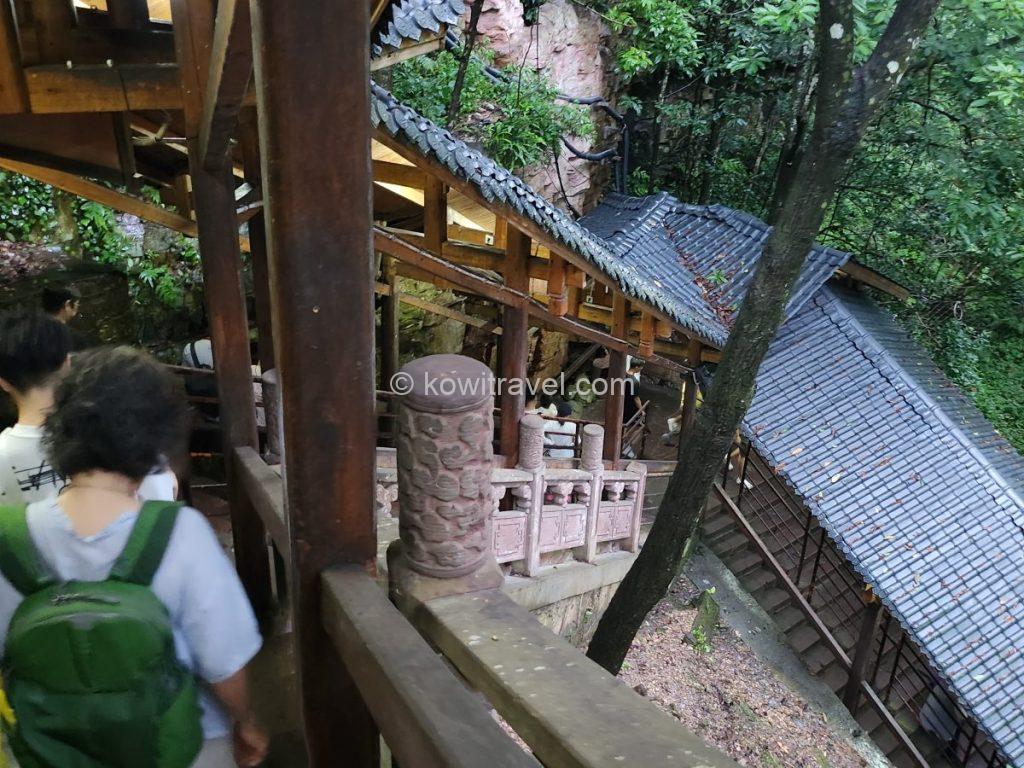
A wooden corridor with stairs leading toward the lower station
5. Departing from the Suyuansimen Transit Hub
Exiting the wooden pathway, I arrived at the Suyuansimen Transit Station, a vital transport hub named because four crystal-clear mountain streams (including the Golden Whip and Guangxi streams) beautifully wind through this exact valley confluence .
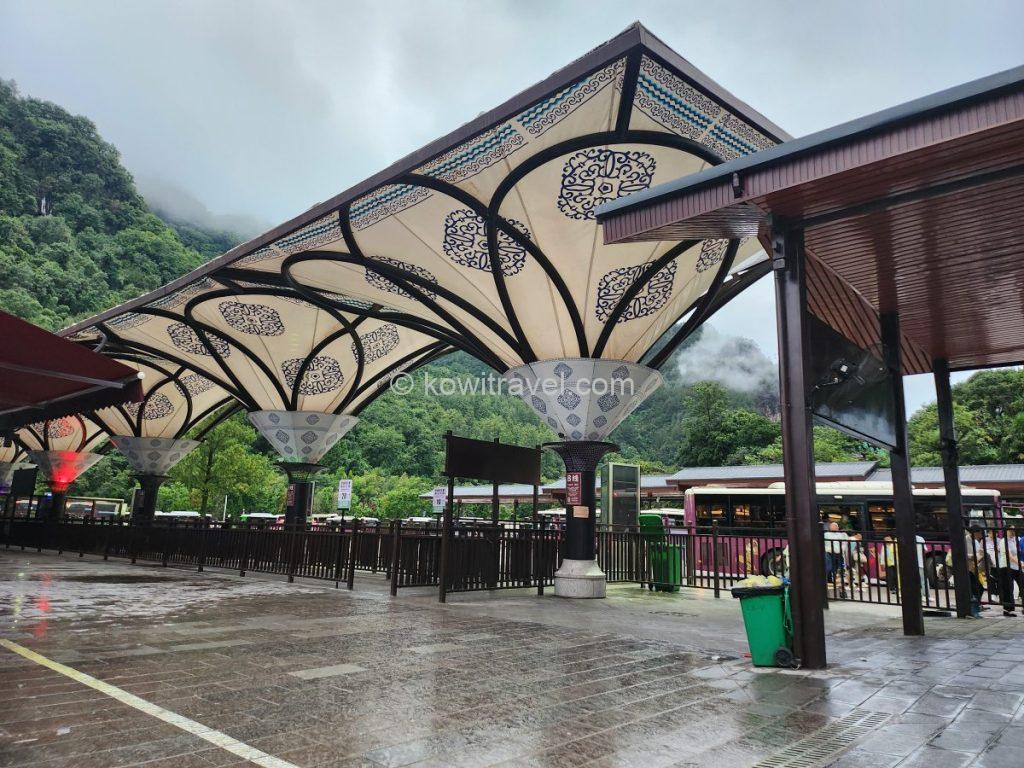
Shuttle bus stop at Shuoyao Samun
Under the massive structural canopies decorated with intricate, modern interpretations of traditional Tujia motifs, the plaza hummed with the shared excitement of travelers waiting for their next connections.
Having successfully conquered the depths and heights of the Yuanjiajie perimeter with my own two feet, I boarded the purple park shuttle bus bound for the Ten-Mile Gallery, eager to chronicle the next poetic chapter of this grand Zhangjiajie expedition.
6. The Ten-Mile Gallery – Riding Through a Living Shanshui Scroll
📌 TL;DR: Don’t walk this—take the iconic mini-monorail. As you click-clack along the valley floor, you’ll pass high-definition geological sculptures including the slouch-backed “Herb-Gathering Old Man”, the twin-pointed “Emperor’s Crown”, the V-shaped “Gateway of the Gods”, and the legendary “Three Sisters Peaks” acting as maternal sentinels in the mist.
A brief eco-shuttle ride from Suyuansimen brought us to the final grand highlight of our Post 11 chronicle: the poetic Ten-Mile Gallery canyon gorge.
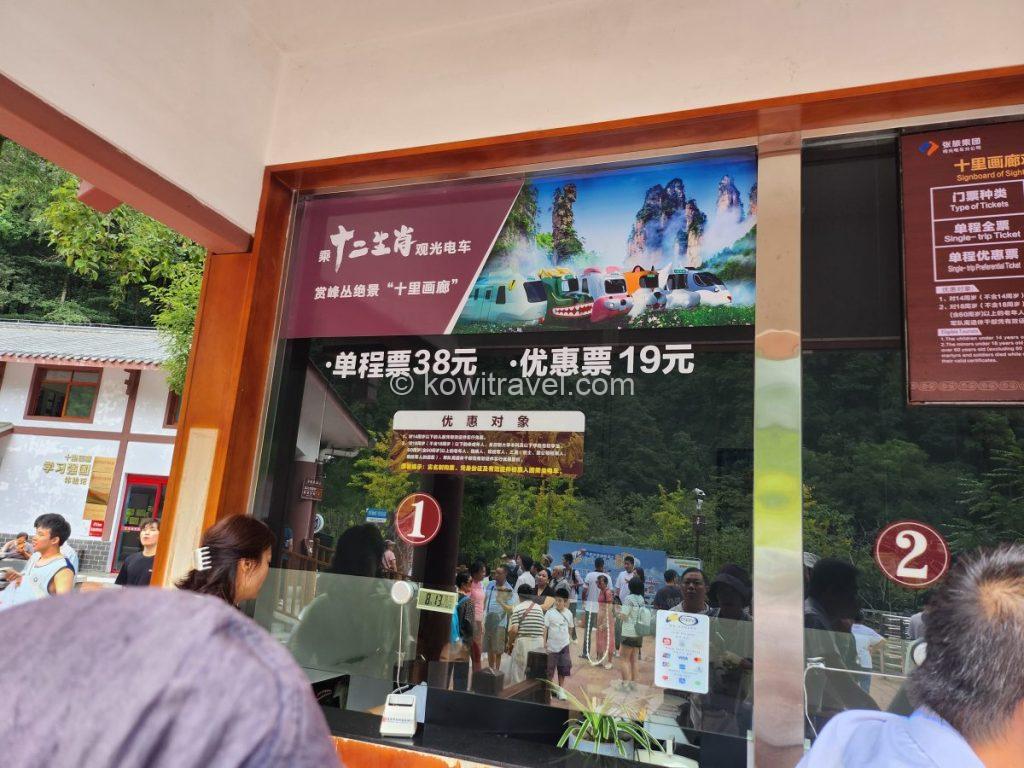
Ticket office for the Ten-Mile Gallery monorail
The name reflects a historic local sentiment: “The bizarre rock curtains lining both sides of the canyon resemble a massive, continuous painting unfurled over ten li (approx. 5.8 kilometers).”
👉[Check real-time pricing for the Zhangjiajie Ten-Mile Gallery monorail on Klook.com]
This deep valley is flanked on both sides by dramatic, interlocking rock curtains that give you the surreal sensation of wandering straight through a massive, ancient landscape album.
To manage our physical pacing after clearing thousands of vertical stone steps, we purchased tickets for the area’s iconic mini-monorail, climbing aboard the open-air train blocks.
As the small train clicked and rumbled along the valley floor, nature’s most intricate geological sculptures began to reveal themselves through the dense green canopy in perfect succession.
6. 1) The Herb-Gathering Old Man – The Mystical Healer of the Canyon
Among the numerous stone spires gliding past the monorail windows, a stunning monument forced me to grab my camera. This was The Herb-Gathering Old Man, widely recognized as the most delicate natural sculpture in the entire gallery.
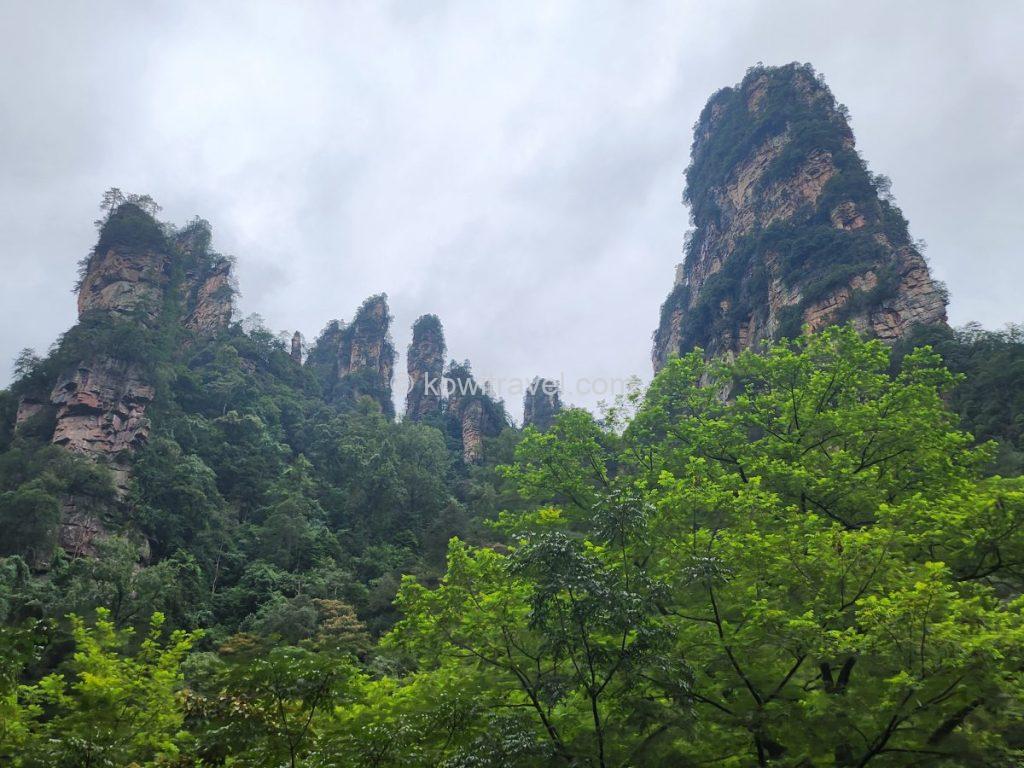
If you look closely, it truly resembles a person carrying something on their back
Zooming into the crest of the sharp sandstone spire, the silhouette is astonishingly realistic. It perfectly depicts an elderly man with a slightly slouched back, wearing a traditional headscarf, and carrying a large woven basket on his back as he navigates the high cliffs.
Local Tujia lore whispers that he was a legendary tribal doctor who spent his days harvesting mountain herbs to treat soldiers wounded in Emperor Xiang’s ancient rebellion, eventually transforming into stone right where he walked. It stands as a flawless monument to the precise horizontal bedding and vertical joint weathering unique to Zhangjiajie.
6. 2) The Emperor’s Crown Monolith near ‘Tianzi Zuo’
As we glided past the old healer and looked higher into the canopy, a bizarrely shaped rock structure captured my attention.
The summit of this spire is split cleanly into two distinct points, bearing an uncanny resemblance to an imperial Crown or a high sacrificial altar.
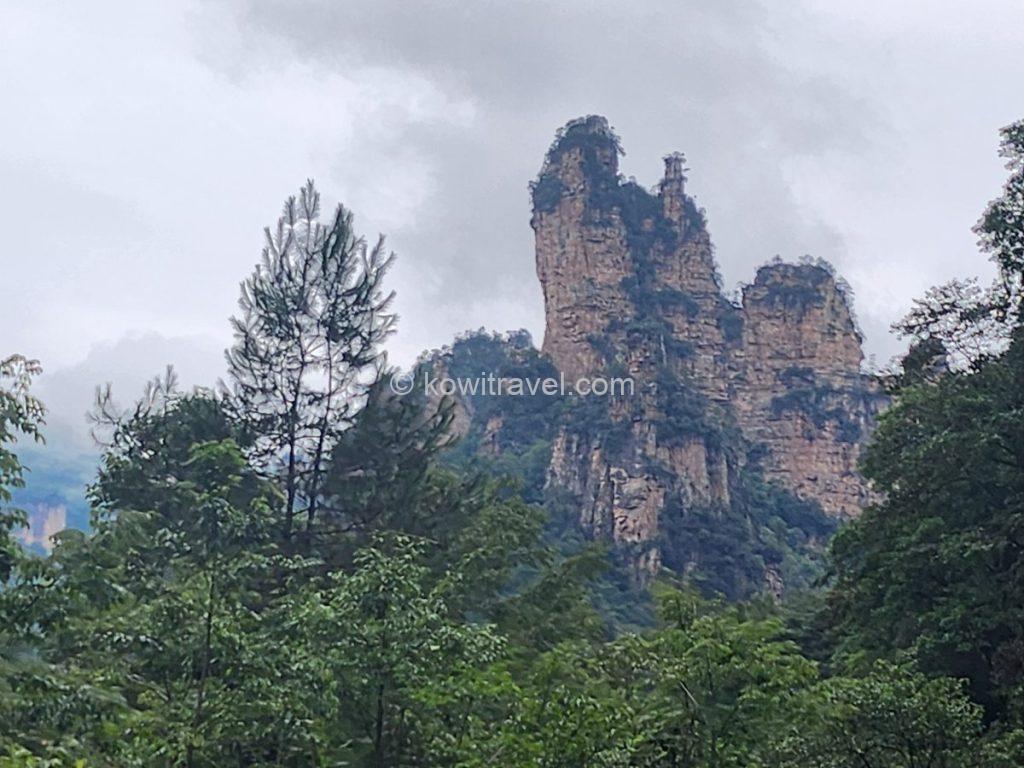
Tianzi Peak (Heavenly Son Peak) and the surrounding rock formations
Local legends hold that this was the very seat where Emperor Xiang would sit to rest during his campaigns, serving as a symbolic sentinel of the Tianzi Zuo territory.
6. 3) The Gateway of the Gods, ‘Jin Zhi Men’
This unique formation features two massive sandstone columns that fracture cleanly at the top to form a giant V-shaped opening, looking precisely like a monumental Gate to the Heavens.
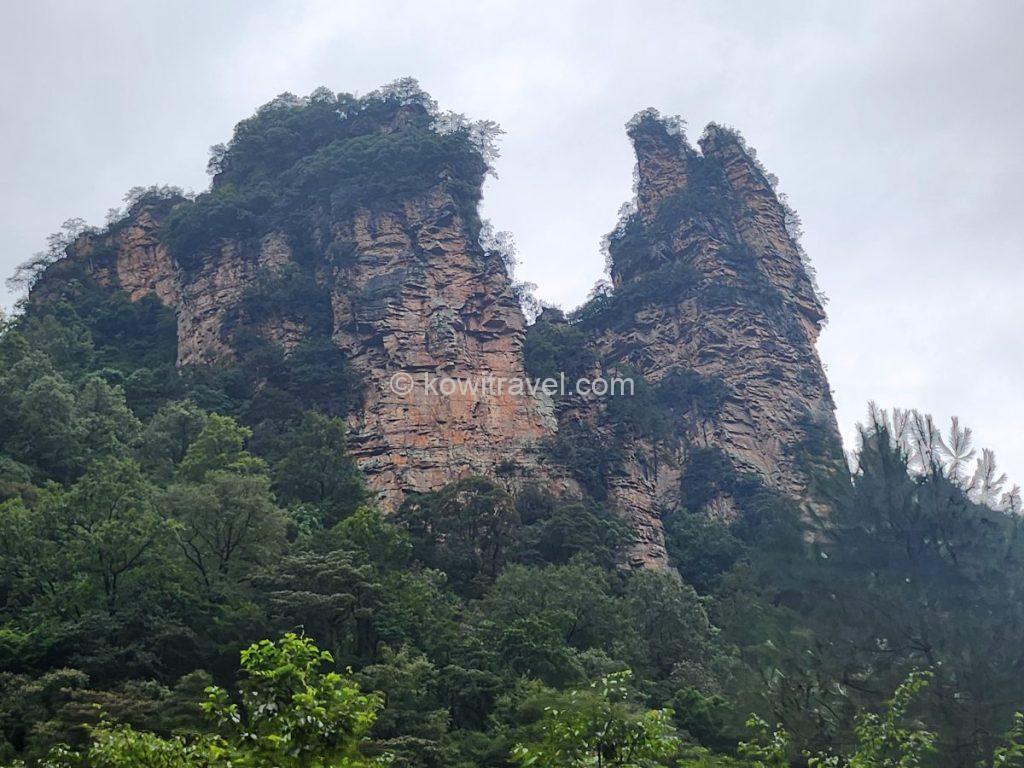
The unique appearance of the “The Gateway of the Gods” (Jin zhi men) rock formation
It offers an incredible view from the canyon floor, showcasing the grand evolutionary split where the horizontal walls of Yangjiajie separated into the independent pillars of Yuanjiajie.
6. 4) The Three Sisters Peaks – Sentinels of Eternal Devotion
As the monorail approached the terminal turnaround station, a majestic trio of massive rock columns rose in unison to dominate the forward horizon. This was the definitive climax of the Ten-Mile Gallery: The Three Sisters Peaks.
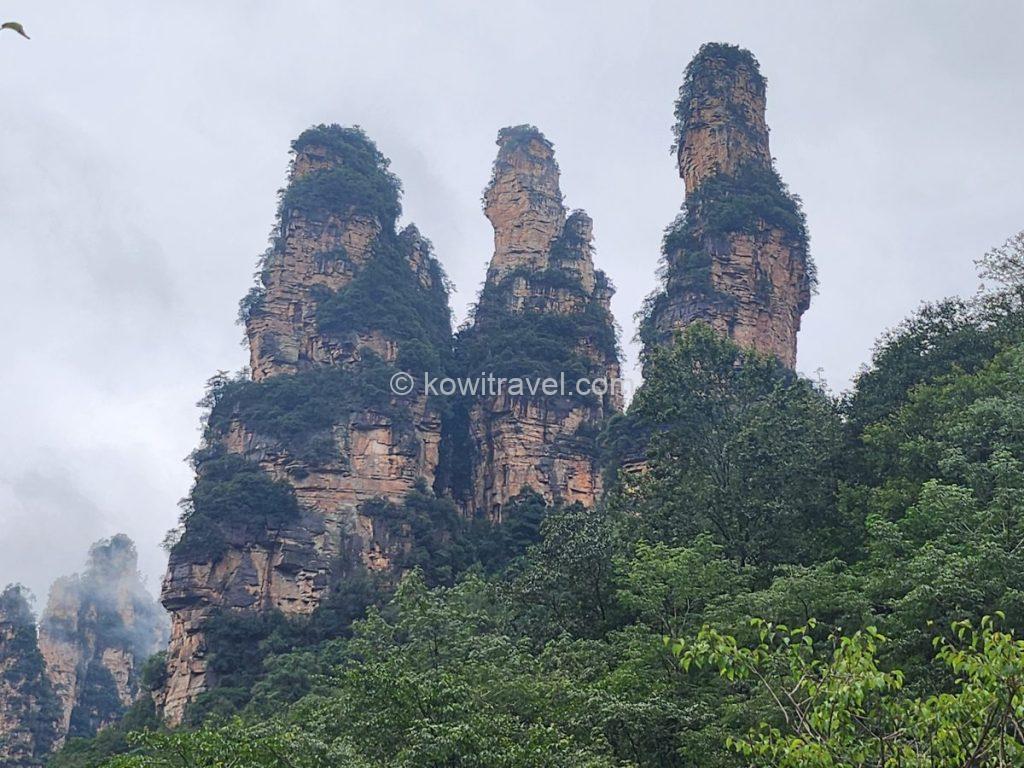
A close-up view of the “Three Sisters” rock formation
Standing side-by-side, each peak bears an incredibly distinct feminine form. The leftmost column, The Eldest Sister, features a contour resembling a mother holding a newborn baby in her arms.
The middle column, The Second Sister, portrays a woman with a child strapped to her back, gazing longingly into the distance for her husband. The rightmost pillar, The Youngest Sister, depicts a modest, unmarried maiden holding a gathering basket.
The moving legend of these sisters transforming into mangbu석 (devotion stones) while waiting endlessly for loved ones who went off to war, framed beautifully against the shifting valley mist, provided a deeply emotional and dreamlike finish to our grand trek.
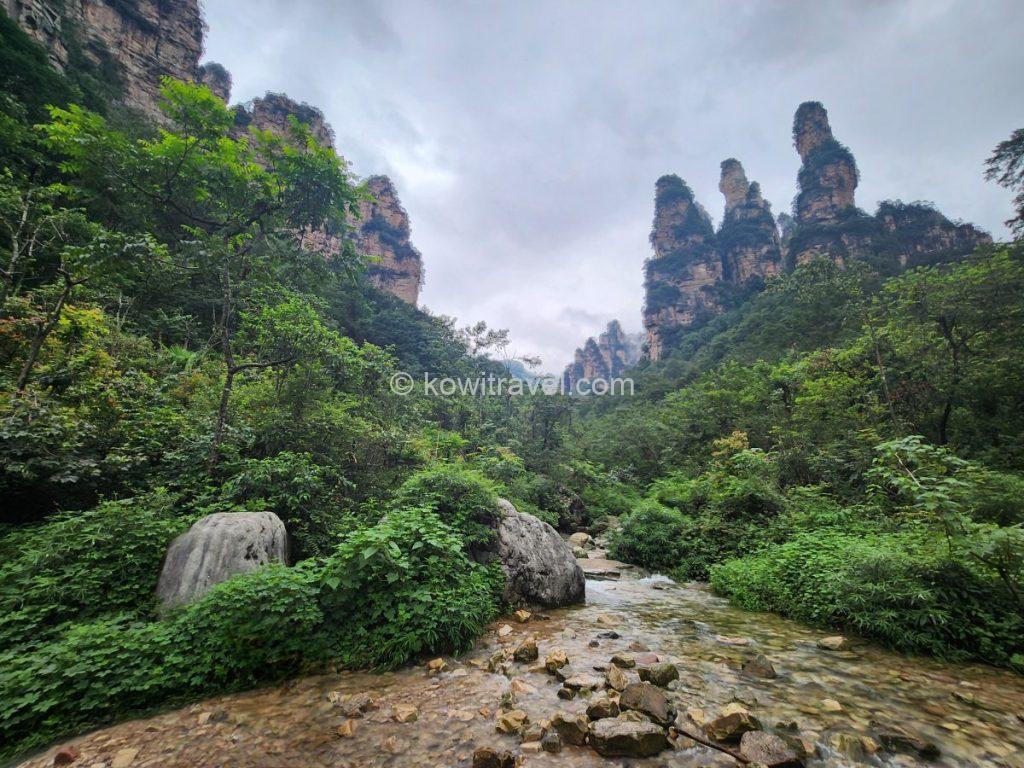
The “Three Sisters” rock formation as seen from a walking path near the terminus of the Ten-Mile Gallery
7. Looking Ahead to Post 12
Beginning at the untouched heights of Yuanjiajie’s freestanding stone giants, plunging down the vertigo-inducing drop of the Bailong Elevator, and finally looking straight up at the poetic strange and uniquely shaped rocks from the floor of the Ten-Mile Gallery, we have officially brought a triumphant close to our grand walking expedition through the Zhangjiajie National Forest Park.
Stepping away from the valleys, our journey now pivots toward a completely different side of Zhangjiajie’s hidden worlds.
In the next post, we leave the surface behind to explore the massive underground palace of Yellow Dragon Cave , stepping into an uncharted realm of subterranean mysteries. From there, we will step out onto the vertigo-inducing Glass Bridge suspended high over the void at the Zhangjiajie Grand Canyon.
The dramatic twist of Zhangjiajie—moving from the heavens to the earth, and deep into chasms and caves—continues in Post 12. Stay tuned!
👉[ Read the Review of #10. Part 1 – Tianzi Mountain and Yangjiajie ]
” This post includes affiliate marketing links. If you make an accommodation booking through these links, I may earn a small commission at no additional cost to you.”