#13. A Mind-Blowing Natural Wonder of Vertical Cliffs and Emerald Canyons!
🚨 TL;DR: Zhangjiajie Grand Canyon at a Glance
● The Vibe: Massive glass bridge 300m in the air, adrenaline rides down, and a chill emerald lake cruise to finish.
● The Playbook: Book the Route B Combo Ticket ($40–$45) online in advance. It includes everything and saves massive cash.
● Pro Hack: Double the fun by pairing it with Yellow Dragon Cave in the morning—they are on the exact same road.
1. Getting from Downtown Wulingyuan to the Grand Canyon – Didi/Amap Taxi Hacks & The Ultimate ‘Yellow Dragon Cave’ Combo Routine!
Many travelers assume the Grand Canyon is right next to downtown Wulingyuan. In reality, it’s a fairly long drive navigating provincial roads and winding mountain passes.
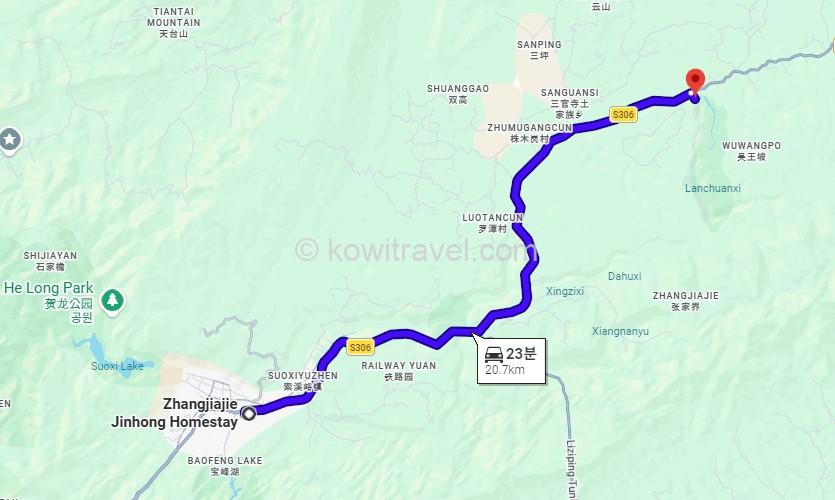
Route and travel time from the Dongmun accommodation to Zhangjiajie Grand Canyon
If you head straight to the Grand Canyon from a hotel near the East Gate, the distance is roughly 20km to 22km. It takes about 25 to 35 minutes one way, and a taxi hailed via the Amap (Amap/Gaudemap) app will cost around 60 to 80 RMB (approx. $8.50 to $11.50 USD).
Because we had a flexible schedule and wanted to pace ourselves, we originally visited one major attraction per day. However, for independent travelers looking to aggressively save both time and money, here is an absolute game-changer of an itinerary tip.
Combine the Grand Canyon with Yellow Dragon Cave (which I covered in Episode 12) into a single-day trip!
👌 [Pro Travel Tip] The Ultimate Same-Day Route: Morning at Yellow Dragon Cave ➡ Afternoon at the Grand Canyon
If you look at the map, Yellow Dragon Cave sits almost perfectly midway between downtown Wulingyuan and the Grand Canyon.
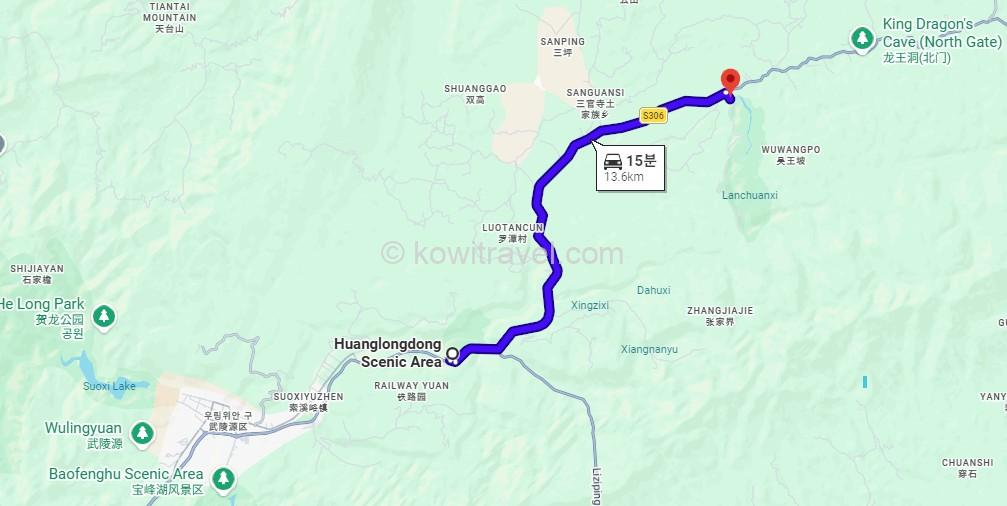
Route and travel time from Huanglong Cave to Zhangjiajie Grand Canyon
Therefore, if you have the stamina and want to optimize your schedule, knocking out both in one day is logantically flawless.
A thorough exploration of Yellow Dragon Cave—from walking the cavern paths to taking the underground boat tour—takes about 2 to 2.5 hours. We highly recommend entering around 9:00 AM, grabbing lunch nearby right after, and immediately heading over to the Grand Canyon for the afternoon.
- The Math Behind the Combo: Shifting from Yellow Dragon Cave to the Grand Canyon cuts the travel distance down by nearly 7km, meaning you only need to cover about 13km to 15km. This shaves 8 to 10 minutes off your drive and drops your Amap taxi fare to under $6 USD.
👌 The ‘Getting Back’ Survival Hack!
The exit area of the Grand Canyon is quite remote and far from the city center, making it notoriously difficult to hail a taxi on Amap when you finish. If possible, exchange WeChat contact info with the taxi driver who drops you off and make a personal booking for them to pick you up later. Alternatively, you will have to haggle with unregulated private drivers on-site. We struggled to catch a ride and had to walk quite a ways down the road before our app ride request went through. Keep this in mind!
👌 Amap Taxi App Tips!
When you get into your taxi, the driver will ask for the last 4 digits of your registered phone number to verify your identity. Simply say the numbers in Chinese or show them your phone screen, and the driver will punch it into their navigation pad to start the trip.
As for payment: If you have Alipay linked to your Amap app, the fare is automatically processed through the app when you reach your destination. You can jump right out without having to fish for cash or hand over a credit card.
After a short drive framed by Zhangjiajie’s signature jagged stone pillars soaring outside the window, we successfully arrived at the heart of the Grand Canyon and the entrance to the Glass Bridge ticket gate.
Let’s dive into the pulse-pounding journey of the Zhangjiajie Grand Canyon.
2. History, Geology, and the Irresistible Charm of Zhangjiajie Grand Canyon
[Click to Read] History, Geology, and Myths (If you love details!)
Zhangjiajie Grand Canyon was historically known as Lanchuanxia (“Broken Boat Canyon”). It is a massive natural gorge sculpted over hundreds of millions of years by tectonic shifts and water erosion.
Local folklore says that during a catastrophic ancient flood, a mystical celestial vessel descended from the heavens to rescue the stranded villagers. Once its mission was complete, the boat allegedly remained here and decayed over time, earning the gorge its original name. Today, following major tourism development, it has been given the much more intuitive and globally recognized name: Zhangjiajie Grand Canyon.
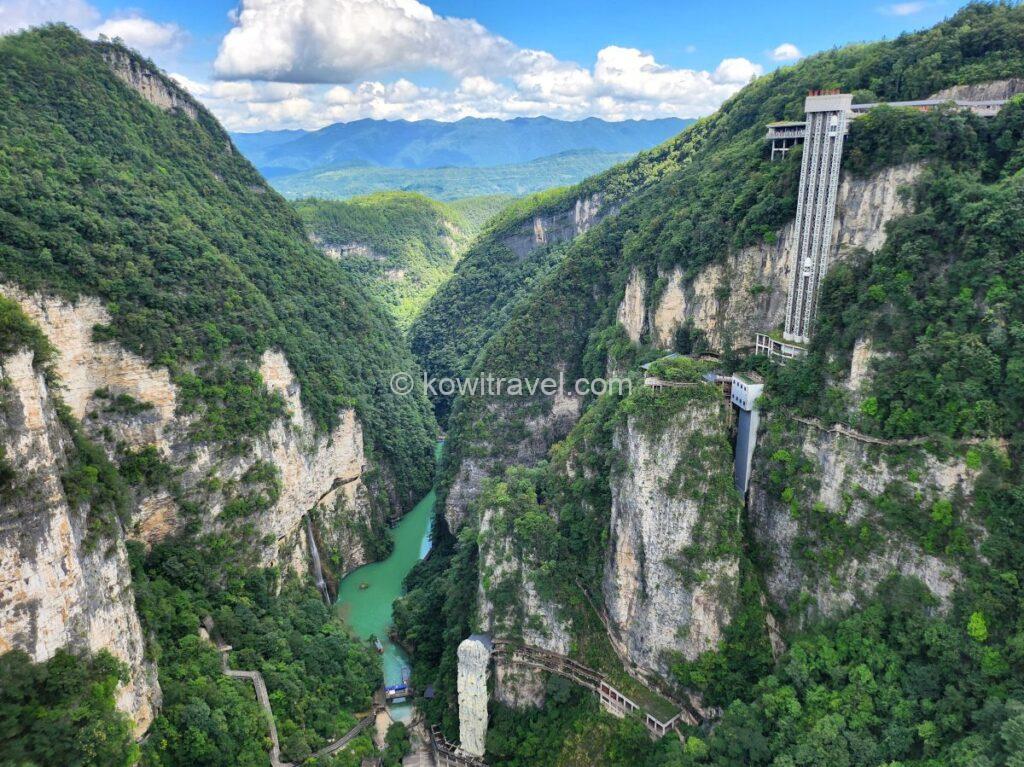
The vast panorama of the Zhangjiajie Grand Canyon, viewed from the glass bridge, commands one’s full attention.
Geologically, this is a textbook example of a Karst landform. It features sheer, plunging cliffs, cascading waterfalls, and crystal-clear streams cutting through the canyon floor. Looking down from the rim, it genuinely looks as though the earth was split wide open by a titanic force.
The stream flowing below glows with a brilliant emerald hue, a stunning visual byproduct of the limestone and heavy mineral content in the water. This vivid water contrasts beautifully with the dense, untouched primeval forest, creating an atmosphere straight out of an ethereal fairyland.
Furthermore, because of its deep, enclosed valley structure, the canyon maintains its own isolated microclimate. It stays incredibly cool inside even during the scorching heights of summer, preserving a pristine ecosystem where rare, indigenous flora thrives.
Unlike Tianzi Mountain or Yuanjiajie, where you mostly look at the scenery from afar, the Grand Canyon is a playground. It seamlessly weaves nature with high-adrenaline activities—including the world’s longest and highest glass bridge, VR experiences, cliffside slides, ziplines, and canyon cruises—making it easily the most dynamic and interactive stop in Zhangjiajie.
3. Diving into the Grand Canyon – Selecting Route B and Ticket Pricing
📌 TL;DR: Skip the analysis paralysis—just buy the “Route B + Experience Package” (7-in-5 Combo) for ~$42. It bundles the Glass Bridge, elevator, slide, VR ride, and cruise boat for way cheaper than buying piecemeal on-site. Budget 3.5 to 4 hours total.
- Quick Route & Pricing Breakdown
The canyon offers several ticket tiers, but if you want the definitive experience, you absolutely must choose the ‘Route B Combo Ticket’.
👉 [Check real-time Zhangjiajie Grand Canyon ticket options and rates on Trip.com]
👉 [Check real-time Zhangjiajie Grand Canyon ticket options and rates on Klook.com]
- Route B Itinerary: Walk across the Glass Bridge ➡ Scenic Cliffside Elevator ➡ VR Hot Air Balloon Experience ➡ Wuangpa Slide (Mugunghwa Slide) ➡ Shincheon Lake Cruise.
- Booking Tip: Instead of scanning QR codes and paying for each individual activity on-site, it is significantly cheaper and much more convenient to buy a bundled combo ticket online in advance (roughly $40 to $45 USD / 298 RMB retail).
- Total Time Required: Budget around 3 to 3.5 hours strictly for exploring and trying out the activities. If you visit during peak season when lines are long, expect it to take 4 hours or more, so plan your day with plenty of buffer time.
- Ticket Tier Details
- Route A (Pure Canyon Trekking + Cruise): A basic admission ticket that skips the Glass Bridge entirely, taking you straight down to the valley walking paths and ending with the boat ride. Price: approx. 60–63 RMB (~$9 USD).
- Route B Standard (Glass Bridge + Canyon Trekking + Cruise): The baseline ticket to cross the bridge, hike down through the lower canyon paths, and exit via the boat (excludes the extra thrill rides). Price: approx. 178 RMB (~$25 USD).
- Route B + Experience Package (7-in-5 Combo): The ultimate package. It covers the baseline Route B entry and allows you to freely pick 5 major thrill attractions—including the zipline, elevator, Wuangpa slide, and VR hot air balloon—without paying piecemeal. It is a massive money saver compared to buying them individually on-site. Price: approx. 295–298 RMB (~$42–$44 USD).
- Route C (Glass Bridge Round-Trip Only): A quick ticket for travelers who only want to step onto the Glass Bridge and walk back out without descending into the canyon below. Price: approx. 125–138 RMB (~$18–$20 USD).
4. The Live Route B Review: Activities & Attractions
4.1) A 300-Meter Abyss, Stepping onto the World’s Highest & Longest Glass Bridge
💡TL;DR: The Glass Bridge Rules
Security Alert: Zero tolerance for DSLRs, selfie sticks, metal flasks, or large bags. Pack ultra-light.
The Experience: 300m high, 430m long. You must wear the provided cloth shoe covers. It feels like walking on a giant sky mirror.
The Ultimate Thrill: Look down from the center to spot the world’s highest commercial bungee jump (260m / 3,000 RMB).
Stepping out of the taxi, we were greeted by the sleek, modern, and beautifully organized entrance plaza of the Zhangjiajie Grand Canyon.


With the weather being so clear, I head toward the ticket office with a light step, full of anticipation that I’ll be able to get a great view of the grand canyon.
Lady Luck was on our side; the weather was gorgeous, featuring a brilliant blue sky dotted with fluffy white clouds—perfect conditions for sweeping views. Flanked by traditional red Chinese knot decorations and clean signage, we walked toward the ticket gates with a skip in our step.
From the main ticket office, you hop onto a complimentary scenic shuttle bus that winds up the mountain roads for about 10 to 20 minutes before dropping you right at the official Glass Bridge entrance.
The very first obstacle you hit here is a notoriously strict security checkpoint.
To prevent any structural scratches to the glass panels and eliminate the catastrophic risk of dropped objects, professional cameras (like DSLRs), heavy tumblers, metal thermos flasks, and selfie sticks are strictly banned. You are only allowed to bring your smartphone and a small pouch or compact bag. Independent travelers should pack as light as humanly possible for this trip.
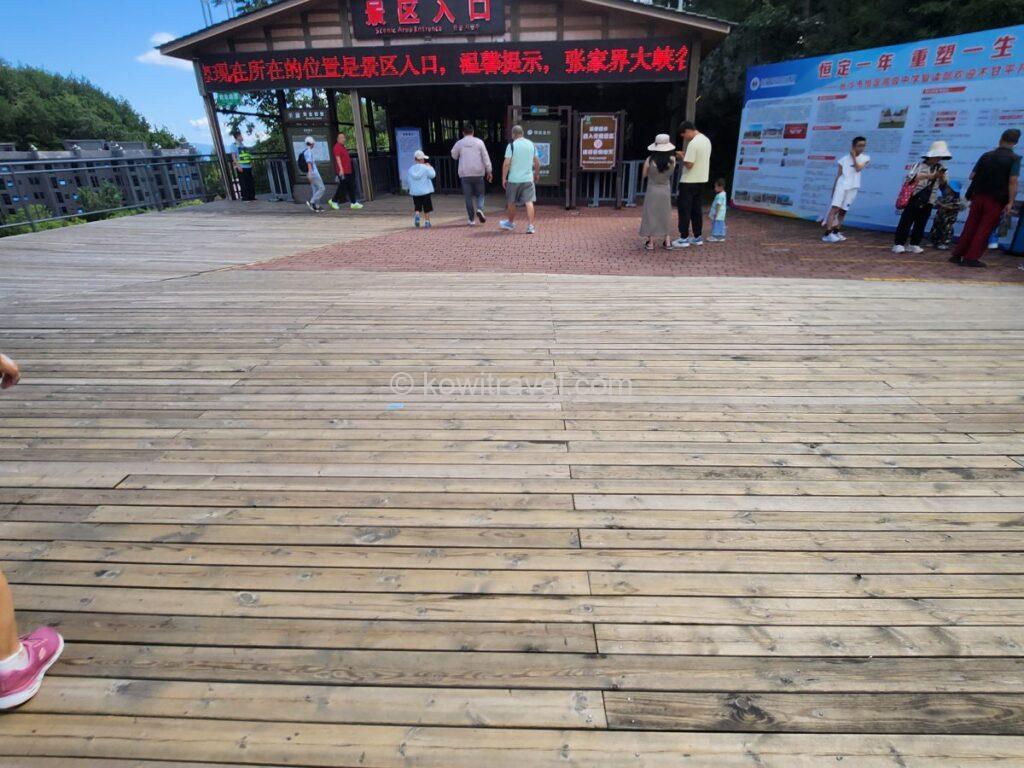
After getting off the free shuttle bus, you will arrive at the entrance to the tourist site, which leads to the glass bridge.
Once you clear security and step through the gates, the legendary Zhangjiajie Grand Canyon Glass Bridge comes into view, commanding your attention with its staggering scale.
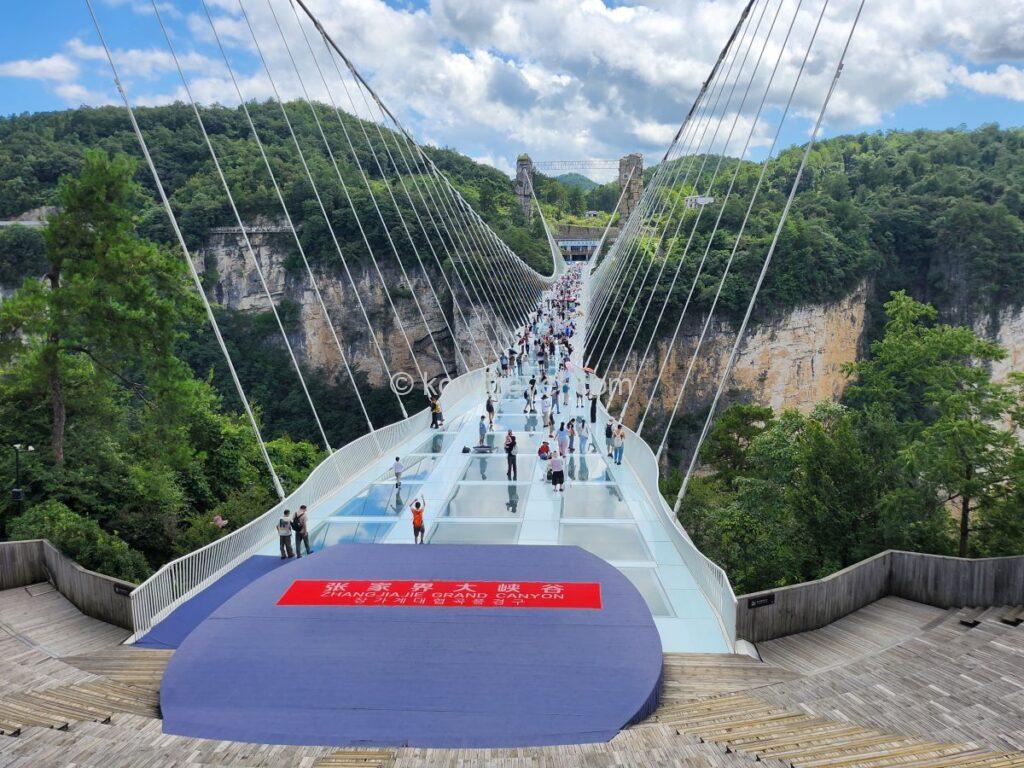
A miracle suspended in mid-air—finally revealed, here is the magnificent sight of the world’s highest and longest glass bridge.
As the crown jewel of the canyon, this structural marvel is suspended 300 meters above the canyon floor, stretching 430 meters long and 6 meters wide between two sheer cliff faces. Because the floor is built entirely out of transparent glass panels, walking across it delivers a heart-stopping thrill as you look straight down into the massive abyss right beneath your feet.
Right before the bridge deck, there is a large photo spot featuring the canyon’s name in bold letters. Standing here and catching your first glimpse of the vertical drop—revealing the tiny emerald stream winding 300 meters below—is guaranteed to make your pulse quicken.
Before you can officially step onto the glass, everyone is required to pull a pair of specialized cloth shoe covers over their footwear to protect the surface. Once our covers were securely on, we took our first tentative steps onto the transparent panels.


I feel a dizzying yet thrilling sensation, as if I were walking on the clouds.
Stepping out onto the bridge feels like walking on thin air, offering an incredible mix of liberation and raw adrenaline. I initially worried the bridge might sway in high mountain winds, but it is engineered with ultra-thick, three-layered tempered glass. It felt incredibly rigid, stable, and reassuringly solid.
The bridge deck was highly entertaining; visitors were everywhere, sitting, kneeling, and laying flat on the glass panels to capture the ultimate dramatic perspective for their social media feeds.
The vivid atmosphere on the glass bridge—something that photos simply cannot fully capture—is truly remarkable. You can see people sitting down on the transparent floor to snap a photo, caught in a moment that is as thrilling as it is delightful, with a dizzying abyss visible right beneath their feet.
If you walk right to the dead center of the span and peer down through the glass, you will notice a metallic structural cage hanging underneath.
That is the world’s highest commercial bungee jump platform, sitting at a terrifying 260 meters! Jumping from a height that eclipses even the Macau Tower to dive like a bird into the gorge is something I could only marvel at from a safe distance. Even though a single jump costs a steep 3,000 RMB (roughly $420+ USD), standing on the bridge and watching thrill-seekers from all over the world actually take the plunge is a fantastic spectator sport. Keep your eyes peeled!
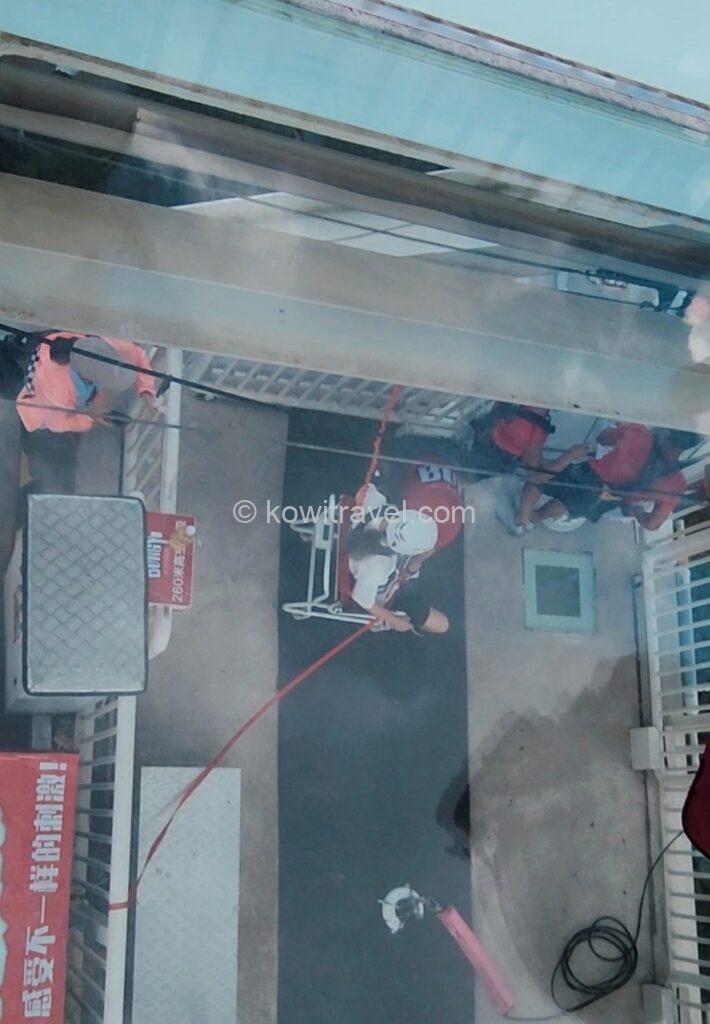
A female tourist preparing to jump from a bungee jumping platform
The bright sun and white clouds reflected so perfectly off the clean panels that it created an optical illusion, making it feel like we were drifting across a massive mirror suspended in the sky.
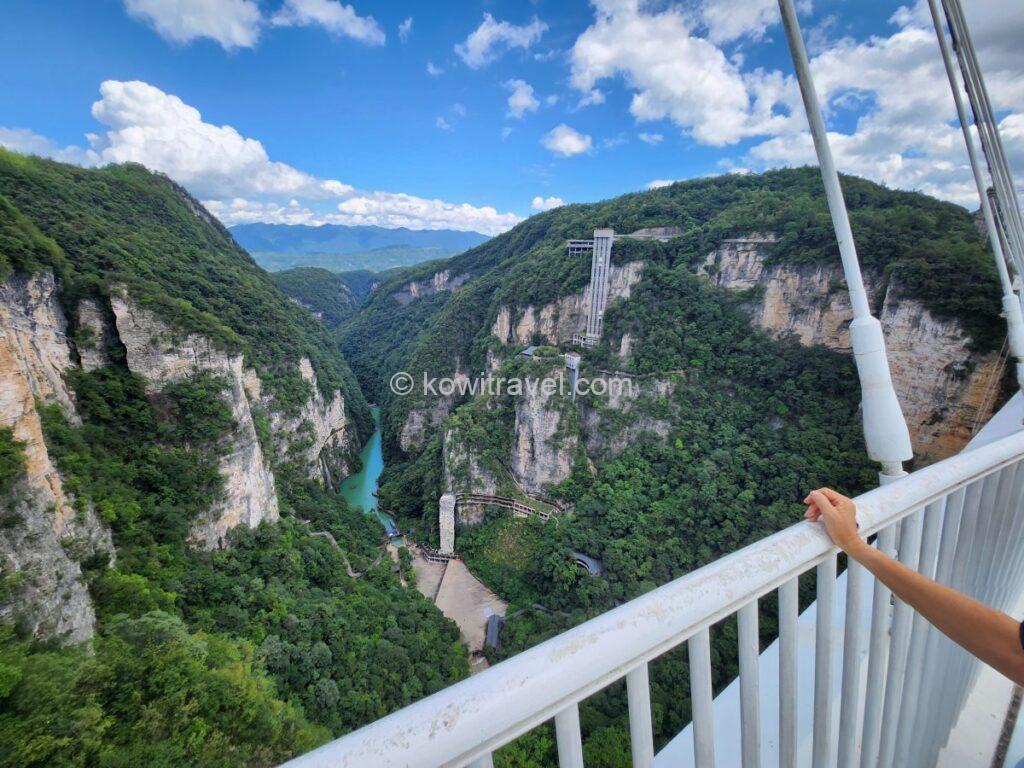
The breathtaking view of the grand canyon and the emerald-colored lake, seen from the bridge
Leaning against the handrails and looking outward opens up a panoramic view of the canyon’s pristine wilderness. The sheer rock walls framing the emerald water lane look exactly like a classic Chinese ink wash painting come to life.
Looking off to the right cliffside, you will see a massive vertical elevator tower built into the rock. That tower marks the transition point where the high-altitude bridge walk ends and the dynamic descent down into the canyon floor begins.
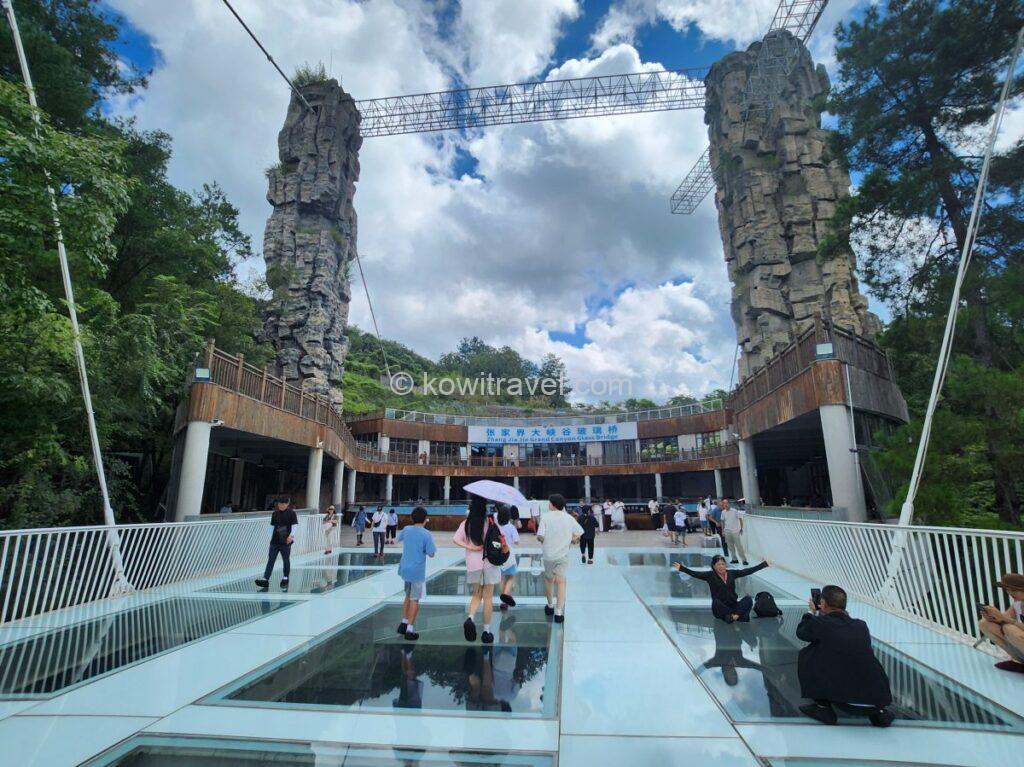
The imposing grandeur of the massive stone towers supporting the suspension bridge
4.2) Hugging the Cliffside, The Glass Skywalk Trek Immediately Following the Bridge
After crossing the bridge and entering the circular courtyard, clear signage directs you toward the next leg of the journey. Following the arrow pointing right, we headed toward the ‘Glass Walkway’.
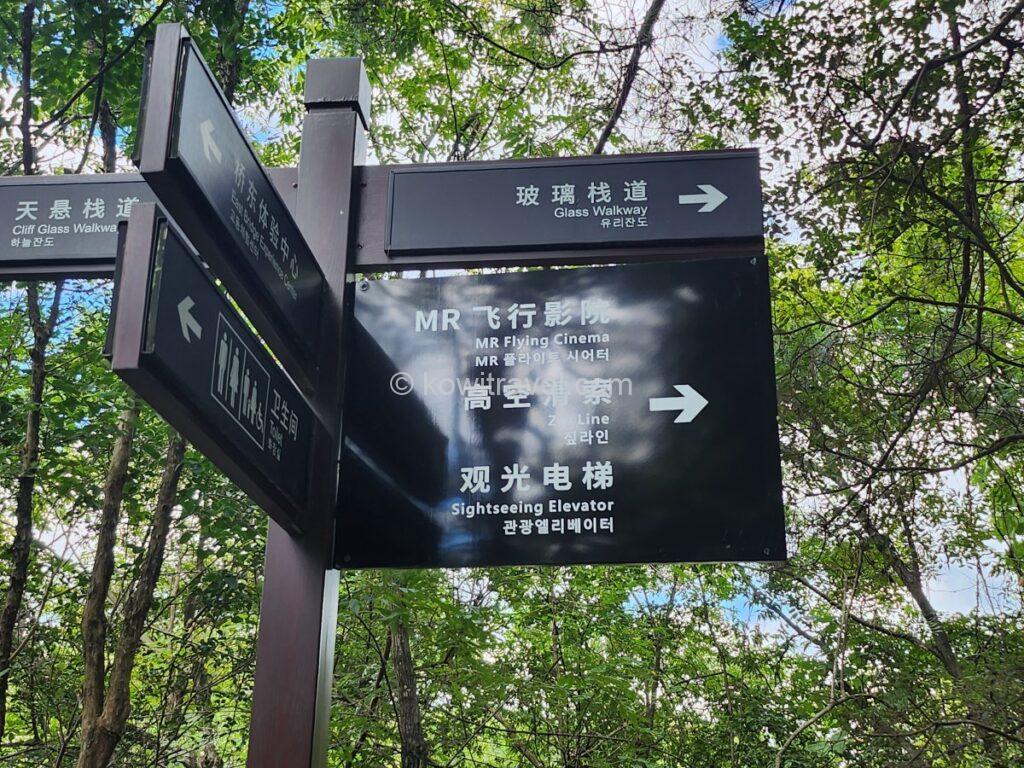
Follow the signs along the path toward the glass walkway.
The descent phase of the tour starts with a walk along a narrow pathway bolted directly into the vertical cliff face. Stepping down a brief flight of stairs, the glass skywalk appears, clinging to the rugged rock wall.


The glass walkway clings to the side of a cliff, with its transparent floor, it offers an exhilarating—and dizzying—experience.
Because one side of the walkway features a completely transparent glass floor, it delivers a totally different flavor of vertigo compared to the wide bridge. With every single step, the deep green primeval forest below stares right back up at you, instinctively forcing you to keep one hand firmly on the mountain-side railing.
As you leisurely pace along the skywalk, you get the absolute best profile view of the massive Glass Bridge spanning the gorge behind you.
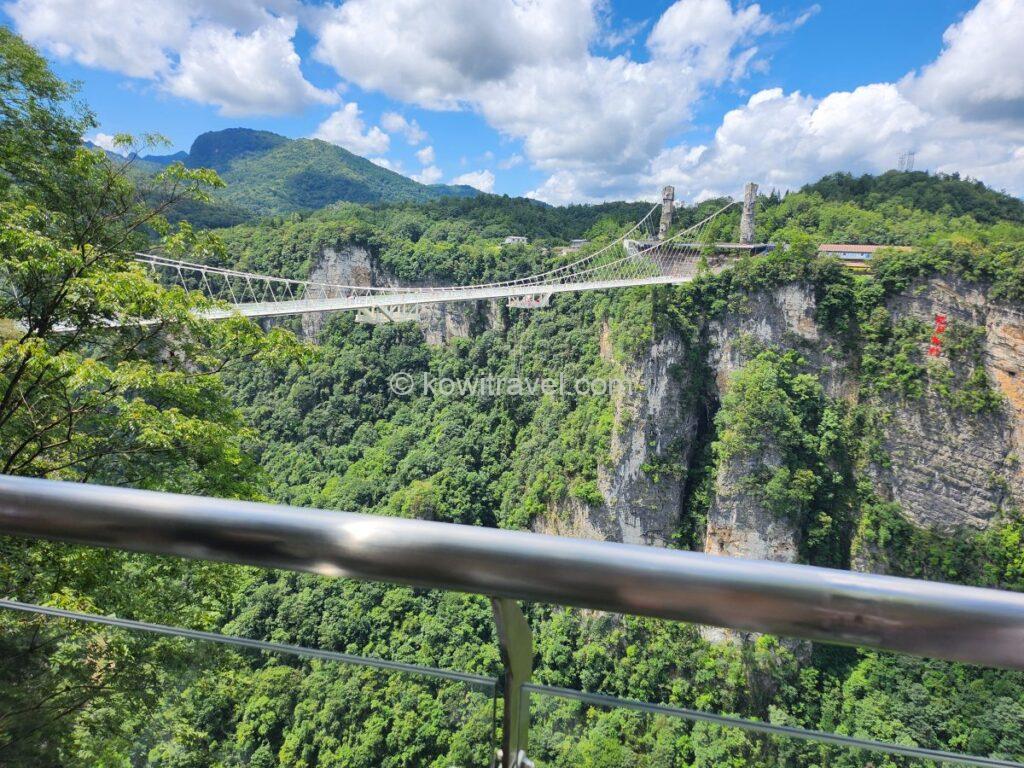
From the glass walkway, you can take in the massive scale of the glass bridge—a true testament to the grand proportions often found in China.
Seeing that massive white structure hanging over 300 meters of empty space gives you a profound sense of awe. It hits you all over again: “Wow, I just walked across that massive void.” This specific stretch of the path is hands-down the best vantage point to capture both the immense scale of the canyon and the miracle of modern engineering in a single photograph.
4.3) Flying Through the Gorge – The Futuristic 3D VR Hot Air Balloon Experience
Near the end of the cliffside trek, the path uniquely transitions indoors into a high-tech activity space: the VR Hot Air Balloon Experience Hall. It serves as an entertaining, futuristic interlude to catch your breath while midway down the cliff.
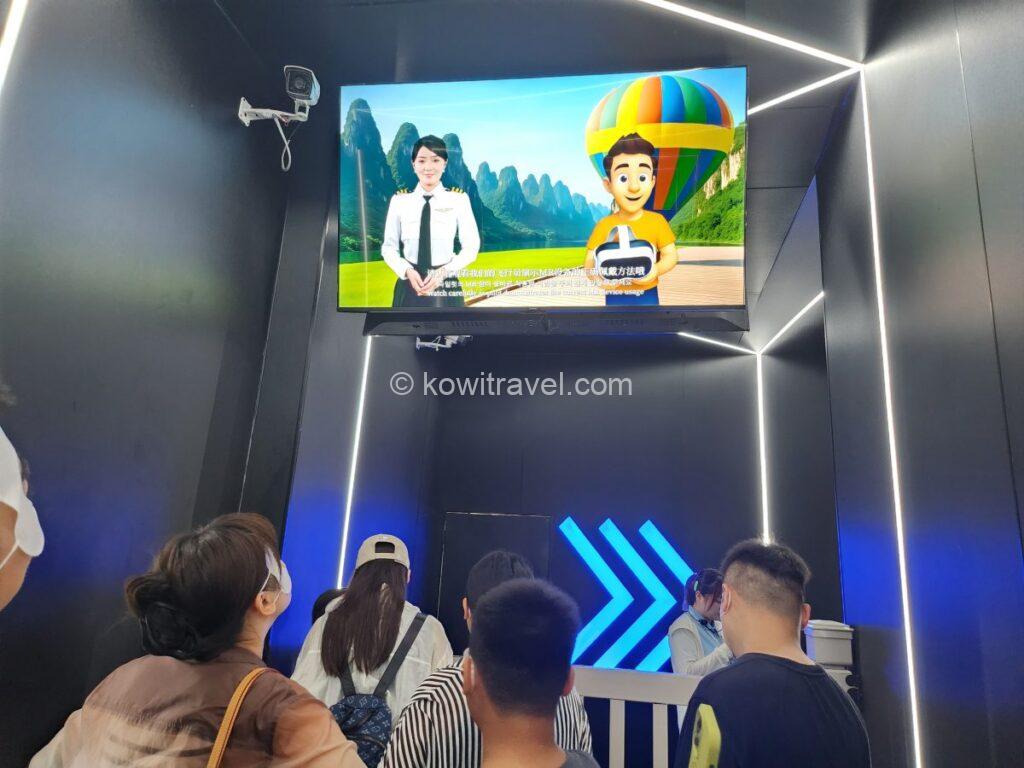
Entrance to the hot air balloon experience area
Inside the theater, you are greeted by large simulator bays shaped like real hot air balloon baskets. Visitors board in groups of three to five, strap on a pair of 3D virtual reality goggles under the guidance of the staff, and prepare for takeoff.
Unlike stationary theater seats, this simulator uses a standing basket structure that mimics a real flight deck.
I was highly impressed by the hygiene standards here; because the goggles are shared by hundreds of visitors daily, the staff distributes disposable, one-time-use eye patches to ensure a clean and comfortable experience.
Instead of violent jolts, the standing basket subtly tilts, sways, and shifts pitch in perfect synchronization with the virtual balloon’s flight path, maximizing the sensation of altitude. Standing up while experiencing it makes it feel like your feet are dangling over an open void. The 5-minute feature launches your balloon high above the Glass Bridge before diving down into a 720-degree panoramic flight, weaving tight lines through the deep stone crevices like a bird.
Guided by playful animated characters on screen, you smoothly navigate the colossal rock pillars and deep ravines of the canyon. The visual depth and spatial tracking were incredibly sharp, delivering a highly immersive sense of flight that made for a memorable virtual adventure.
4.4) Pure Speed, Blasting Down the Mountain on the Wuangpa Slide!
With our adrenaline pumping from the VR flight, we followed the wooden boardwalks and zigzagging staircases further down until we arrived at the staging area for one of the absolute highlights of the descent: the Wuangpa Slide .


Signpost for the Owangpa Slide (left) and the boarding area for the slide (right)
👌 Alternative Thrill Option – The Zipline
At this junction, you can customize your descent style. If you prefer to fly across the open canyon canopy strapped to a harness, a high-velocity Zipline option is available right nearby. If you want the ultimate open-air rush, simply follow the zipline signage instead.
For this trip, I opted for the Wuangpa Slide, which sends you shooting down a stone chute winding through the dense forest canopy.
Before jumping in, you are given a pair of heavy-duty canvas patch-pants to pull over your clothes to reduce friction, along with a pair of thick gloves. You control your descent speed entirely by pressing your hands and feet against the slide walls. The moment you push off into the covered tunnel, the acceleration kicks in. Drifting through the banked curves at high speed was a total blast—it instantly makes you feel like a kid again.
5. Hitting the Valley Floor: The Vertical Elevator Tower and the Lower Paths
Shooting out of the exit of the Wuangpa Slide, you finally touch down safely on the floor of the deep canyon basin.
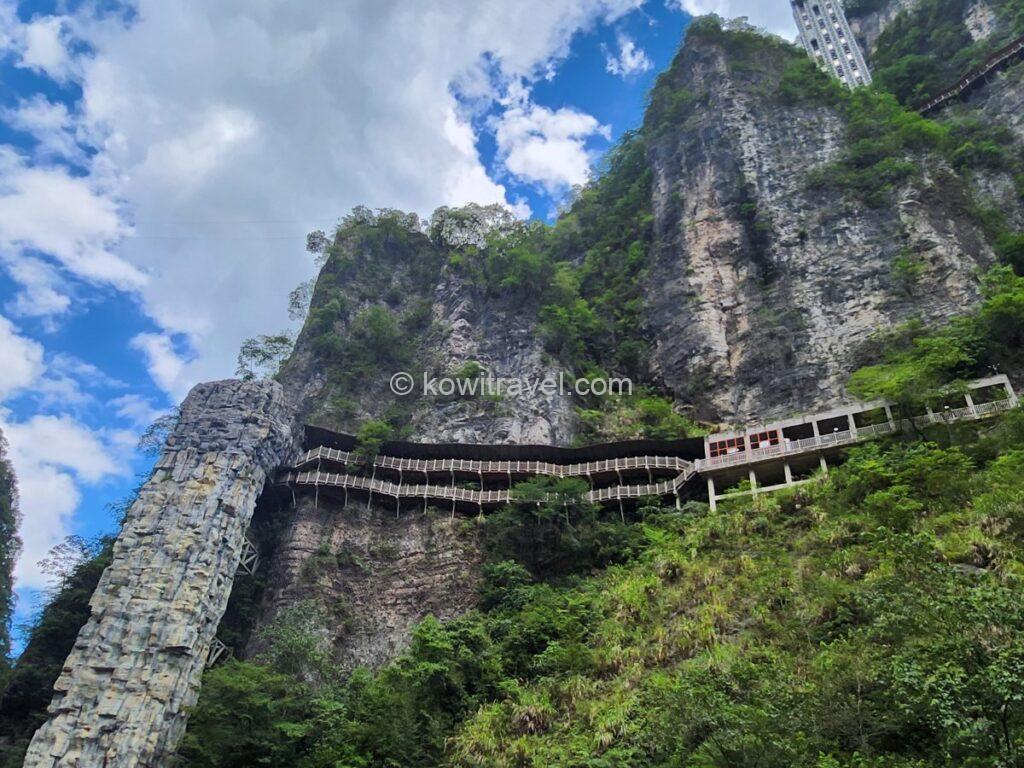
Immediately to the left, a colossal, rounded stone tower that looks like stacked river boulders commands the plaza. This massive structure serves as a multi-tiered rock-climbing wall and an artistic structural pillar for the base camp.
Stepping out into the clearing and craning your neck to look straight up, the Glass Bridge you were just walking on has shrunk into a razor-thin silver needle tracing the sky. It gives you a real, tangible appreciation for just how far down you have traveled.
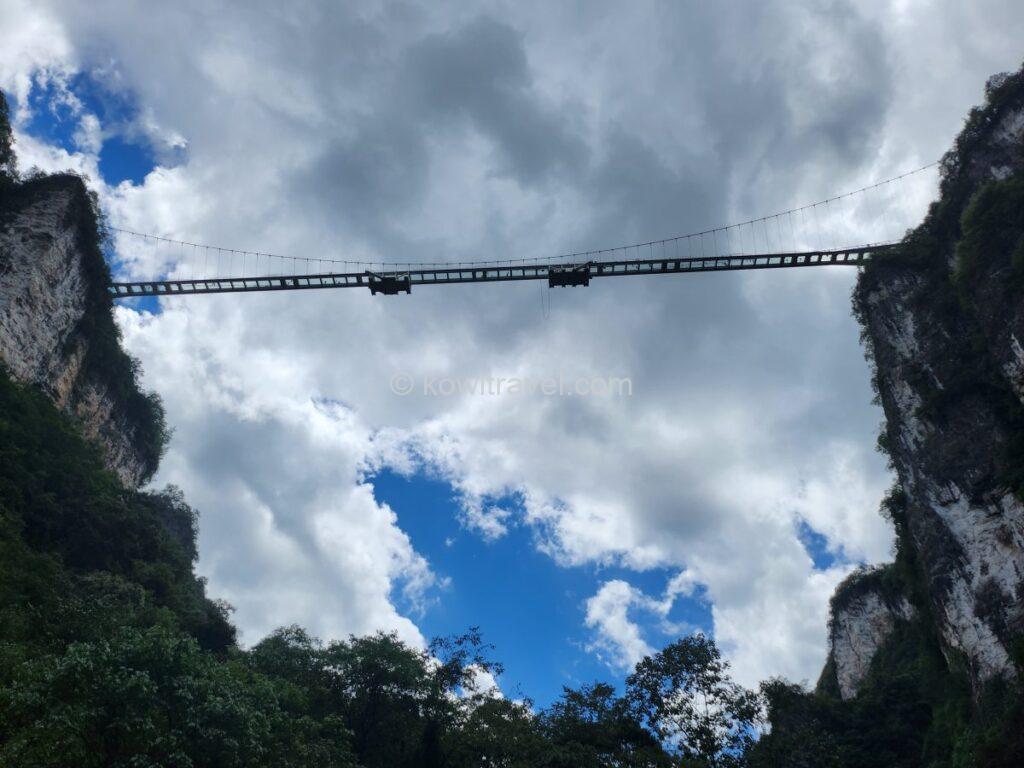
Looking up at the glass bridge from below, it appears remarkably high—so high, in fact, that the massive glass bridge I had walked across earlier now seems quite small. It is another reminder to marvel at the human ingenuity that made it possible to construct a bridge spanning the gap between two cliffs.
Adjacent to the plaza, the sheer scale of the transparent glass observation elevator tower climbing the vertical cliff face is breathtaking.
From this lower staging base, the high-altitude thrills conclude, transitioning into the tranquil second half of the tour: a peaceful valley trek alongside a bubbling stream leading toward the boat docks.
6. Hikes Through the Ancient Forest – Exploring the Lower Canyon Boardwalks
This stretch features a beautifully maintained wooden boardwalk weaving through the base of the vertical cliffs. The towering rock walls completely block out the sun overhead, making it feel like you are exploring a hidden, prehistoric cavern corridor.
Once you walk past the lower plaza, you are instantly transported into an entirely different world from the high-altitude bridges above.


You will pass the lower plaza (on the left) and enter the wooden walkway (on the right) where the trek begins.
Leaving the adrenaline behind, the path shifts into a deeply restorative healing trek along flat, beautifully constructed wooden paths running parallel to a roaring, ice-cold mountain stream.
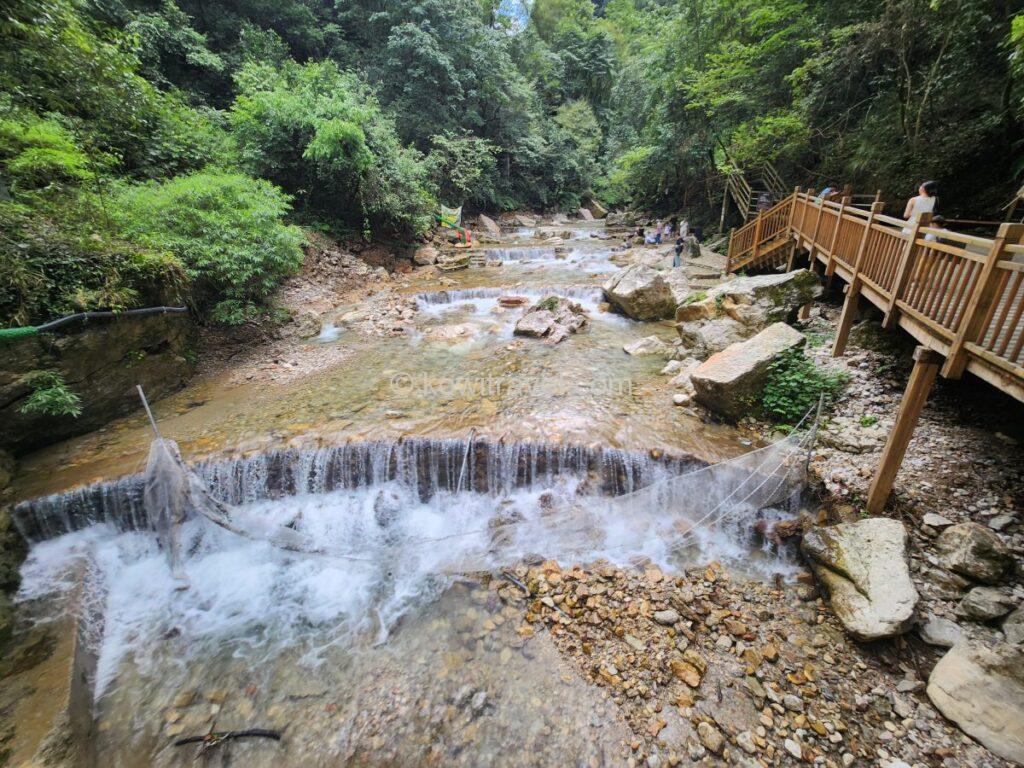
The crisp, roaring sound of the rushing water acts as natural white noise, instantly melting away any travel fatigue.
As the gorge narrows, the massive rock walls overlapping above form a natural canopy, offering cool, refreshing shade even at high noon. Walking with the rushing stream right beneath your feet makes it feel like you are uncovering a secret garden hidden away from the rest of the world.
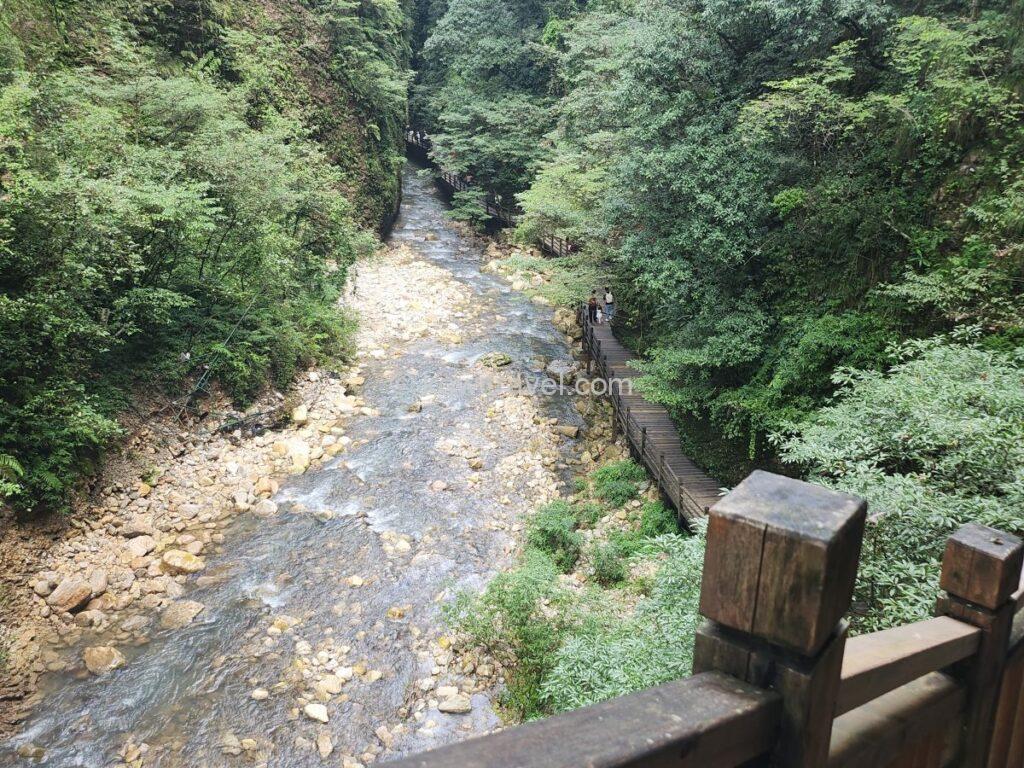
The shade created as the canyon narrows makes trekking much easier.
Further down the trail, the rushing rapids calm down, pooling into a breathtaking, glass-like emerald lake. With zero wind ripples on the water, the ancient forest and soaring cliffs reflect off the green surface like a massive, pristine mirror—it is an absolute showstopper of a view.
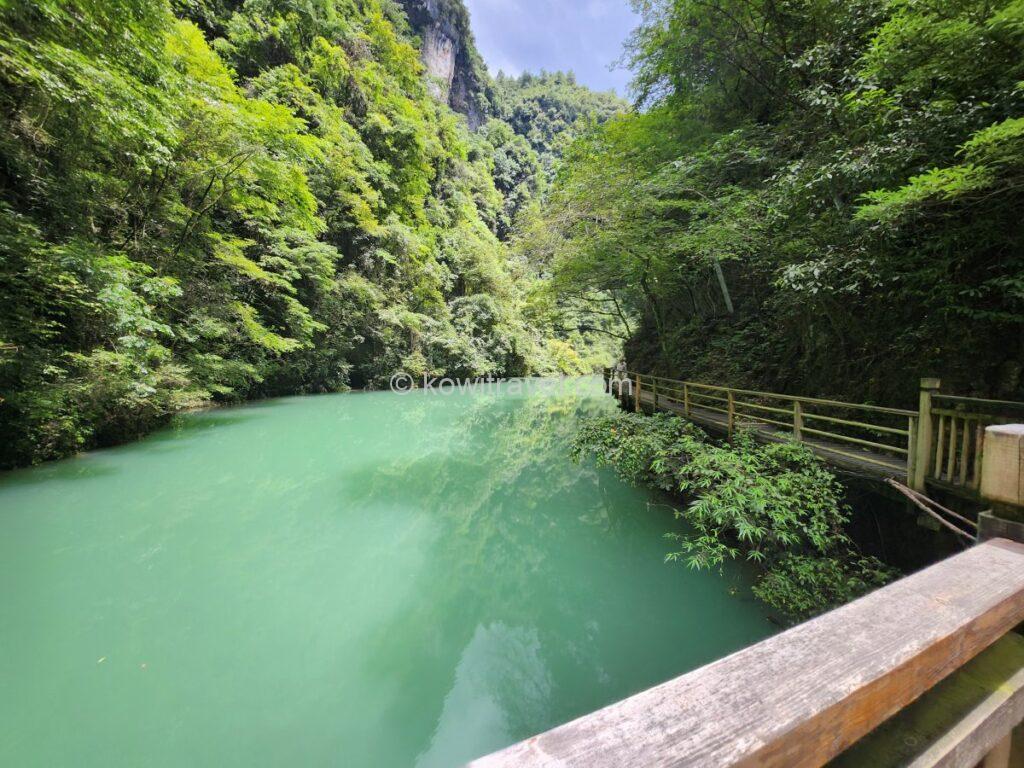
A soothing walking path along the edge of a calm, emerald-hued lake
Completely cut off from any artificial or urban noise, this lower trail offers a peaceful, meditative experience that stands out beautifully from the crowded, chaotic nature of Zhangjiajie’s other main scenic zones.
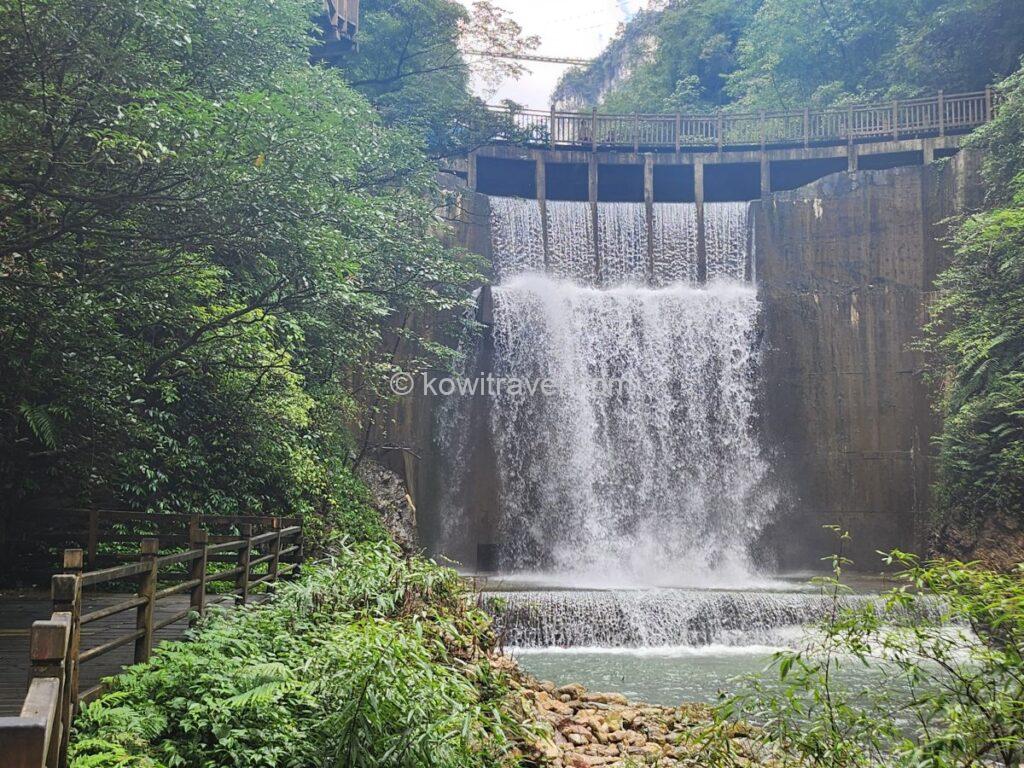
Near the start of this lower tracking path, you will encounter the ‘Tianxia Waterfall’. This is a beautifully engineered, dam-style artificial waterfall designed to collect the upper stream waters and send them cascading down a massive concrete wall, offering a grand, refreshing welcome to the lower trek.
7. Waterfalls and Hidden Sanctuaries – Mid-Way Rest Stops
About halfway through the lower valley hike, a roaring sound signals your approach to a massive, authentic natural waterfall plunging down the stone face.
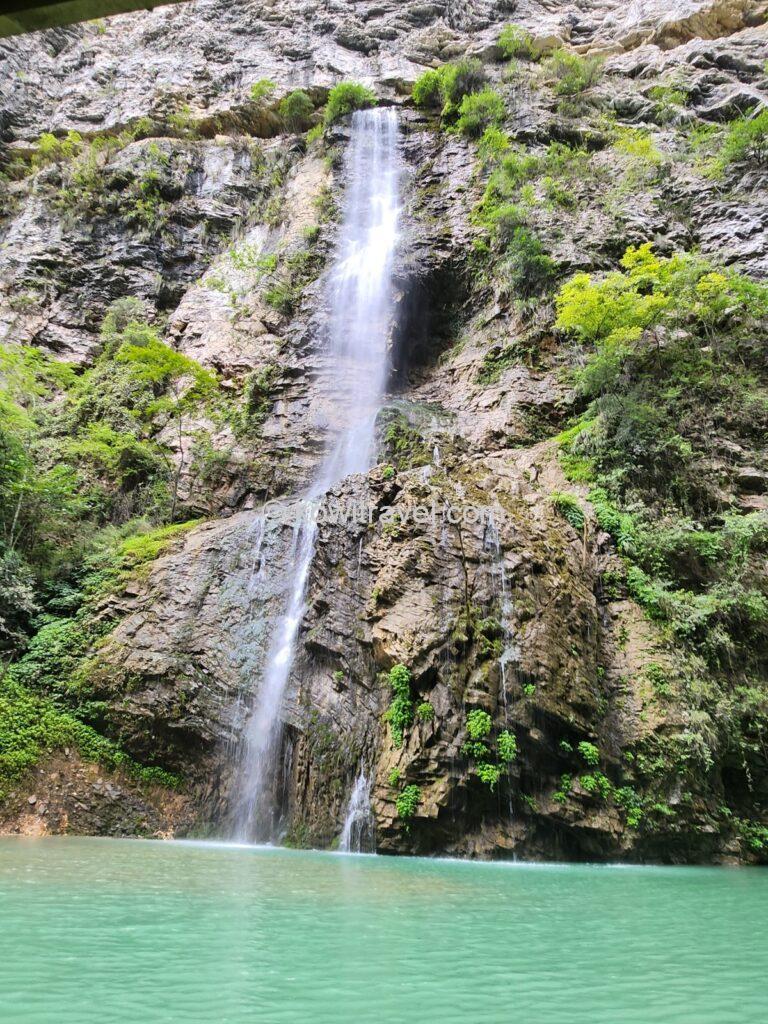
The sound of a waterfall cascading into the lake causes weary footsteps to pause for a moment.
Bursting directly out of a fissure midway up the gray rock wall, the water cascades gracefully into the emerald lake below, evoking the deep artistic weight of a classic scroll painting. Directly across from the falls, a beautifully designed traditional pavilion and viewing platform serve as the premier photo destination for hikers to pause and snap memories.
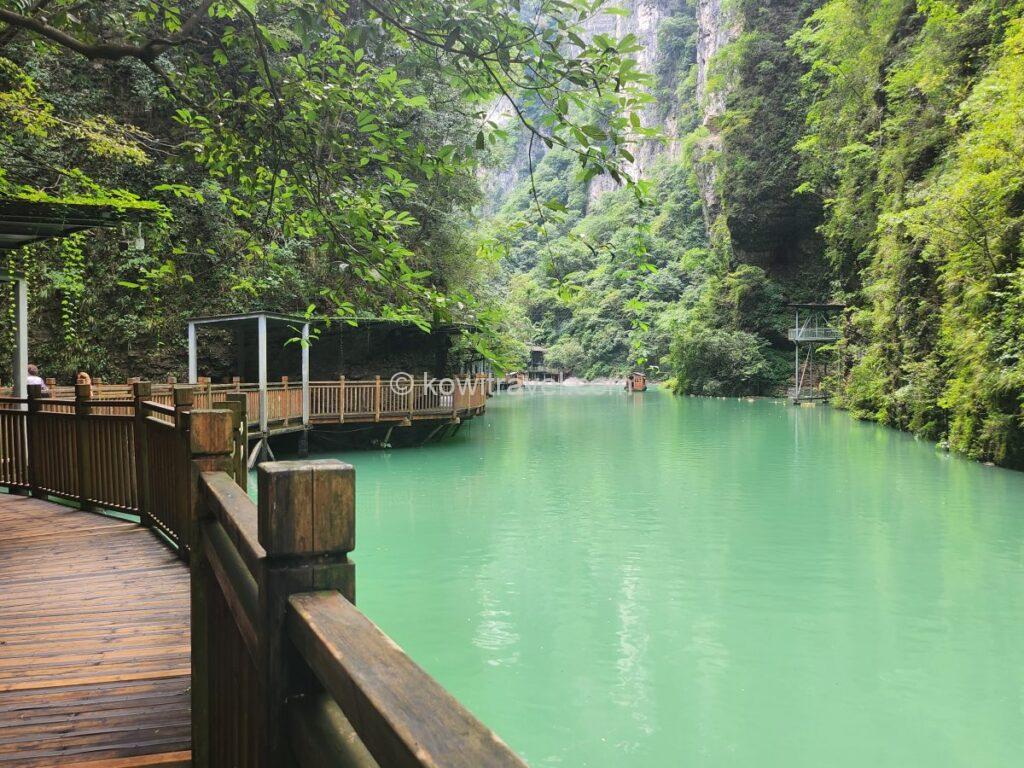
The entire path maintains an easy, flat grade along the water’s edge, making the valley exploration incredibly accessible and stress-free for all fitness levels.


A wooden deck path (left) and a spectacular waterfall cascading into the lake after emerging from the middle of a rock face (right)
Past the waterfall, the canyon walls tighten up significantly once more.


The rock faces on the opposite side of the narrow boardwalk step up so close you feel like you could reach out and touch the ancient textures.
Emerging from this narrow corridor reveals a large, natural cavern shelter that felt like an absolute oasis for tired hikers. After walking for hours in the summer humidity, this spot was a godsend!
Tucked under the deep rock shade, the cavern channels a constant, chilly mountain breeze over a collection of patio tables and umbrellas—the ultimate spot to give your legs a much-needed break.
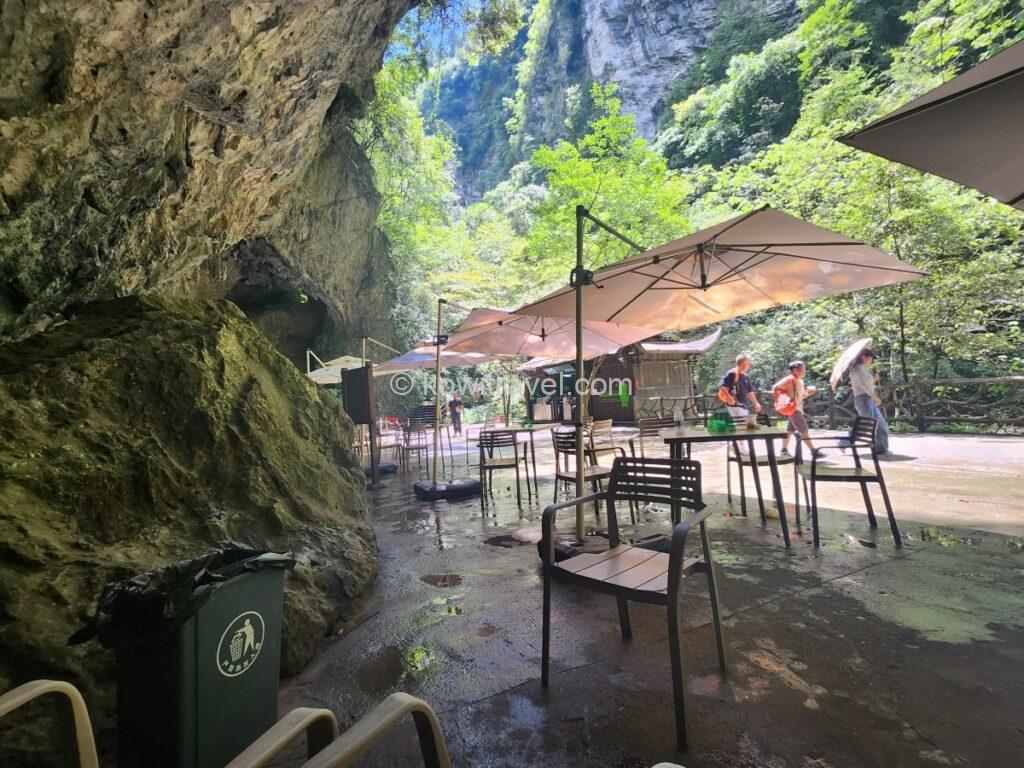
A small cafe operates right behind the seating area, so I ordered a refreshing iced coffee and enjoyed a moment of pure bliss out of the heat.
Once you recharge your batteries and resume your walk along the boardwalk, the distant silhouette of the cruise boat docks—the official final gate of the Grand Canyon tour—slowly begins to emerge across the calm water.
8. Gliding Across the Emerald Lake, The Cruise Boat Finale
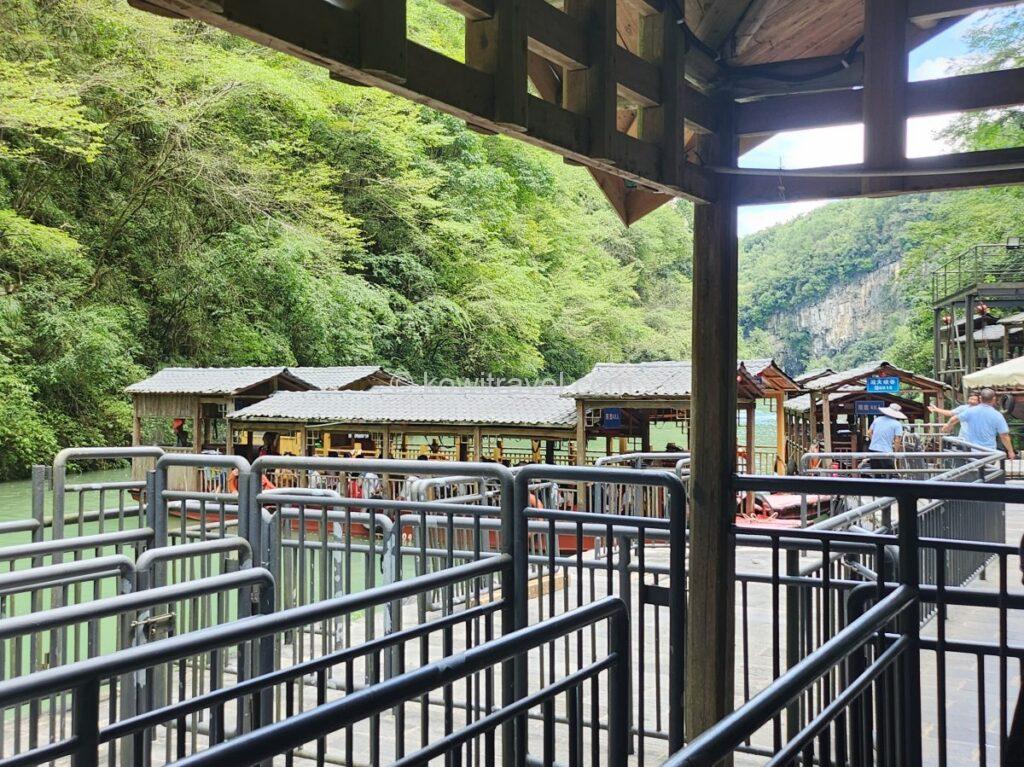
The boat pier at Xinchuan Lake, the final stop on the Grand Canyon tour
Exiting the deep forest trail brings you to the edge of the lake and the entrance of the Shincheon Lake Cruise Dock. Styled like a clean, organized train station platform, travelers file into queues where a fleet of charming, canopy-topped traditional wooden boats are waiting to welcome passengers.
Once aboard, the boat glides effortlessly into the still, deep green water.
This cruise serves as a beautifully tranquil conclusion to an otherwise high-intensity tour.
As you drift along, watching the ancient cliffs reflect off the pristine turquoise surface, a bold red inscription carved into the cave walls appears Zhangjiajie Grand Canyon.
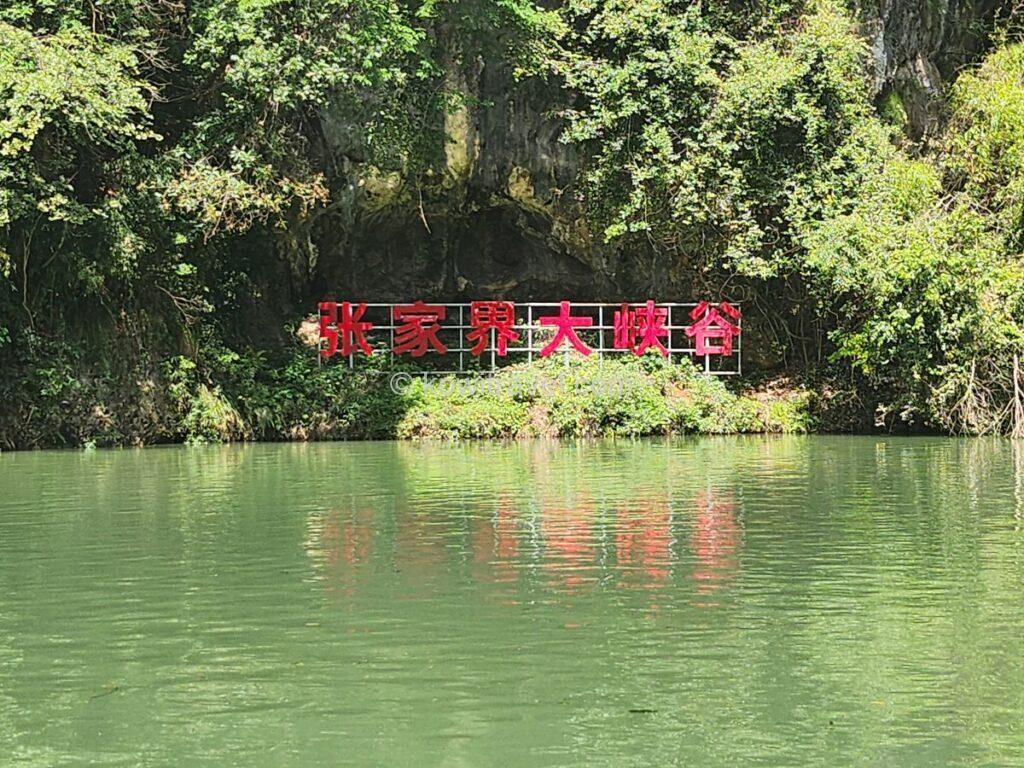
Official sign for “Zhangjiajie Grand Canyon”
Starting 300 meters in the air on a transparent bridge, dropping down the cliffs through a series of high-speed thrill rides, and finally drifting out through a silent, majestic canyon lake—this brilliantly designed progression makes it immediately obvious why Zhangjiajie Grand Canyon is considered a world-class travel itinerary. It is a flawless ending.
9. The Grand Exit – Tujia Heritage and the Monumental Exit Plaza
Stepping off the boat, a brief climb up a set of stone steps leads you out into a massive, wide-open exit plaza framed by a vast blue sky.
At the absolute center of the square stands a towering bronze monument modeled after the traditional ceremonial drums of the ‘Tujia’ people—the prominent indigenous ethnic minority group of Zhangjiajie—leaving you with a distinct taste of local culture as you depart.


Exit plaza (left) and bronze statue (right)
Beyond the monument sits the main exit complex, a massive structure that beautifully interprets traditional Tujia tiered tiled roofs through a grand, contemporary architectural lens. The exterior walls are decorated with large red welcome banners, showcasing the massive scale typical of premier Chinese destinations. Passing through these final gates officially brings our heart-racing journey through Zhangjiajie Grand Canyon to a close.
10. Preview of the Next Adventure
After an incredible journey that balanced vertical thrills with horizontal tranquility, it is time to shift our Zhangjiajie home base from the ‘Wulingyuan Scenic Zone’ down into ‘Downtown Zhangjiajie City.’
In Episode 14 of our independent travel series, we will tackle the mountain widely revered as the Soul of Zhangjiajie: The Complete 4-Day/3-Night Itinerary for Tianmen Mountain .
I will be sharing firsthand accounts of exploring the legendary Tianmen Cave (The Gateway to Heaven), walking the terrifying Ghost Valley Skywalk built into the high cliffs, and navigating the mountain’s insane infrastructure. Stay tuned for the next installment!
👉 [Click here to read Episode 12: The Complete Yellow Dragon Cave Exploration & Review]
“This post contains affiliate links. If you make a booking or purchase through these links, I may earn a small commission at no additional cost to you.”
Leave a Reply