#12. The True Story of the Underground Labyrinth: A Complete Breakdown of Zhangjiajie’s Huanglong Cave
🚨 TL;DR: Huanglong Cave at a Glance
● The Vibe: A massive 4-story underground Karst labyrinth with glow-in-the-dark stalagmites and a hidden river boat cruise.
● The Star Attraction: ‘Dinghai Shenzhen’—a ultra-slender, 19.2-meter stalagmite insured for a whopping 100 million RMB.
● Pro Tip: It stays a crisp 15–16°C year-round. It is the absolute perfect escape when the summer heat gets brutal.
1. Moving Beyond Western Wulingyuan to the Hidden Gem of the East
Leaving behind the vibrant energy of central Wulingyuan and Zhangjiajie National Forest Park, we are now heading to a mysterious underground kingdom tucked away by Mother Nature. This is Huanglong Cave (Yellow Dragon Cave), the grand opening stage for the eastern leg of our Zhangjiajie tour.
After busily exploring Yuanjiajie, Shilihuanlang (Ten-Mile Gallery), and Tianzi Mountain—the surface world fiercely guarded by thousands of razor-sharp sandstone pillars—it is finally time to venture beneath the earth and explore a subterranean palace shaped by hundreds of millions of years.
👉[ Check real-time Zhangjiajie Huanglong Cave Tickets on Trip.com ]
👉[ Check real-time Zhangjiajie Huanglong Cave Tickets on Klook.com ]
Offering a complete 180-degree contrast to the raw, rugged charm of the Forest Park, let’s dive right into this Huanglong Cave guide together!
1.1) Travel Tips: Getting from the Accommodation (Ginhong Minsu) to Huanglong Cave
Huanglong Cave is located about 5 to 8 km east of downtown Wulingyuan (near Ginhong Minsu), making it incredibly close and easy to reach.
If you call a taxi using the Amap (Gaode Maps) app, you will arrive comfortably at the cave’s parking lot in about 10 to 15 minutes without any traffic.
For independent travellers, a one-way ride costs around approx. 15 to 25 RMB, making it the absolute best option to save both your time and energy.
After getting out of the taxi and walking through a beautifully open outdoor landscaped area, you will pass the ticket office and come face-to-face with a large bridge leading toward the cave.
With its crystal-clear creek gently flowing beneath a blend of classic wooden and stone architecture, this bridge acts as a wonderful gateway—visually telling you, “You are now leaving the human world and stepping into the mystical underground kingdom of the dragon.”
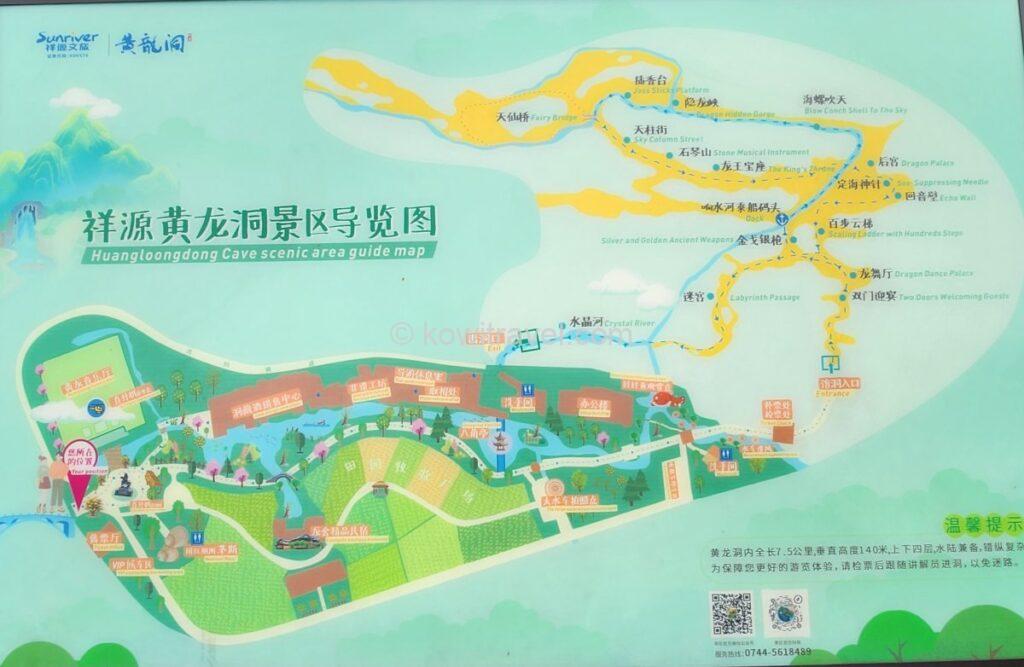
The complete map and guideboard of Huanglong Cave
1.2) Beating the Heat to Reach the Subterranean Gateway: Crossing the Entrance Bridge
Once you hop out of the taxi on the roadside and cross the low bridge, you enter the Ecological Square that leads into the massive underground world of Huanglong Cave. The very first thing that catches your eye at the start of the path is a uniquely shaped thatched structure that blends flawlessly with the surrounding mountains.
While this exotic space looks like a Tujia cultural exhibition hall or an art gallery, it turns out to be—of all things—a public restroom!
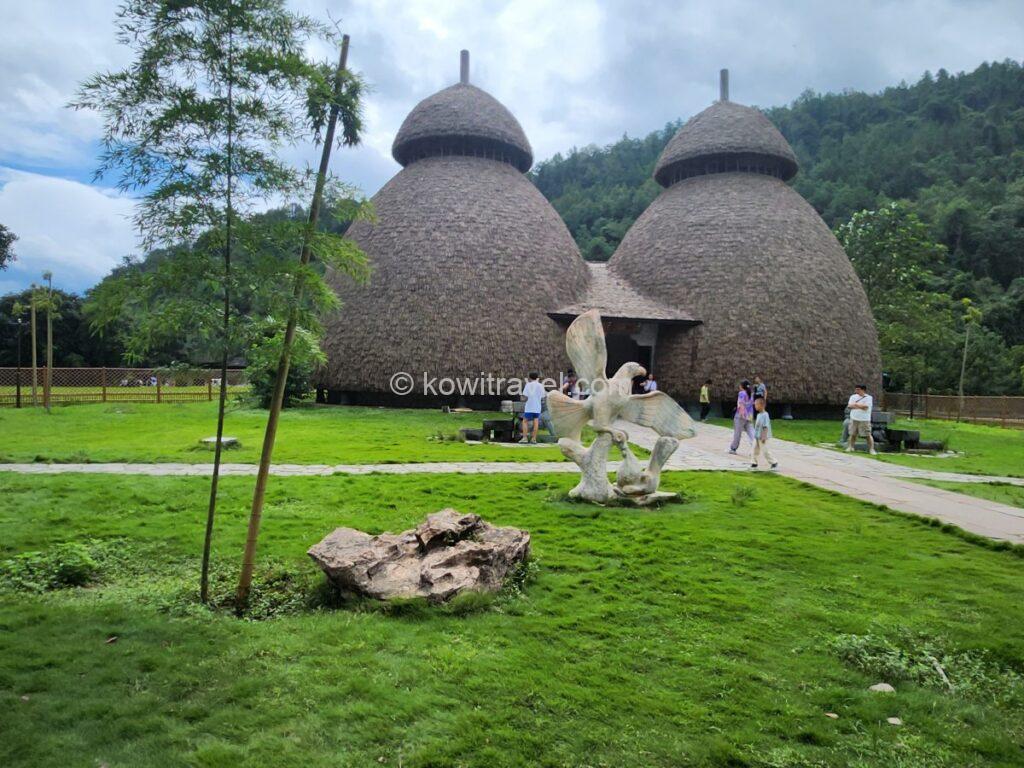
The eco-friendly public restroom, designed so beautifully it looks like a landscape art piece
It is actually a brilliant piece of ecological architecture. It was designed in the shape of traditional Tujia hats and wild mushrooms specifically to erase the cold, artificial look of concrete and blend seamlessly with nature.
Passing this eco-restroom brings you to the “Waterwheel Garden,” where dozens of wooden waterwheels spin endlessly along the valley. This landscape is far more than just a pretty photo spot, it serves as a massive preview on the surface of the dynamic underground water systems we are about to see inside the cave.
This valley is the exact point where the abundant subterranean waters originating deep within the cave—known as the “Xiangshui River”—meet the outside world.
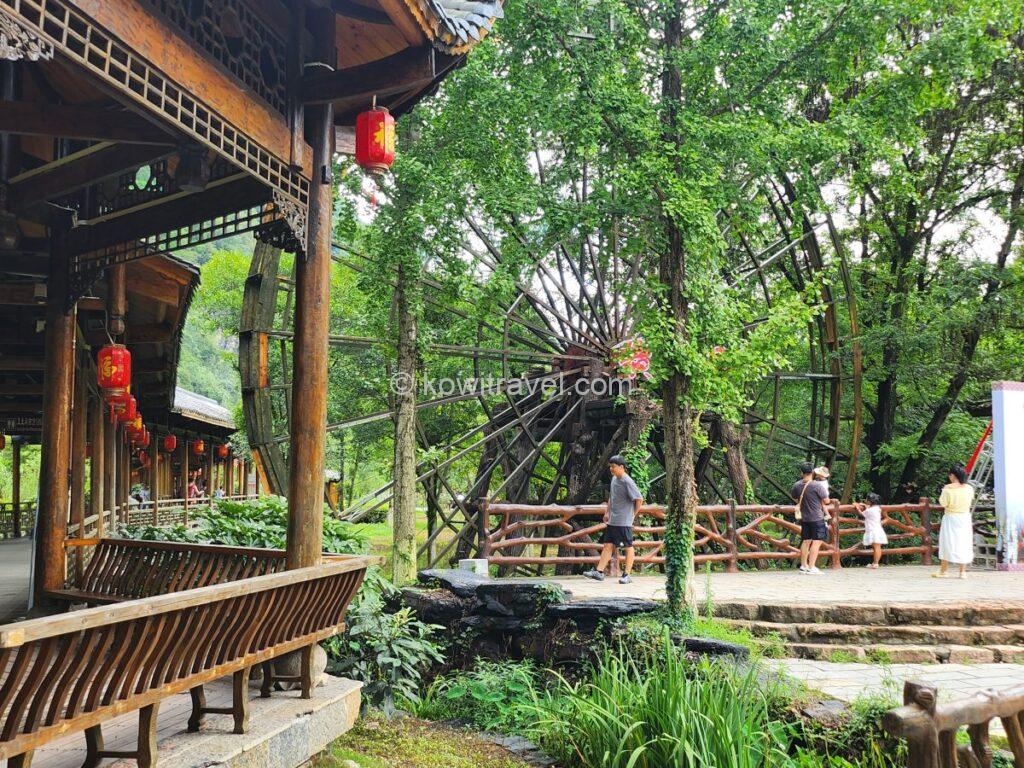
The beautiful Waterwheel Garden with spinning waterwheels running along a traditional wooden corridor
Following the footsteps of the young militia who once marched into the dark to survey regional water resources for military and local purposes, we finally head into the heart of the cave.
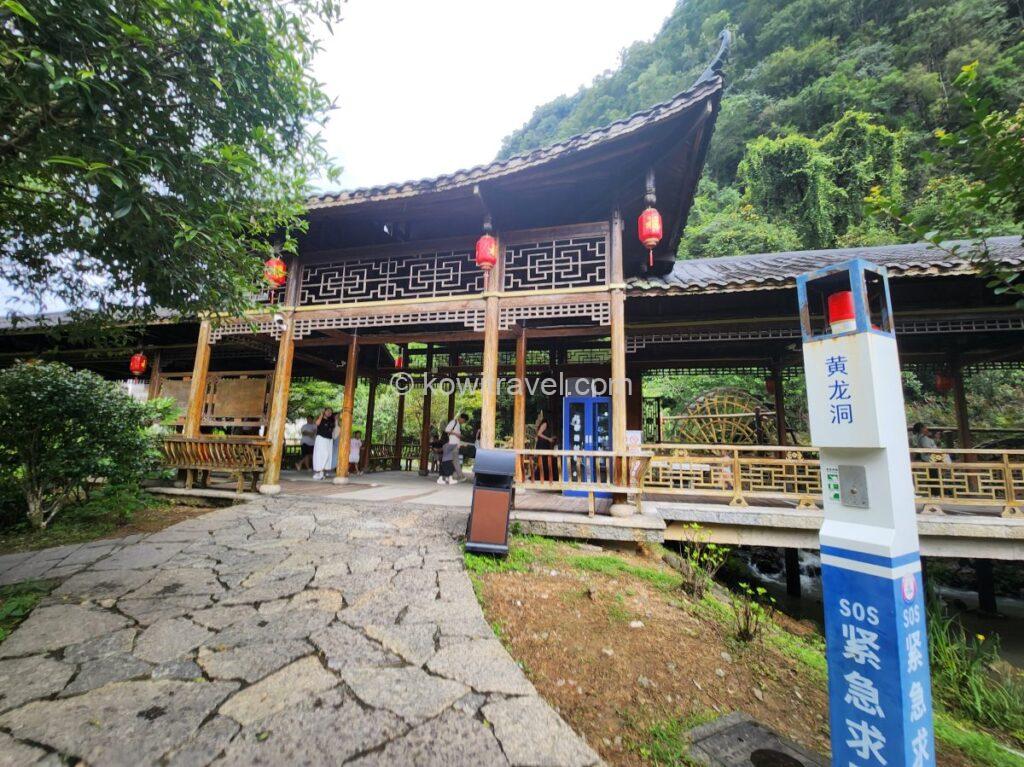
The final ticket check gate and signboard of Huanglong Cave
At the very end of the traditional wooden corridor wrapping along the waterwheel valley, you finally stand before the ticket gate proudly displaying the “Huanglong Cave” signboard.
Seeing the blue SOS emergency rescue pillar standing right next to the gate felt like a silent reminder that this was our last piece of modern safety equipment on the surface.
The moment you step through this gate, the light and noise of the outside world vanish instantly. A massive four-story Karst labyrinth, boasting a 7.5 km developed trail and a vertical drop of 140 metres, grandly opens its jaws before us.
2. A Subterranean Palace Shaped by Hundreds of Millions of Years of Silence, ‘Huanglong Cave’
Now, shall we step inside the pitch-black entrance?
Let’s unpack the secrets of hundreds of millions of years of silence through the following photos.
Huanglong Cave is a globally rare, colossal Karst system. Including the unexplored sections that human feet have yet to touch, its total geological length stretches over 15 km with a vertical height of 140 metres.
It features a fascinating four-story internal layout: two wet layers where underground rivers flow, and two dry layers resembling subterranean forests.
👉Note: Out of this massive scale, the pure walking route developed for general tourists is said to be around 3.2 km.
The ceilings are so high that entire skyscrapers or massive traditional pavilions could easily fit inside the cave. With 13 grand halls and 96 labyrinth-like pathways woven together, it has earned the prestigious academic title of “The All-Round Champion of the World’s Caves.”
2.1) A Legacy Left by a 300-Million-Year-Old Ocean: How Huanglong Cave Was Formed
💡TL;DR: The Quick Geology
● The Origin: Once a deep ocean floor 380 million years ago, pushed up by tectonic shifts and carved by water for eons.
● Fun Fact: Every single stalactite and stalagmite inside is still alive and growing at a microscopic pace of a few millimeters per century.
Before we lose ourselves in the dazzling views inside, it’s only right that we look at the fascinating facts of how this giant space was born and revealed to the world, don’t you think?
According to geological records, Huanglong Cave was a massive carbonate rock (limestone) fault line sitting deep beneath the ocean about 380 million years ago.
After tectonic shifts pushed the land high above sea level, underground water streams spent millions of years tirelessly carving and dissolving the soft limestone, slowly sculpting this magnificent Karst wonderland beneath the earth.
To this day, the stalactites and stalagmites—formed by mineral-rich water droplets falling from the ceiling and rising from the ground—are still growing at a microscopic pace of just a few millimetres every century.
2.2) Eight Young Men Who Broke the Taboo: The True Story Behind the Discovery
📌 TL;DR: Forget the fake internet lore about a snake hunter finding the cave. It was actually discovered in February 1983 by eight brave local youth militia who risked their lives breaking a generational taboo to map out the pitch-black abyss.
If you search the internet, you will often find a casual story claiming that ‘a local villager accidentally stumbled upon the cave while hunting for snakes.’ However, this is simply a distorted local folk tale twisted for commercial tourism.
[Click to Read] The Real Discovery Story (If you love details!)
For generations, the native Tujia people held a deep-seated legend that a spiritual Yellow Dragon, who controlled the weather and rain, lived deep within the cave. Because the entrance was incredibly narrow and the inside was pitch-black, the old folks warned that “once you step inside, you will never come out alive.”
Due to its sheer, terrifying scale, locals viewed it as the forbidden, sacred territory of the dragon. Aside from occasional villagers gathering herbs or chasing wildlife who hovered nervously near the mouth, the cave remained completely wrapped in mystery, untouched until the early 1980s.
The real breakthrough happened in February 1983. A group of eight local Tujia youth militia, led by a man named Mao Shuan, risked their lives and broke the ancient taboo. Armed only with torches and ropes, they pushed through the absolute darkness for kilometres.
They eventually emerged to discover the massive underground chambers and hidden rivers, reporting their findings to the world for the very first time.
Recognising their heroic exploration, the Chinese government officially designated these eight young men as the “Discoverers of Huanglong Cave.”
Thanks to their bravery, the cave was able to open its doors to global travellers just a year later, in October 1984.
Knowing the true story behind it made looking at the cave entrance feel entirely different; I could almost feel the daring spirit of those young men stepping into the absolute unknown all those years ago.
2.3) Masterpieces of Nature: Stalactites and Stalagmites Piercing the Dark
The moment you pass the final gate and step into the cave, the surface heat vanishes completely, replaced by a refreshing, crisp air that stays around 15 to 16°C all year round. As your eyes adjust to the darkness, dreamy blue and purple lights begin to illuminate the underground channels, welcoming you into a mystical maze.
The limestone walls, beautifully carved with lines from thousands of years of flowing water, make you realize that this isn’t just a stagnant cave—it is a massive, living hydrological wonderland.
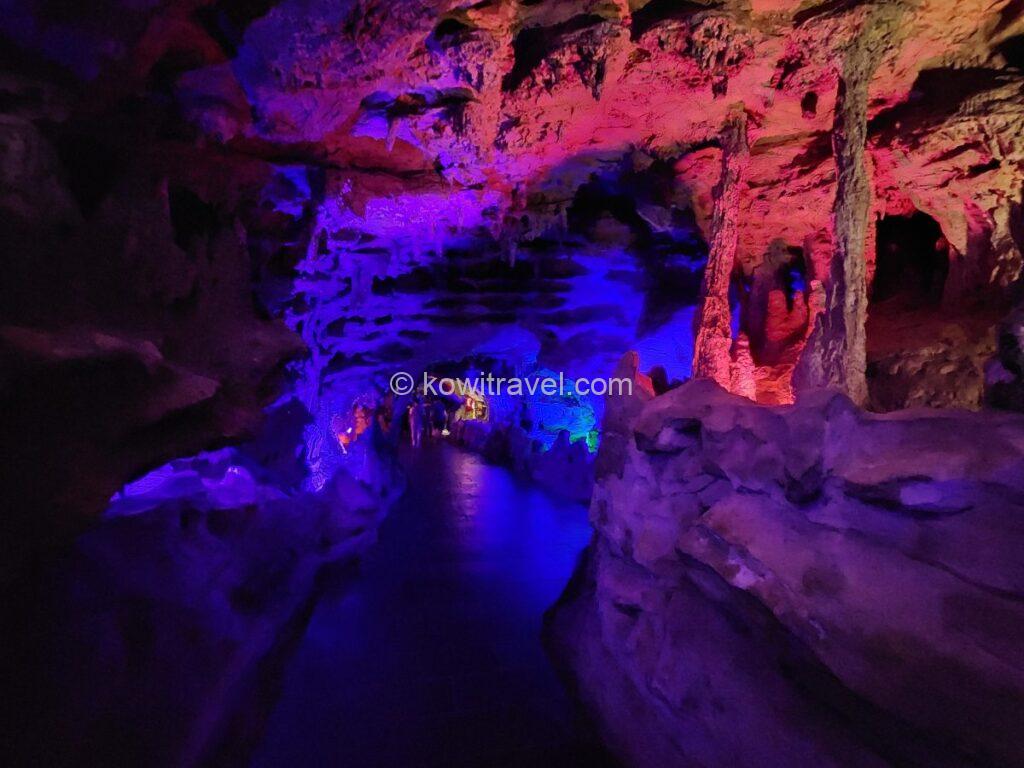
The entry path inside the cave, flowing with dreamlike purple and blue lights
Walking a bit deeper along the path, you will come across bright golden characters carved into the stone wall: “Huanglong Cave Wine Cellar.”
Capitalising on the cave’s unique environment, which naturally locks in a perfectly constant temperature and humidity, this area serves as a natural underground cellar for aging traditional Chinese Baijiu.
It’s a fascinating spot that shows how nature’s gifts blend with human culture, and it does a wonderful job of catching your eye before you head into the main stalagmite zones.
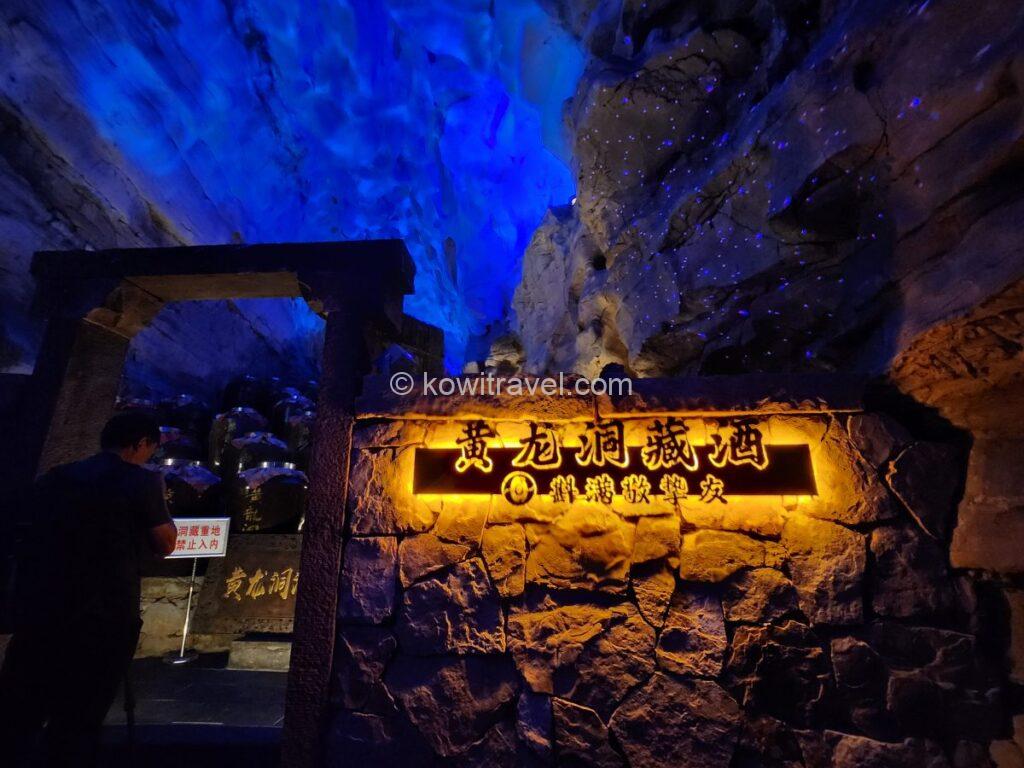
‘Huanglong Dong Cang Jiu’, the natural underground cellar used for aging traditional Zhangjiajie wine
Soon after, a colossal open chamber reveals itself, showcasing the dynamic evolution of Karst topography on a mind-blowing scale.
This is a textbook example of a collapse chamber, created over millennia as gravity and the dissolving power of water droplets caused massive ceiling rocks to come crashing down. Left completely raw and untouched, the giant jagged boulders and exposed limestone layers make the cave feel like a massive, natural geological textbook.
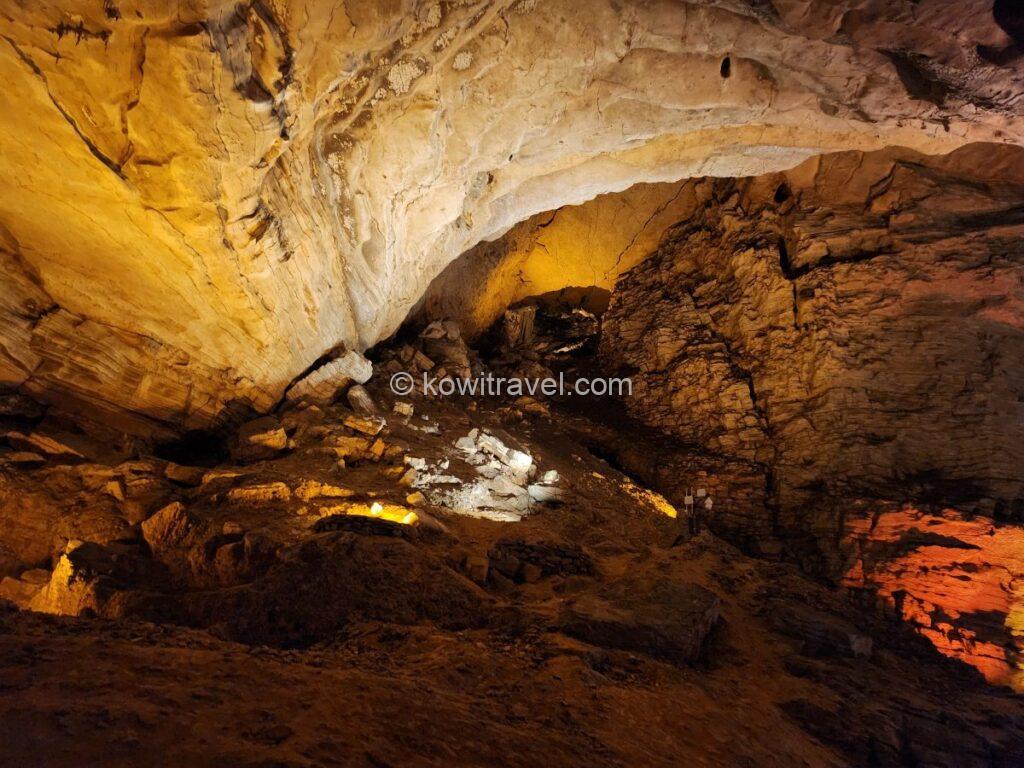
The massive Karst collapse chamber and its valley of fallen boulders
Next, the grand feast of world-class stalagmites truly begins. Bathed in a warm golden glow, this massive stalagmite is the spectacular result of calcium carbonate-rich water drops falling from the ceiling, stacking up from the ground layer by layer like the rings of a tree.
The intricate textures covering its surface feel like a beautiful, uninterrupted diary of time written by Mother Nature over thousands of years.
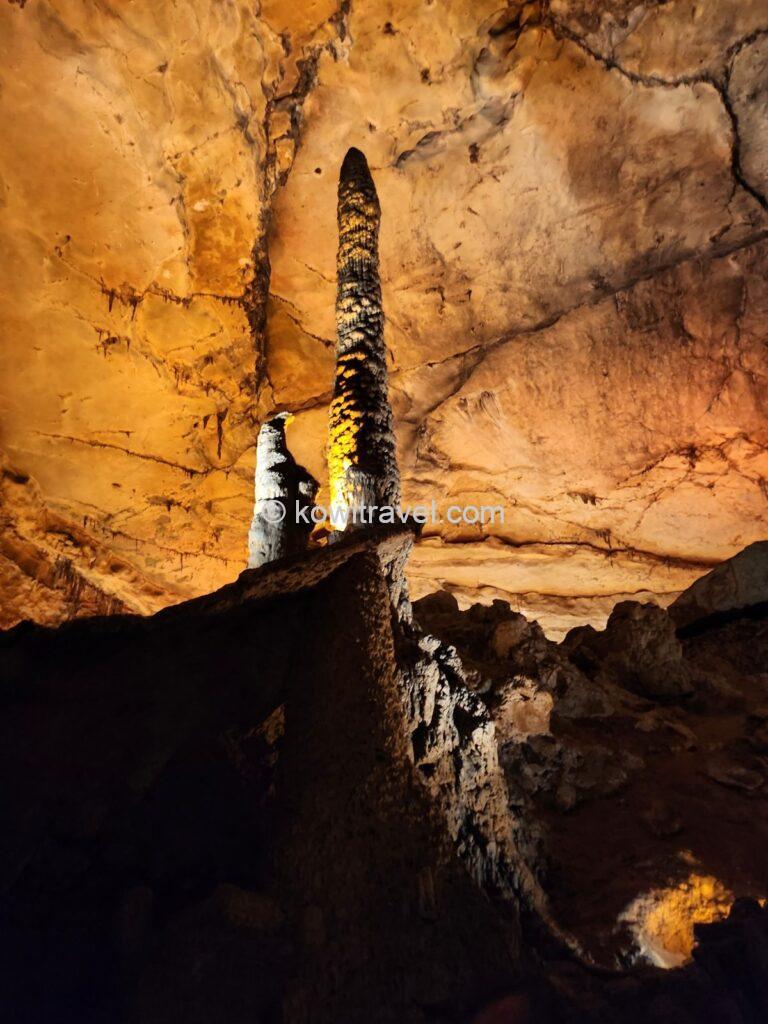
A solitary, massive stalagmite reaching majestically toward the ceiling
Moving along, a dense forest of stalagmites, each shaped by different water speeds and volumes, comes into full view.
Whether stubby or razor-sharp, these unique shapes are dictated entirely by the size of the ceiling cracks and how frequently the water drops. It was genuinely hard to believe that single, patient drops of water over countless lifetimes could create such intricate natural sculptures.
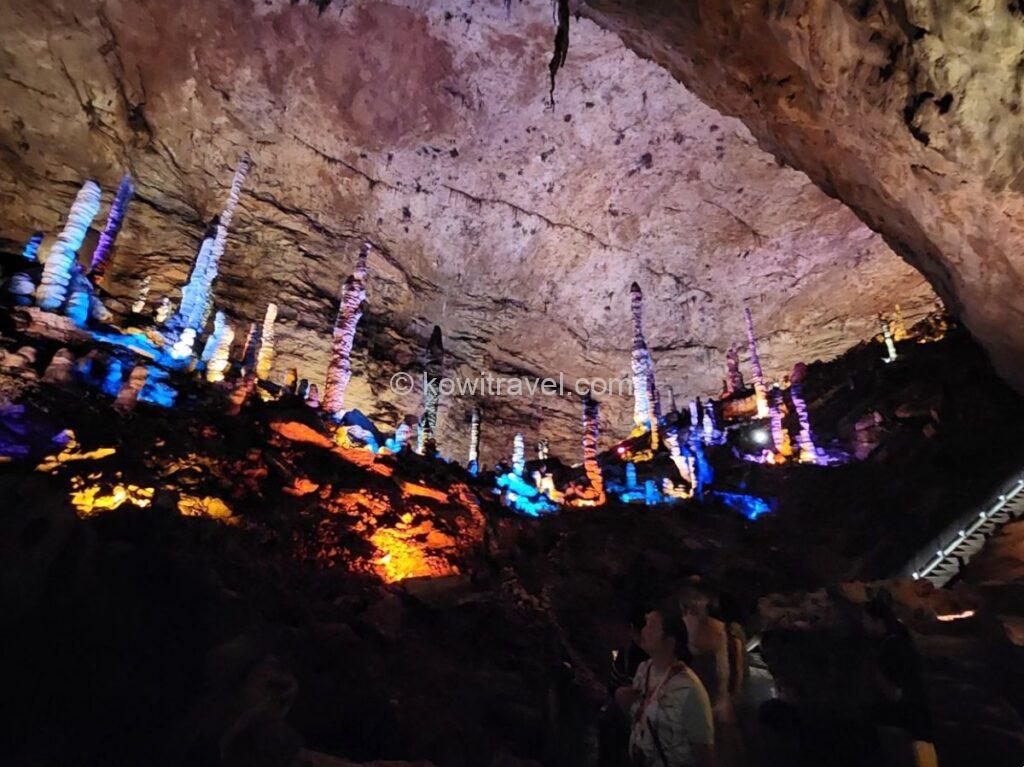
A dense cluster of diverse stalagmites creating a mystical atmosphere under the colorful lights
The giant stalagmite zone rising alongside the walking trail is easily one of the crown jewels of Huanglong Cave. Cool blue lights amplify the eerie yet magical textures of the formations. Walking along the safely designed wooden decks lets you study these geological wonders from incredibly close up. Realising that these pillars take hundreds of years just to grow a single centimetre, yet stand multiple storeys high, leaves you with a profound sense of awe that completely transcends a human lifespan.
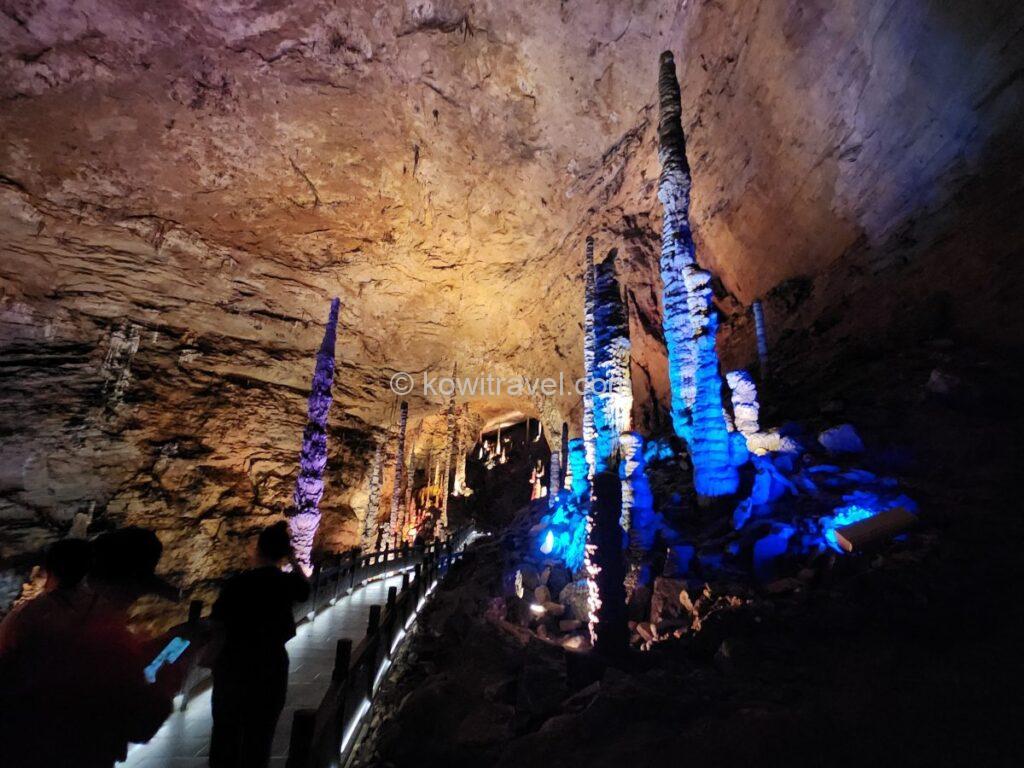
The massive stalagmites glowing in cool blue tones right next to the visitor walking trail
As you climb higher along the trail and look down, you instantly feel why this place is proudly called ‘The Best Cave in Asia.’ Spreading out beneath you is a vast underground plaza where hundreds, if not thousands, of stalagmites shoot up from the floor like a massive subterranean stone forest. It is the ultimate viewpoint to witness the peak of Karst evolution, where the stalactites above and stalagmites below eagerly reach for one another.
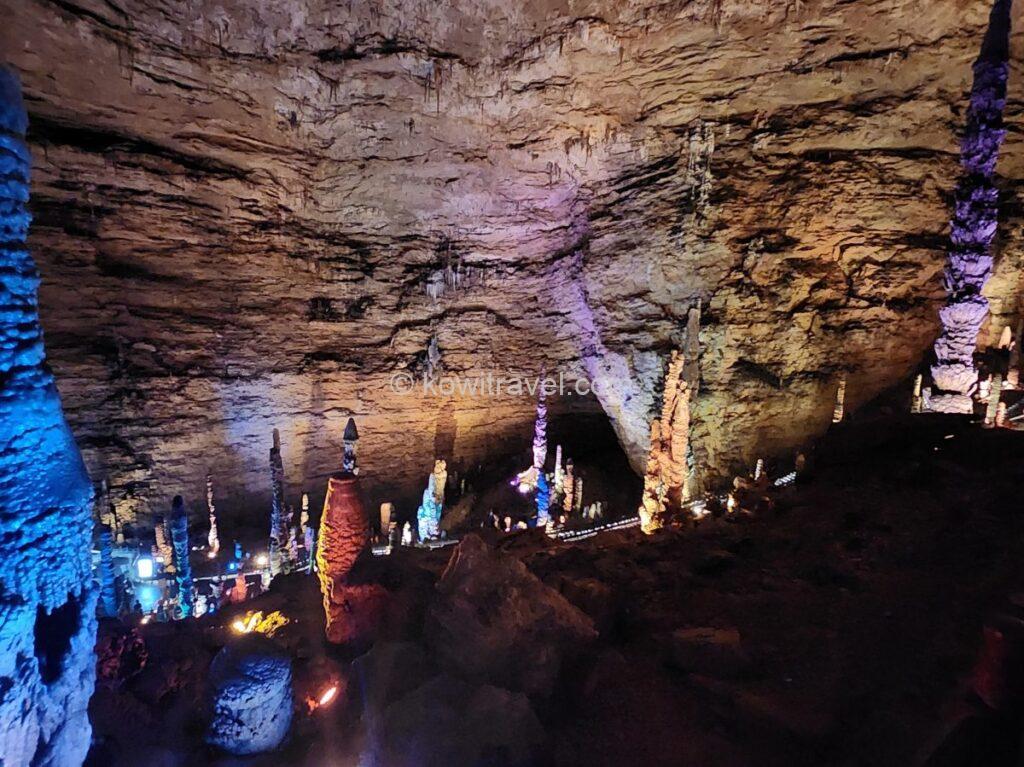
A panoramic view of the vast underground plaza and its dense colonies of stalagmites
Stepping onto an even higher observation deck, the cave’s layout feels incredibly multi-dimensional. Colorful lights cast deep shadows and bring out every ridge of the stalagmite forest, beautifully proving the immense vertical scale of this four-story subterranean complex. It is a profound moment where you don’t just view a tourist spot—you stand face-to-face with the sheer depth of time stacked up by tectonic shifts and ancient waters.
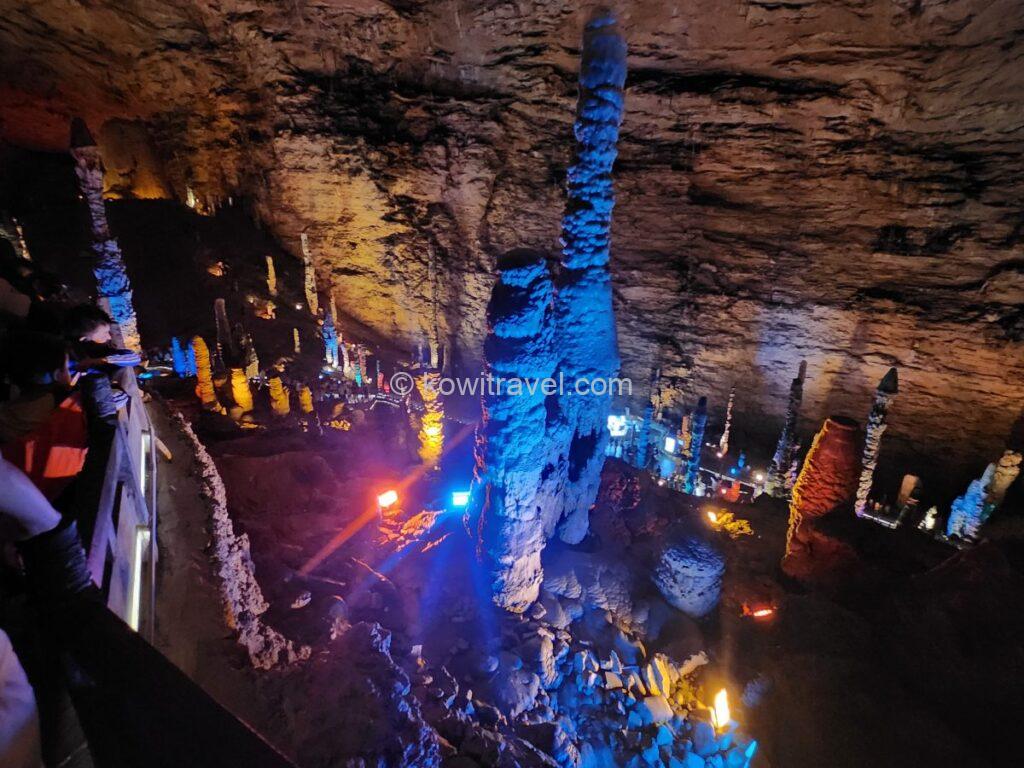
The multi-dimensional view of the illuminated underground plaza looking down from the high deck
Continuing up the long internal staircases, towering, column-like stalagmites fill your vision, almost touching the ceiling. You are quite literally witnessing a live show of geological evolution—a moment in time just before these lower stalagmites and upper stalactites fuse to become solid “Stone Pillars (석주).” Free from any artificial exaggeration, you can’t help but bow your head in respect to Mother Nature, who carved this entire masterpiece using nothing but flowing water and limestone.
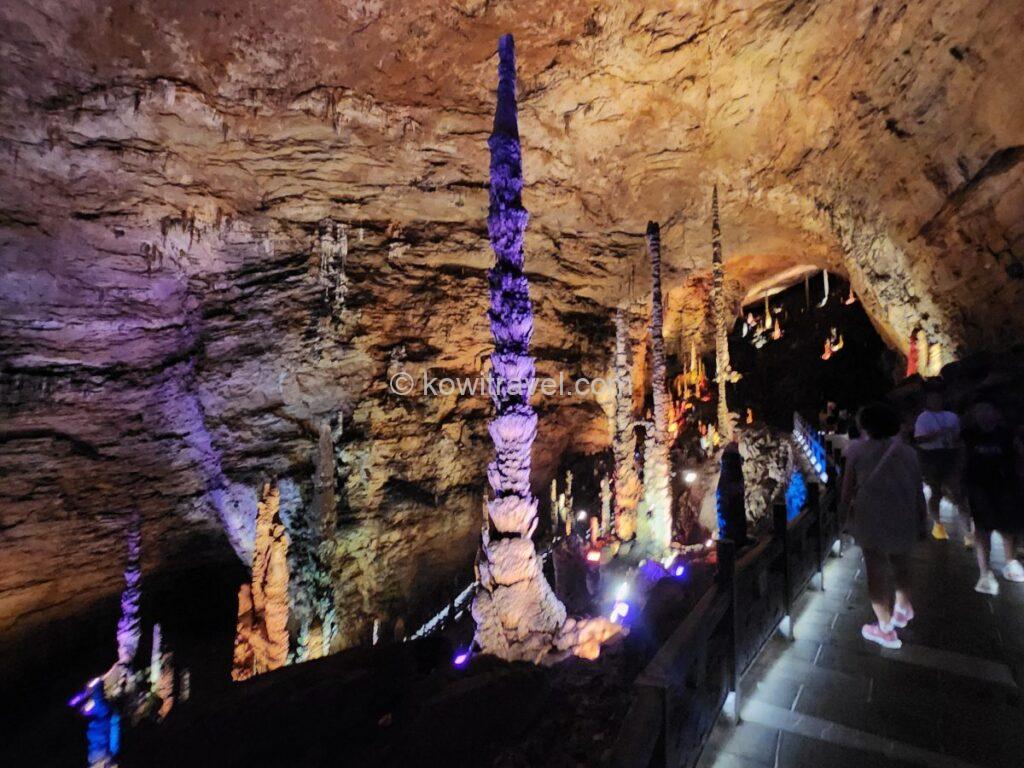
Towering stalagmite colonies soaring up so high they almost touch the cave ceiling
Passing the sky-high stalagmites, you are greeted by an incredibly unique, massive complex of stalagmites that have fused together, looking just like the giant walls of an ancient fortress or the pillars of a mythical temple. Warm amber and crimson lights sharply highlight the rough, intricate ridges of the stone. Seeing stalagmites—which require centuries just to gain a centimetre—standing together on such a monumental scale makes you fully realise why Huanglong Cave is celebrated as Asia’s finest Karst miracle.
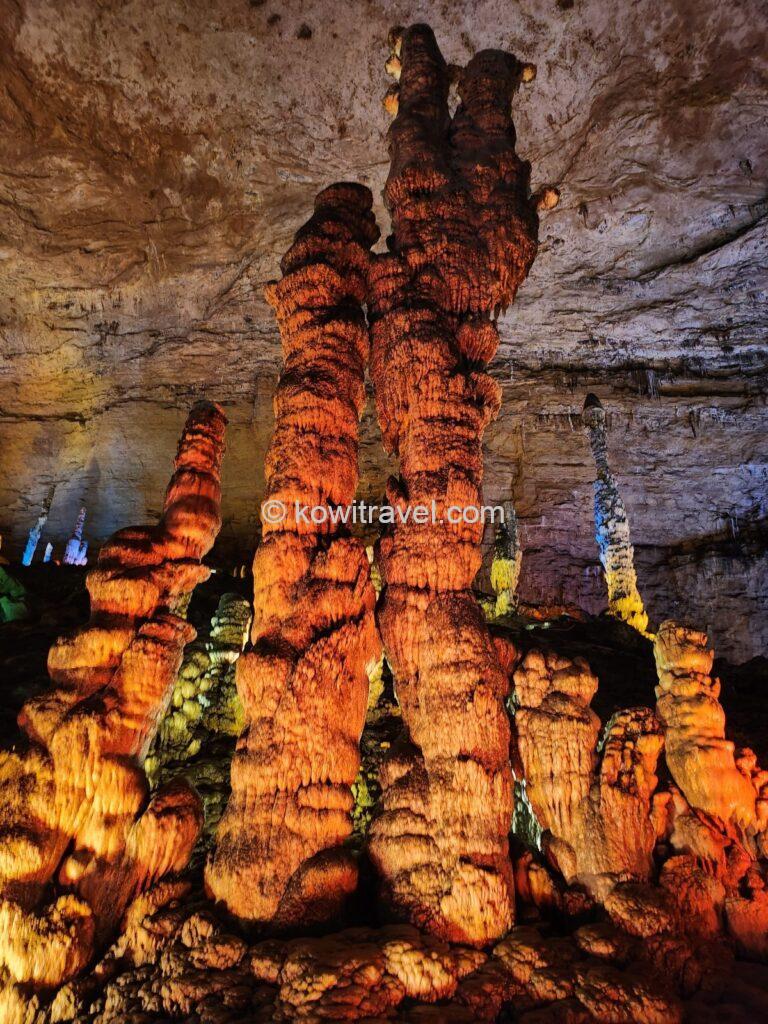
A towering, complex cluster of fused stalagmites glowing in a rich, warm golden hue
As you follow the guide path deeper, you will spot a large stone marker carved with the words ‘Eagle Looking For Food’ alongside its Korean translation. Proudly displaying the UNESCO World Natural Heritage logo, this marker beautifully highlights the official global status of Huanglong Cave.
More than just a standard directional sign, it serves as a powerful reminder that the ground we are walking on is a precious natural treasure meant to be preserved by all of humanity.
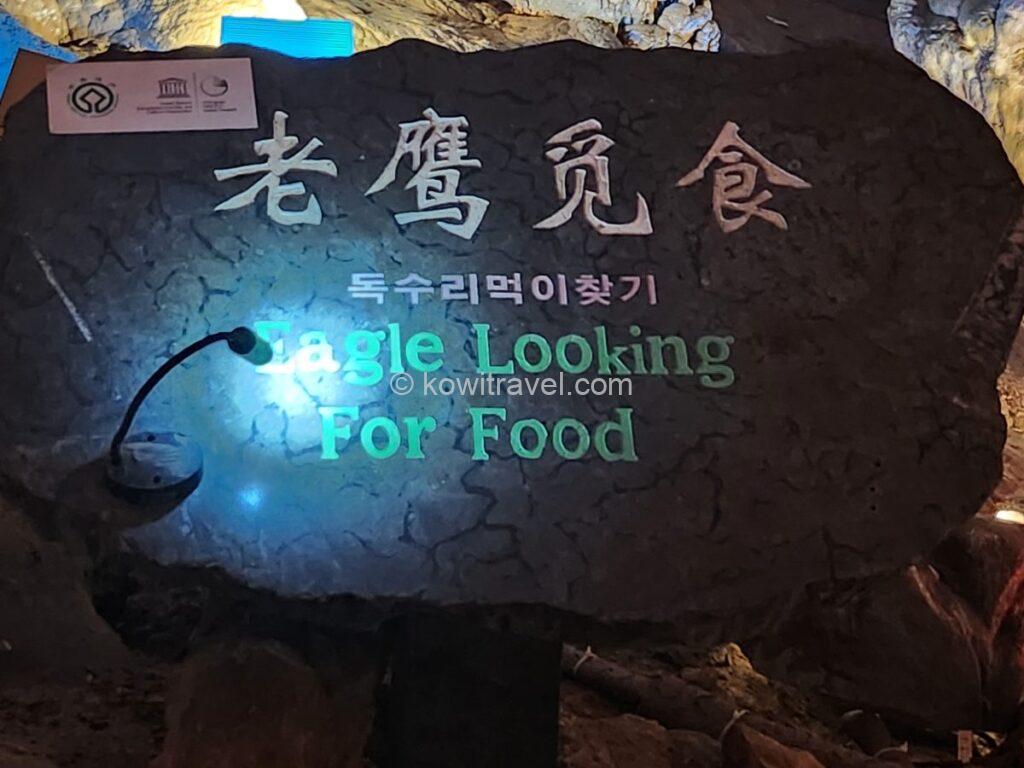
The official UNESCO World Heritage marker for the ‘Eagle Looking For Food’ formation
If you turn your gaze right behind the marker, the playful story behind the name unfolds right before your eyes.
Rising gracefully among the surrounding formations is a peculiarly shaped stalagmite that looks exactly like an eagle hunching its wings, peering downward as if targeting its prey.
It’s a delightful spot where a beautiful accident of geological history meets human imagination, marking one of the most memorable and charming highlights of the later half of the cave tour.
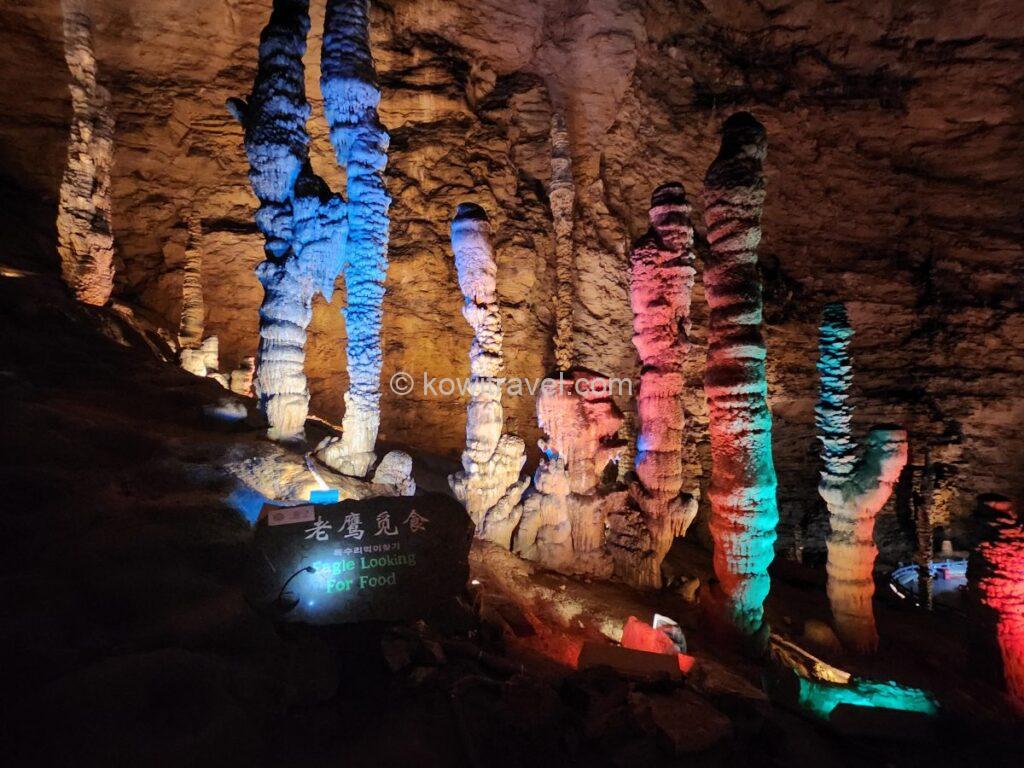
The full view of the ‘Eagle Looking For Food’ formation nestled within the stone forest
Past the Eagle Rock, climbing even higher opens up a vast, breathtaking space where dozens of glowing, multi-coloured stalagmites stand in a grand formation. This area, bustling with lines of travelers, serves as the majestic gateway into ‘The Dragon Palace’, the largest grand hall within the entire cave.
Walking between these colossal stone columns that look as though they are holding up the massive limestone roof truly feels like walking through the pillars of a grand, ancient temple from myths.
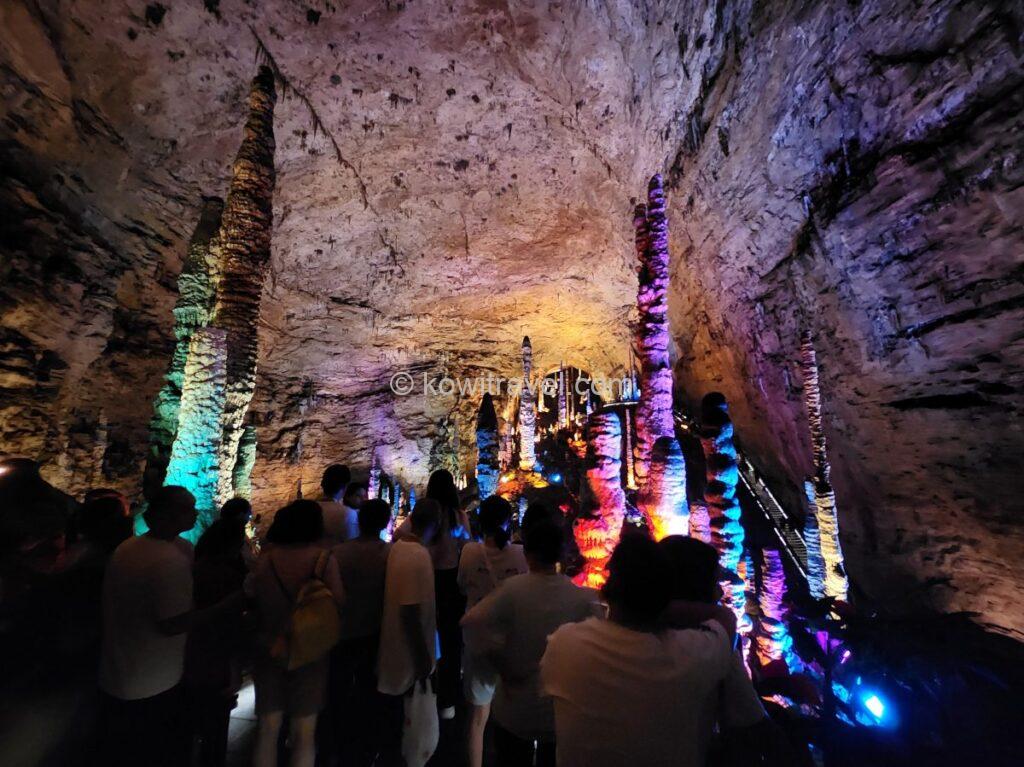
The grand entry path into the Dragon Palace, lined with columns of towering stalagmites
Venturing deeper into the heart of the Dragon Palace, the density and height of the formations become even more spectacular. In particular, a sky-scraping stalagmite glowing brilliantly in warm amber lights offers a perfectly clear look at the magnificent process of becoming a solid stone pillar in the near geological future.
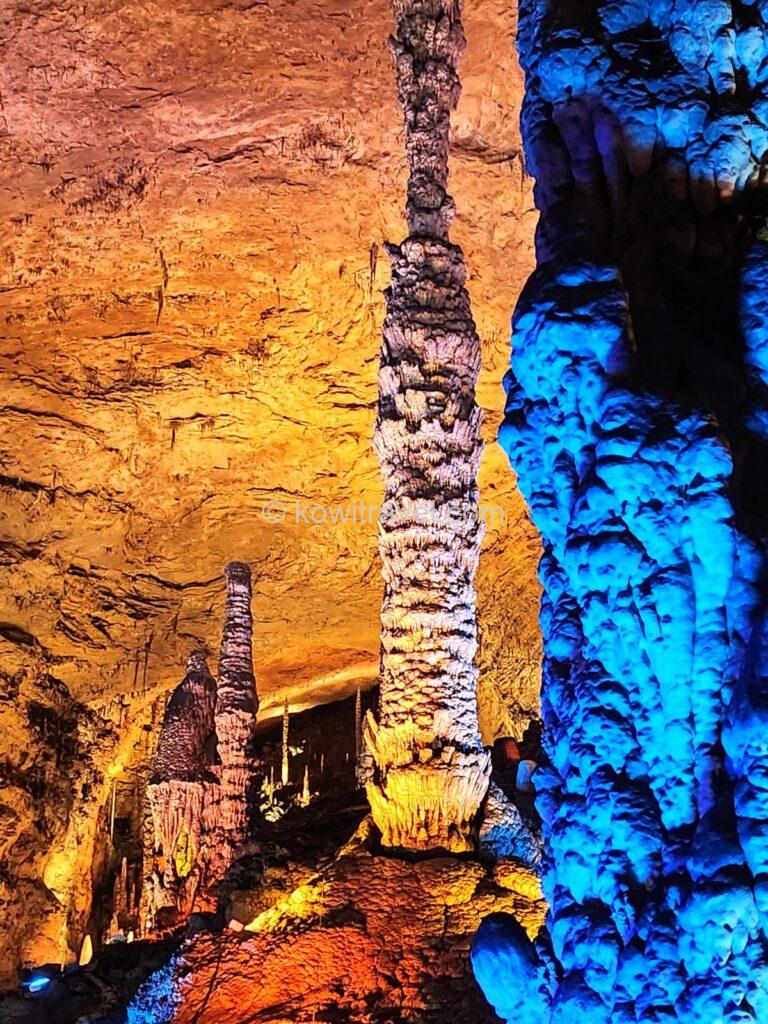
A magnificent, towering stalagmite glowing like solid gold under the amber lights
Once you pass this grand geological landmark, the ultimate star of this journey—the legendary ‘King of Stalagmites (Dinghai Shenzhen)’, insured for a jaw-dropping 100 million RMB—finally reveals its breathtaking form.
2.4) A Miracle of Nature Insured for 100 Million RMB (19 Billion KRW): ‘King of Stalagmites’
💡TL;DR: The 100 Million RMB Rock
● The Stats: 19.2 meters tall, but only 10 cm wide at the top. It took nearly 200,000 years of single water drops to build.
● The Flex: Because it’s so fragile that a tiny tremor could snap it, the Chinese government actually bought a 100 million RMB ($14M+ USD) property insurance policy for it in 1998.
Stepping into the deepest heart of the Dragon Palace Hall under the escort of countless stalagmites, you are suddenly brought face-to-face with a solitary, unbelievably slender stone pillar shooting straight toward the roof.
This is the undisputed symbol and greatest geological treasure of Huanglong Cave: ‘Dinghai Shenzhen’ (meaning ‘The Needle that Calms the Sea’).
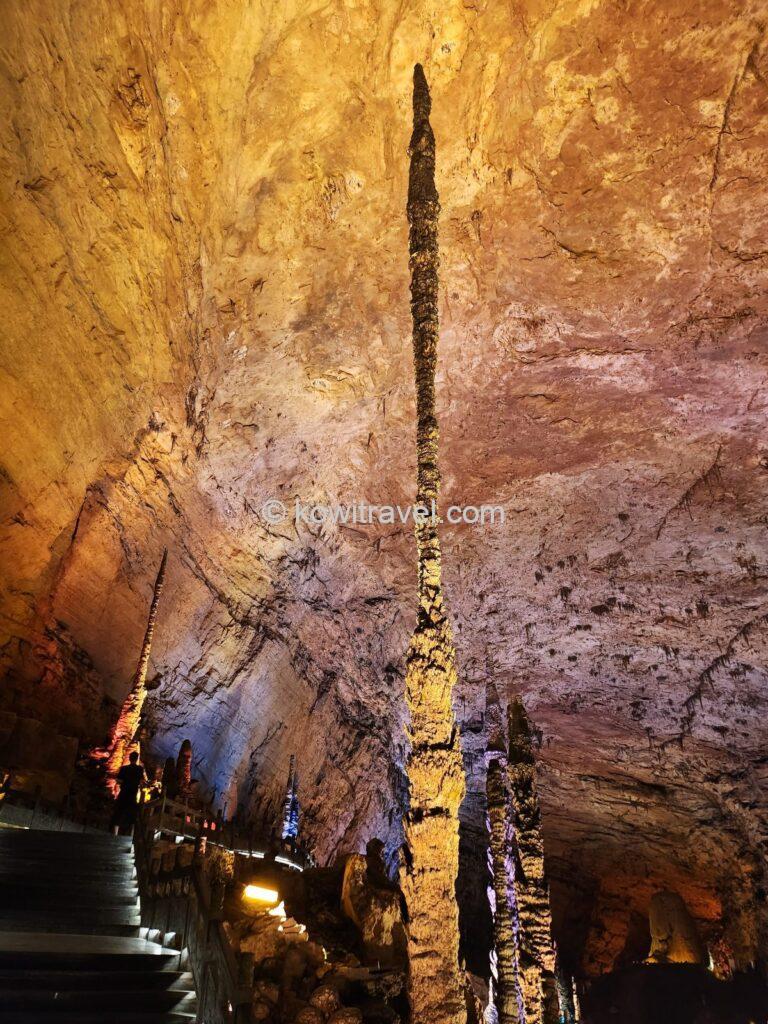
The breathtaking aura of Dinghai Shenzhen, soaring proudly as if to pierce the very roof of the cave
Standing an incredible 19.2 metres tall with a top diameter of only about 10 cm, this miraculous stalagmite is a supreme masterpiece sculpted by single water drops over a flawless span of nearly 200,000 years.
Because it is so incredibly thin and tall, even a minor tremor poses a devastating risk of snapping it. To protect it, the Chinese government and the scenic area authority took the unprecedented step in 1998 of purchasing a 100 million RMB natural property insurance policy for it, making global headlines.
While you can never truly put a price tag on the wonders of time, this historic insurance policy is undeniable proof of this stalagmite’s absolute geological rarity.
If you widen your gaze from the pillar itself, you can easily see why it earned such a grand, poetic name. It stands proudly, encircled by a massive assembly of stalagmites that look like loyal guardians honoring the ‘magical needle.’
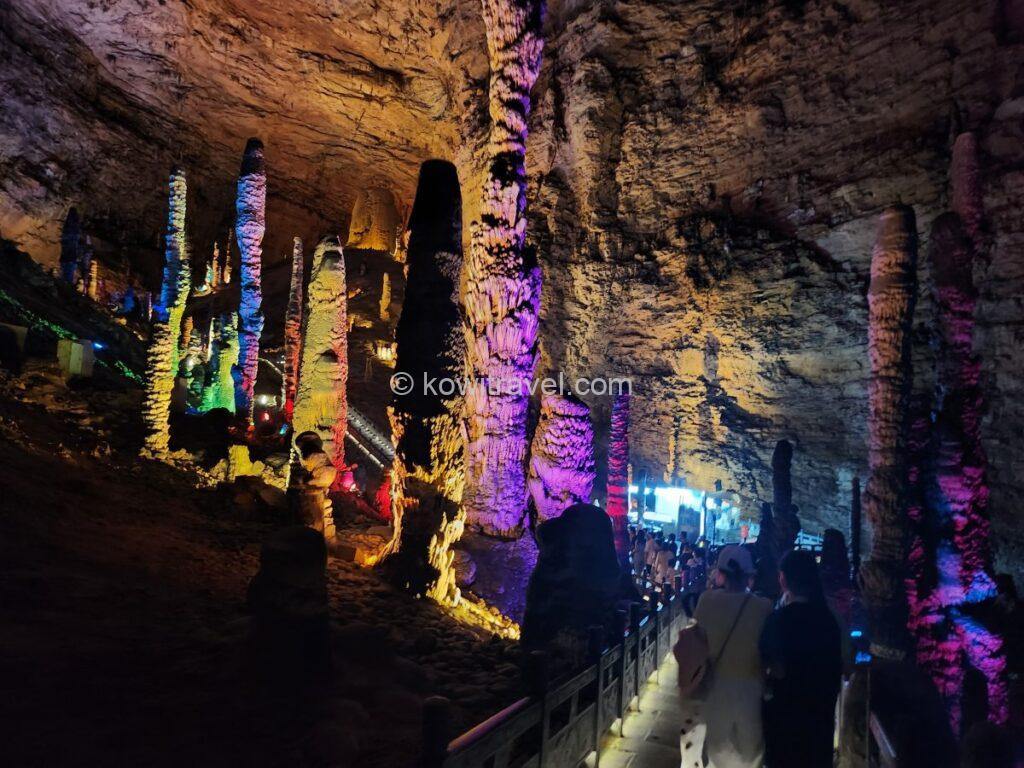
Endless Karst stalagmites glowing in colorful lights, creating an ethereal atmosphere
Moving past the King of Stalagmites and exploring further into the Dragon Palace Hall, your eyes are treated to yet another visual style of Karst art.
These large columns, glowing under beautifully set red lights, are the result of water drop volumes and speeds remaining perfectly consistent over tens of thousands of years, stacking up vertically under the strict laws of gravity. The rough yet beautifully rhythmic textures on their surfaces tell a gorgeous story of pure time.
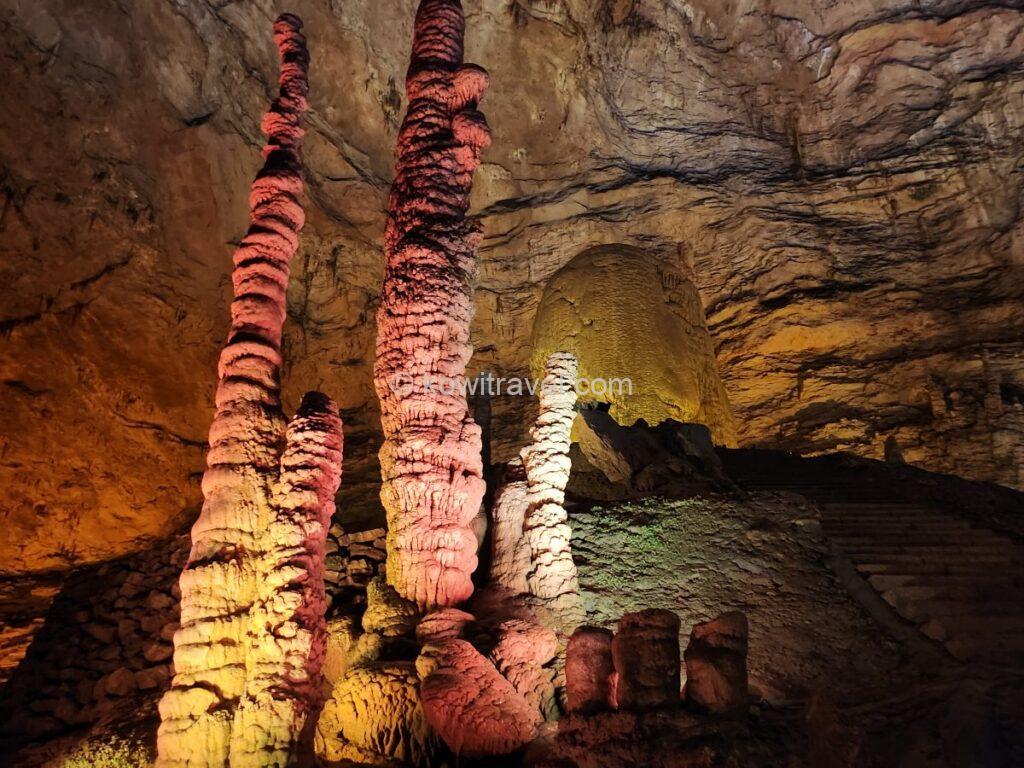
Large, textured stalagmite columns stacked up perfectly over eons of time
Turning your eyes right behind this specific cluster of pillars, you finally meet another magnificent wonder of Huanglong Cave’s geology: a colossal, dome-shaped Stone Bell.
Known scientifically as a massive ‘Flowstone’ structure, this smooth, rounded boulder dome is a beautiful natural phenomenon created over hundreds of thousands of years as lime-rich water cascaded down and hardened into a grand bell shape on the floor.
If you look closely right in front of this giant bell’s center, there is an incredibly sweet detail: a remarkably slender stalagmite growing up, agonizingly close to touching the dome above. This is the famous ‘Stalagmites Just Before a Kiss’ spot.
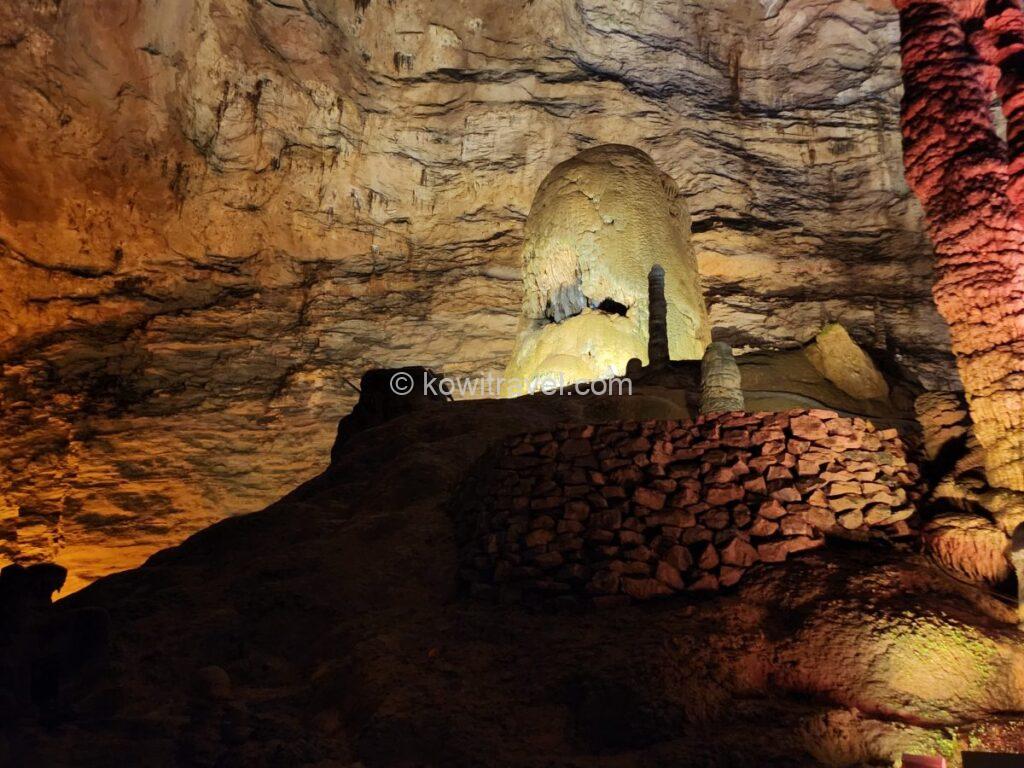
The breathtaking view of the grand dome-shaped Stone Bell and the stalagmite standing just a hair’s breadth away from a kiss
When you apply the geological fact that calcium carbonate takes roughly 100 years just to grow 1 cm, you realize these two will need to wait several more centuries just to finally touch and become a complete stone pillar. It feels like catching a glimpse of the earth’s slow, patient breathing rhythm, leaving you with a profound sense of wonder.
Deeply moved by Mother Nature’s grand design—crafted using nothing but limestone and water—we begin to guide our steps downward toward our final adventure: the underground river.
2.5) Gliding Silently Across the Subterranean River: The Magical Boat Cruise on ‘Xiangshui River’ and the Return to Earth
Leaving the magic of the Dragon Palace Hall behind, the path leading down to the deep underground river feels like a grand adventure all on its own. To reach the lower water system, you find yourself descending an exotic, spiral steel deck staircase wrapped tightly along the sheer cliff faces of the cave.
Looking down from the top, the red boats waiting for us and the glowing green waters of the Xiangshui River look wonderfully small and distant far below. It’s a spectacular visual that shows just how massive and multi-layered the cave’s structure truly is—and it immediately explains why wearing a pair of comfortable sneakers is an absolute must for this tour!
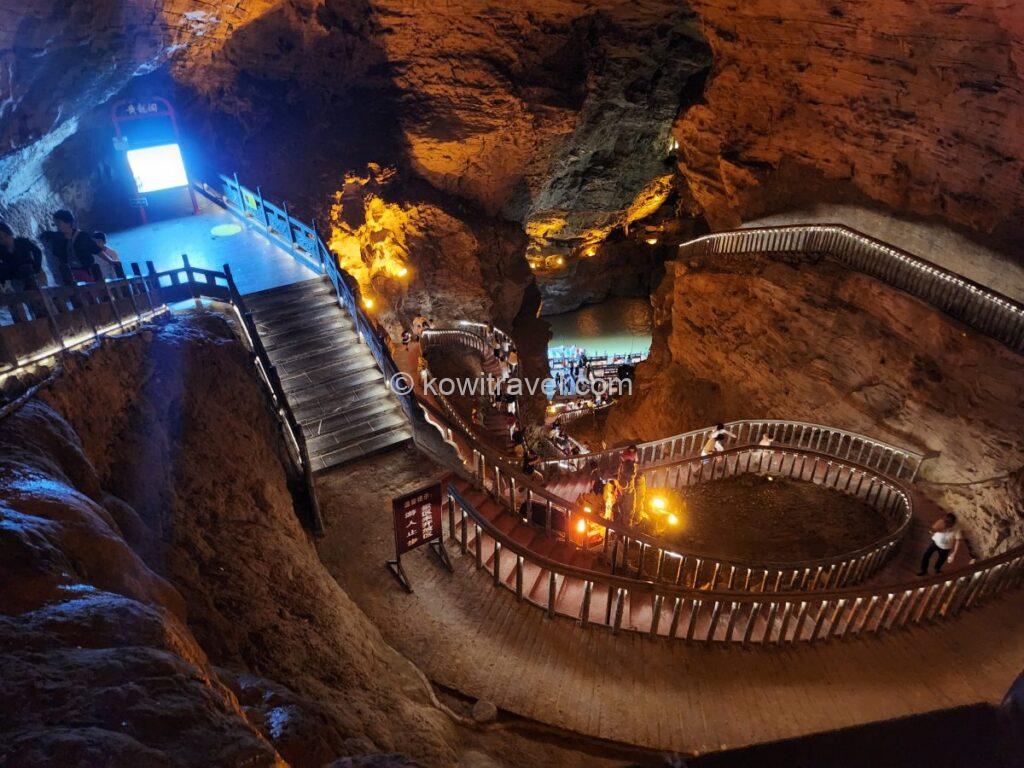
The spiral steel staircase winding down the cave walls toward the underground boat launch
After soaking in the grand views of the stalagmite forests and completing the long descent down the stairs, you finally arrive at the boat launch for the Xiangshui River cruise on the second underground level—the grand finale of our Huanglong Cave expedition.
The name ‘Xiangshui’ beautifully translates to ‘Echoing Water,’ named because the rushing water sounds echo loudly just like a mountain stream on the surface.
Flowing through the second subterranean tier of the cave, the Xiangshui River is the only one out of the cave’s three underground rivers that visitors can actually board a boat to explore.
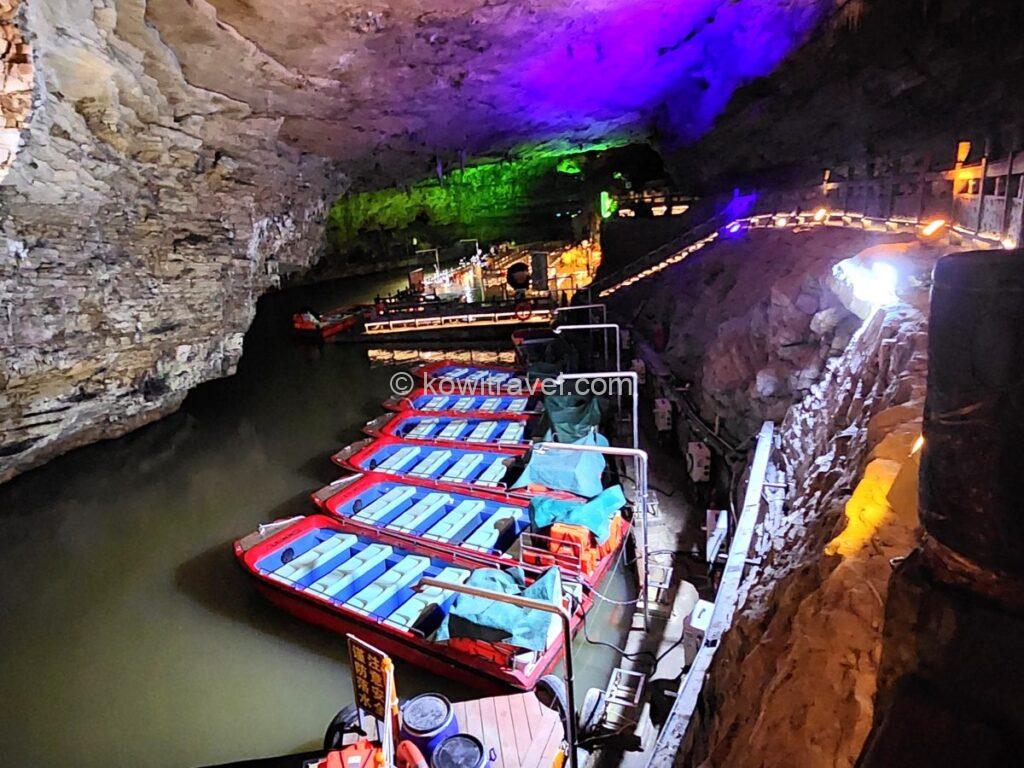
The colorful underground boat launch, marking the final highlight of the Huanglong Cave journey
This hidden river was carved out over hundreds of millions of years as rainwater and groundwater seeped through rock fractures, steadily dissolving the weakest parts of the limestone to hollow out a massive water highway.
Boasting a dynamic hydrological system that maintains a crisp 15 to 16°C water temperature all year round—with an average depth of 6 metres and plunging down to 12 metres at its deepest—standing before this glowing green waterway sends a thrilling sensation through you, almost as if you are preparing to escape from the very core of the Earth.
Boarding the boat and looking out from the bow onto the mystical waters of the Xiangshui River. The vibrant green lights reflecting off the water break the ancient silence of the cavern.
As the boat glides smoothly and silently through the darkness, you can look up to see the raw, rugged limestone ceilings carved out by water currents over countless eras.
Cruising quietly through this surreal underworld, completely cut off from any noise of the human world for about 10 to 15 minutes, is easily the most perfect final chapter to the story of Huanglong Cave.
When the boat gently berths at the disembarkation dock at the end of the river channel, you pass through a brief exit corridor lined with local souvenir shops, and suddenly find yourself stepping right out into the warm, bright sunshine and lush greenery of the exit garden.
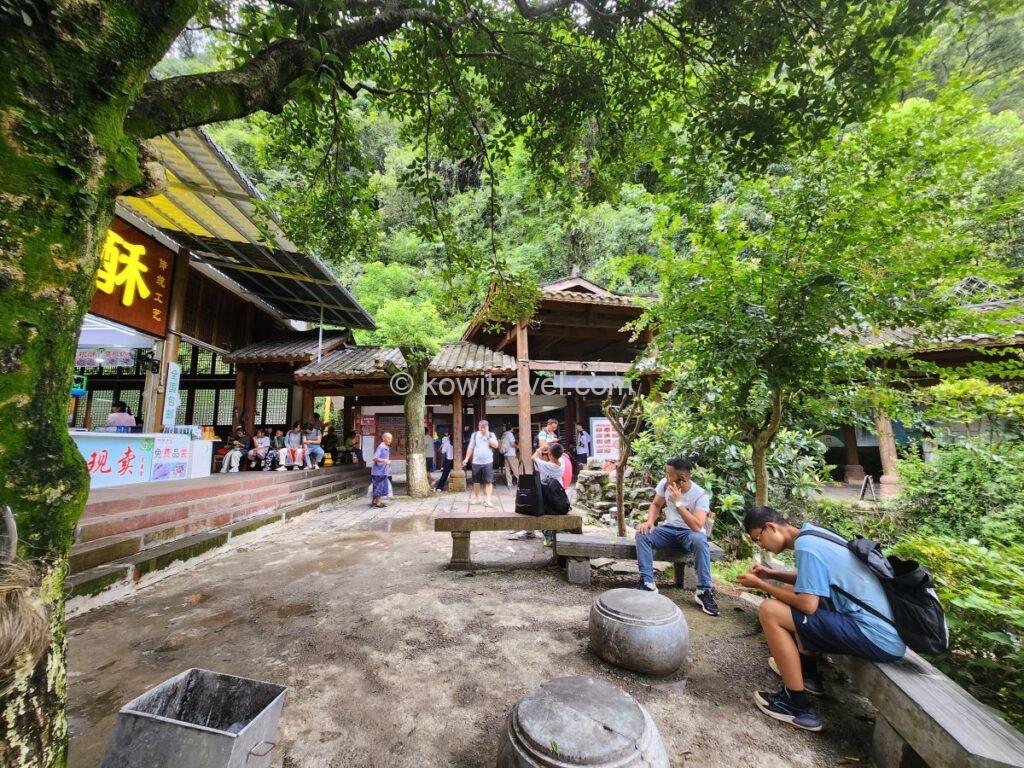
The refreshing view of the outside world after stepping past the souvenir shops at the boat exit
Stepping out of a chilly, pitch-black underground empire and instantly returning to a bright world filled with traditional Tujia wooden architecture and forest trees is a dramatic visual contrast unique to Huanglong Cave.
Our grand expedition—which took us through the vertical and horizontal depths of a Karst palace built by hundreds of millions of years—comes to a beautiful, deeply fulfilling end in this sun-drenched exit courtyard.
3. A Sneak Peek at Our Next Adventure
Hidden away by hundreds of millions of years and brought to light by eight brave Tujia youth militia who risked everything in 1983, the journey through Huanglong Cave is a magnificent geological epic. From the eco-friendly aesthetics at the entrance to the breathtaking stalagmite forests of the Dragon Palace, the 100-million-RMB treasure of Dinghai Shenzhen, and the final boat cruise along the Xiangshui River, you can trace our entire multi-dimensional route at a glance on the map above.
Leaving behind the awe-inspiring memories of Huanglong Cave—unpacked purely through solid facts and geological history—our footsteps now head toward a brand-new natural wonder.
In our next chapter, we are completely leaving the underground world behind to scale the surface. Get ready for ‘#13: A Complete Breakdown of Zhangjiajie Grand Canyon’, where we will explore a massive crack ripped into the surface of the Earth and walk across the heart-stopping heights of the world’s longest glass bridge.
I’ll be sharing the most efficient travel tips for transferring seamlessly from the cave to the canyon, alongside some genuinely breathtaking views of the canyon’s edge, so stay tuned!
“This post is part of affiliate marketing, and a small commission may be paid if a reservation is made through the links provided.”