#14. The Gateway to Heaven: A Grand Epic of Human Grit and Mother Nature’s Majesty Upon Absolute Cliffs!!
🚨 TL;DR: As of 2026, the popular Route A and B (including the downtown cable car) are completely suspended for maintenance. Route C (Express Cable Car Round-Trip) is currently your ONLY option to visit Tianmen Mountain—here is exactly how to navigate this loop flawlessly without wasting your morning.
1. From Downtown Zhangjiajie to Tianmen Mountain – The Hidden Secret of the “Cableway Lower Station” That Confuses First-Time Travelers
After wrapping up our heart-pumping, stomach-dropping tour of the Zhangjiajie Grand Canyon in our last episode (Episode 13), we packed up our bags and moved our home base from the scenic Wulingyuan area straight into the vibrant heart of downtown Zhangjiajie.
The magnificent destination I’m introducing today is none other than Tianmen Mountain, a colossal natural wonder universally revered as the very “Soul of Zhangjiajie.”
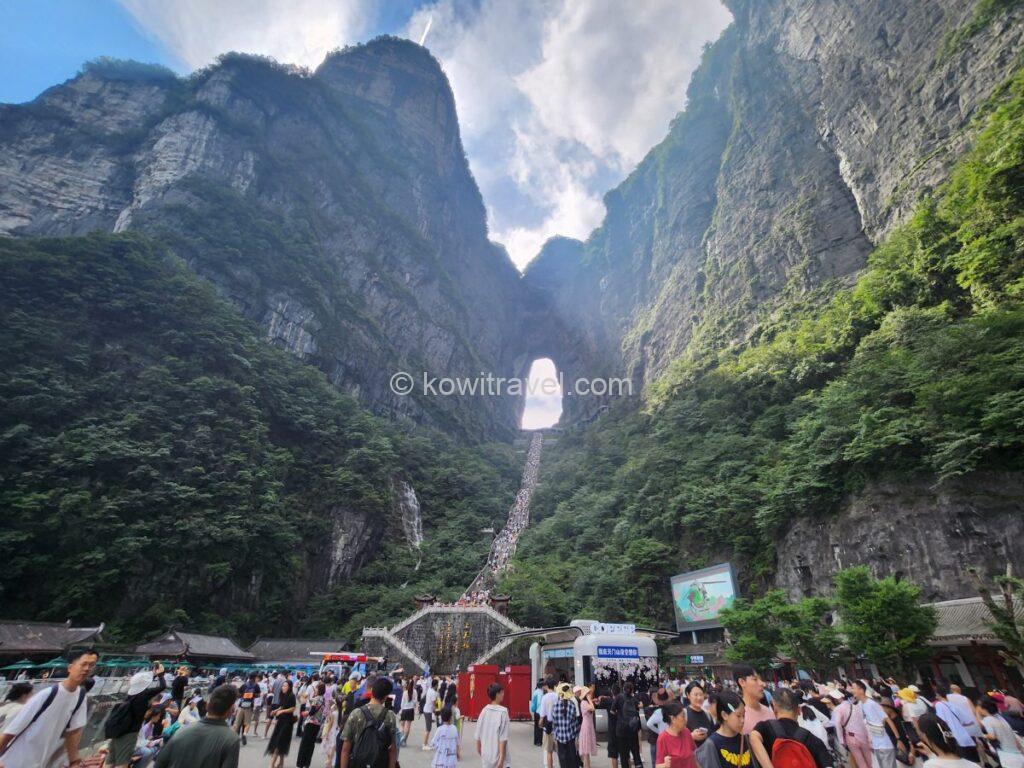
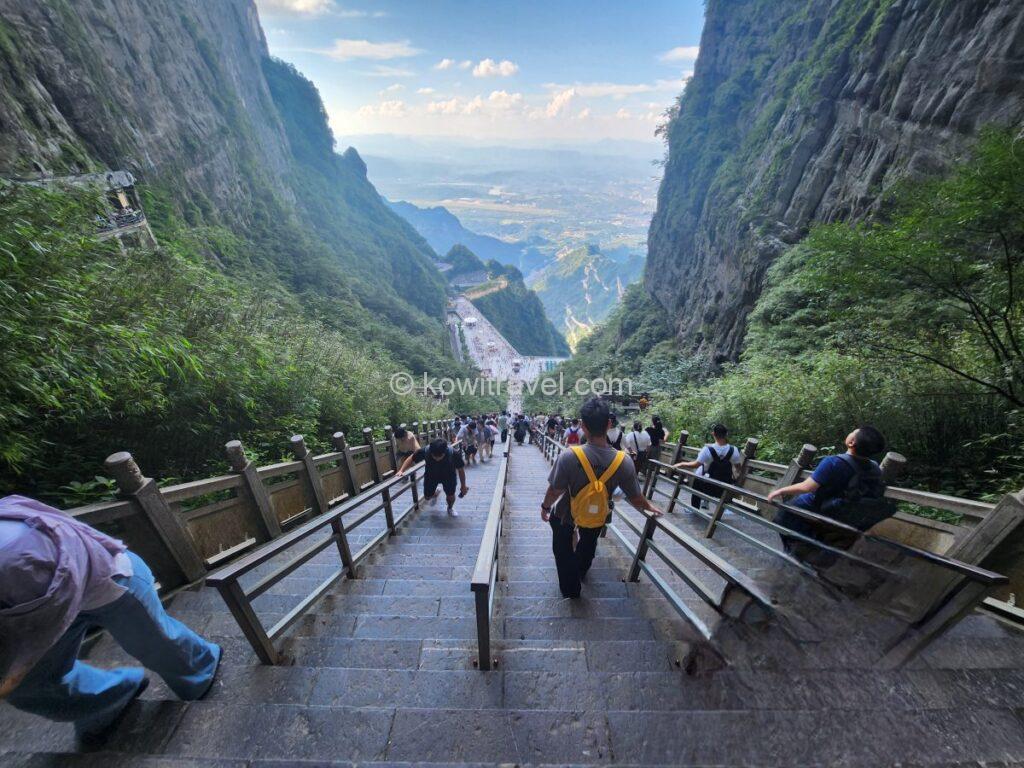
Tianmen Cave, the crowning jewel of Tianmen Mountain. A breathtaking view of the grand cavern and the dizzying 999 Steps to Heaven from the lower plaza.
When independent travelers first plan this trip, almost everyone hits a total roadblock.
You’ll inevitably ask yourself, “Wait, I’m supposed to be going to a giant mountain, so why is everyone telling me to head straight to a ticket office next to the train station right in the middle of the city center?”
Here’s the logistical secret: The departure terminal and boarding station for the world’s longest mountain cable car—which whisks you from civilization all the way up to the alpine summit—is actually built right in the middle of downtown Zhangjiajie (near the main railway station and central bus terminal).
On official maps and signs, this place is designated as the Tianmen Mountain Cableway Lower Station.
When you’re preparing to hail a taxi from your hotel room using the Gaode Map (Amap) app, do not type in the name of Tianmen Mountain itself. If you do, the app might route you to a distant mountain road or a closed maintenance gate.
You must explicitly set this downtown “Cableway Lower Station” as your final destination. This tiny, crucial detail is the only way to block any waste of time and keep your route perfectly ironclad from the very start.
Now, let’s officially dive into the grand epic carved into the sky.
2. A Miracle Crafted by the Cosmos: The Ancient Origins and Mind-Blowing History Behind Tianmen Mountain
Before we dive deep into the nitty-gritty details of the trail maps and hiking paths, let’s pause and unpack the mind-blowing history of how this massive mountain came to be, and exactly why it is crowned as the spiritual soul of Zhangjiajie.
As the old travel saying goes: The more you know, the more you see!
Reaching a towering elevation of 1,518.6 meters, Tianmen Mountain is a classic textbook example of an alpine karst limestone landform, ringed by dizzying, sheer vertical cliffs that drop straight into the abyss.
Intriguingly, the top of the mountain flattens out into a massive, sprawling plateau. Because this plateau is so isolated, ancient high-altitude vegetation has thrived here completely undisturbed, forming a pristine primitive forest that feels like an island floating in the clouds.
A long time ago, this geological titan didn’t carry the name it does today; it was originally called “Songliang Mountain.” However, everything changed during the middle of the Three Kingdoms period, specifically in the year 263 AD. Back then, this entire region fell under the territory of the Kingdom of Eastern Wu.
One fateful day, a cataclysmic, thunderous roar cracked through the heavens, and a massive chunk of the mountain’s sheer cliff face suddenly collapsed. When the dust finally settled, a colossal, door-like cavern had been cleanly punched straight through the body of the mountain.
The King of Eastern Wu, Sun Xiu, viewed this jaw-dropping event as a deeply auspicious omen sent directly from the heavens.
He proclaimed that “the gateway to the celestial realm has officially opened,” and proudly bestowed the name Tianmen Mountain (Heaven’s Gate Mountain) upon the peak, permanently changing the local prefecture’s name to “Tianmen County.”
This world-famous cavern, known today as Tianmen Cave, stands as the absolute highest naturally formed alpine limestone cave on Earth. It measures a staggering 57 meters wide, towers at an incredible height of 131.5 meters, and cuts a deep path over 60 meters long.
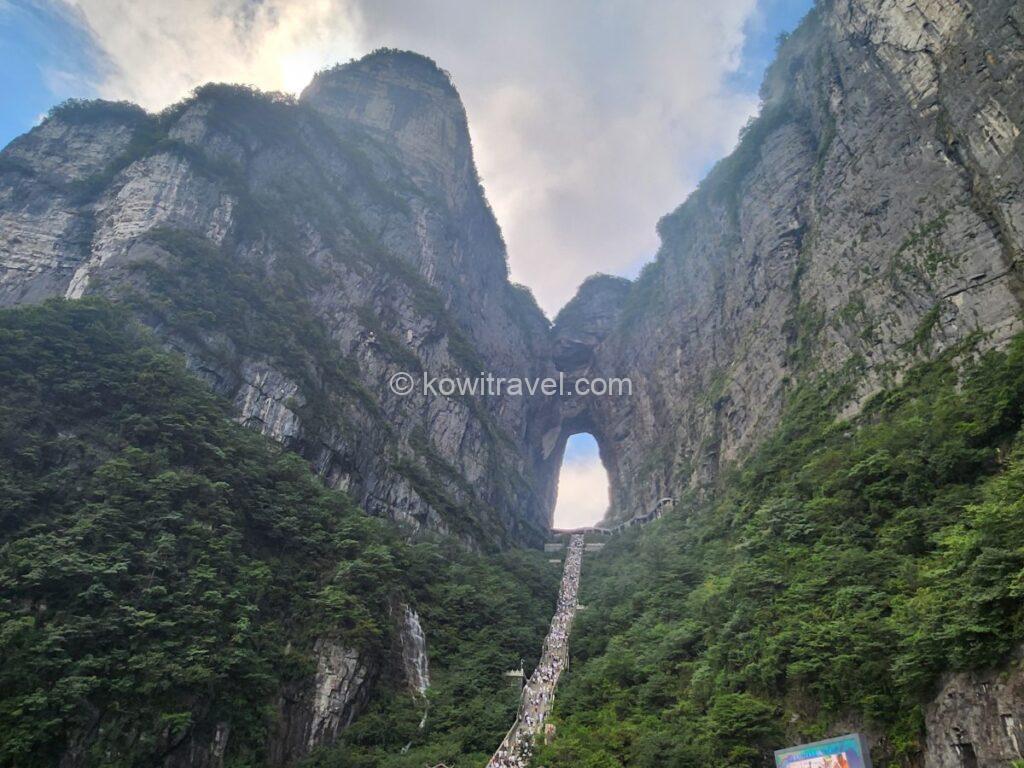
True to its name, the colossal limestone arch feels like a mystical portal leading straight into the celestial realm.
Back in 1999, this natural wonder achieved legendary global fame during an international aviation air show. A team of elite stunt pilots actually flew their propeller planes straight through the gaping maw of this cliffside cavern hole, performing mind-boggling aerial acrobatics.
Whenever the heavy mountain mist rolls into the valley and fills the massive gap, it looks exactly like a mystical, glowing portal leading straight to heaven, creating an ethereal spectacle that words cannot fully describe.
3. “Why on Earth is Online Information So Contradictory?” – The Definitive Fact-Check on Lines A, B, and C
If you’ve spent any time on travel forums, you’ve probably noticed that every single blog post describes a completely different route. It’s incredibly confusing. The reason for this mess is simple: many articles are based on outdated hearsay or temporary detours mistaken for permanent layouts.
To make your trip completely stress-free, let’s lay out the definitive facts regarding the original Line A, B, and C routes that have served as the standard blueprint for years.
First, here is the golden rule to keep in mind: No matter which route you choose, the actual sights you see at the summit are 100% identical. Every ticket grants full access to the Ghost Valley Skywalk, the Coiled Dragon Cliff Glass Skywalk, and Tianmen Cave.
The only difference is the logistical sequence—what you ride to go up, and what you ride to come down.
- Line A (Downtown Cable Car Up ➡ 99-Bend Bus Down)
You board the world’s longest passenger cable car (7,455 meters for a scenic 30-minute ride) straight from the downtown terminal to the summit. You explore the upper loop first, take the deep-mountain escalators down to Tianmen Cave, and then ride the green shuttle buses down the terrifying 99-Bend Tongtian Avenue to the front gate. This is the classic textbook route. - Line B (99-Bend Bus Up ➡ Downtown Cable Car Down)
The exact reverse of Line A. You catch a city shuttle to the front gate, ride the stomach-churning 99-Bend bus up to Tianmen Cave first, take the escalators up to the plateau, and enjoy a peaceful cable car ride straight back down into downtown. - Line C (Express Cable Car Round-Trip) ➡ The Route We Personally Took!
This line completely skips both the 30-minute downtown cable car and the winding 99-Bend bus. Instead, you take a shuttle to the front gate and hop directly onto the Tianmen Cave Express Cable Car to fly up to the cave square. You explore the cave, hit the summit loop via the escalators, and head down using the exact same path in reverse—a perfectly symmetrical round-trip.
💡 Independent Traveler’s Fact Check!
If an online post claims, “I booked Line A but still had to ride a bus on the way up,” that’s factually incorrect. The authentic Line A exclusively uses the bus for the descent, and Line B uses it for the ascent. That is the immutable standard.
When we arrived during the absolute peak mid-August season, Lines A and B sold out within minutes of the ticket window opening. We had no choice but to take Line C.
But looking back, Line C turned out to be a massive blessing in disguise! Because it completely bypasses the downtown station—the biggest bottleneck for massive tour groups—we experienced almost zero congestion and significantly shorter wait times. If Lines A and B are sold out, don’t be discouraged for a second!
🚨 URGENT 2026 TRAVEL UPDATE: Current Route Status
When I tackled this mountain last August, all three routes were running smoothly.
However, based on the latest 2026 updates, the primary downtown cable car is currently undergoing a massive structural overhaul. Because of this, Line A, Line B, and all tourist buses along the 99-Bend Road are completely suspended.
This means if you are planning a visit right now, Line C (Express Cable Car Round-Trip) is your ONLY option!
Keep this in mind so you don’t waste your morning standing around an empty downtown station based on outdated blogs.
4. Understanding Base Ticket Pricing and On-Site “Extra Fees”
📌 TL;DR: Your base ticket excludes the 32 RMB escalator up to Tianmen Cave (highly recommended to save your knees) and the 5 RMB red shoe covers required for the Glass Skywalk, so ensure you have mobile payment or cash ready on-site.
The standard cost for an all-inclusive combo ticket hovers around 275 to 288 RMB ($38 to $40 USD) for a regular adult. No matter which transit line you select, the official base price remains exactly the same. You can easily check live rates and availability directly through these trusted platforms:
👉 Check Real-Time Tianmen Mountain Ticket Prices on Trip.com
👉 Check Real-Time Tianmen Mountain Ticket Prices on Klook.com
This ticket seems to cover everything—park entry, major cable cars, and the inner-mountain escalators (Tiers 1 through 7). It makes you think you won’t spend another penny. However, the moment you set foot on the mountain, you’ll discover a few specific zones that require on-site extra costs.
- The Inner Tianmen Cave Ascent Escalator (Tiers 8 to 12): 32 RMB Per Person (One-Way Upgrade)
When you stand at the lower plaza and look up at Tianmen Cave, you are faced with the infamous “999 Steps to Heaven”—a dizzying, incredibly steep flight of stone stairs. In the sweltering humidity of mid-summer, climbing these steps on foot is absolute physical purgatory. To save your knees, ride the modern escalators bored directly through the solid bedrock. To ride them upward, you must pay an additional 32 RMB per person at the on-site booth. - The Downward Journey is… Completely Free?!
Here is a fascinating piece of operational trivia: if you tour the high-altitude cliff walks on the summit first and take the upper escalators down into Tianmen Cave, the ride down Tiers 8 through 12 back to the lower plaza is 100% free! The park collects no fees for the downward direction to ensure visitors descend safely and efficiently. - Other Minor On-Site Pocket Expenses:
Coiled Dragon Cliff Glass Skywalk Shoe Covers: 5 RMB (Mandatory rental; you cannot step onto the transparent glass trail without these red fabric covers to protect against scratches).
Open-Air Summit Chairlift: 25 RMB One-Way (An optional ski-lift style chair gliding over the forest canopy between the highest peaks and Tianmen Temple—fantastic for conserving leg power).
5. Embarking on the Real Line C Adventure – A Deep, Step-by-Step Field Guide to the High-Altitude Summit and Every Cardinal Cliff Path
📌 TL;DR: The upper plateau is a fully interconnected loop.
To conquer the summit smoothly without backtracking or wasting energy, follow this directional strategy: East Line (Glass Skywalk) ➡️ North Line (Ghost Valley) ➡️ Tianmen Temple ➡️ West Line for a seamless descent.
5.1) The Tianmen Cave Express Cable Car and the Scenic Fuyuan Skywalk
Our journey along Route C officially kicked off when we boarded the free park shuttle bus at the downtown terminal. The bus drove smoothly out of the city and zipped along the highway, quickly dropping us off at the sprawling, majestic mountain front gate plaza.
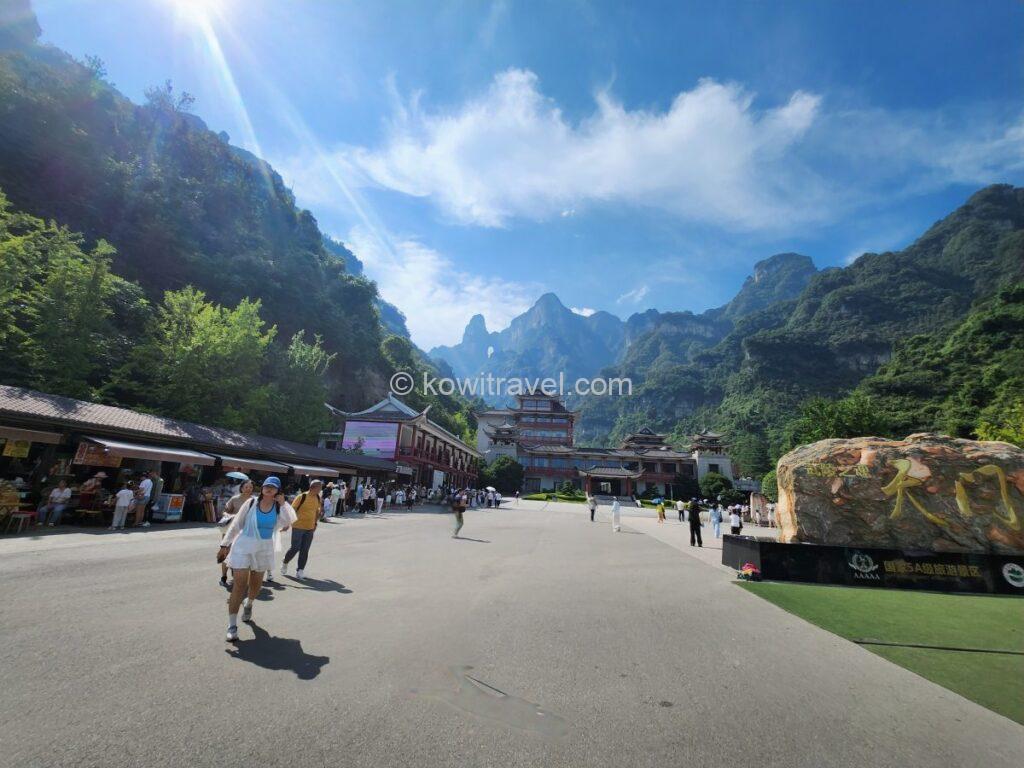
The majestic mountain front gate plaza. Standing here gives you an incredible view of the distant Tianmen Cave punched straight through the highest crest.
This valley plaza is an absolute premier photography hotspot.
When you stand in the very center of the square and look straight up, you can see the tiny, distant hole of Tianmen Cave framed by titanic vertical stone walls.
We followed the clear English signs guiding us away from the main square, passing right by the massive outdoor stage structures built for the famous “Tianmen Fox Fairy Show”—a legendary night-time musical production.
A short walk up the stone path brought us directly to the boarding terminal for the core engine of our day: the Tianmen Cave Express Cable Car.
Boarding the express cable car from the lower valley station to head up to the cave plaza.
The moment we stepped out of the upper cable car station, we found ourselves standing directly at the entrance of a gorgeous, winding cliffside pathway known officially as the Fortune Skywalk .
Looking down from the Fortune Skywalk reveals a bird’s-eye view of the winding 99-Bend Road and the downtown city landscape.
The name itself carries a beautiful poetic meaning, translating to “The Skywalk of Blessings and Good Fortune.” To blend into the high-altitude wilderness, the handrails of this concrete path have been beautifully sculpted to look exactly like rustic tree branches.
As we strolled along this introductory path, we could peer over the edge and watch the famous 99-Bend Road twisting through the green valley deep below like a giant coiled serpent.


The rustic, winding path of the Fortune Skywalk leading travelers toward the lower cave square.
The Fortune Skywalk guided us smoothly around the mountain flank and delivered us straight to the bustling lower plaza of Tianmen Cave.
We paid our 32 RMB fee and boarded the Tiers 8–12 escalators, riding comfortably through the cool tunnels inside the mountain rock.
The moment we stepped out into the daylight right at the mouth of the massive cave opening, a spectacular, completely unexpected view unfolded right before our eyes.
We walked along the wooden viewing decks and found ourselves staring at a gorgeous, perfectly still Mirror Reflection Pond nestled deep inside the limestone cavern walls.
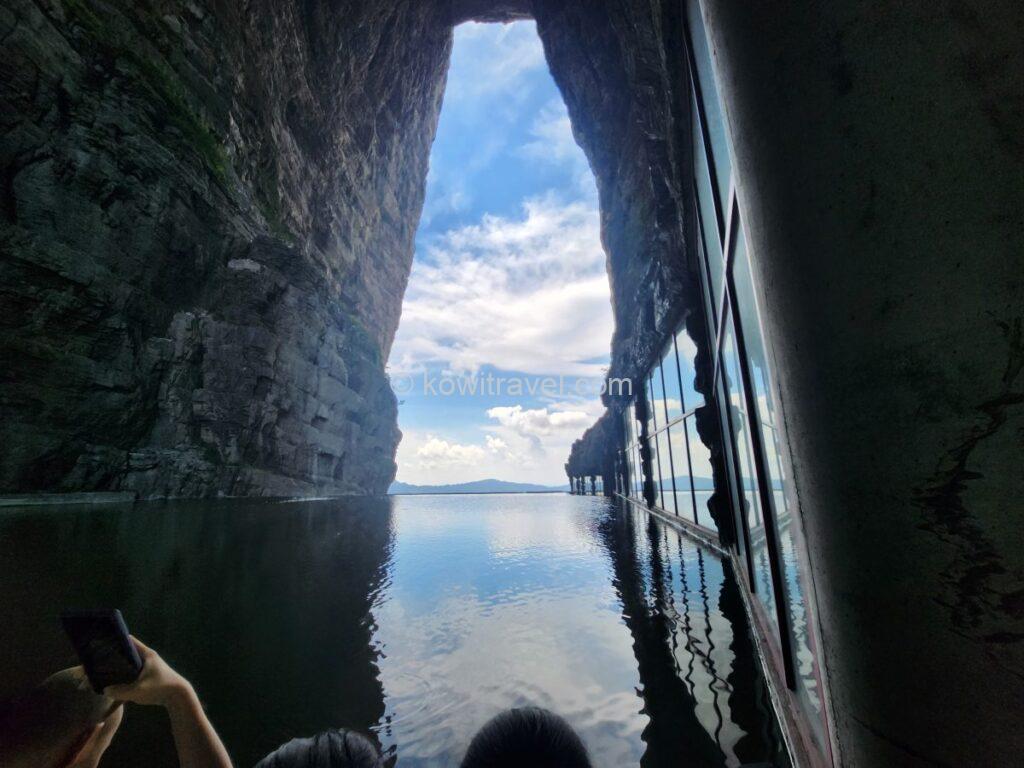
The crystal-clear Mirror Reflection Pond inside Tianmen Cave, beautifully projecting the blue sky and the colossal rocky vault on its glassy surface.
This pool continuously catches the pure, natural mountain spring water that trickles down from the ceiling—a water source locals affectionately refer to as “Tianmen Holy Water.”
The park authorities constructed a beautifully polished stone basin here so that the water remains completely smooth like glass. Standing at the edge, you can watch the deep blue sky and the titanic limestone arch of the cave perfectly mirrored on the water’s surface, creating a deeply spiritual, symmetrical visual illusion.
From here, we boarded the massive, free inner-mountain escalators (Tiers 1 through 7).
These heavy-duty escalators carried us straight through the heart of the mountain for several continuous minutes, finally depositing us directly onto the high-altitude summit plateau.
The very second we pushed open the heavy exit doors, the sheer, needle-sharp stone peak of the Yunmeng Fairy Summit soared dramatically into the sky.
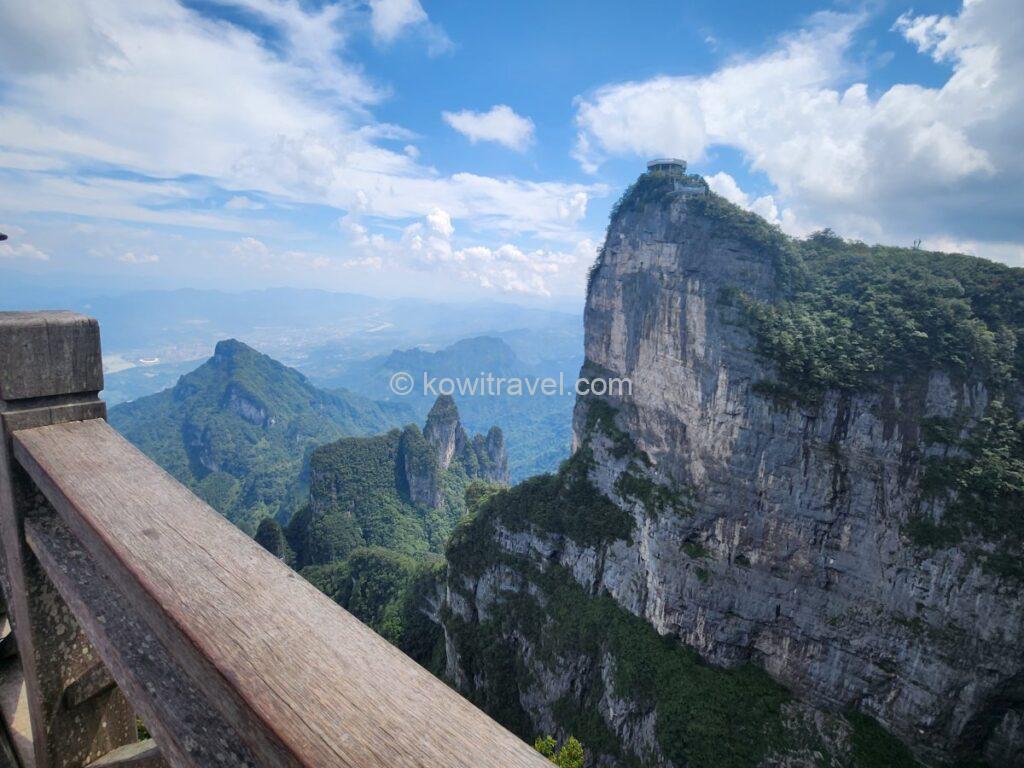
The towering, razor-sharp peak of the Yunmeng Fairy Summit, crowned by its high-altitude scenic observation pavilion.
We stepped onto the elevated wooden plank pathways—known locally as the Plank Bridges—which are bolted directly onto the completely vertical, 90-degree limestone cliff face.
Walking along this magnificent highway in the sky, suspended hundreds of meters above the misty abyss, made us realize why this place is revered as the living soul of Zhangjiajie.
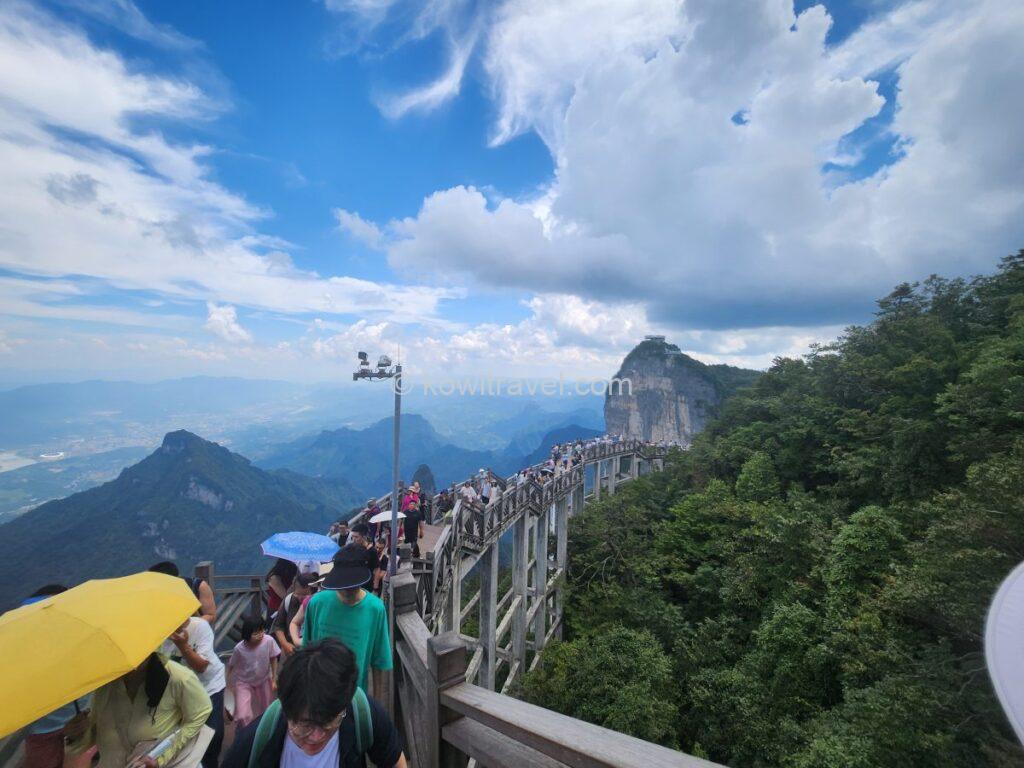
The extreme engineering of the summit plank walkway, bolted securely into the sheer vertical limestone cliff faces.
To navigate the summit plateau successfully without getting lost or wasting your physical energy, it is incredibly important to understand how the trail system is laid out. The top of the mountain is designed as a massive, perfectly interconnected Full Loop (Summit Circular Trail).
Think of the upper escalator station near Tianmen Cave as your absolute southern anchor point on the map.
From this spot, you venture East to tackle the transparent glass trails, curve into the North Line for Ghost Valley, reach the absolute northernmost point for Tianmen Temple, and loop back down via the panoramic West Line.
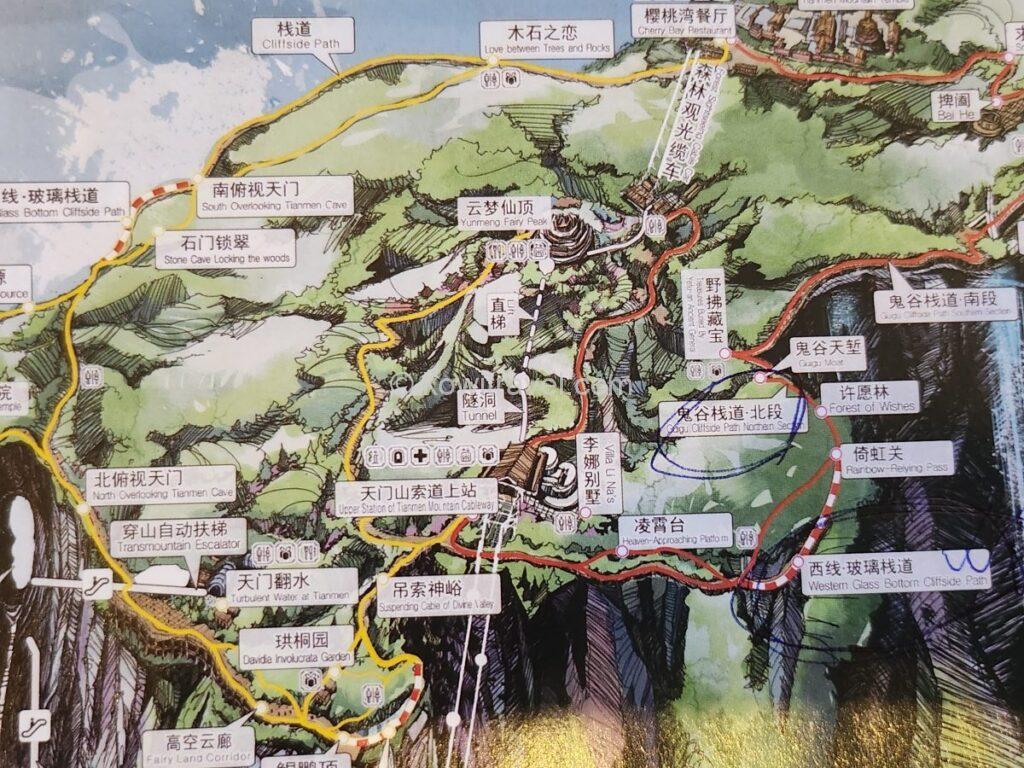
The official trail map highlight: The crimson path on the lower right shows the route leading through the Glass Skywalk and into the North Line.
Let me lay out the raw, vivid details of the exact paths I walked, step by step.
5.2) [The East Line] The Prelude to Pure Adrenaline: The Heart-Stopping Coiled Dragon Cliff Glass Skywalk
The moment you turn onto the East Line, you are instantly confronted by the most famous attraction on the entire mountain: the legendary Coiled Dragon Cliff Glass Skywalk.
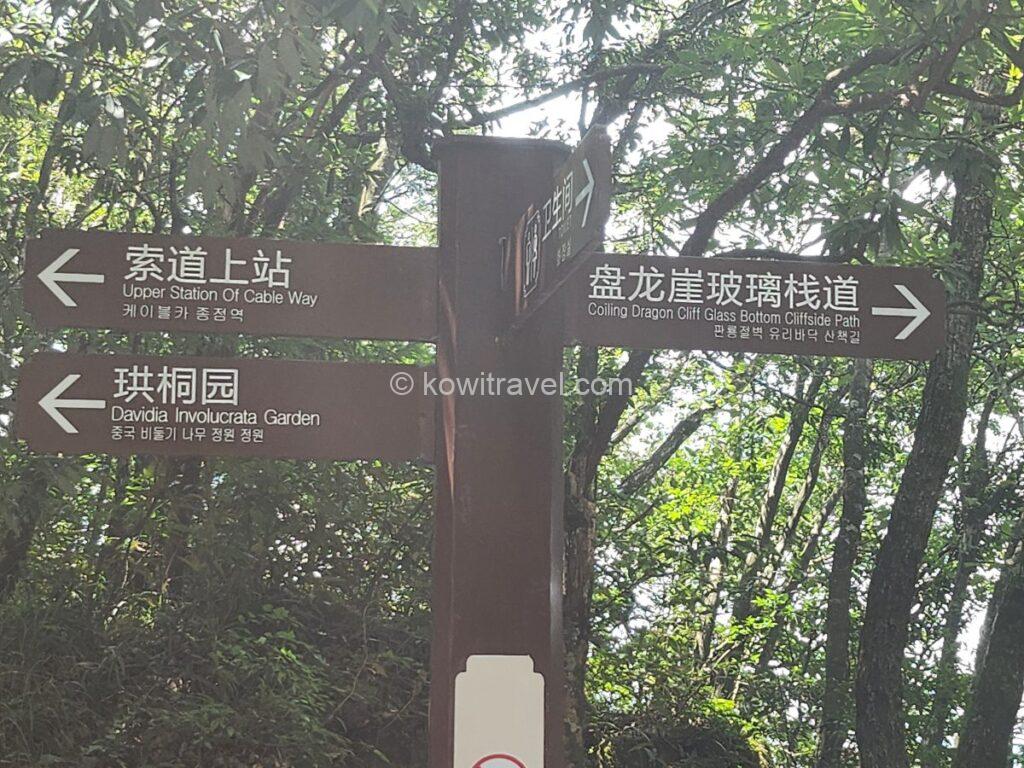
The clear directional signboard marking the entry point of the Coiled Dragon Cliff Glass Skywalk.
This pathway is pinned directly onto the outer face of a vertical cliff, sitting at an altitude of over 1,400 meters above the valley floor. The entire floor of this narrow walkway is constructed from completely transparent, heavy-duty tempered glass panels.
I have to admit, even though I knew the engineering was safe, the exact second I lifted my foot and took my very first step onto that clear glass, a sharp wave of pure psychological tension shot straight through my body.
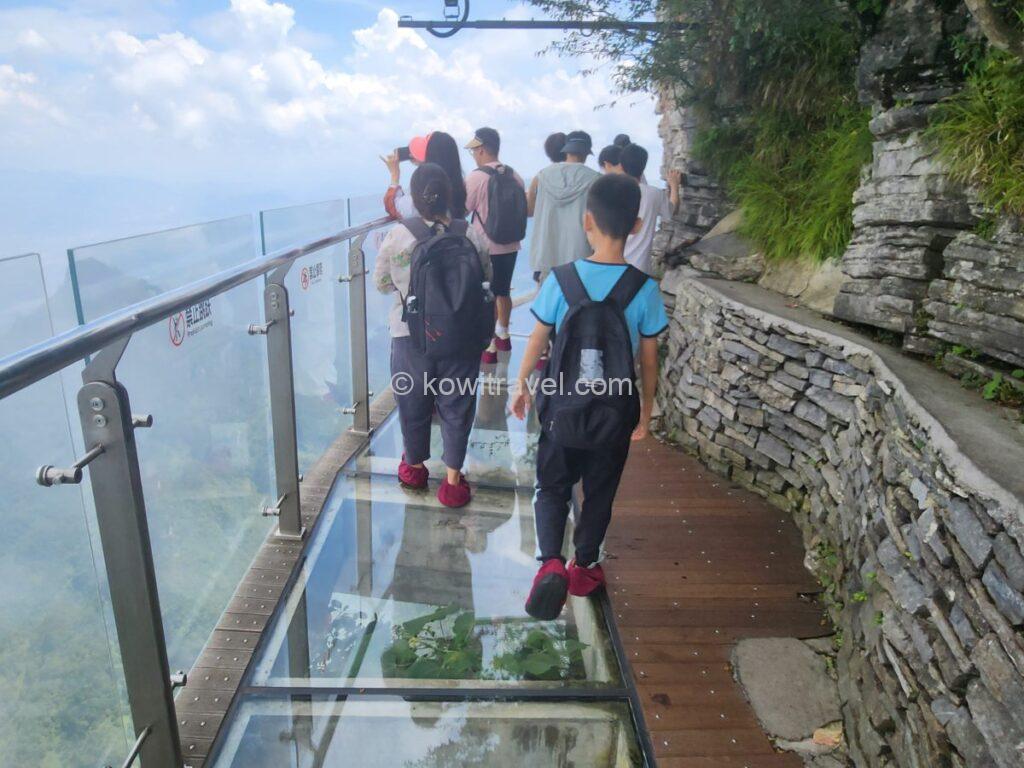
Stepping out onto the transparent glass floor triggers an instant rush of pure, heart-pounding adrenaline.
When you look down between your shoes, there is absolutely nothing beneath you but a sheer 4,600-foot drop and the tiny tips of the primitive forest canopy swirling in the mountain mist below.
Every single step feels like you are literally walking on thin air.
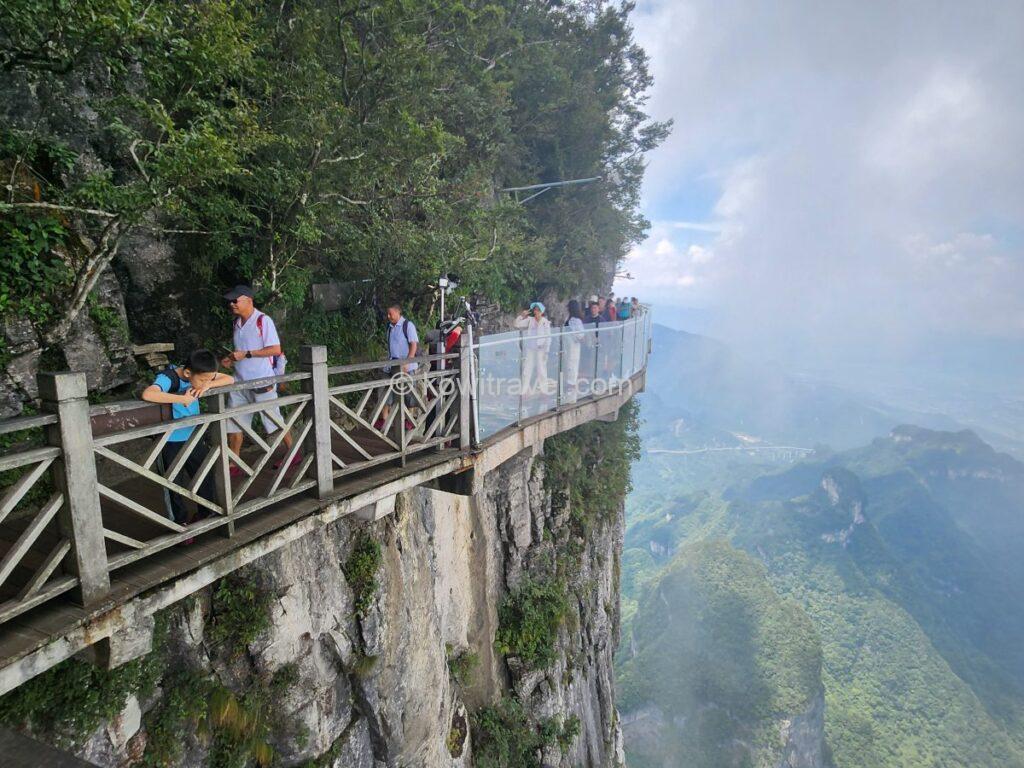
The dramatic view of the glass path hanging off the massive cliff wall, offering a spine-tingling perspective of the abyss.
To prevent any scratches or scuffs from clouding up the transparent view, the park rangers enforce a strict safety rule: every single visitor must pay a small 5 RMB fee to rent a pair of bright red fabric shoe covers.
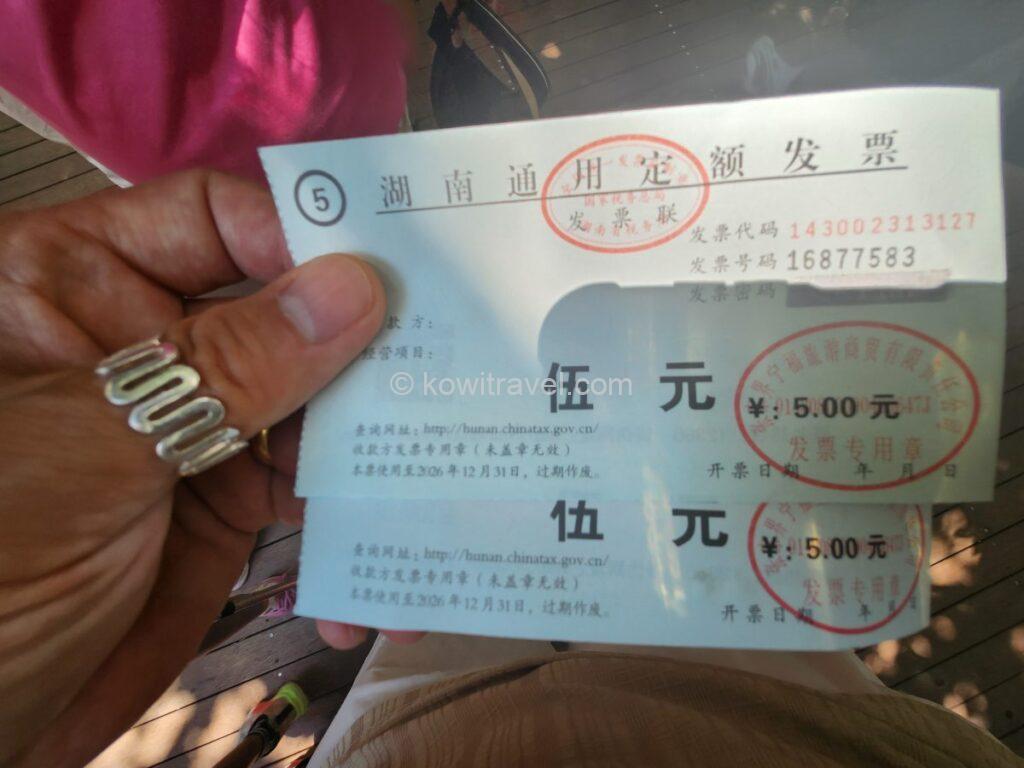
The mandatory red fabric shoe covers provided at the entrance to protect the clear glass panels.
The moment you transition from the solid stone path onto that completely clear, cantilevered glass shelf hanging out over the open sky is an unforgettable highlight you cannot miss.
5.3) [The North Line] A Highway Strung Over the Void: From the Ghost Valley Skywalk to the Deep V-Shaped Canyon Gorge
The very second the glass panels come to an end, you pass through a rustic stone archway and enter the northern sector, greeted by the striking entrance of the Ghost Valley Skywalk .
The entire entry path here is a sea of brilliant, fiery red—thousands of travelers have tied vibrant red prayer ribbons to the gnarled mountain trees, creating a deeply mystical atmosphere.
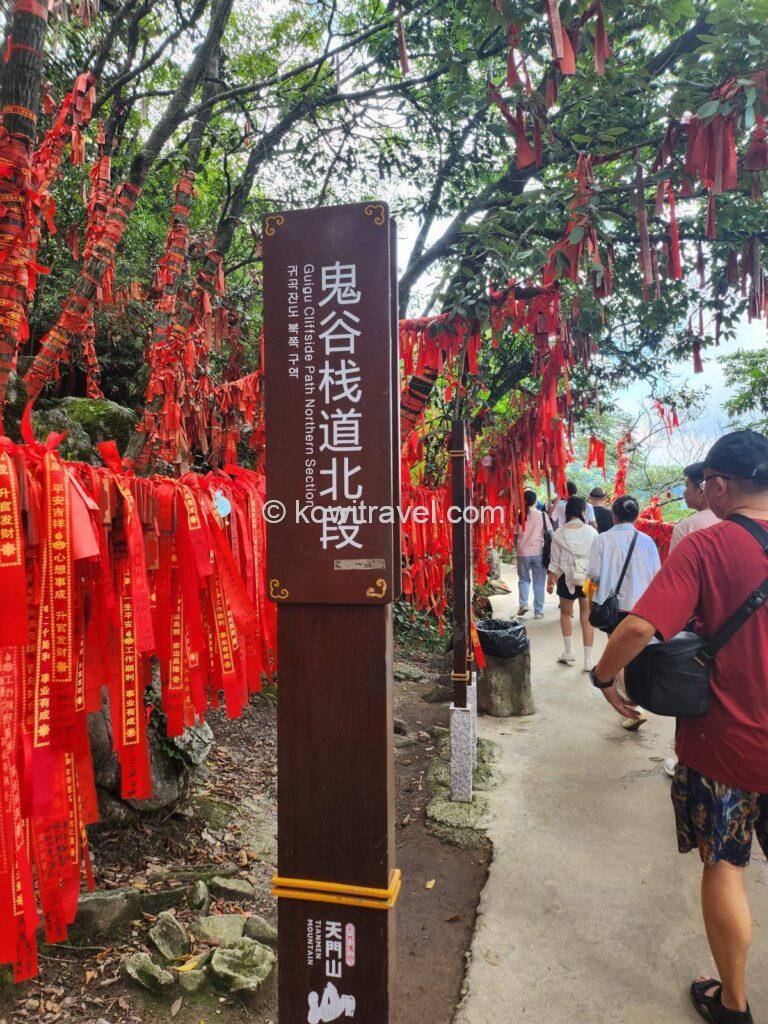
The northern entrance of the Ghost Valley trail, densely covered in thousands of vibrant crimson prayer ribbons.
The path takes its terrifying name from a famous ancient Chinese philosopher and master strategist who retreated into these isolated mountain cracks to meditate. It is a narrow ribbon of reinforced concrete pinned directly onto a smooth, vertical 90-degree cliff wall.
It grants the absolute best front-row seats to watch the legendary alpine sea of clouds roll through the jagged limestone towers.
Walking here genuinely feels like you are floating over a vast, bottomless void, making you realize just how small we are in the face of monumental nature.
As we rounded the first major cliff corner, the mountain walls dropped away to reveal a staggering panoramic view of overlapping vertical peaks.
If you look far into the distance toward the highest ridge, you can spot the gleaming white, geodesic dome of the high-altitude Weather Radar Station sitting like a futuristic outpost on the rocky crest next to the highest summit.
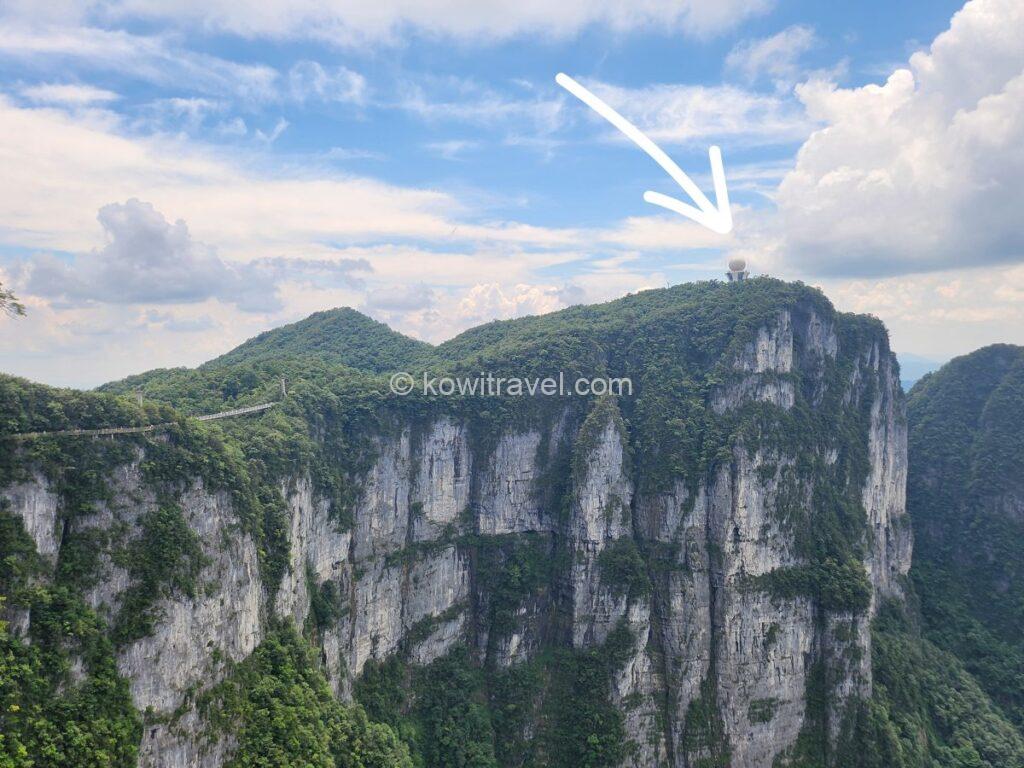
The white dome of the high-altitude weather radar station visible on the distant mountain crest.
The concrete path continues to hug the stone wall, supported by massive vertical pillars drilled straight into the cliffs—a testament to the unbelievable grit of the laborers who built this skyway.
Slowly, the path curves inward, diving deep into a colossal, sharply creased V-shaped canyon gorge known as the Tongtian Avenue Overlook.
Walking through this deeply indented canyon loop allows you to see the path you just walked hanging off the opposite cliff face.


The breathtaking concrete walkway hugging the steep cliff side, highlighting the incredible human effort required for its construction.


A dramatic view looking directly down into the vertical chasm of the Tongtian Avenue canyon loop.
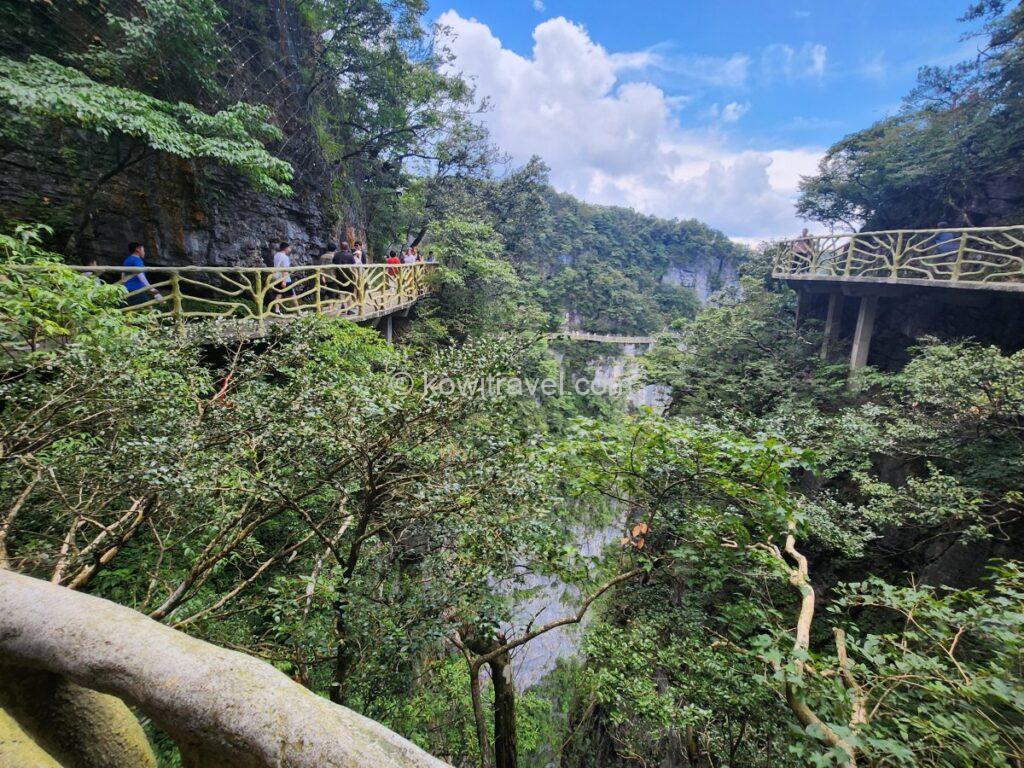
The deep, V-shaped indentation where the sheer cliffs sharply crease inward, forming a magnificent gorge.
5.4) [The Far North Summit] The Sacred Mountain Sanctuary: Exploring the Ghost Valley Suspension Bridge, the Legend of Yafu, and Tianmen Temple
Following the North Line trail all the way to its northernmost apex brings you to the grand finale of the cliff-walk sector. Here, you come face-to-face with a terrifying suspension bridge slung precariously across the open void: the famous Ghost Valley Suspension Bridge .


The directional sign for the southern Ghost Valley sector (left) and the dizzying view of the steel-cable Ghost Valley Suspension Bridge (right).
This bridge is a dramatic feat of construction, slung between two completely isolated vertical stone pillars.
Standing in the exact middle of this swaying bridge while the wind howls through the gorge and looking straight down through the wooden slats into the bottomless valley below gives you a profound sense of absolute liberation.
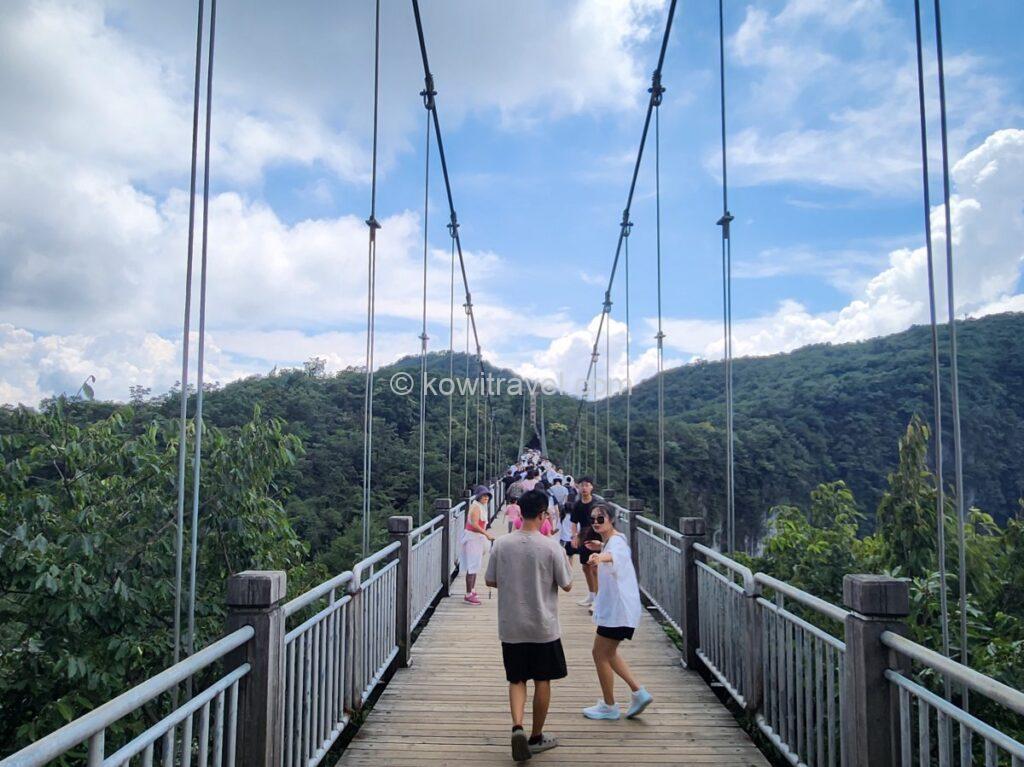
Walking across the swaying wood-and-steel suspension bridge hanging hundreds of meters above the mountain floor.
Once you safely cross to the other side of the suspension bridge, you enter a wide, beautifully shaded forest clearing known as the Yafu Zhangbao Rest Area.


The historical marker for the Yafu Zhangbao outpost (left) and the rustic snack stalls inside the shaded forest clearing (right).
[Click to expand: The Legend of the Imperial Treasury and the “Six Riddles of Tianmen Mountain”]
The name “Yafu Zhangbao” translates directly to “The Secret Outpost Where Monk Yafu Hid the Imperial Treasure.” This historic site is tied directly to one of the most famous legendary mysteries of the region, known to locals as the “Six Riddles of Tianmen Mountain.”
During the turbulent final years of the Ming Dynasty, a powerful peasant rebel leader named Li Zicheng launched a massive revolution, successfully capturing the Forbidden City and declaring himself emperor. However, his triumph was short-lived; the elite military forces of the incoming Qing Dynasty quickly routed his army, forcing his remnants to scatter. Li Zicheng’s direct nephew and most trusted military general, a fierce warrior named Li Jin, gathered his closest guards and fled deep into the untamed wilderness of Zhangjiajie’s cliffs to escape execution.
To completely hide his true identity from the imperial bounty hunters, General Li Jin shaved his head, donned the simple robes of a Buddhist monastic, and took the spiritual name “Monk Yafu.”
According to ancient regional lore, when the rebel forces originally fled the capital, they managed to smuggle out the entire contents of the imperial treasury—a mind-boggling fortune consisting of solid gold bars, silver brick bullion, and priceless crown jewels. Monk Yafu allegedly hid this unimaginable fortune deep within the secret, inaccessible cracks of Tianmen Mountain’s sheer vertical cliffs, planning to dig it up later to fund a massive counter-rebellion to overthrow the Qing Dynasty.
For hundreds of years, thousands of desperate treasure hunters, historical explorers, and local villagers have combed through these dangerous vertical drop-offs, but the hidden imperial fortune has never been found. Today, this legendary cliffside outpost has been transformed into a peaceful mountain rest station, complete with wooden benches, clean restrooms, and local snack stalls where exhausted hikers can buy refreshing cold drinks and ice cream.
After resting our legs and cooling off with a cold fruit juice, we walked just a few hundred meters further along the flat forest trail and suddenly arrived at the grand, spiritual crown jewel of the mountain plateau: the magnificent Tianmen Mountain Temple.


The directional sign guiding visitors to the temple (left) and the grand Tang-style entrance gates of Tianmen Mountain Temple (right).
This sprawling monastic complex is a stunning replica built entirely in the majestic, elegant architectural style of the ancient Tang Dynasty.
Seeing a massive, multi-tiered Buddhist temple complex built right on top of a highly dangerous, isolated mountain plateau fills you with pure awe for human determination.


The grand Tianwang Hall (left) and the fiercely sculpted, towering guard statues of the Four Heavenly Kings protecting the inner altar (right).
We walked through the grand entrance gates into the quiet inner courtyards. The first major structure you encounter is the grand Tianwang Hall (Hall of the Heavenly Kings).
Stepping inside the cool wooden interior, you are greeted by the towering, highly colorful, and fiercely sculpted statues of the Four Heavenly Kings standing guard on either side of the altar.


The side wooden viewing decks of the grand Daxiong Baodian (left) and the intricate, multi-tiered octagonal wooden architecture of the Guanyin Pavilion (right).
We walked along the stone-paved side decks of the grand Daxiong Baodian (Great Buddha Hall) and headed toward the back of the monastic grounds.
Standing tall against the bright blue sky is the most photogenic structure in the entire complex: the Guanyin Pavilion, a highly intricate, multi-tiered octagonal wooden tower featuring beautifully swept, curved eaves.
After exploring the temple grounds, we exited through a hidden side trail that transitioned into a deeply unique, enclosed walkway known as the Gua Dong Stone Path.
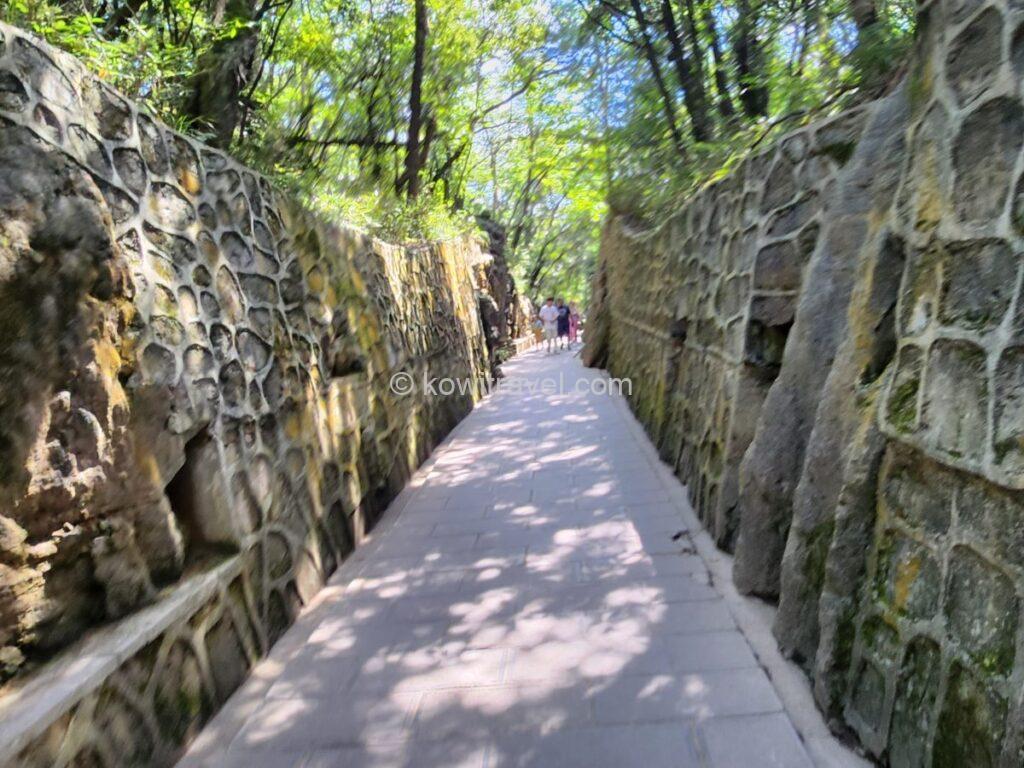
The beautiful Gua Dong Stone Path, lined with ancient stacked river stones that create a deeply rustic, fortress-like atmosphere.
This beautiful pathway was carved directly out of the raw mountain rock when the park authorities were building the pedestrian loop. The two side walls are constructed from thick, massive stones stacked together using an ancient geometric masonry technique.
Walking down this path feels like exploring a secret escape tunnel inside an ancient medieval fortress, making it a fantastic hidden photography spot.
5.5) [The West Line] A Peaceful Forest Stroll, the Panorama of the City, and Returning to the Mountain Core
Once you clear the stone fortresses of the Gua Dong path, you officially cross over to the West Line of the summit plateau. The trail turns sharply back toward the south, beginning your smooth, comfortable return journey.
If the East and North lines are defined by raw, aggressive vertical stone drops that test your fear of heights, the West Line offers a completely different aesthetic.
This side of the mountain is much softer, heavily shaded by a thick canopy of ancient trees, and features wide, flat concrete paths wrapped in lush alpine greenery.


The heavily forested West Line trail, featuring lush alpine greenery and highly comfortable, shaded walking paths.
As you stroll past the scenic junction known as Guanyungu (The Gateway Where the Clouds Gather), you will encounter the directional signs for Yingquanwan (The Spring of the Jade Foals).
Following this path leads you along the westernmost rim of the high-altitude cliffs.


The directional sign dividing the path toward Guanyungu (left) and the Yingquanwan loop that connects back to the central escalators (right).
As we walked along this peaceful ridge, the dense trees suddenly parted, and we found ourselves staring through the rustic handrails at an absolutely jaw-dropping panoramic view of Zhangjiajie Downtown laid out thousands of feet below us.
From this extreme height, the entire city looked like a miniature toy model, with the winding river cutting through the streets. Staring at the city center where we started our morning gave us a profound sense of accomplishment—we had officially walked around the entire crown of the mountain!
Peering through the handrails at the breathtaking, miniature layout of downtown Zhangjiajie far below.
We followed the clear signs marking the Yingquan Circular Path, and within a few minutes, we found ourselves standing right back at the grand entrance plaza of the central mountain escalator hub, ready to begin our descent back to the middle of the mountain.
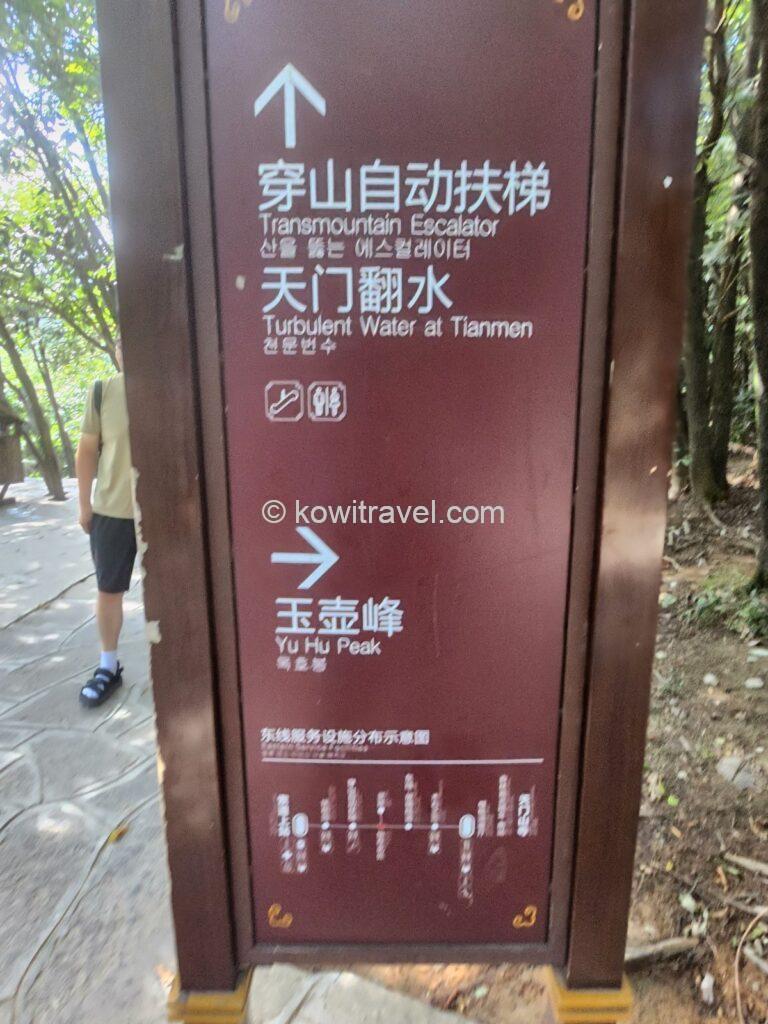
The final directional signboard marking the entry entrance for the deep-mountain transit escalators.
5.6) Standing inside Heaven’s Gate: The Spectacular Grand Finale at Tianmen Cave
The inner-mountain escalators dropped us off smoothly right inside the massive, cavernous mouth of Tianmen Cave (Heaven’s Gate).
Seeing this gargantuan natural limestone archway from a distance is one thing, but standing directly underneath its soaring rocky ceiling is an experience that will completely redefine your understanding of scale.
The sheer mass of the stone walls towering hundreds of feet over your head is deeply humbling.
Standing directly inside the gargantuan vault of Tianmen Cave, feeling completely crushed by its massive scale.
When you walk out to the edge of the cave’s viewing deck and peer down, you are treated to a dizzying view: the famous 999 Steps to Heaven cascading steeply down the mountain face at a brutal angle, dropping straight into the lower plaza far below.
Watching brave travelers slowly climb their way up this grand stone staircase provides a spectacular, high-drama conclusion to what is easily one of the most magnificent alpine loop hikes in the world.


Looking up at the majestic limestone arch of Tianmen Cave from the bottom of the plaza after completing the entire loop.
6. Our Last Night in Zhangjiajie – A Local Bus Adventure to the Illuminated 72 Qilou and the Vibrant Street Food Culture of the Night Market
💡 TL;DR: The 110-meter glowing 72 Qilou is colossally tall; don’t stay right in front of the entrance.
Take the pedestrian underpass to the wide-open plaza directly across the main street to frame the entire illuminated skyscraper in one perfect shot.
After completing our loop on the peak, we hopped back onto the inner escalators (riding the downward tiers for free!), boarded the Express Cable Car, and caught the park shuttle bus to return safely to the downtown city center.
Since we were scheduled to board a long-distance transport to Guangzhou early the next morning, this evening marked our absolute last night in Zhangjiajie.
To celebrate the end of our 3-week adventure, we decided to visit the hottest modern nightlife landmark in the city: the spectacular 72 Qilou (72기루).
Our hotel was located about a 15-minute walk from the main city cable car station, so we walked out to the public transit stop directly in front of the central Zhangjiajie Railway Station Bus Terminal and boarded a local city bus, filled with excitement to see the city lights.


The central Zhangjiajie Railway Station Bus Terminal (left) where we boarded our local city transit bus (right) to head out to the night market.
When the bus dropped us off, the sun was just beginning to dip below the horizon, and a massive crowd of both local residents and independent travelers was already gathering in the streets, waiting for the nightly transformation.
The exact moment darkness took over the sky, the massive building suddenly erupted into life as thousands of vibrant LED lights flashed on all at once.


The massive 72 Qilou structure photographed just before the lights turned on (left) and the exact moment it erupted into brilliant nightly colors (right).
The 72 Qilou complex stands as the absolute centerpiece of modern night-time tourism in Zhangjiajie.
There is an incredibly famous saying among travelers in China: “Spend your day feasting your eyes on the natural wonders of the world, and spend your night losing your mind to the lights of 72 Qilou!”
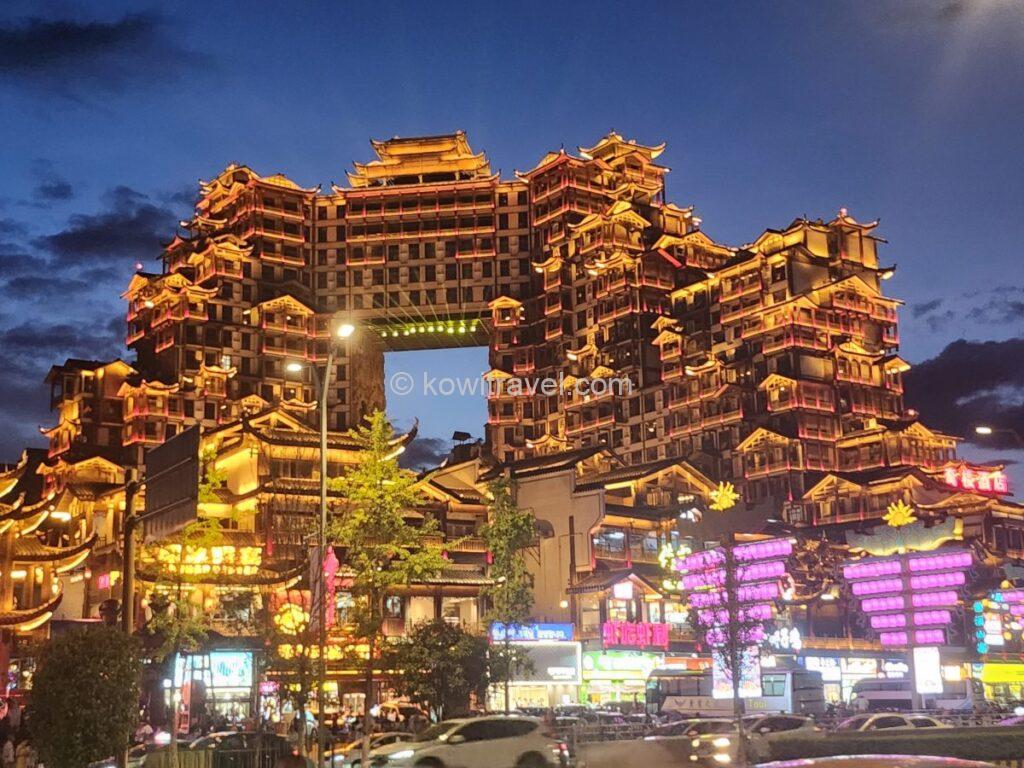
The breathtaking, ultra-modern neon illumination of the 110-meter 72 Qilou skyscraper.
The architectural scale of this building is completely mind-blowing, soaring to an absolute height of 109.9 meters.
The design is a high-tech celebration of the traditional stilt-house architecture (Diaojiaolou) belonging to the local Tujia ethnic minority group.
The building features a massive, completely hollow center carved straight through the upper floors, specifically designed to mimic the iconic silhouette of Tianmen Cave!
Local lore says the number 72 doesn’t mean the building has 72 floors; it originates from an ancient regional legend of the “72 mysterious pavilions” and signifies that visitors can experience 72 distinct cultural joys inside the gates
Although our tight schedule prevented us from exploring the commercial floors inside, simply admiring the exterior from the outside was more than enough.
The moment darkness fell, the entire skyscraper transformed into a giant canvas for a high-definition LED media facade light show, flashing brilliant animations that left us completely spellbound.


A side view of the 72 Qilou (left) and the main entrance, where a spectacular light show takes place (right)
Directly across the wide main street from the 72 Qilou entrance sits a massive, wide-open concrete plaza that turns into a brilliantly lively Local Night Market every single evening.
As independent travelers, skipping the touristy restaurants inside the complex and diving straight into a local open-air street market is where the real magic of travel happens.
Soaking up the authentic local lifestyle and vibrant evening energy at the open-air plaza night market.
This open-air plaza market is an absolute paradise for food lovers, packed with friendly vendors cooking fresh Chinese street food on giant sizzling grills.
You can find rows of freshly grilled lamb and beef skewers heavily dusted with cumin and chili, stalls squeezing fresh local melons and strawberries into freezing cold juices, and traditional Zhangjiajie snacks crafted from mountain mugwort rice and wild arrowroot powders.
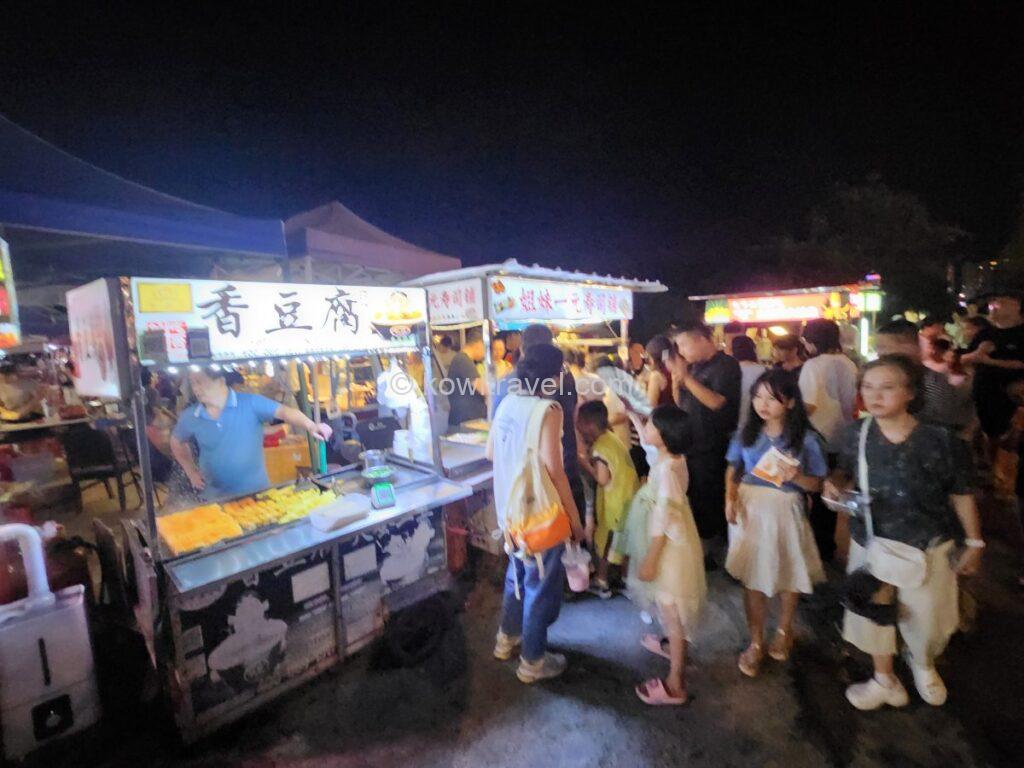
A vibrant night market scene where you can fully experience the lives of the local people.
However, a quick word of warning for travelers with sensitive noses: certain sectors of the market feature vendors cooking traditional fermented stinky tofu (Chuan Chidoufu) and heavy local spice mixtures.
The aroma can be incredibly intense and pungent, so it’s smart to keep your distance from those specific stalls if you are prone to scent sensitivity.
The market stalls begin setting up as the sun goes down, but if you want to experience the absolute peak energy, make sure to visit between 7:00 PM and 9:00 PM. Once the clock passes 10:00 PM, many vendors begin packing up their grills and closing down for the night, so don’t arrive too late!
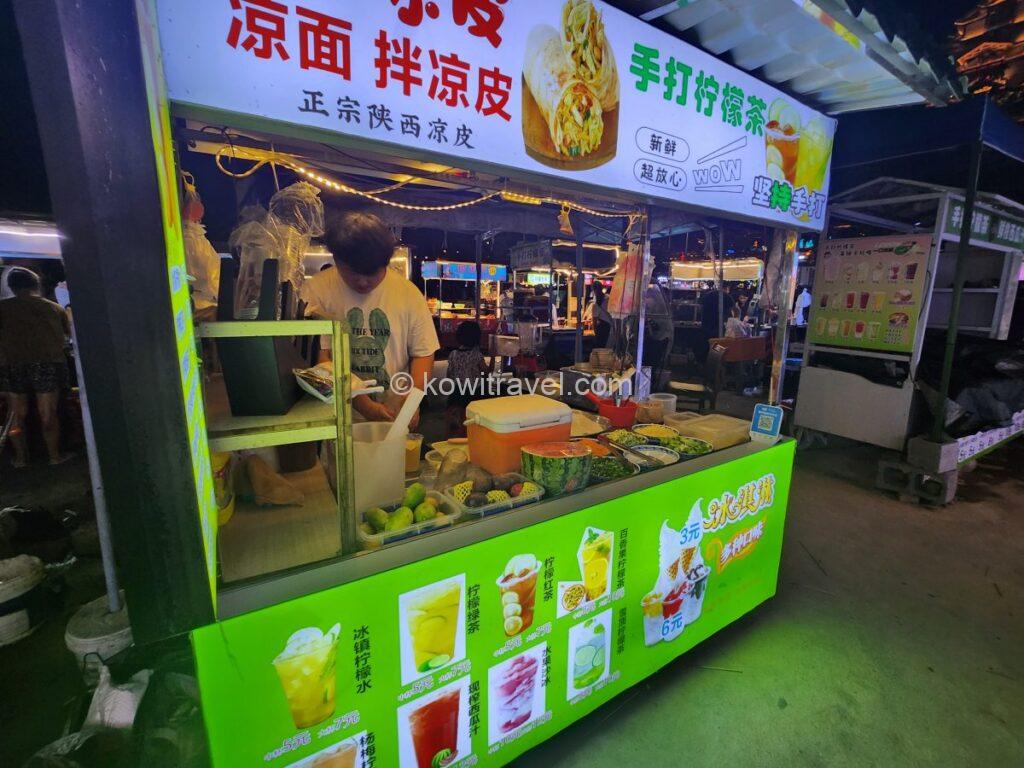
A paradise for foodies—sampling the endless varieties of authentic, sizzling Chinese street food.
Sitting on a simple plastic stool under the flashing neon lights, sipping a freezing cold fruit juice, and watching local families enjoy their evening was the absolute perfect way to heal our accumulated hiking fatigue.
It was a beautiful, relaxing, and deeply authentic conclusion to our final night in this magical mountain city.
7. Coming Up Next in Our Journey…
Our epic, deeply unforgettable 3-week backpacking journey through the towering stone wilderness of Zhangjiajie has officially drawn its final curtain.
Starting from our very next post—Episode 15—we are changing gears completely. We are leaving the rural mountains behind and boarding a train south to explore Guangzhou, the massive economic mega-city of Southern China and the absolute culinary paradise for dim sum lovers.
After that, we will launch straight into our comprehensive independent travel guides for Kuala Lumpur and Penang, Malaysia!
I deeply hope that the real-world, boots-on-the-ground experiences and logistical tips shared in this diary will help every single future traveler plan a flawless trip to this paradise.
Make sure to click follow, and we’ll see you in the upcoming Guangzhou and Malaysia episodes packed with practical travel gold!
👉 Click Here to Read Our Previous Guide: Episode #13 Grand Canyon Glass Bridge & Zipline Adventure
This post contains affiliate links. If you make a booking or purchase through these links, I may earn a small commission at no additional cost to you.