#10. Confronting the Primitive, Raw Majesty of Zhangjiajie
🚨TL;DR: Tianzi Mountain & Yangjiajie at a Glance
● The Vibe: Ink-wash landscapes with thousands of razor-thin stone pillars, hidden mountain bandit fortresses, and vertical ladders climbing straight to the clouds.
● The Route: Skip the generic tour buses. Cable car up to Tianzi Mountain, trek through the horizontal stone fortress walls of Yangjiajie, and conquer the hidden panoramic peak of Yibo Dengtian.
● Digital Survival: Modern China is 100% cashless. Link your credit card to Alipay and navigate seamlessly via Amap before you even step through the park gates.
1. The Journey to Zhangjiajie – A Sharp Contrast to Türkiye
💡TL;DR: Civilization vs. Wilderness
● Türkiye: A deep dive through time, tracing magnificent human history and ruins left by ancient empires.
● Zhangjiajie: Razor-sharp, overwhelming physical grandeur of Mother Nature, far beyond the reach of human history.
Before kicking off this Zhangjiajie series, I have to note a fascinating contrast with my previous trip to Türkiye.
Türkiye and Zhangjiajie, China, offer an incredibly dramatic juxtaposition from start to finish.
If Türkiye was a journey through time—tracing magnificent human ruins, history, and the alien-like landscapes of Cappadocia sculpted over millennia—Zhangjiajie is entirely about the razor-sharp, overwhelming grandeur of Mother Nature, far beyond the reach of human history.
Zhangjiajie felt like the epitome of “raw, untamed wilderness,” preserving a primitive mystery completely untouched by human hands. It was a profound shift in perspective: moving from the footprints of ancient civilizations to the sheer, mind-boggling scale of a landscape seemingly carved by the gods themselves.
Starting with this 10th post, we are completely shifting gears to unveil the prelude to the ” Independent Travel to Zhangjiajie Series,” capturing a colossal natural spectacle that leaves travelers spellbound.
Why We Broke the Mold: Moving Beyond Group Tours
When we were planning our trip, the internet was flooded with cookie-cutter group tour reviews, making granular information hard to come by. While independent travel to the region is becoming more popular now, our journey was a boots-on-the-ground experience.
Instead of sitting on a tour bus following a rigid itinerary, we tackled the terrain on foot, routinely logging over 30,000 steps a day. This is a raw record of that grueling yet rewarding journey, featuring hidden vistas completely ignored by standard travel blogs.
Initially, I wanted to cram the entire Zhangjiajie National Forest Park into this single post. However, as I began sorting through the thousands of photos I took on foot, I quickly realized how recklessly ambitious that was.
In particular, the Yuanjiajie area (home to the floating mountains from Avatar, including Mihun Stage, Southern Sky Pillar, and the First Bridge Under Heaven) and the Ten-Mile Gallery valley trail at the bottom of the Bailong Elevator were packed with so many practical hiking routes and vivid stories.
It felt like a disservice to the vast scale of these landscapes and the hard-earned information to lazily summarize them into a single entry.
To fully deliver these unfiltered, firsthand tips rather than mimicking a generic tour pamphlet, I have split our forest park expedition into two detailed parts:
- [Part 10] Tianzi Mountain & Yangjiajie Scenic Areas
- [Part 11] Yuanjiajie, Bailong Elevator, & The Ten-Mile Gallery Valley Trail
We begin our independent travel to Zhangjaijie with the honest story of the Tianzi Mountain Nature Reserve (Helong Park, Yubi Peak, Fairy Dispersing Flowers, and West Sea Peak Forest)—which revealed its epic silhouette despite the spiteful mist—alongside Yangjiajie, and our heartbreaking decision to bypass Huangshizhai due to a critical accommodation blunder.
Let’s begin the journey from Incheon Airport to Zhangjiajie Airport.
2. A Midnight Arrival: The First Overnight & Memories of Dayong City Wall Night Market
📌 TL;DR: Touchdown past 11:00 PM after a Shanghai layover.
The play here is to book a downtown guesthouse with free airport pickup near the Dayong City Wall night market to crush jet lag before tackling the grueling mountain routes.
With hearts full of anticipation, we boarded our flight at Seoul Incheon International Airport.
Because we took a connecting flight rather than a direct route, we layover at Shanghai Pudong Airport for about three to four hours in a state of nervous excitement.


Independent travel to Zhangjiajie: China Eastern Airlines international flight departing from Incheon (left) and the domestic connecting flight from Shanghai to Zhangjiajie (right)
By the time we transferred to the domestic flight and touched down at Zhangjiajie Airport, it was well past 11:00 PM.
👉[check real-time flight tickets to Zhangjiajie via Shanghai on Trip.com.]
When booking our stay, we made sure to choose a property that offered an airport pickup service. True to their word, the owner was waiting for us at the terminal. Thanks to this, the anxiety of arriving in a completely unfamiliar city in the dead of night instantly vanished.
A short drive brought us to our first base—a charming, authentic local guesthouse tucked away in a narrow alley near the historic Dayong City Wall (Dayongfucheng) in the heart of Yongding District.


A traditional Tujia-style wooden gate (left) and the inner courtyard (right) of an accommodation located within the historic alleys of Dayongfu City
Knowing how taxing long-term travel can be, we intentionally chose our first base in the downtown area. We wanted to fully shake off our jet lag and clear our minds before confronting the massive scale of the national park, rather than recklessly rushing up the mountains on day one.
The entrance leading from the two-lane main road into the narrow alleyway was brightly lit by a vibrant local night market. It offered a slice of everyday Chinese life, nestled right in a typical local residential neighborhood.
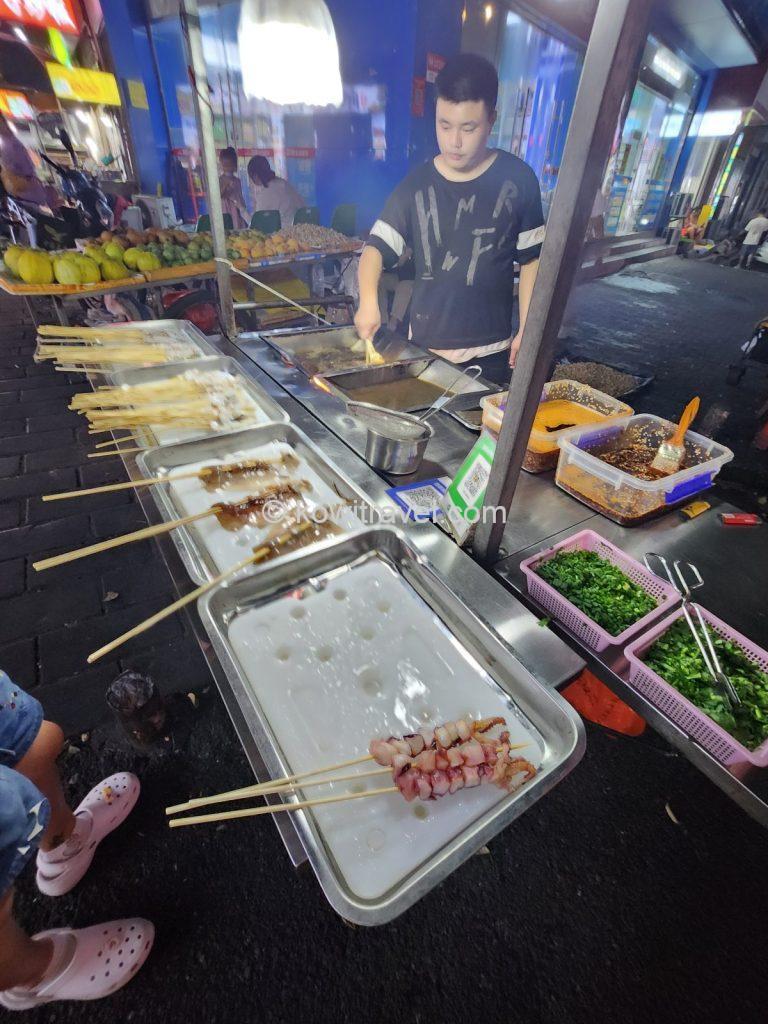
A night market along the main road in front of the first lodging during this independent travel to Zhangjiajie—a glimpse into the lives of local residents working hard to make a living.
Pushing open the main gate, you are greeted by a cozy front desk. Branching out to the left and right are three rooms on each side, totaling six rooms in a detached, courtyard-style layout. Taking the iron staircase to the right of the front office leads to a modest rooftop terrace equipped with a washing machine and clotheslines for guests. Unpacking our bags in this humble abode, we spent two nights soaking in the downtown atmosphere, enjoying a sweet rest, and finalizing our survival gear for the trek ahead.
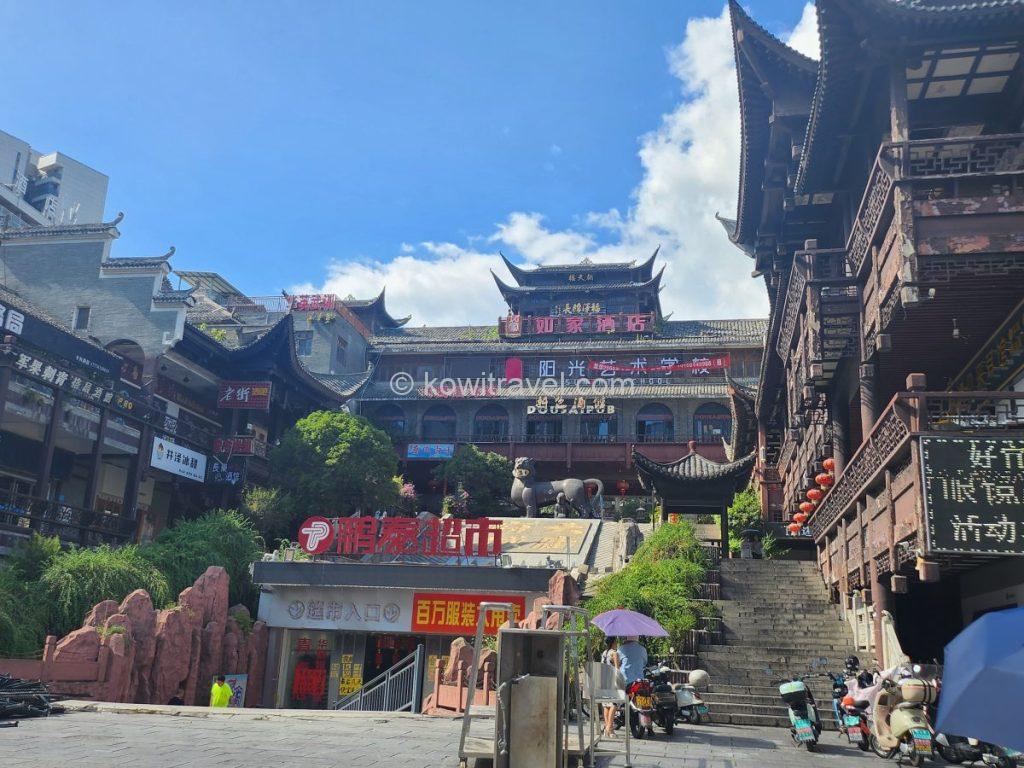
Inside Dayongfu City, a well-known folk culture plaza located in the heart of downtown Zhangjiajie


A major intersection (left) where “Yongding Road” and “Renmin Road”—the primary thoroughfares running east-west through the Yongding District—meet; and the “Nanzheng Street” pedestrian zone and food alley (right) behind Dayongfu City, which transforms into a vibrant night market after dark.
3. Essential Digital Survival Tools: Alipay and Amap
👌 [Travel Tip] The Non-Negotiable Chinese Digital Lifeline
- Alipay (Cashless Society): Cash is virtually dead. From five-star entrances to street-side water kiosks, everything runs on QR codes. Link your international credit card before departure.
- Amap / Gaode Maps (Your Local Uber & Compass): Google Maps is completely blocked. Amap gives precise alleyway mapping and locks in upfront taxi fare estimates, totally eliminating haggling.
Before diving into the national park expedition, there are two lifeline apps that anyone dreaming of independent travel in China must install on their smartphone: Alipay and Amap (Gaode Maps).
To put it bluntly, modern China has almost completely phased out cash; it is a thoroughly cashless society. Every single transaction, from street food to entrance tickets, is executed via Alipay QR codes.
In practice, it was shockingly seamless. To give you an idea of how deeply embedded this mobile payment culture is: even the beggars on the street had Alipay QR code signs hanging in front of their baskets. Frankly, I was stunned.
If you hand over cash to buy a bottle of water at a street kiosk, vendors frequently look panicked because they simply do not carry physical change. Linking a valid credit card to your Alipay app before departure is an absolute, non-negotiable must.
Equally critical is your digital navigator, Amap (Gaode Maps). In a country where Google Maps is completely blocked and useless, Amap functions flawlessly.
What makes it an absolute game-changer for independent travelers using taxis or public transit is that—much like Uber—the estimated fare is calculated and displayed on your screen before you even hop in.
This completely eliminates the fear of being ripped off, even when communicating with drivers who don’t speak a word of English. With its remarkably precise navigation through even the tightest alleyways, Amap was our most reliable companion, allowing us to navigate downtown Zhangjiajie with complete peace of mind.
4. A Rookie’s Absurd Blunder: The Fork Between the South and East Gates
💡TL;DR: The Logistics Lifeline
● The Mistake: Booking near the South Gate while aiming for East Gate (Wulingyuan) tracks.
● The Rescue: Lost passports and wallets at the old base were recovered via a 30-minute emergency drive by our legendary English-speaking host at Jinhong Homestay.
For anyone planning an independent trek through Zhangjiajie, the most common source of confusion is understanding the geography of the South Gate (National Forest Park Entrance) versus the East Gate (Wulingyuan Sign Gate Entrance).
As a first-timer who hadn’t fully grasped the spatial layout and transit dynamics of the park, I made an absurd rookie mistake: I booked our very first base for the Wulingyuan National Park exploration near the South Gate. By the time I realized the logistical nightmare this would cause for our planned routes, we had already checked into our South Gate accommodation.


“Zhijianshan” (Mountain View) lodging near the South Gate of Zhangjiajie (left). A wooden sign (right) bears a humorous message: “Open all year round—just trying to earn a few coins.”
4. 1) An Unexpected Blessing: Two Nights at the South Gate
[Click to Read] The Host Rescue Story & Gate Logistics (If you love details!)
Though our journey kicked off with a painful logistical error, this wild card variable turned out to be an unexpected gift. It forced us to slow down and discover the serene, mystical beauty of the South Gate Plaza—a spot we otherwise would have skipped entirely.
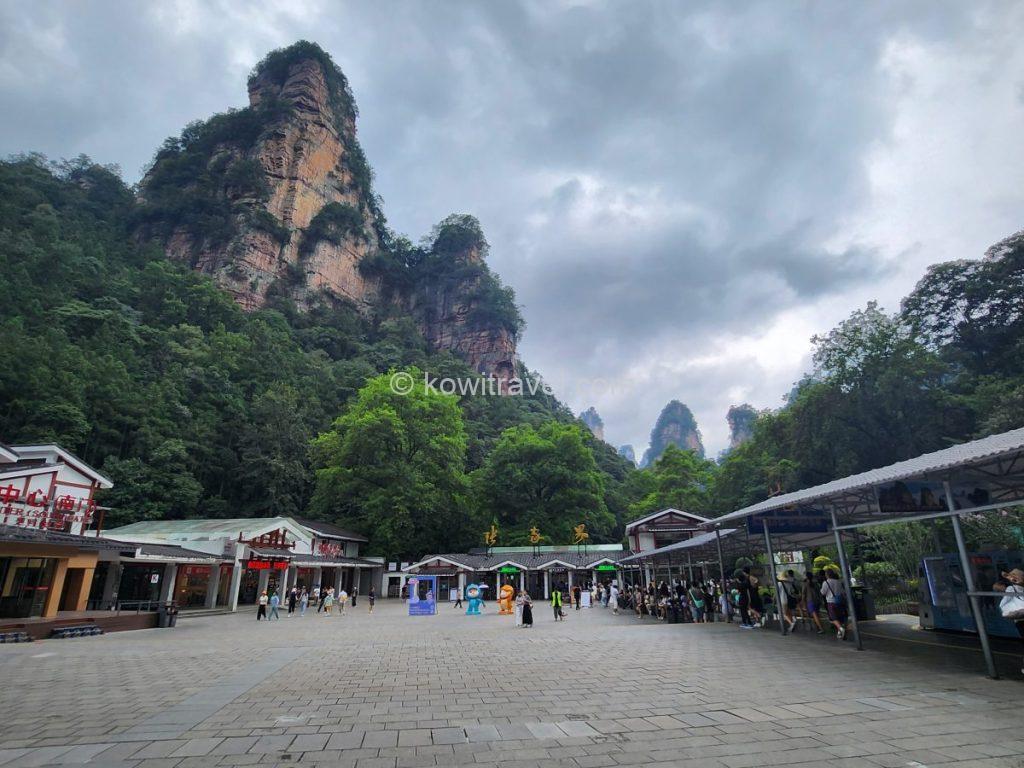
The plaza at the South Gate ticket office.
Stepping out to the South Gate Plaza just for a casual stroll without purchasing entry tickets, we found it bustling with crowds despite the fickle, rainy weather. Rising sharply behind the ticket office was a breathtaking amphitheater of towering sandstone cliffs and jagged peaks.
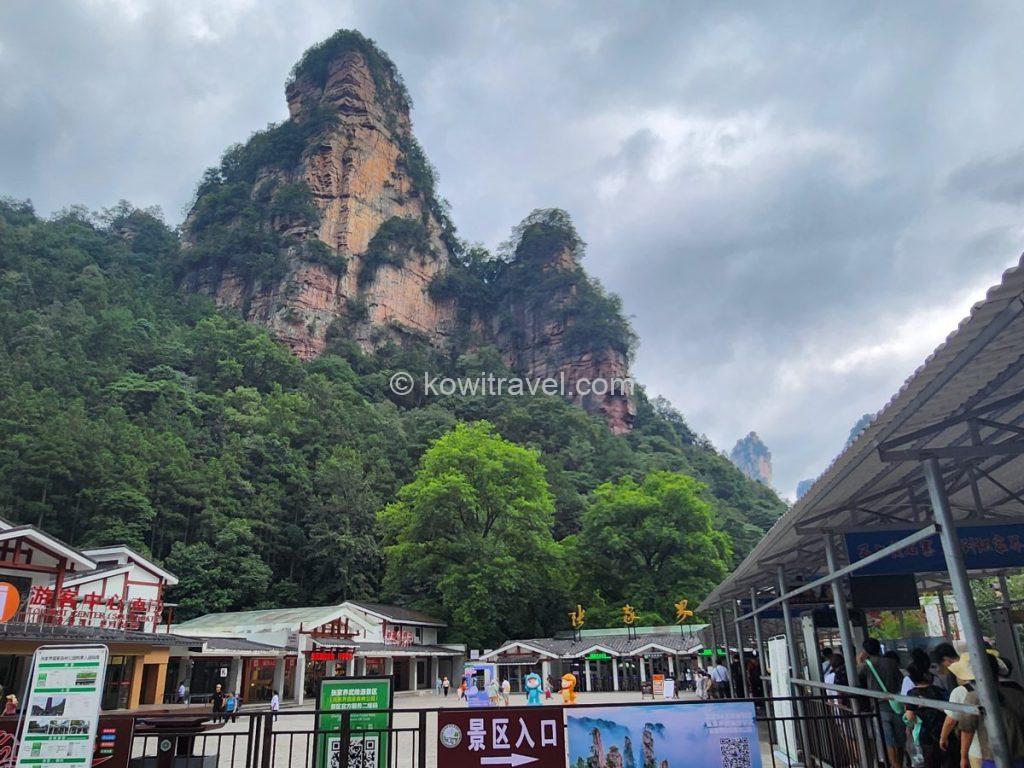
Rising behind the ticket office entrance are massive sandstone pillars that form the foundation of the Huangshizhai (Yellow Stone Stronghold) massif.
On one side of the plaza stood a stone statue of Wu Guanzhong, the master of modern Chinese painting who first captured this ethereal landscape on canvas and introduced its beauty to the world.
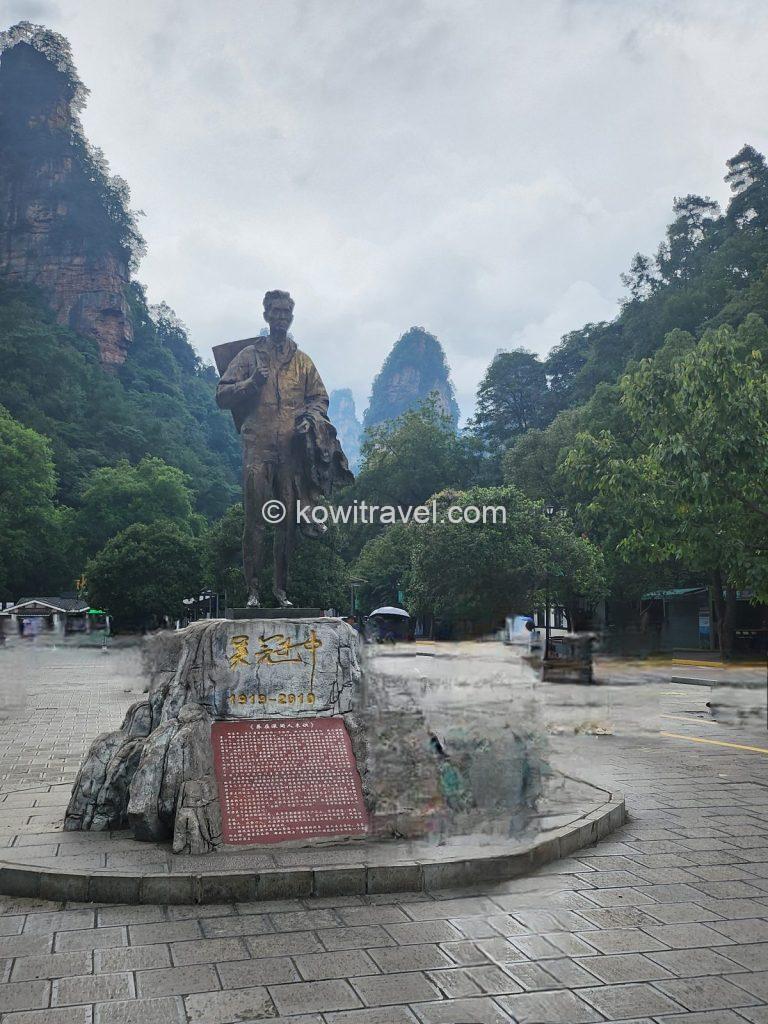
A statue of Wu Guanzhong (1919–2010), a master of modern Chinese art. Before 1979, Zhangjiajie was an obscure, remote mountain area, completely unknown to the outside world. After stumbling upon the site, Wu Guanzhong captured its breathtaking scenery in his ink-wash paintings. He described the landscape as “a magnificent, unpolished poem of the wilderness,” a tribute that propelled the name “Zhangjiajie” to fame across China and the rest of the world.
Standing against a backdrop of razor-sharp stone peaks that resembled upright paintbrushes, the master’s statue enveloped in a thick, descending shroud of mountain mist looked like a living, breathing ink-wash painting.
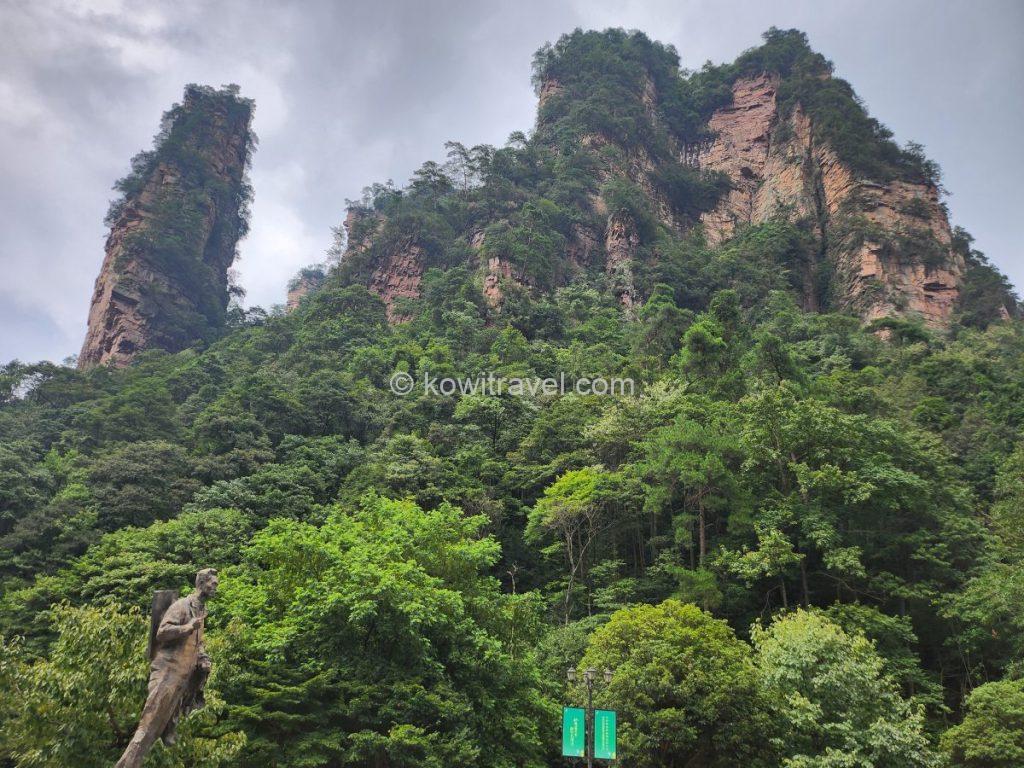
Directly behind the statue of Wu Guanzhong, sharp, pillar-like rock formations—resembling upright calligraphy brushes—stand in a grand, imposing manner, as if acting as a guard.
I later learned that if you want to visit Huangshizhai (Yellow Stone Village), entering through the South Gate is actually the most efficient route. At the time, however, we were completely blind to this fact, stubbornly fixated on the idea that we had to enter through the East Gate.
While it forced a mandatory rewrite of our original itinerary, this detour became a sweet, unexpected pocket of rest courtesy of travel’s unpredictability.
4. 2) Finding an English Lifeline: Moving to Wulingyuan ‘Jinhong Homestay’ at the East Gate
Leaving our bittersweet memories of the South Gate behind, we quickly packed our bags and relocated to Wulingyuan downtown near the East Gate. This would serve as our true base camp for a grueling 7-day, 6-night campaign cutting across the National Park, Huanglong Cave, and the Grand Canyon.
Anyone who has traveled independently in China will fiercely agree on one thing: the single greatest barrier is communication. Even at major chain hotels, English is rarely spoken, often leaving you swallowing your frustration while relying heavily on translation apps.
This brings me to the exact reason why I chose this specific East Gate accommodation out of hundreds—and why I highly recommend it.
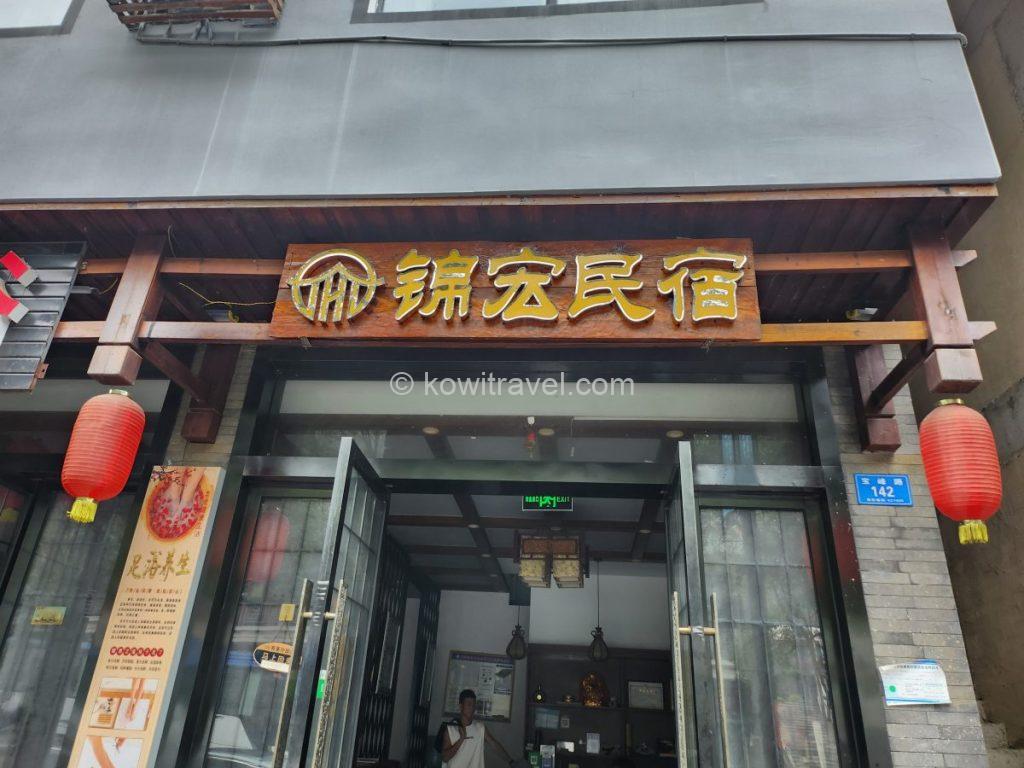
The entrance to “Jinhong Homestay,” located near the East Gate.
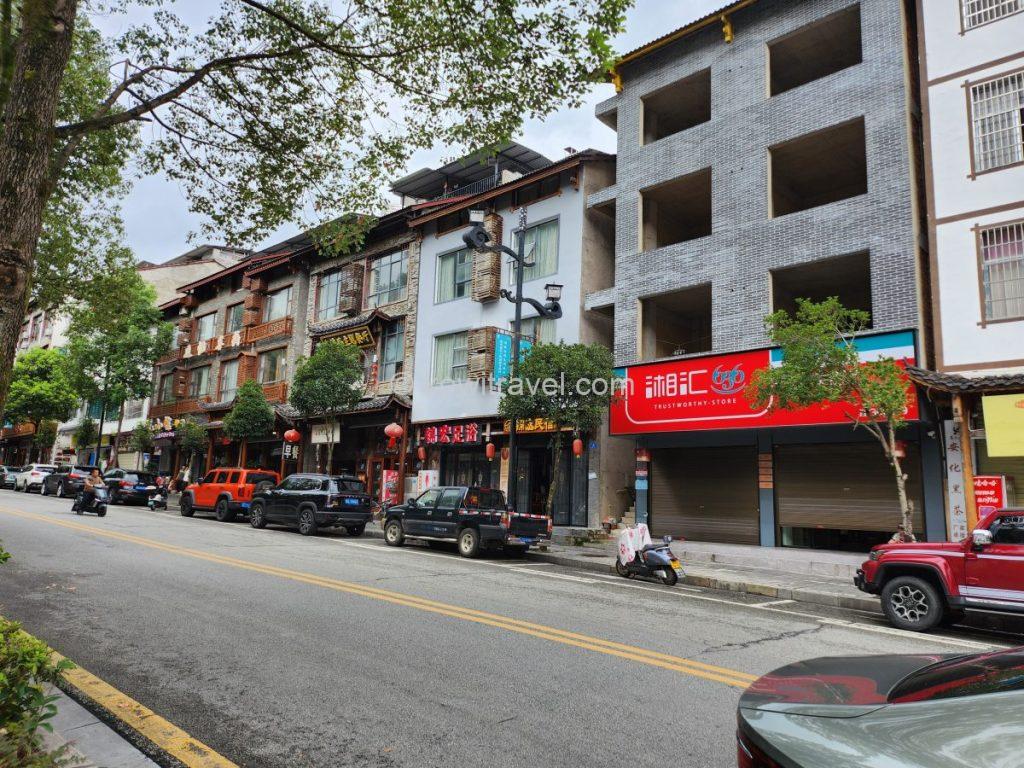
An exterior view of the homestay, seen from in front of the Hilton Hotel across the street
It is Jinhong Homestay. In local guidebooks and booking platforms, it is widely listed as Jinhong Homestay or Jinhong Minshu (located at 142 Baofeng Road, Jundiping Subdistrict, Wulingyuan District, Zhangjiajie).
👉 [Check real-time booking information for “Jinhong Homestay” on Trip.com]
I booked this stay based entirely on reviews stating that the owner’s second son speaks English. In a sea of communication barriers, he was an absolute oasis. From the initial booking stage to mapping out our local trekking routes, he cleared up every single point of confusion, lifting a massive weight off our anxious shoulders.
😱 A Heart-Stopping Scare on the Road
Right after relocating from the South Gate to Wulingyuan downtown, a minor disaster struck. Because we were on a long-term journey, we had a lot of luggage. It wasn’t until we checked into our new East Gate room that I realized my backpack—which contained our most critical items, our passports and wallets—had been left behind on a dining table in the reception area of our previous South Gate accommodation.
The sheer panic of realizing our passports and entire travel funds might be lost in a foreign country was paralyzing. I rushed downstairs and explained the crisis in English to the owner’s son (if I recall correctly, his English name was James). He immediately called the previous accommodation and negotiated in Chinese. He turned to me and said, “They found it. I’m calling an emergency courier to have it sent here.”
Just as we breathed a sigh of relief, the South Gate property called back: it was too late in the afternoon, and no couriers were available. We had to fetch it ourselves.
The two gates are separated by a 20-to-30-minute drive, and options for public transit back to the South Gate in the late afternoon were virtually nonexistent. Seeing our distress, James explained the situation to his father. Without a moment’s hesitation, the owner grabbed his keys and gestured for us to get in his car. He drove us all the way back himself.
Thanks to his incredible kindness, we recovered the backpack safely. When we tried to offer a monetary reward as a token of our immense gratitude, he steadfastly refused to accept a single yuan. In return, we extended our stay by an additional two nights as our way of saying thank you.
Logistically, the location is phenomenal.
Situated at 142 Baofeng Road in Wulingyuan, it sits directly across the main avenue from the Hilton Garden Inn Zhangjiajie Wulingyuan. This prominent landmark makes it incredibly easy to find on map apps, even for first-time visitors.
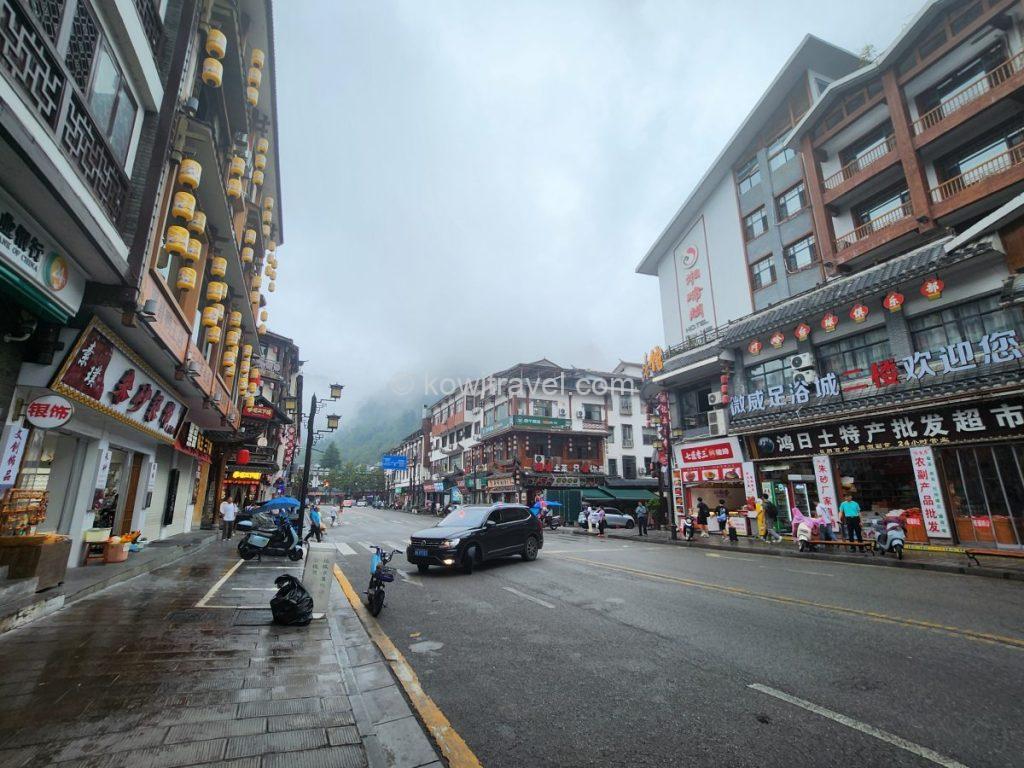
The street in front of the homestay is lined with restaurants and various souvenir shops. Further down the road, you will reach an intersection; turning right at this intersection leads to the East Gate ticket office of the Zhangjiajie National Forest Park.
Since this is a local homestay rather than a sterile hotel, the exterior has a modest, neighborhood feel that might underwhelm you at first glance. However, the moment you open your room door, you are greeted by a massive, beautifully crafted wooden bed frame that reimagines traditional Tujia minority architecture, anchoring the room in a cozy, cultural embrace. Despite the sweltering August heat, the bedding and overall room condition were impeccably clean and crisp—perfect for our extended stay.
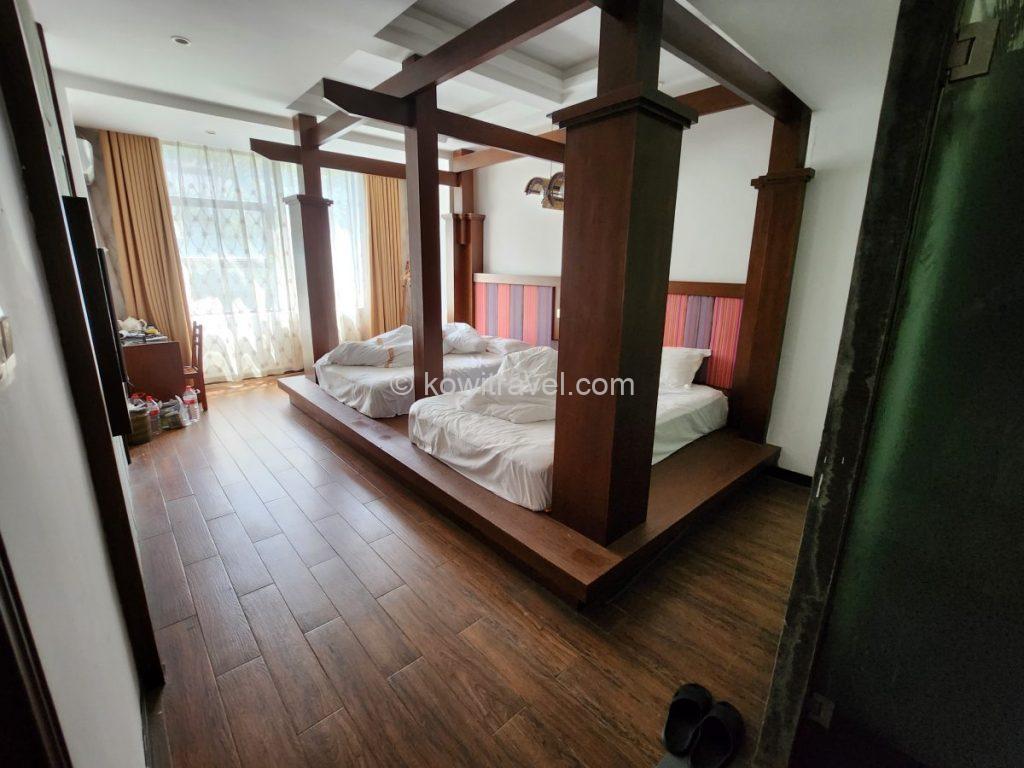
A look inside the room. While the layout may vary slightly from room to room, they are generally spacious and clean, ensuring a comfortable stay.
Above all, having an English-speaking lifeline and a genuinely warm host family made our stay flawless. We continued our conversations with the father using translation apps, forging a wonderful bond. On our second day in Wulingyuan, despite the miserable downpour, he went out of his way to drive us right up to the East Gate entrance.
One afternoon, returning to the guesthouse drenched in sweat after battling the summer heat, we found the owner and his sons sitting out front, slicing into a massive watermelon. The moment they saw our exhausted faces, they gestured warmly, shouting, “Come sit down! Let’s eat cool watermelon together!” We naturally joined them, devouring the sweet fruit and chatting for ages. Though our spoken languages were entirely different, their genuine kindness remains one of the most cherished memories of our time in Zhangjiajie.
💡 Traveler’s Note: As veteran long-term independent travelers, we prioritize high cost-performance unless a place is completely unlivable. If room luxury or premium hotel amenities are a dealbreaker for you, keep this in mind when booking.
Step outside the homestay and a short walk brings you to a major intersection lined with neon-lit local restaurants. Crossing the bridge connects you directly to “Laodangsancha,” the most bustling nightlife street in Wulingyuan—perfect for an evening stroll to soak in the local vibe.


A night view of the intersection at Baofeng Bridge (left) and Baofeng Bridge itself (right).
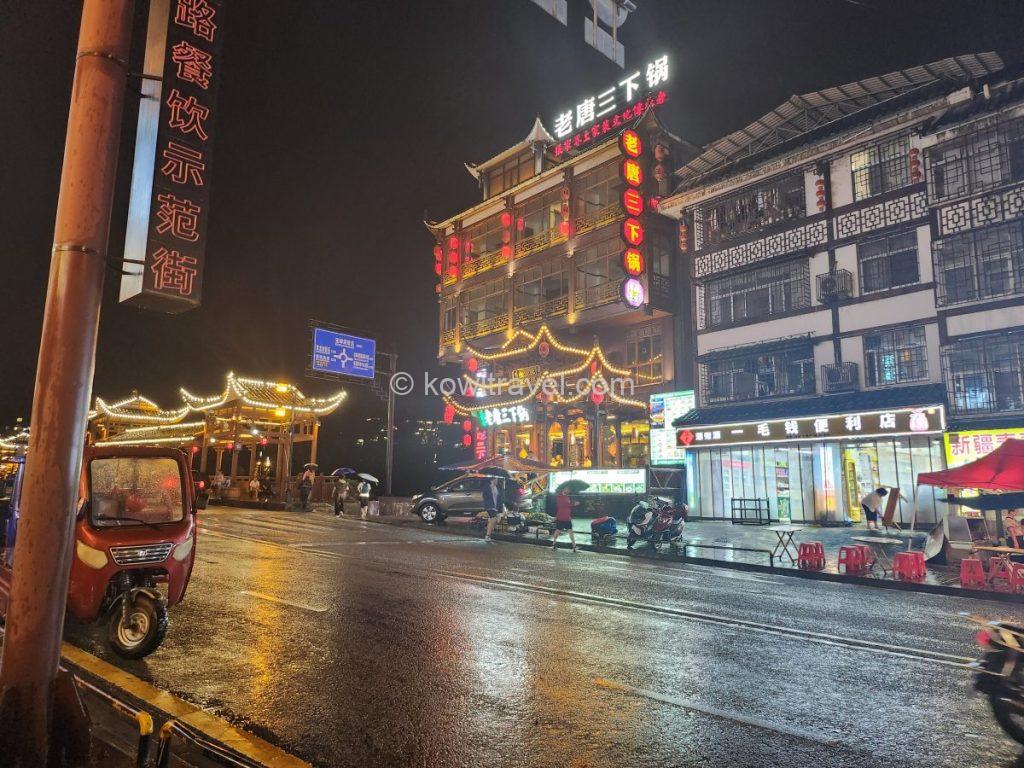
If you continue straight from the intersection and cross the bridge (Baofeng Bridge), you arrive at the “Wuling Road Central District”—the liveliest area in Wulingyuan, known for its concentration of restaurants and eateries.
Turn right at that same intersection, and you head straight to the East Gate ticket office (Wulingyuan Sign Gate). Walk a brief distance behind the property, and you’re at the entrance of Baofeng Lake. It is an absolute prime location tailored for independent explorers.
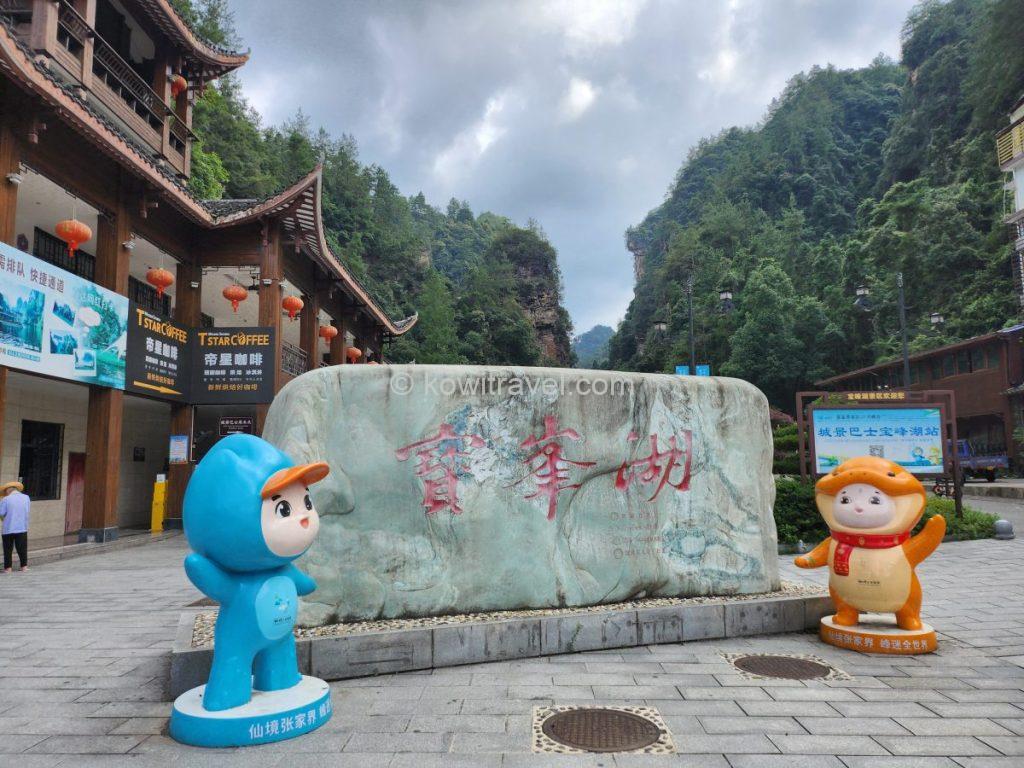
A short walk uphill from the homestay brings you to the entrance of Baofeng Lake
5. Proven on Foot: Mastering the Core Nodes of Wulingyuan
Tickets for Wulingyuan National Forest Park are exclusively sold as 4-day integrated passes.
👉[ Check real-time information for the Zhangjiajie Wulingyuan combined ticket on Trip.com ]
👉[ Check real-time information for the Zhangjiajie Wulingyuan ticket on Klook.com ]
Our grand plan was to space out our exploration, savoring a different pocket of Wulingyuan’s majesty each day. Nature, however, had other plans.
During our mid-August visit, a torrential downpour washed out the first two days of our pass, burying the entire canyon system under a thick wall of white mist. Realizing that hiking up to the peaks would yield zero visibility, we had to make a cold, tactical decision: completely cut Huangshizhai from our itinerary. This allowed us to compress the park’s big three—Yuanjiajie, Yangjiajie, and Tianzi Mountain—into the remaining two clear days.
While Day 1 was a total washout, by Day 2 the storm had mellowed into a drizzle. Donning rain ponchos, we completed a rapid, baseline sweep of the Tianzi Mountain and Yangjiajie sectors.
By the morning of Day 3, the sky finally cleared. We hit the trails with furious intensity, hiking until our clothes were soaked through with sweat and our feet were blistered, logging over 30,000 steps. We maintained this blistering pace into Day 4, clocking another 30,000 steps to conquer the remaining vistas.
Below is the verified breakdown of the sights and historical context of each scenic zone to help you optimize your own route.
5. 1) Tianzi Mountain Area: An Epic Ink-Wash Painting of Ten Thousand Stone Brushes
💡TL;DR: The Emperor’s Ink-Wash Masterpiece
- The Vibe: Endless columns sharp as celestial calligraphy brushes piercing the fog.
- Dianjiangtai (The Assembly Stage): Thousands of quartz peaks standing in tight lines like an army frozen mid-march.
- The Lore: Named after Tujia Chieftain Xiang Dakun (Emperor Tianzi), who petrified his writing brushes into stone upon his historic defeat.
Entering through the East Gate early in the morning, we boarded the park shuttle to the lower station of the Tianzi Mountain Cable Car, riding it up to the summit ridge at an elevation of 1,200 meters.
Tianzi Mountain unfurled before us as an endless labyrinth of slender, razor-sharp stone spires, looking as if thousands of celestial calligraphy brushes had been driven straight into the earth.
The summit plateau of Tianzi Mountain is a premier scenic zone where surreal geological structures collide with the historical lore of the local Tujia minority. Here are the definitive spots you cannot afford to miss:
- Helong Park
Serving as the central hub of the Tianzi Mountain summit, this expansive park was built to honor Marshal He Long, a legendary military commander and statesman who hailed from Hunan Province.
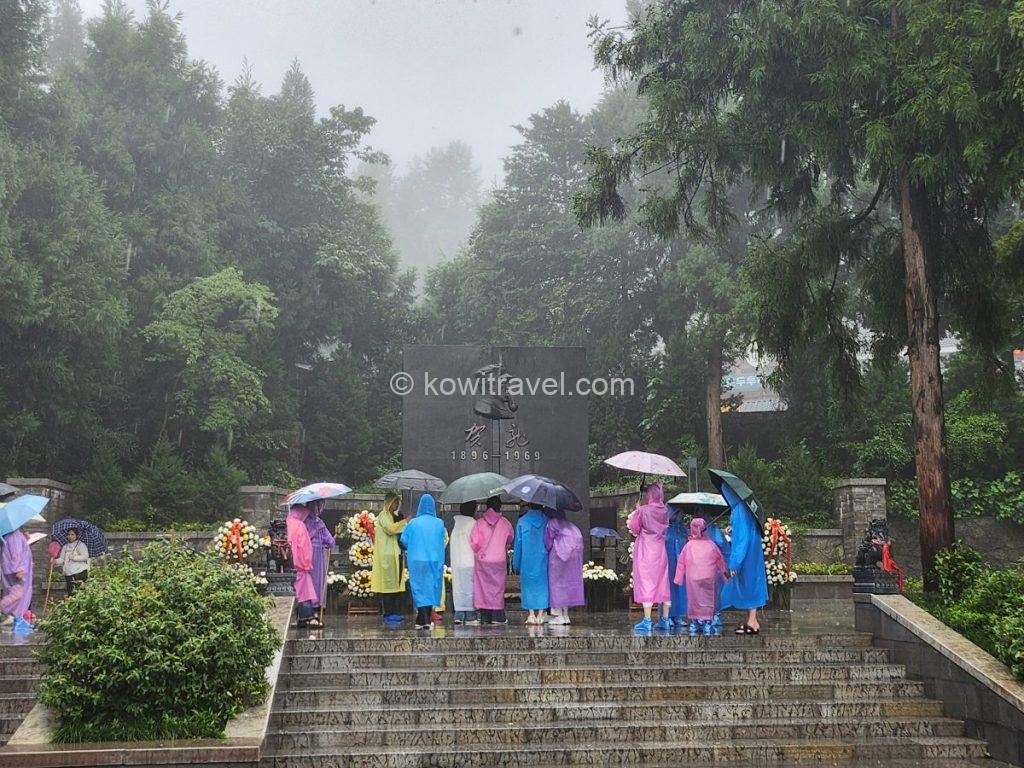
Monument to General He Long
The focal point is the colossal Marshal He Long bronze statue, positioned against a backdrop of plunging stone spires. Standing 6.5 meters tall and weighing a massive 9 tons, this bronze monolith cuts an imposing figure, appearing to stand guard over the magnificent peaks below.
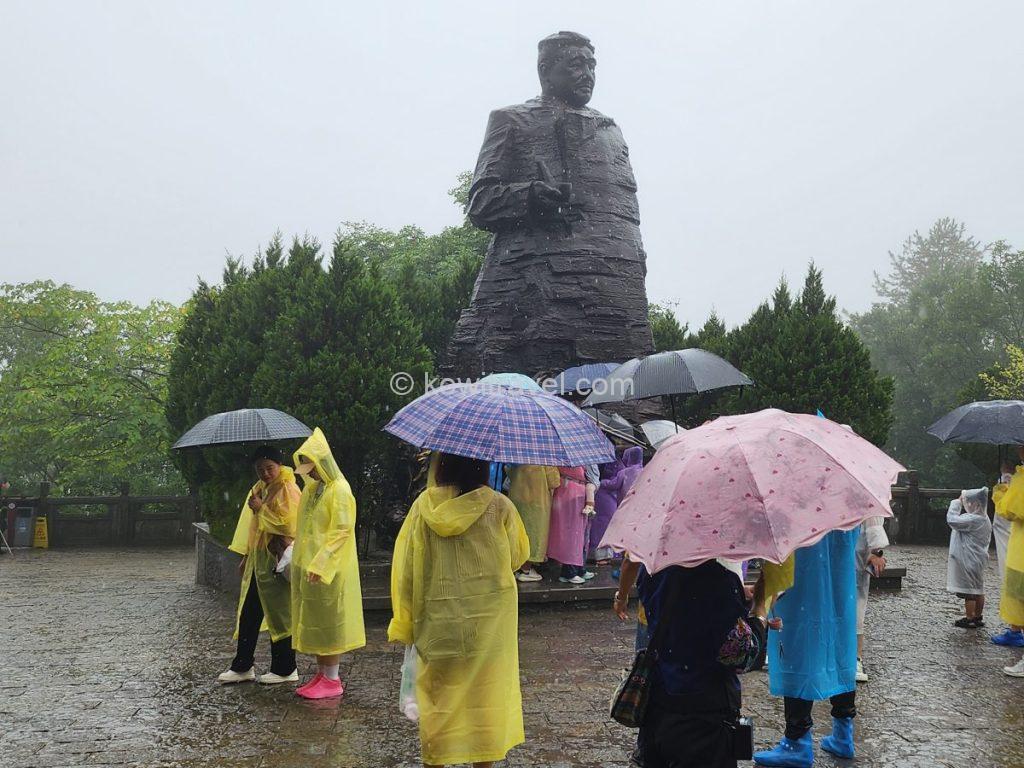
Despite the inclement, rainy weather, it was quite striking to see so many locals gathered before the massive full-length statue to pay tribute to General He Long.
- Yubi Peak / Imperial Brush Peak
Yubi Peak is the definitive icon of Tianzi Mountain and the literal face of Zhangjiajie.
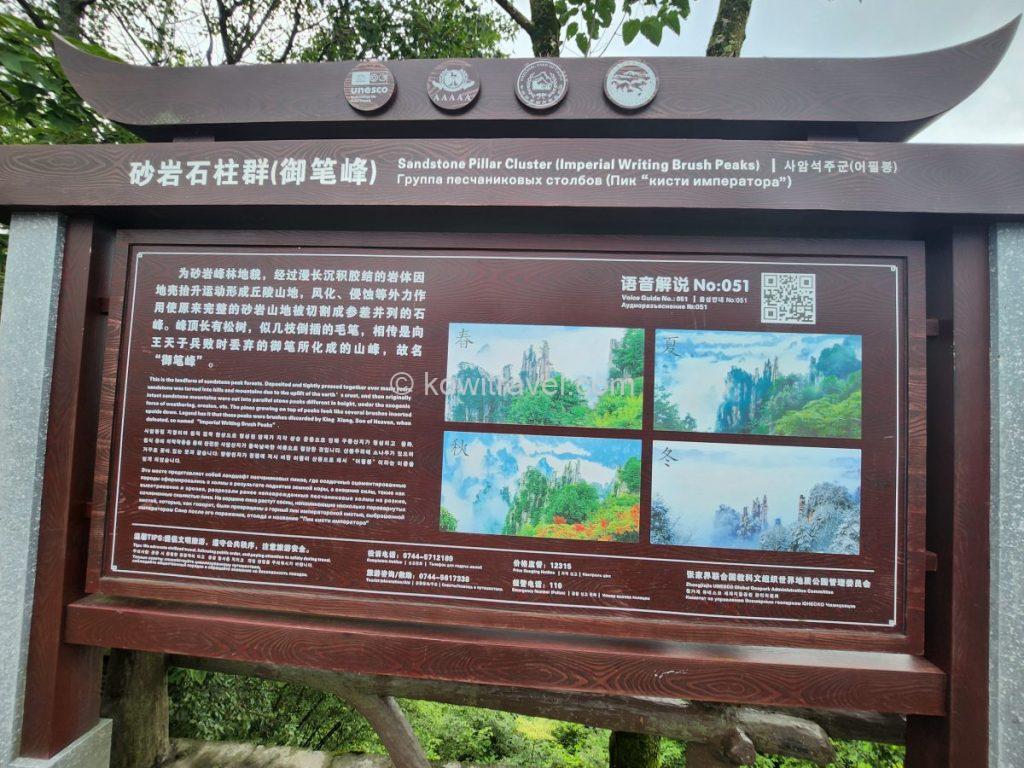
An information sign for the “Imperial Brush Peak” (Yubi Peak) explains that this site features a collection of sandstone pillars.
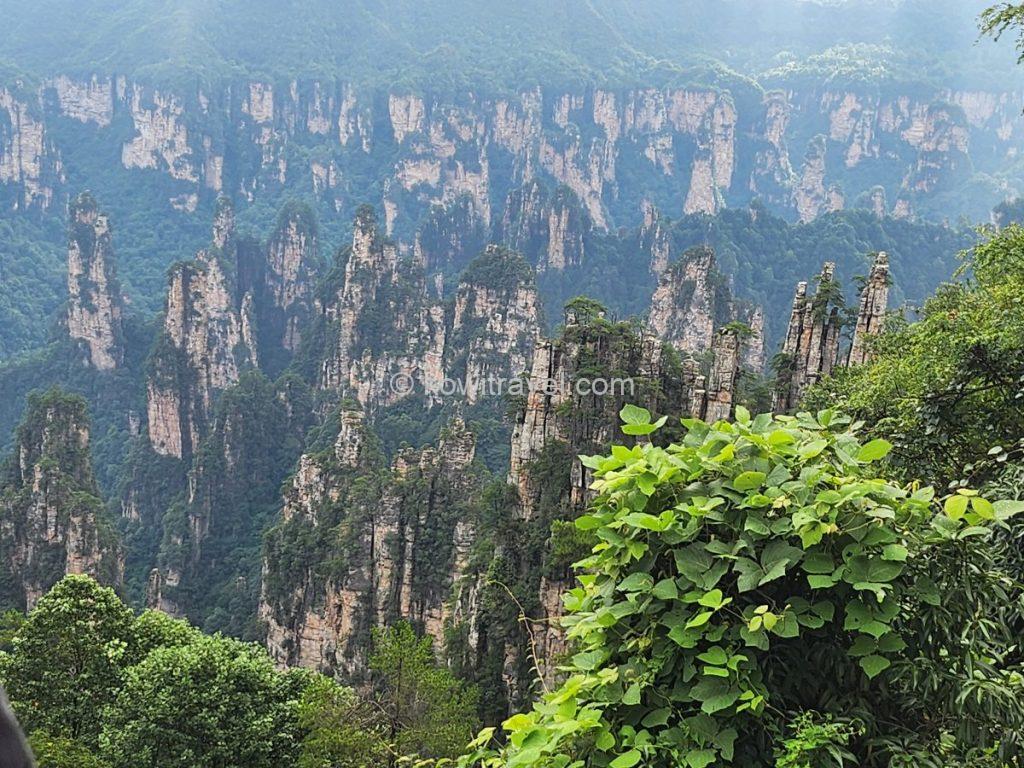
Standing prominently in the foreground is the Imperial Brush Peak—a rock formation shaped like a calligraphy brush—set against the backdrop of a magnificent, elongated mountain range that stretches across the horizon like a fortress wall.
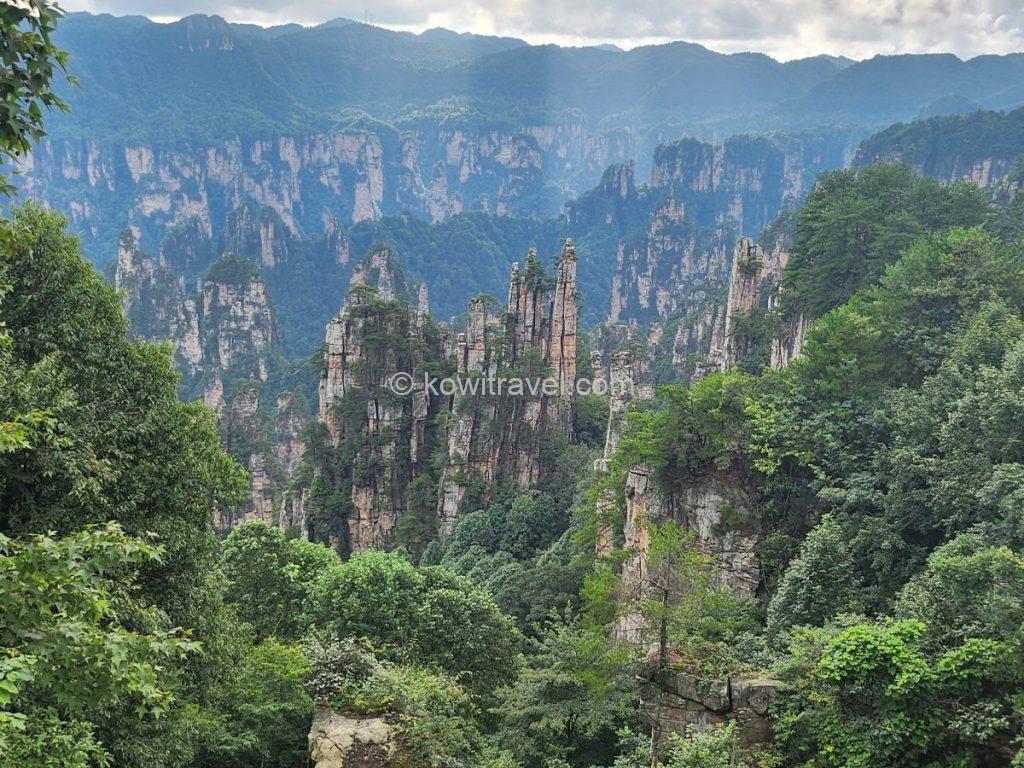
Locals liken this mountain range to a massive “inkstone” or a brush rest placed beside the “brush” (the Imperial Brush Peak), referring to the entire landscape as a scene where a calligraphy brush has been laid down. I captured the grand, sweeping composition using a wide-angle lens; with shafts of light breaking through the clouds, the scene took on an almost epic quality.
According to local Tujia legend, during the early Ming Dynasty, the tribal chieftain Xiang Dakun (who declared himself ‘Tianzi’ or the Son of Heaven) led a rebellion against the imperial army. Upon his tragic defeat, he threw down his calligraphy brushes in an act of furious defiance. The brushes landed upright, instantly petrifying into these very cliffs.
Looking out from the deck, you will see a cluster of three to four razor-thin stone pillars piercing the sky, their tips tufted with resilient pine trees, perfectly mimicking upside-down writing brushes.
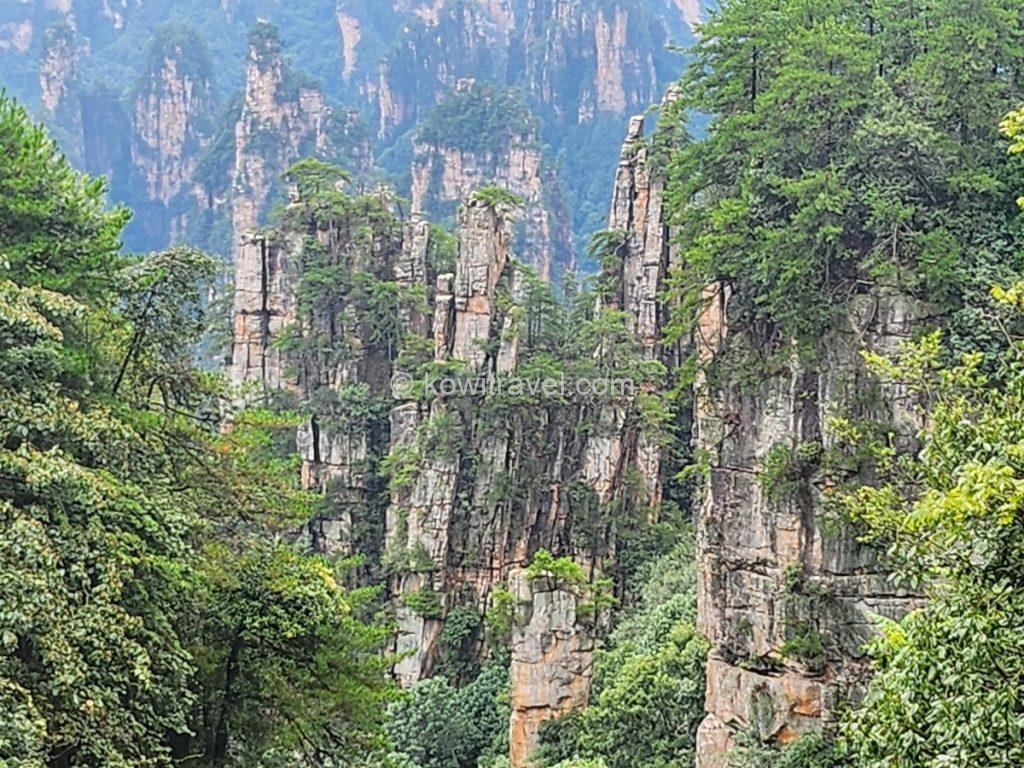
Rising sharply from the valley floor are several slender sandstone pillars, each topped with pine trees that grow with such delicate precision they resemble the bristles of a brush.
- Jeonjangdae / Dianjiangtai – The Emperor’s Stage of Ten Thousand Soldiers
Peering into the deep abyss of the Tianzi Mountain canyon, you hit the first truly jaw-dropping vantage point: Dianjiangtai. Lore dictates that this was the grand stage where Chieftain Xiang Dakun assembled and reviewed his hundreds of thousands of tribal soldiers before marching into battle.
Standing on the wooden observation deck and looking down, a shiver runs down your spine as you instantly understand the myth.
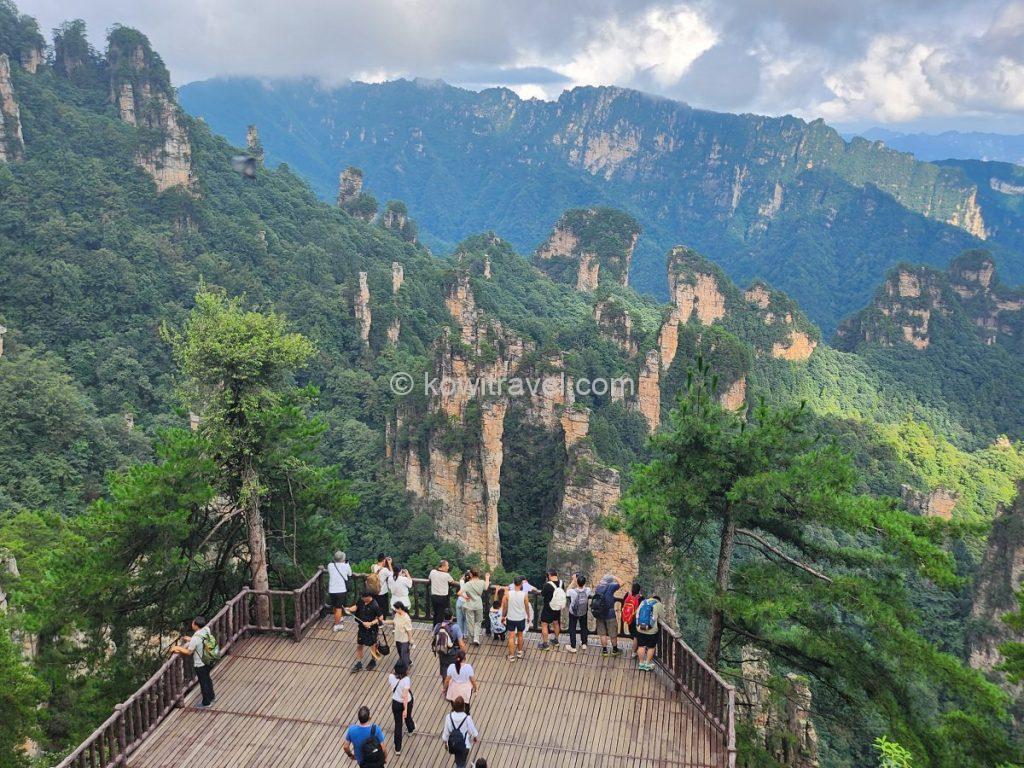
The main deck of the “West Sea Observation Deck,” located near He Long Park on Tianzi Mountain. The view from here reveals the full panorama of the “West Sea Peak Forest”—a landscape often described as “islands floating above a sea of clouds.”
Deep within the bottomless gorge, thousands of slender quartz sandstone pillars rise sharply in near-perfect formation, looking exactly like a massive army clad in stone armor, frozen mid-march while waiting for their emperor’s command.
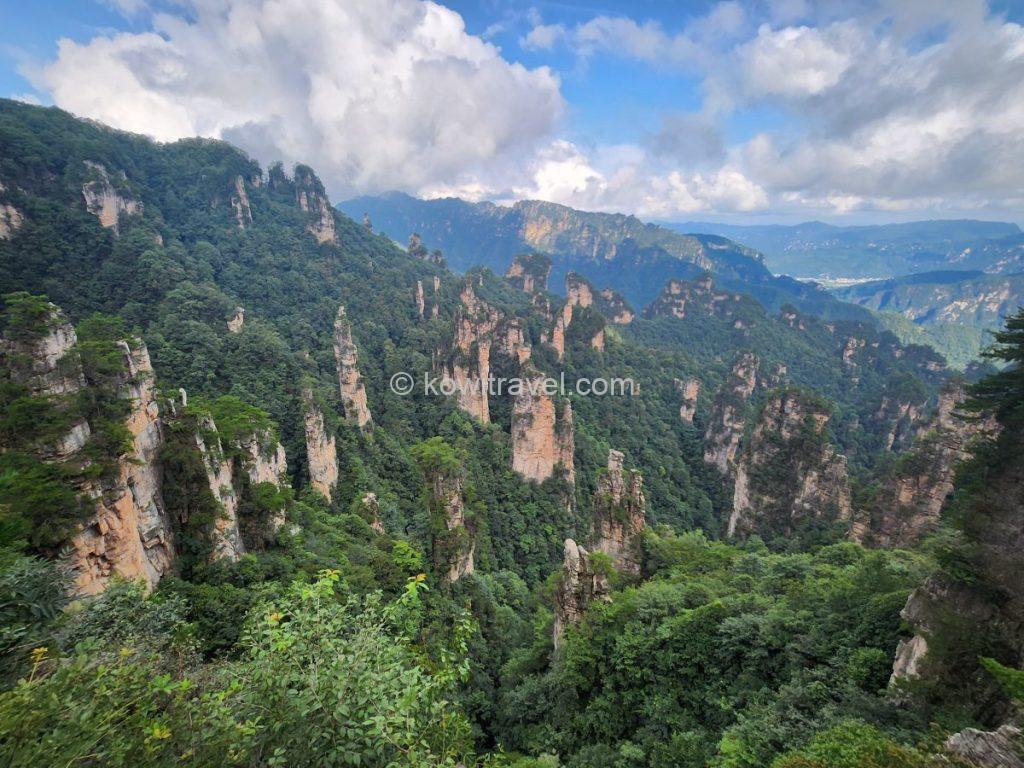
From this vantage point, one can see a dense cluster of stone peaks that evoke the image of the “Emperor Xiangwang” (Xiangwang Tianzi) reviewing his vast army of 100,000 soldiers.


Thick, towering stone pillars stand at the center, surrounded by rows of slender, blade-like rock formations—arranged with such orderly precision that they call to mind the legendary Tujia Emperor, Xiangwang Tianzi, inspecting his troops before a great battle.
The contrast between the massive sandstone barrier walls in the far distance and the jagged forest of stone spires (Sandstone Peak Forest) in the foreground captures the raw energy and sheer scale of Zhangjiajie in its truest form.


A view of Appeal Peak (Eopilbong) and the rock formations of the West Sea (Seohae). Sunlight, filtering through the clouds, casts a dreamlike glow over the massive, fortress-like rock formations in the distance.
- Fairy Dispersing Flowers
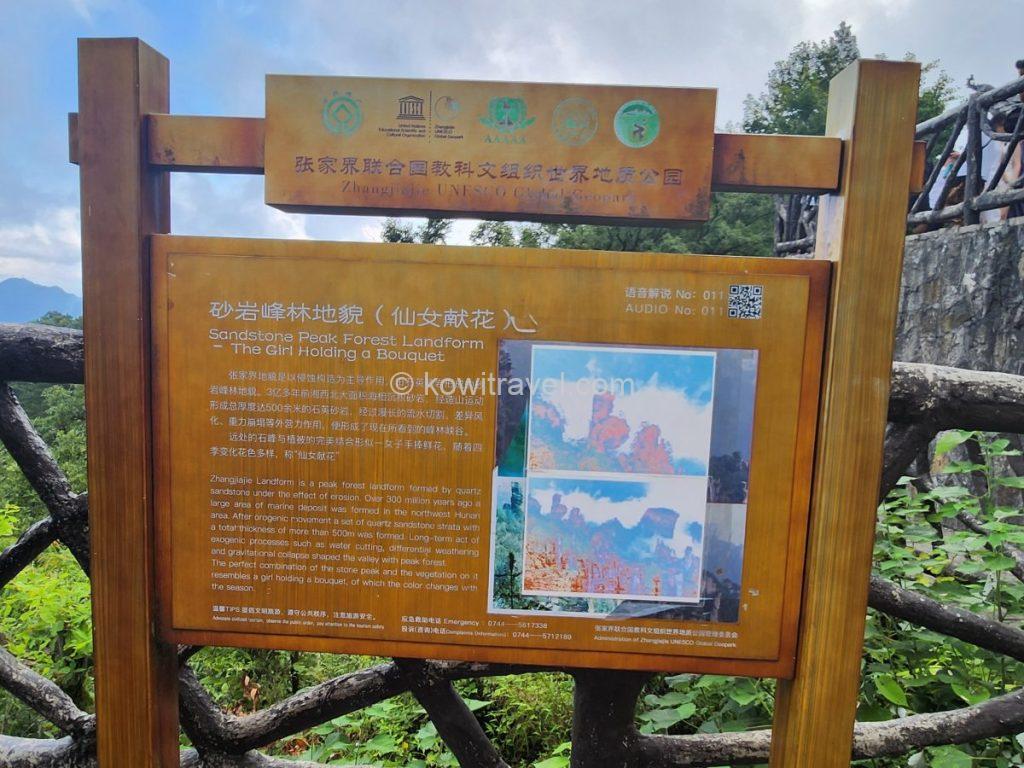
Information sign for “A Fairy Offering Flowers” (Seonnyeo Heonhwa).
Located directly across from Yubi Peak, this landmark earns its name from its uncanny resemblance to the profile of a celestial maiden cradling a flower basket and scattering petals over the gorge.
The bittersweet legend claims that a fairy descended from heaven to mourn Chieftain Xiang Dakun after he leaped off the cliffs in defeat. As she stood scattered flowers across Wulingyuan to honor his soul, she petrified into this very stone pillar.
- The West Sea Peak Forest / Xihai Fenglin
The massive canyon basin unfurling beneath Helong Park, Dianjiangtai, and Fairy Dispersing Flowers is known locally as the “West Sea” (Xihai). When a heavy downpour clears, mountain mist completely floods the basin, transforming the canyon into a literal “sea of clouds” where thousands of stone spires peek through like scattered islands in a western ocean.
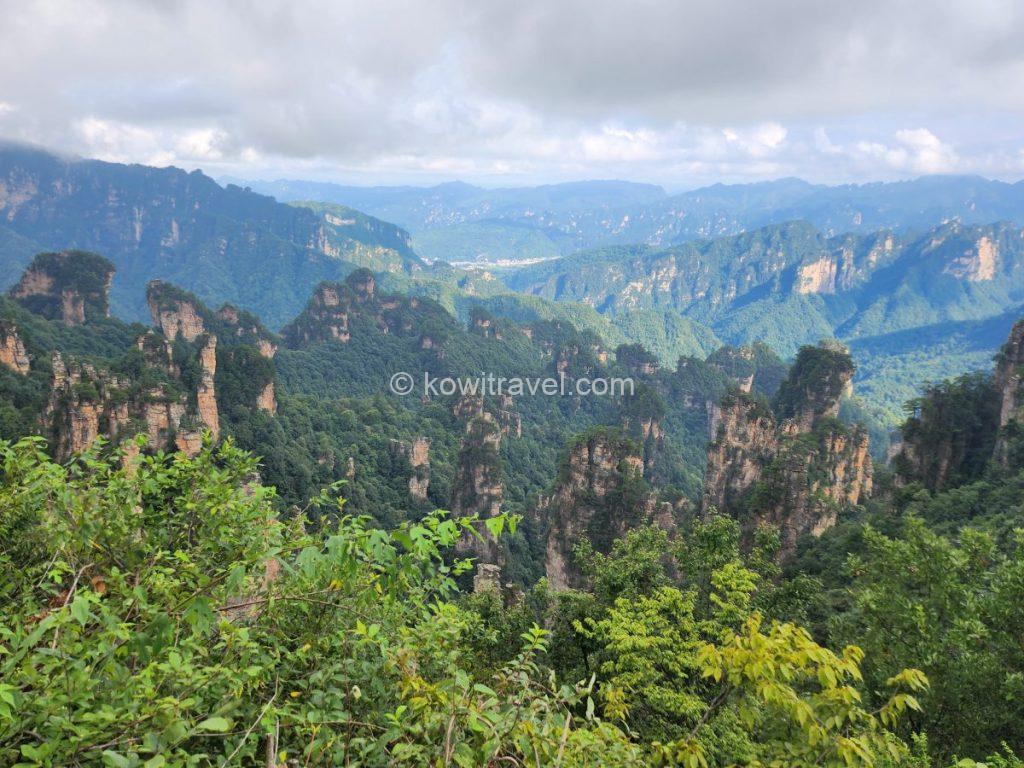
A view of the gorge as seen from “Dianjiangtai” (Jeomjangdae)—an iconic landmark on Tianzi Mountain.
While park signage often refers to this view simply as a “Sandstone Peak Forest”—which is the formal geological classification for a landscape where thousands of rock columns form a dense forest—Xihai Fenglin is the proper geographical name denoting this specific, legendary canyon system on Tianzi Mountain.
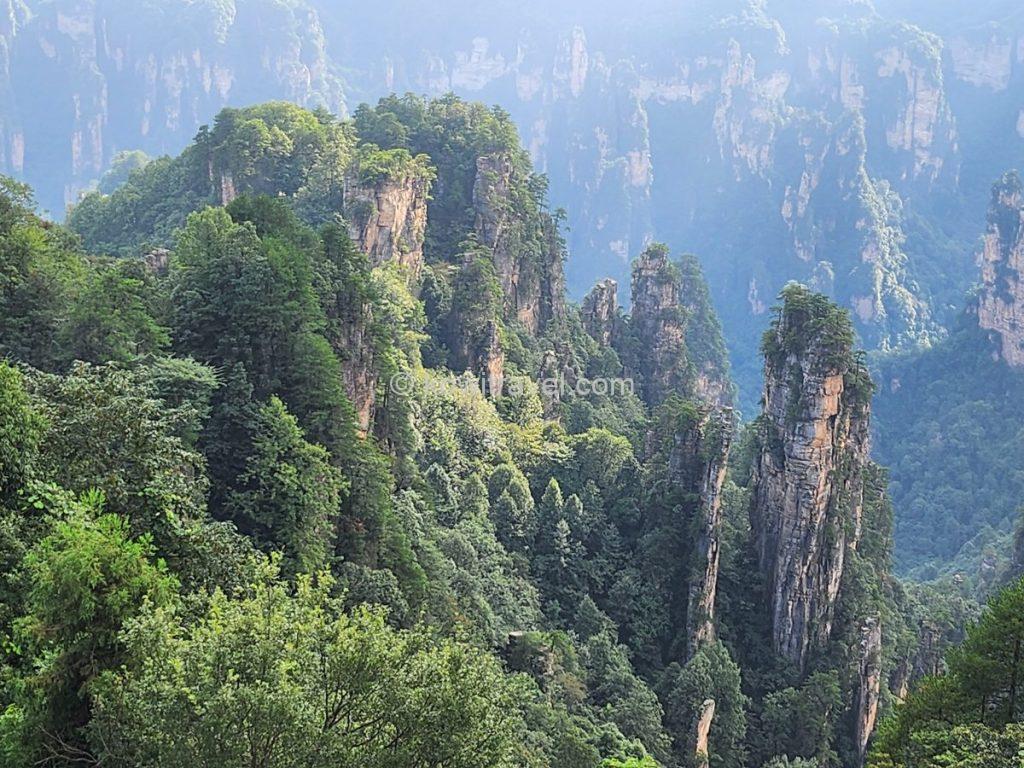
A section of the West Sea Peak Forest (Seohae Bongnim) valley. In the foreground on the right, a massive, smooth, and vertically elongated stone pillar stands out; it perfectly illustrates the unique topography of Tianzi Mountain, characterized by rock formations that are thinner and sharper than those found elsewhere in Zhangjiajie.
It is a stunning sanctuary where vertical columns gather like an imperial army beneath a shifting sea of clouds.
- Tianzi Pavilion
Perched dramatically on the eastern ridge of the Tianzi Mountain summit, this classical multi-tiered pavilion is an artificial structure built to honor Chieftain Xiang Dakun and provide a panoramic lookout over the valley.
Featuring a grand, sweeping tiled roof, this three-story wooden architectural masterpiece also marks the exact trailhead for the steep pedestrian route winding down into the Ten-Mile Gallery valley.
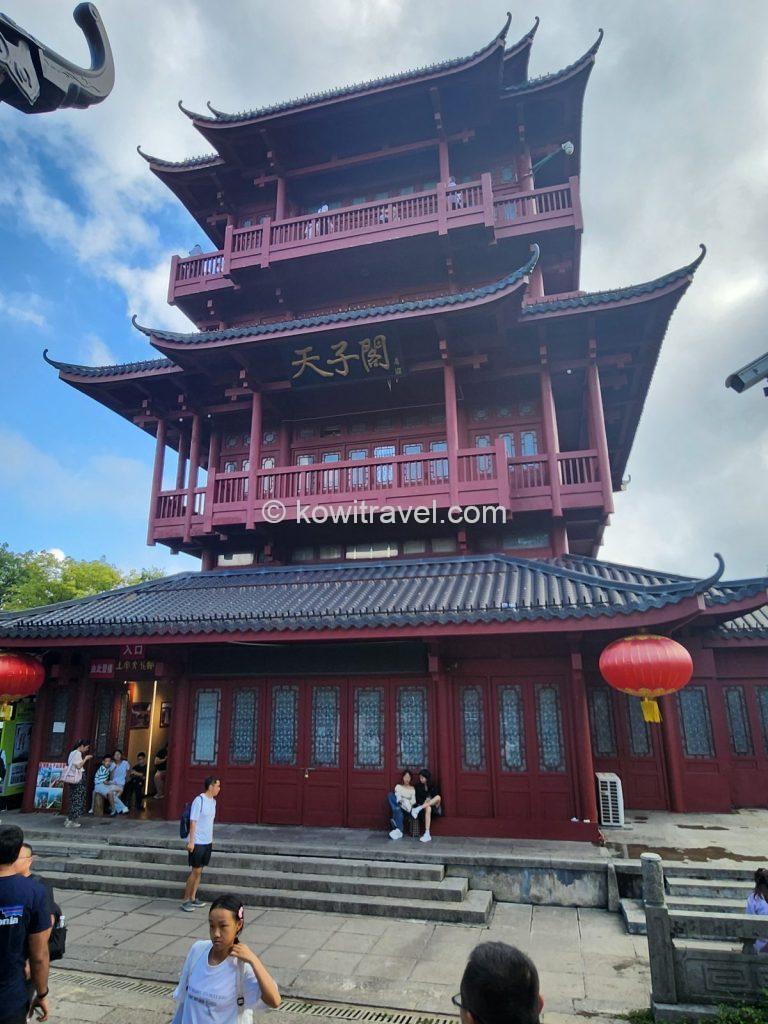
A view of the Tianzi Pavilion (Cheonjagak). Located at one of the highest vantage points on the upper reaches of Tianzi Mountain, this is a primary observation deck offering a wide-angle panoramic view of the entire West Sea Peak Forest.
5. 2) Yangjiajie Area: One Step to Heaven and the Natural Great Wall
📌 TL;DR: If Yuanjiajie is about isolated stone spires, Yangjiajie is a showcase of massive horizontal fortress walls (“Sandstone Peak Walls”). Conquer the nearly vertical steel ladder of Yibo Dengtian (1,130m) to unlock a 360-degree panoramic skyline that 99% of standard group tours completely miss.
Compared to Yuanjiajie or Tianzi Mountain, the Yangjiajie Scenic Area was developed much more recently, making it the finest sanctuary for experiencing the “raw, rugged, and untamed charm” of Zhangjiajie.
The name itself dates back to the Northern Song Dynasty, when the legendary military clan—the Yang Family Generals—set up camp here to suppress a local rebellion. Their descendants eventually built a clan village here, settling permanently. It is entirely fitting that the rock formations here uniquely resemble defensive ramparts and the fierce posture of military generals, a nod to this deep historical heritage.
- The Natural Great Wall / Tianyan Changcheng
While Yuanjiajie is famous for its thick, isolated monolithic stone pillars, Yangjiajie is characterized by razor-sharp rock walls that stand tightly packed together, extending horizontally in double and triple layers. The uncanny resemblance to an ancient, hand-built fortification earned it the moniker “The Great Wall built by Nature.”
Standing at the edge, you are confronted by colossal sandstone walls sculpted over hundreds of millions of years, standing shoulder-to-shoulder like an endless horizontal fortress.
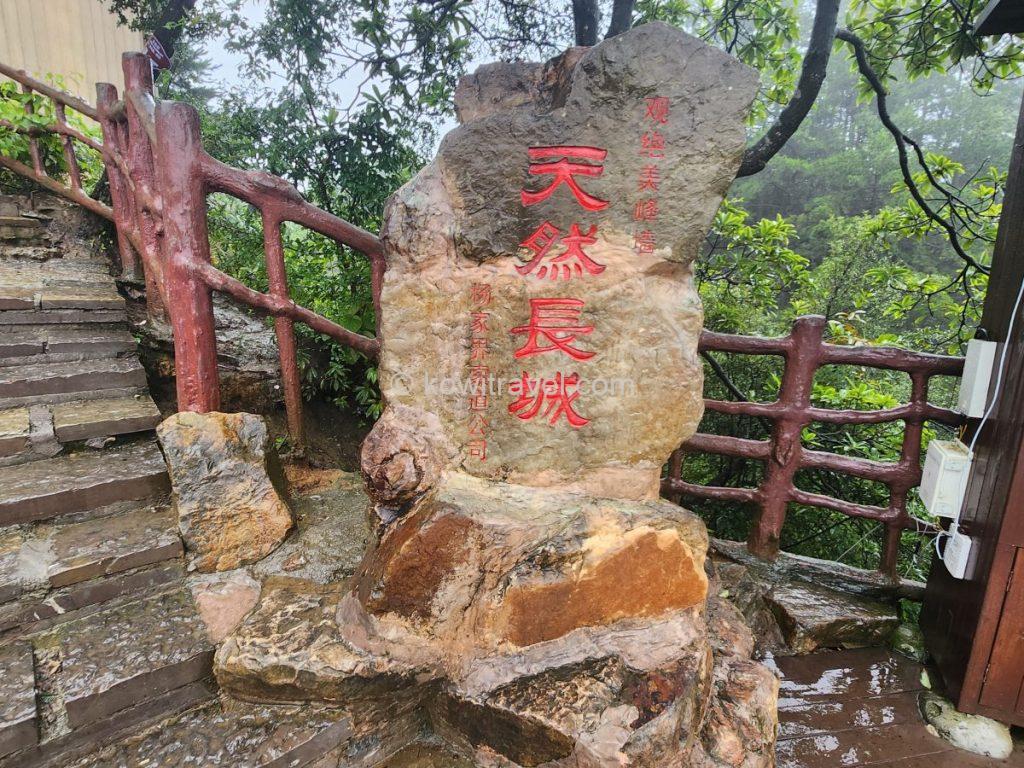
An information sign standing at the entrance to the observation deck.
It is said that the military of the legendary Yang Family Clan turned these steep cliffs into an impregnable fortress to establish their defensive lines. Standing there in person, the sheer scale and imposing presence of the landscape feel completely impenetrable to any army. It serves as a magnificent gateway that instantly steals the breath of anyone entering Yangjiajie.
(Photos: The Natural Great Wall)
Fortuitously, due to the heavy rain that had fallen over the previous few days, a massive sea of white mist completely flooded the valleys.
Watching those multi-layered, colossal stone walls pierce through the dense fog was like looking at a great wall built above the clouds by the hands of the gods themselves.


Enveloped in a mysterious, thick mist, the massive, fortress-like rock formations—known as the “Natural Great Wall”—appear as a grand stronghold floating above the clouds.
- Witnessing a Geological Treasure: The Sandstone Peak Walls
As I hiked further along the main trail at the summit of Yangjiajie, a large brown geological information board caught my attention.
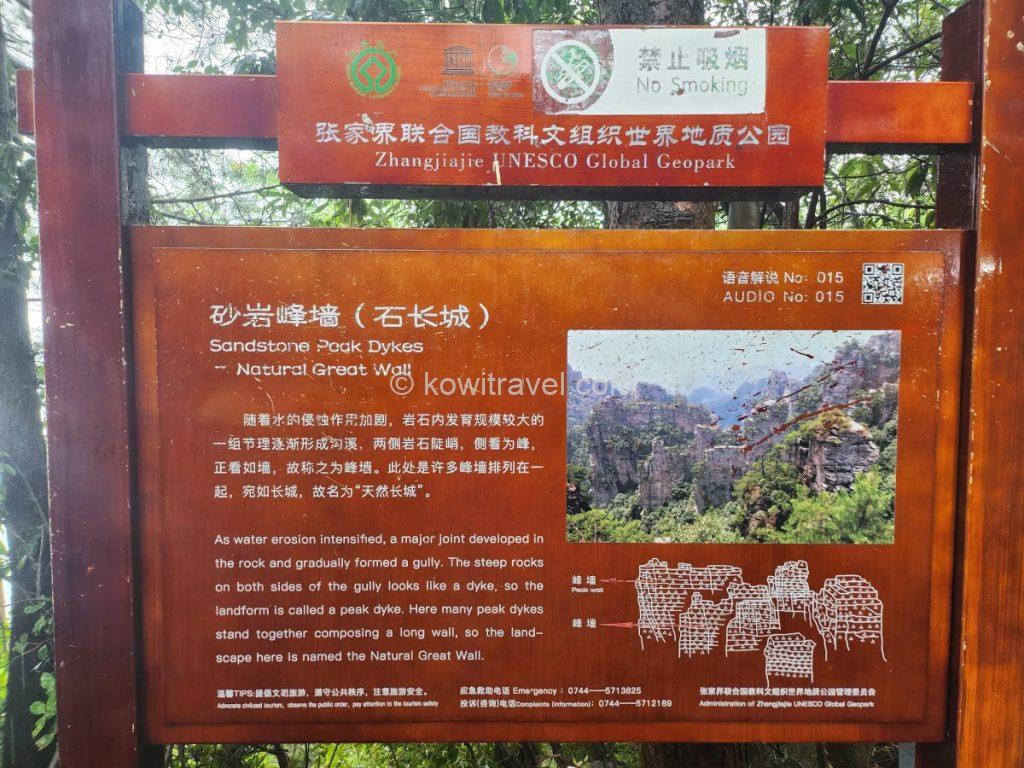
Information sign for the “Sandstone Fortress” (Seokjangseong).
According to the explanation on the sign, while most of Zhangjiajie’s famous rock formations take the form of isolated, lonely, and sharp stone pillars, the sandstone structures here in Yangjiajie are split into long horizontal stretches. This creates a highly unique formation: from the side, they look like sharp peaks (峰), but from the front, they look like massive fortresses or stone walls (墙). In fact, the sign explicitly refers to them as the “Great Stone Wall.”
💡 Travel Insight:
The Natural Great Wall” and “Sandstone Peak Wall” refer to the exact same phenomenon. To put it precisely, “Sandstone Peak Wall” is the technical, geological classification, whereas “The Natural Great Wall” is the poetic tourism name given to help visitors grasp its sheer majesty.
The unique view from the Natural Great Wall observation deck showcases a globally rare geological formation known as the Quartz Sandstone Peak Wall. This represents a specific evolutionary stage where ancient sandstone platforms—originally sitting beneath the ocean floor hundreds of millions of years ago—uplifted and fractured vertically into massive wall-like structures.
If subjected to millions of more years of erosion, these walls will eventually splinter into independent, freestanding pillars (known as Sandstone Peak Forests), like those seen in Yuanjiajie and Tianzishan. Yangjiajie, however, perfectly preserves the preceding evolutionary phase.
The thick rock formations in the foreground show sections that have just begun to separate from the massive walls behind them, allowing you to literally witness the grand evolution of nature in real time.
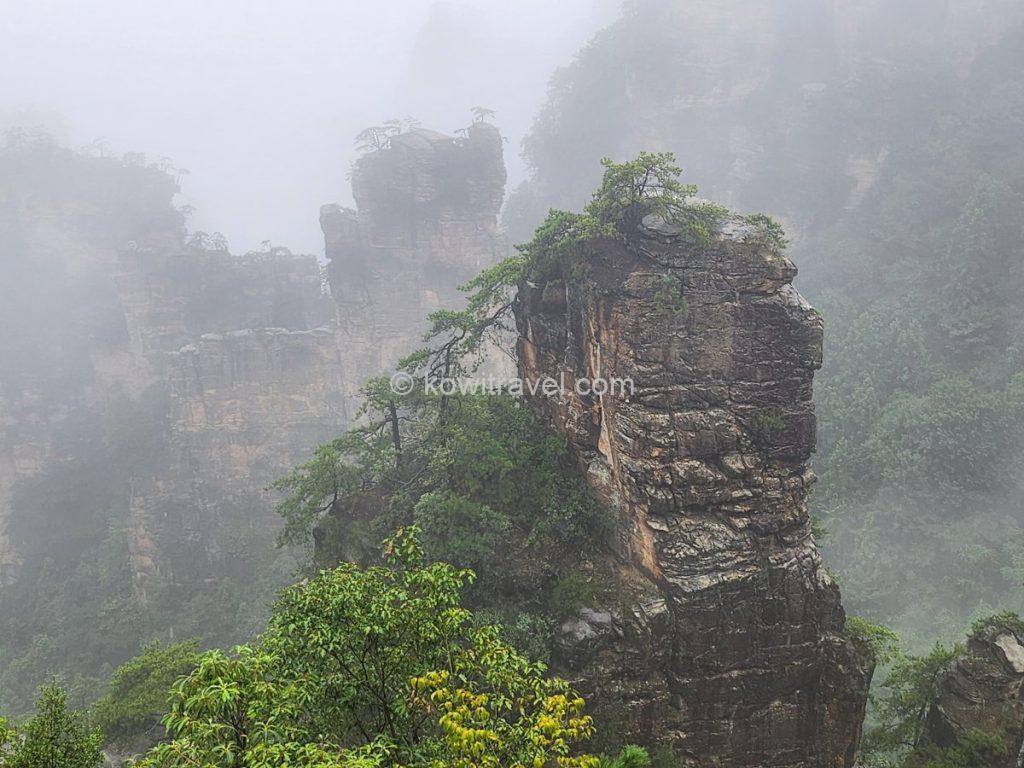
Erosion has shaped these thick layers of sandstone into structures that resemble a fortress wall, with flat, leveled-off tops.
Stepping up to the observation deck railing, the scenery was nothing short of a masterpiece.
The heavy mist piercing through the layered stone walls created a mystical atmosphere, making the entire valley look like a natural fortress suspended in the heavens.


Massive rock formations stand in a row, appearing much like the walls of a fortress.
- Yibodengtian – One Step to Heaven
Passing the Natural Great Wall sign and following the trail deeper into the heart of Yangjiajie leads you to the thrilling Yibodengtian Observation Deck.
True to its name, which translates to “ascending to heaven in a single step,” this is a heart-pounding route where you must climb a nearly vertical steel ladder built directly into a narrow cliff face to reach the summit. The railings and surrounding pine trees at the top are heavily adorned with vibrant red wish ribbons (Heyuandai) left by travelers, creating a beautifully surreal atmosphere.


The “Yibo Dengtian” (One Step to Heaven) observation deck (left) and a view of the mist-filled gorge from the deck (right).
Sitting at an elevation of 1,130 metres, this spot serves as the absolute highest peak of the Yangjiajie Scenic Area and features a massive, isolated viewing platform. Because you have to scramble up a vertical metal ladder that barely accommodates one person at a time, it remains a hidden gem that reveals a completely unobstructed 360-degree panoramic view of Zhangjiajie.
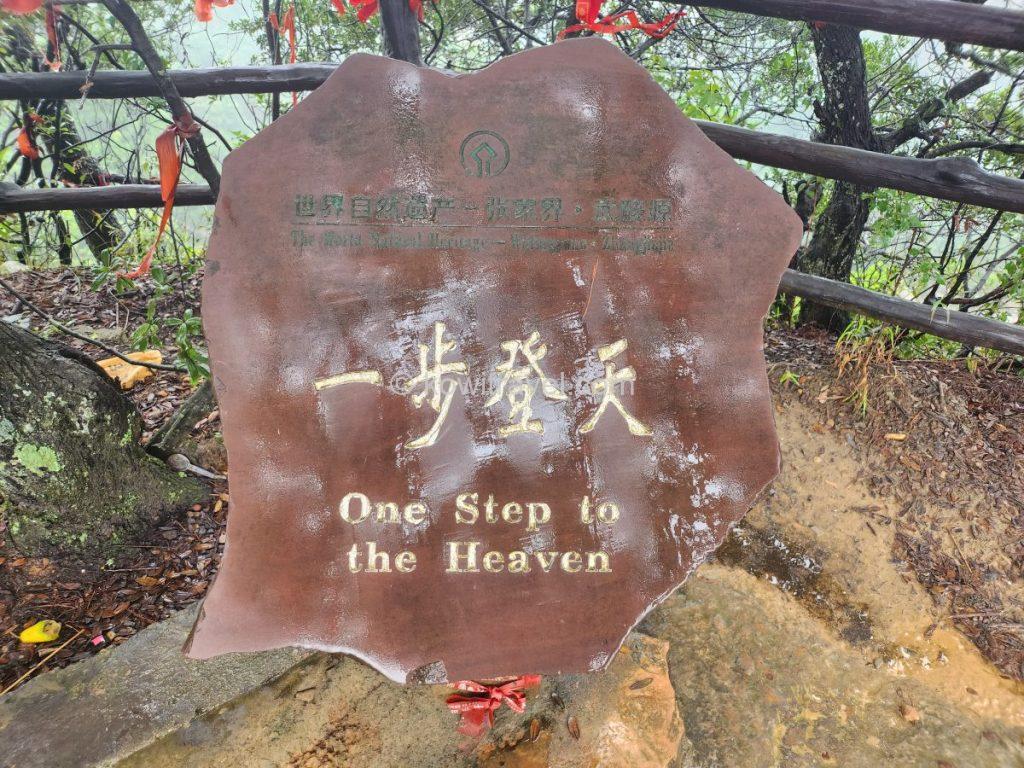
An information sign posted at the entrance to the dizzying iron ladder.
While the ascent is so steep and grueling that it leaves you completely breathless with trembling knees, the exact moment your feet touch the summit brings a rush of pure adrenaline. It truly feels as though you have transformed into an immortal spirit walking among the clouds—which is precisely how this peak earned its legendary name.


The vertical iron ladder section—the highlight of “Yibo Dengtian.” The ladder on the left is for ascending, while the one on the right is for descending. Because the incline is nearly vertical, one must essentially crawl up to reach the final observation deck at the summit—a place that truly feels like reaching the heavens in a single step.
Standing in this wide-open space, you can look past the horizontal sandstone walls you encountered earlier and witness a panorama of vertical stone pillars scattered majestically through the swirling fog. The sea of clouds encountered at Yibodengtian after such a challenging trek was undeniably one of the greatest highlights of my entire journey through Zhangjiajie.


A panoramic view of the area surrounding “Yibo Dengtian” from the observation deck. Deep crevices within the sheer, red sandstone cliffs are densely packed with primeval green forests, showcasing the raw, rugged, and primordial majesty characteristic of the Yangjiajie region.
⚠️ The Truth About Yibodengtian That 99% of Tourists Miss
Most tourists assume that the wide rocky platform they stand on after climbing the vertical steel ladder is actually “Yibodengtian.”
However, the true Yibodengtian is the independent sandstone pillar towering directly opposite this 1,130-metre lookout. Unlike the surrounding massive rock walls, this lone, solitary pillar shoots straight up into the sky like a giant needle or pestle (棒槌).
That standalone pillar is the real geological marvel.
If you look closely at the red circle on the right side of the information map below and contrast it with the actual scenery, you will see exactly what I mean.
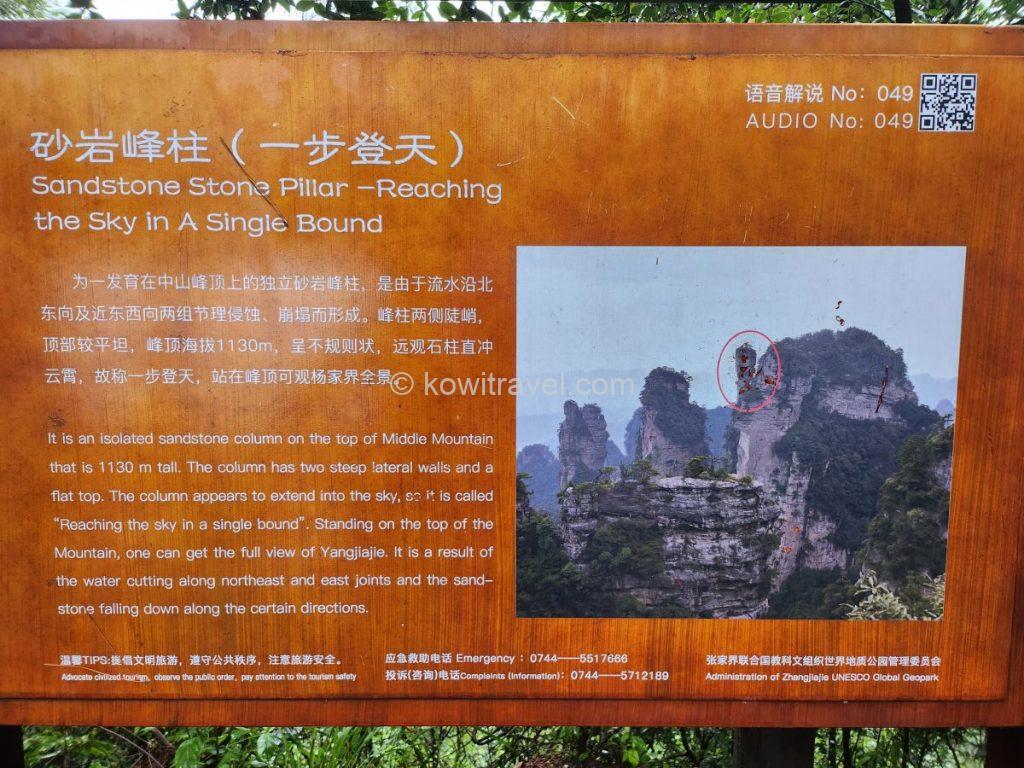
The “Yibo Dengtian” information sign. It explains that the formation is “an isolated sandstone pillar rising from the top of Zhongshan Peak, created over hundreds of millions of years as river water and rain flowed through vertical rock joints, causing erosion and collapse.”
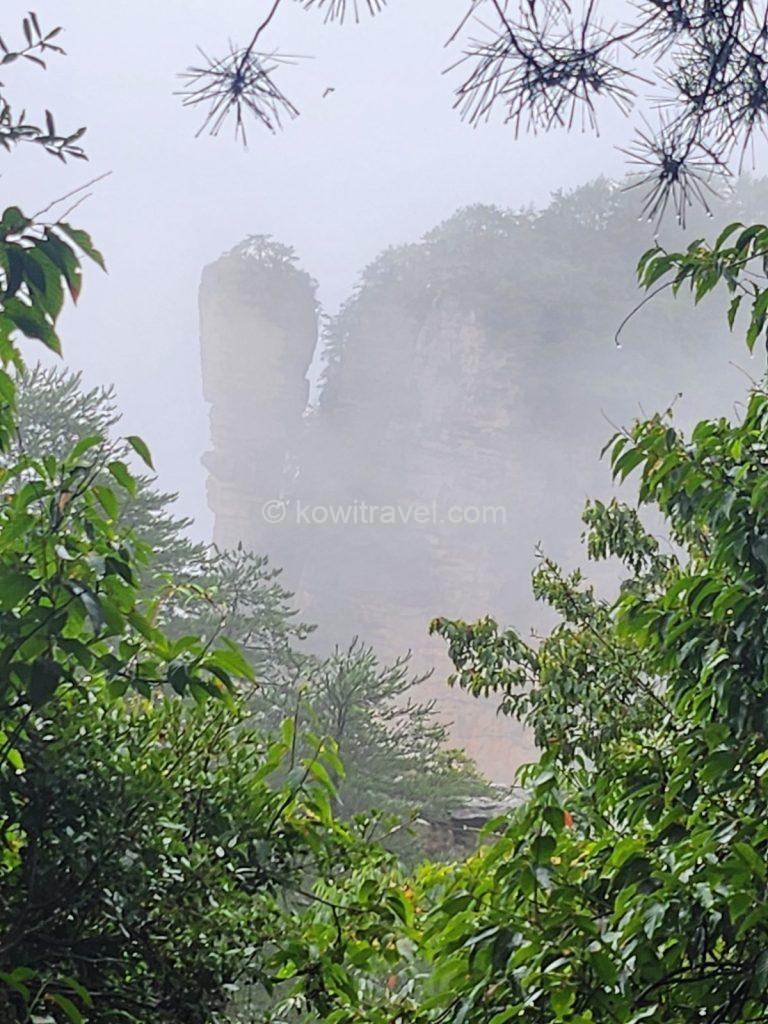
The sandstone pillar, highlighted by a red circle on the sign above. Unlike the massive, wall-like rock formations nearby, this pillar stands alone, reaching toward the sky like a giant club. When viewed from afar below, it appears to thrust straight upward, as if one could reach the heavens with just a single additional step—which is how the rock formation itself came to be called “Yibo Dengtian” (One Step to Heaven).
😱 Because the steel ladder is exceptionally steep, please maintain a firm grip on both handrails and climb slowly. Children and elderly travelers must exercise extreme caution during both the ascent and descent.
👍The Independent Traveler’s Privilege:
Because of its treacherous terrain and strict time constraints, the vast majority of group tours completely skip Yibodengtian. It has become a hidden sanctuary exclusively enjoyed by independent adventurers. If you are traveling solo or managing your own itinerary, this is a non-negotiable must-see.
- Passing Through ‘Tujia Tang’, the Ancient Fortress of the Tujia Minority
On the descent after soaking in the thrill of Yibodengtian, I stumbled upon a historic wooden fortress gate tucked deeply between the rugged canyons of Yangjiajie.
This area replicates an authentic Tujia Minority Outpost, offering a glimpse into the ancient defensive lifeways of Zhangjiajie’s indigenous Tujia people (and historically serving as a notorious bandit stronghold).
My eyes were immediately drawn to the bold red characters inscribed on the wooden plaque above the gatehouse: ‘Tujia Tang’.
Signifying a traditional Tujia gathering place or ancestral hall, the entrance featured a formidable ox skull totem mounted prominently on the wall. This powerful cultural symbol, traditionally used to ward off evil spirits and intimidate outsiders, perfectly preserved the rugged, lawless atmosphere of an ancient mountain fortress. Below it stood a wooden sign carved with the phrase ‘Wen Ding Zhangjiajie’ —a symbolic declaration that you are passing through the ultimate gateway to conquering the peaks of Zhangjiajie.
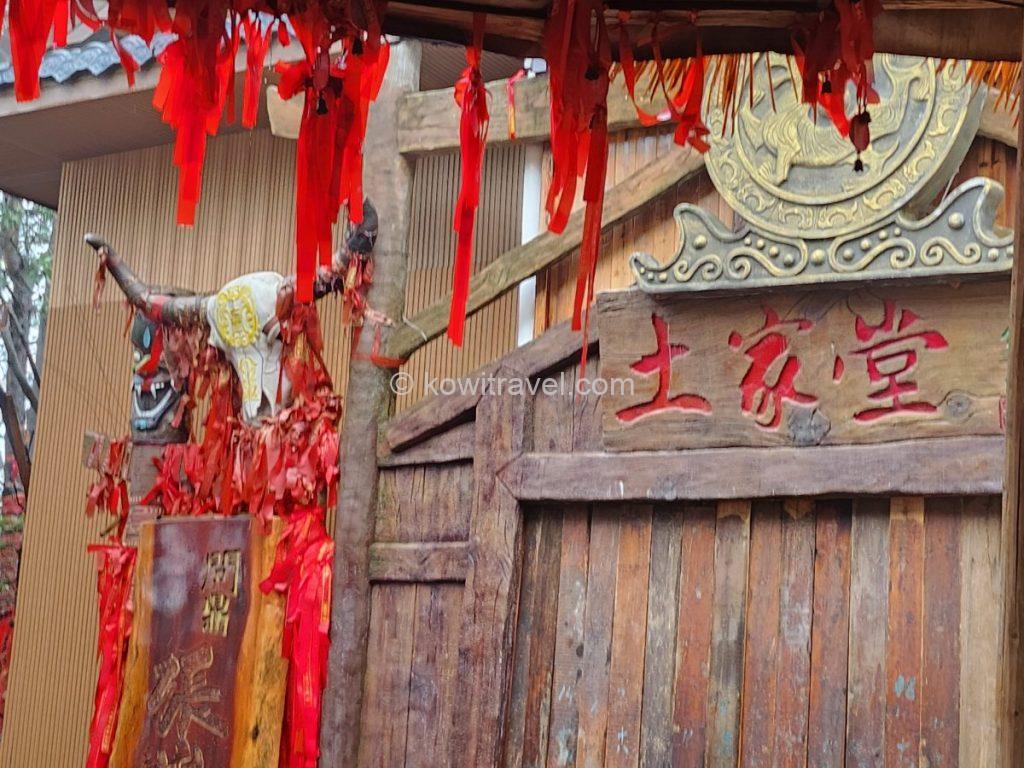
Togadang signboard and the ox-head totem
Passing through the gatehouse, the descent transformed into a breathtaking tunnel of crimson ribbons.
The trail railings and the branches of the surrounding pine trees were completely cloaked in tens of thousands of red wish ribbons. The brilliant red created a striking, dreamlike contrast against the misty, emerald-green forest canopy.


Tunnel of red ribbons (left) and a stone-stepped path (right)
The trail continues down a flight of steep stone steps. Walking along these rain-slicked steps, flanked on both sides by walls of crimson ribbons, stirs a genuine sense of adventure—as if you are navigating a secret highway once guarded by Tujia warriors centuries ago.
It is an incredible, off-the-beaten-path spot where you can truly immerse yourself in the raw, unpolished history of Yangjiajie.
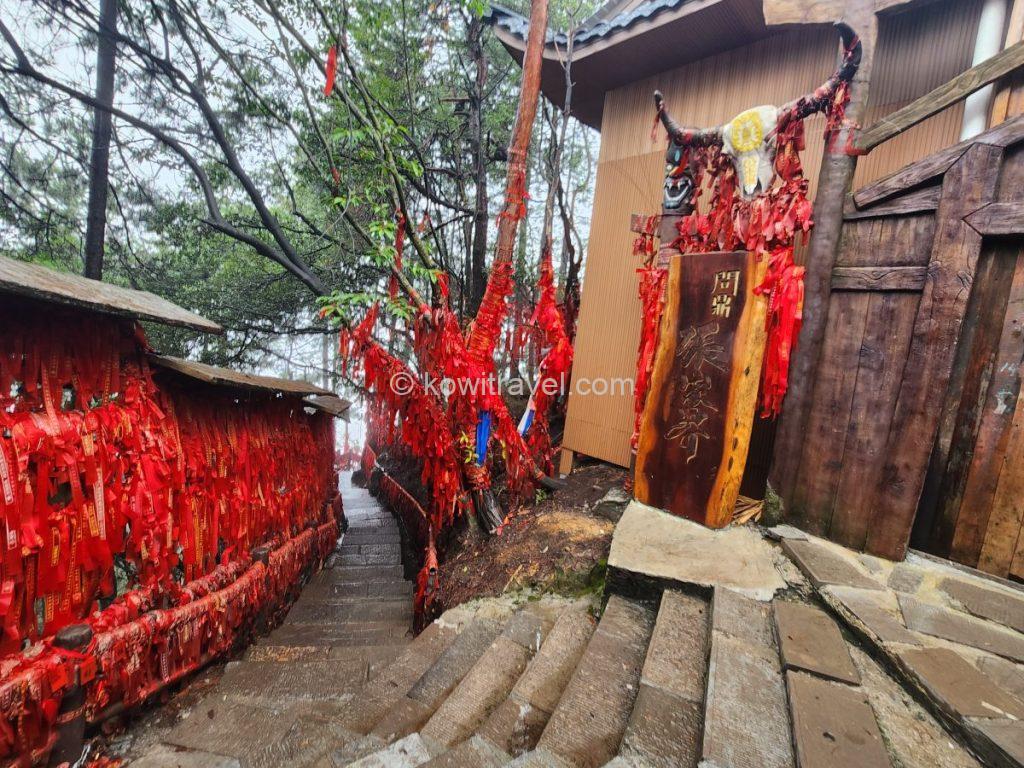
Steep descending stairs and a view of Togadang
6. Looking Ahead: Saying Goodbye to Huangshizhai, Venturing into the Heart of Yuanjiajie
💡 TL;DR: The Tactical Pivot
- The Sacrifice: Dropping Huangshizhai due to a 2-day torrential rain washout to save sheer physical stamina for the big three.
- The Realization: Every stone giant in this park belongs to the same geological platform splintered over eons.
- Next Up: Venturing into the heart of Yuanjiajie to stand eye-to-eye with the floating floating monoliths of Pandora.
To thoroughly explore and document the independent highlights of two massive territories—Yuanjiajie and the Ten-Mile Gallery—with my own two feet, I had to make a cold, realistic executive decision regarding our remaining time.
Ultimately, that meant making the painful choice to completely scratch Huangshizhai (Yellow Stone Village), located near the South Gate, from our itinerary.
The famous local proverb, “He who fails to climb Huangshizhai has never truly been to Zhangjiajie,” weighed heavily on my mind, and I will admit my footsteps felt heavy making that call.
However, this trekking experience taught me a profound lesson: all of these bizarre, towering stone pillars across the national park belong to the same geological family, having splintered from one monolithic sandstone mother-platform over millions of years.
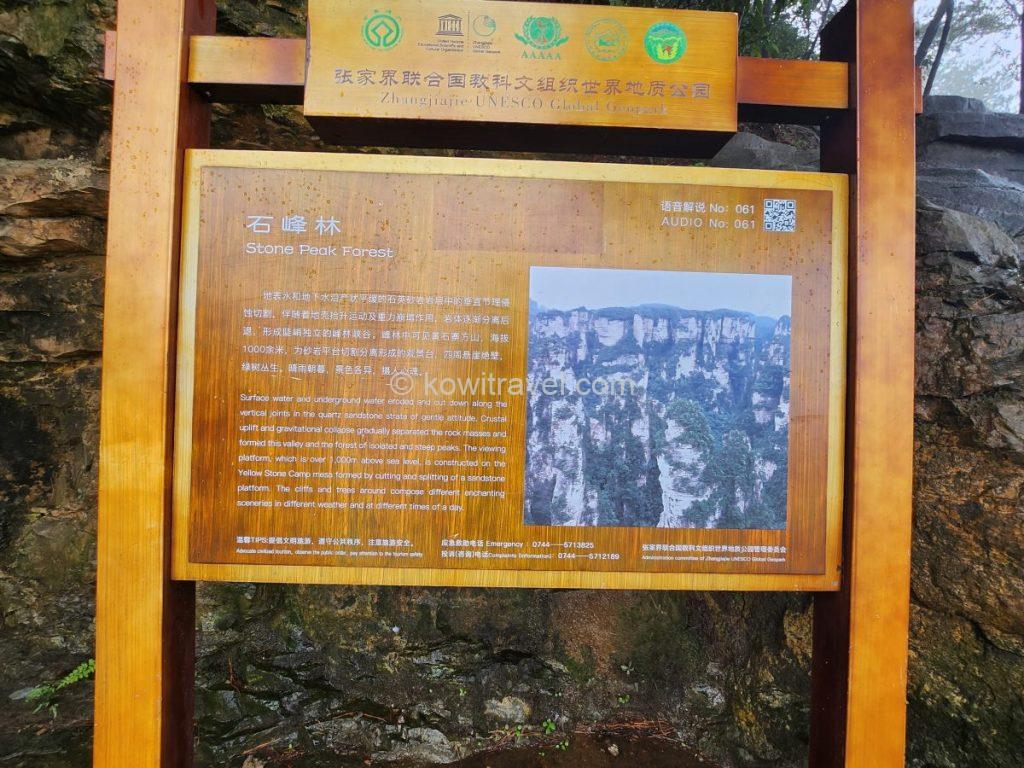
Information board and description for Seokbongnim
Though I never got to set foot on the summit of Huangshizhai, the majestic stone fortresses of Tianzishan and Yangjiajie provided more than enough exposure to the pristine, primeval mysteries of this ancient landscape.
The lingering regret of what was missed will simply serve as the perfect excuse to lure me back to this corner of the world in the future.
For now, our gaze shifts toward the absolute crown jewel of this national park trek—the very place for which I willingly sacrificed Huangshizhai and saved every ounce of my physical energy.
In the next post, we venture into Yuanjiajie, home to the towering vertical columns that inspired the floating mountains of the movie Avatar.
We will also cover the vertigo-inducing Bailong Elevator, which shatters the limits of human engineering, and the poetic, mist-shrouded landscapes winding through the Ten-Mile Gallery. Stay tuned for the raw, step-by-step hiking chronicle!
👉[ Read the Review of #11. Yuanjiajie, the Bailong Elevator, and the Ten-Mile Gallery ]
” This post includes affiliate marketing links. If you make an accommodation booking through these links, I may earn a small commission at no additional cost to you.”
Leave a Reply