#17. Sleepless Nights from the Intense Culture Shock of the Hungry Ghost Festival, and Exploring Penang’s Vibrant Night Market Culture
1. Introduction – What Was That Unfamiliar Sound Shattering the Peaceful Nights of Jelutong?
Life at the comfortable, modern Straits Garden Condo in Jelutong was an absolute dream, blending the convenience of public transit with the lively energy of the local morning market.
👉 Check out Part 16: Penang One-Month Stay Accommodation Tips & Early Morning Market Tour
Every single day, my wife and I felt firsthand that we had made the right call choosing to stay here instead of dealing with the noise and aging infrastructure of George Town.
We were immersing ourselves deeply into local life, firmly believing that every country has its own unique culture and that respecting local traditions and religions is both a virtue and a golden rule for long-term travelers.
However, there are moments when things cross slightly past the line of common courtesy and etiquette, testing a foreigner’s patience and inflicting a fair bit of agony.
Little did we dream that during our peaceful month-long stay in Jelutong, an event awaited us that would completely turn our nights upside down—delivering the biggest culture shock of our trip and demanding every ounce of our patience.
In this 17th installment, we are diving vividly into that intense nocturnal episode in Penang, alongside the dazzling nightlife of the Jelutong Friday Night Market (which has plenty of great video footage to go with it) and the hidden sides of the local dining scene.
2. Sleepless Nights from the Noise – The Biggest Culture Shock and Frustrating Reality of Our One-Month Stay
One morning, out of nowhere, massive tents began going up along the main road right in front of our condo, followed by the installation of a grand stage equipped with gigantic loudspeaker systems.
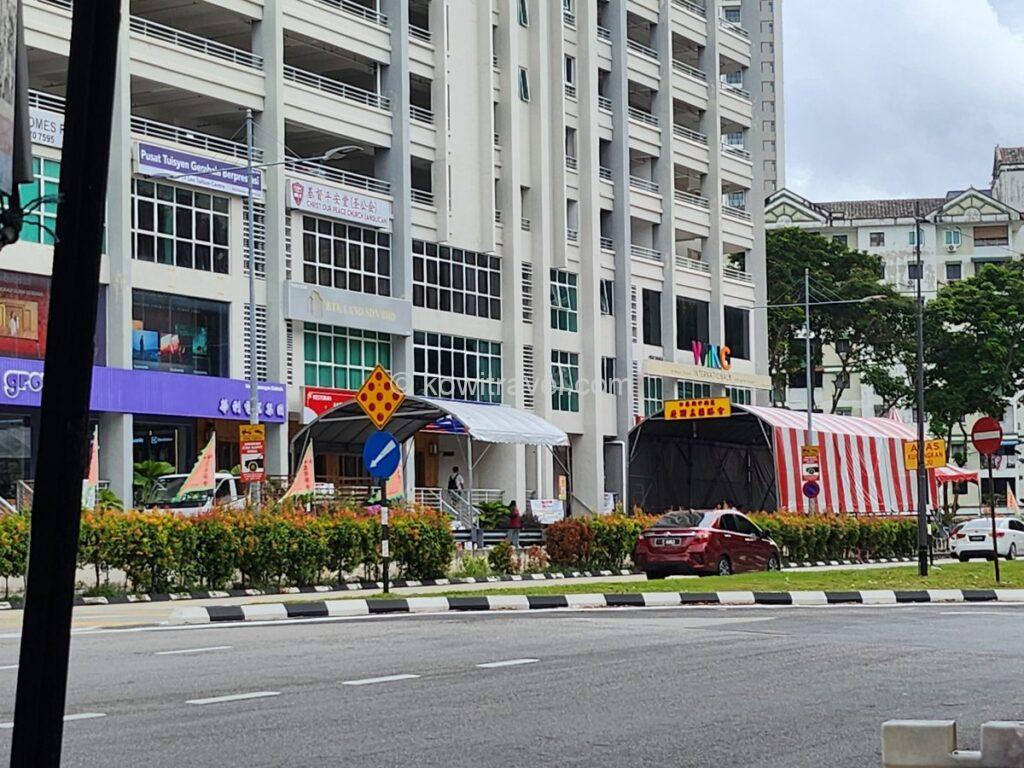
The scene of the Hungry Ghost Festival noise shock: Massive tents and a stage taking over the entire parking lot right in front of our accommodation.
Up until that point, we simply assumed it was a modest neighborhood party or a small local festival.
We could not have been more wrong.
For four to five straight days without a single break, from the exact moment the sun went down until well past midnight into the early morning hours, an uproar of singing and dancing erupted at an unimaginable, ear-splitting volume.
Even with all the modern double-glazed windows of our condo shut tight and the curtains drawn, the thumping vibrations of the bass drums and the piercing blare of the loudspeakers echoed right through into our high-floor apartment.
Night after night, my wife and I suffered from extreme irritation and exhaustion, unable to sleep even with earplugs firmly in place.
What shocked us even more was that at this late hour, despite countless locals living in the surrounding apartments and houses who surely needed to sleep for work and daily life the next day, not a single person called the police or lodged a complaint.
An incomprehensible scene unfolded where everyone silently tolerated the noise as effortlessly as accepting a natural change of seasons.
On top of that, throughout the rituals, the streets and alleys were littered with piles of ash from giant dragon-shaped incense sticks, burnt remnants of joss paper (spirit money), and illegally dumped trash left completely unattended, severely blighting the cityscape.
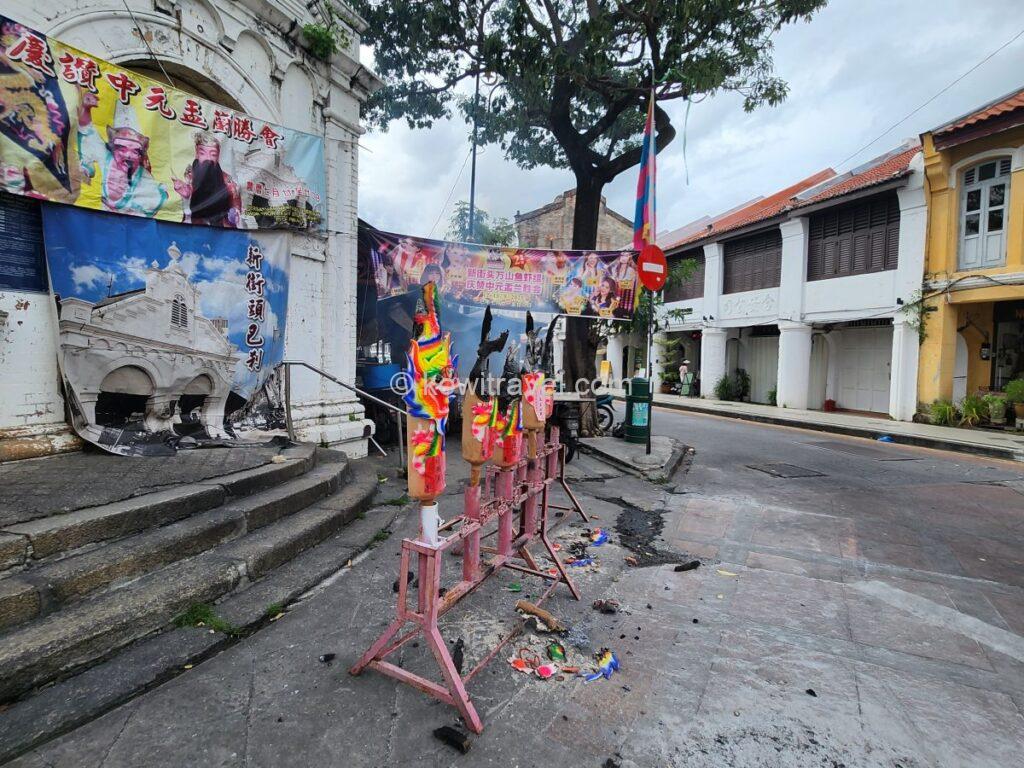
Scattered throughout the alleys are the remnants of giant, dragon-shaped incense sticks—piles of ash and the charred traces of joss paper used as offerings for spirits.
From the perspective of a long-term traveler, it felt deeply disappointing and bitter that a historic tourist city visited by travelers from all over the world—even in a residential local neighborhood—seemed to lack even the most basic administrative guidelines for street cleanliness and nighttime noise control, almost as if the state government and authorities had washed their hands of it completely.
Why is this phenomenon tolerated across all of Penang?
The culprit behind this commotion was none other than the traditional Chinese Taoist festival, the ‘Hungry Ghost Festival’ (Zhongyuan Jie).
During the seventh lunar month (around August to September on the Gregorian calendar), it is believed that the gates of hell open, releasing hordes of hungry, wandering spirits into the earthly realm.
Among local Chinese Malaysians, there is a deeply rooted Taoist reverence and fear that unless these spirits are lavishly entertained, fed, and appeased so they return peacefully, misfortune will befall their families and neighborhoods, whereas pleasing them ensures business prosperity for the entire year.
Ultimately, the ear-splitting loudspeaker performances echoing late into the night (known as Getai shows) were not meant for the living—they were ‘entertainment offered to keep the ghosts happy.’ Because of this, locals accepted the sleepless nights and daily inconvenience as a natural religious sacrifice and virtue.
The one saving grace was that the event in our condo’s parking lot didn’t last the entire month; it wrapped up after four or five days, only for another performance to start up just a short distance away.
While we understood and tried to respect the cultural differences intellectually, those hot Penang nights left us feeling let down when it came to urban cleanliness and basic etiquette.
Click here to read the backstory behind Penang’s Hungry Ghost Festival noise and sanitation issues, as well as the state government’s recent positive efforts for change.
The reason this seemingly unreasonable noise and street sanitation neglect repeats itself every August–September (the 7th lunar month) in Penang comes down to a complex web of political power dynamics and cultural taboos.
• Chinese Political Parties Catering to Their Voter Base: While ethnic Malays form the core of Malaysia’s federal government, Chinese-led political parties firmly hold state government power here in Penang. For the Chinese voters who make up Penang’s demographic backbone and hold local economic clout, this festival is the grandest celebration for strengthening clan solidarity. Consequently, a political dynamic has formed where the state government and police turn a completely blind eye to noise regulations and littering enforcement out of fear of losing votes.
• The Taboo Against Cleaning Up Trash: While the rituals are underway, spirits must be allowed to continuously collect their offerings of food and travel money. Therefore, a strict religious taboo forbids cleaning up burnt joss paper or piles of incense ash until the festival period has completely ended. The plastic bags piled on the streets like firecrackers were actually offerings of rice and daily necessities for the spirits, and the ornate dragon pillars lining the roads were ‘giant joss sticks’ billowing smoke for days on end.
🌟 Recent Environmental Improvement Efforts by the State Government and Local Community:
Fortunately, as voices grow louder pointing out that this noise, smoke, and sanitation issue tarnishes Penang’s image as a tourist destination, positive winds of change are blowing. To reduce air pollution and haze, the Penang State Government and festival committees are actively encouraging organizers to “ban the full burning of traditional giant dragon incense and replace them with eco-friendly oil candles.” In high-rise residential areas like apartments and condos, regulations have been significantly tightened so that joss paper may only be burned in “designated concrete incinerators and collection bins” rather than out on the streets. Furthermore, continuous efforts are being made to find middle ground between preserving tradition and modern urban etiquette—such as capping decibel levels for traditional stage troupes and organizing voluntary cleanup campaigns immediately after rituals conclude. So, if you are planning a trip to Penang in the future, there is no need to avoid this beautiful city over noise concerns!
3. The Flip Side of Penang Nightlife
3.1) The Vibrant Culinary Scene of the Friday Night Market Lighting Up Jalan Lenggong and Van Praagh
Ironically, what wiped away all the stress from the Hungry Ghost Festival noise in a single stroke was the colorful ‘Jelutong Friday Night Market’, which takes place every Friday night along Jalan Lenggong and Van Praagh—just across the street from our accommodation (Straits Garden Condo).
👉 Check official night market operating details on the Penang State Government Tourism Portal
Commonly referred to by Penang locals as the ‘Van Praagh Night Market’, this place has a completely different vibe from the commercialized night markets in central George Town featured in tourist guidebooks.
It originated as a traditional community-based mobile night market (Pasar Malam) where local residents, after a grueling week of work as residential neighborhoods developed here, would shuffle out on Friday evenings in their slippers with their families to unwind, grab dinner, and stock up on groceries.
As 7:00 PM approaches, hundreds of vendor stalls set up in clockwork precision along the normally quiet two-way stretch of Van Praagh Road. Once the sun sets and the daytime heat subsides, colorful lights and mouthwatering aromas fill the street.
With 100% local prices and zero tourist markups, there is no better place to experience Penang’s authentic working-class culture.
The lively entrance and bustling food and variety stalls of the Jelutong Friday Night Market, filling Jalan Lenggong and Van Praagh with dazzling lights and locals every Friday night.
As you stroll down the endless rows of stalls, an array of Penang’s signature street snacks captures your eyes and taste buds, stopping you right in your tracks.
Among them, the spot that stole our attention was a ‘Handmade Traditional Mochi’ stall where vendors were carefully shaping rice cakes fresh to order.
Pulling soft, pillowy glutinous rice dough straight out of a pink insulated container and generously coating it in nutty peanut powder and black sesame, the young vendor’s deft handiwork radiated years of mastery.
The famous handmade mochi dessert stall at the Van Praagh Friday Night Market, pinching off chewy rice cakes fresh to order and coating them generously in nutty toppings.
Before the sweet aftertaste of the mochi even faded, right next door, vendors dressed in matching orange uniforms were putting on a show, busily spinning multiple round cast-iron pans simultaneously as they cooked batter.
This was a stall selling Malaysia’s beloved national street snack, ‘Apam Balik’.
Crispy, thin pancake batter is generously filled with sweet corn kernels, crushed peanuts, and sugar before being folded in half. With a cookie-like crunch on the outside and a soft, moist interior, it was the ultimate snack to munch on while strolling through the market.
The vibrant scene at the Apam Balik stall—baking traditional Malaysian pancakes loaded with sweet corn and crushed peanuts to golden perfection—captures the true heat of Penang’s nightlife.
After sampling a rich variety of savory and sweet night market treats, one final, crowning stop awaited us to refresh and cleanse our palates.
It was a ‘100% Natural Sugarcane Juice Truck’, where the entire flatbed of a truck had been converted into a massive juicing station.
When long, peeled stalks of sugarcane are fed whole into the machine, chilled, sweet green juice pours out fresh on the spot.
Blending a subtle, natural sweetness—nothing like artificial sugar—with ice-cold refreshment, it was the undisputed star of the Penang night market, instantly washing away the sultry tropical heat.
Live action at the Van Praagh Night Market sugarcane truck, feeding whole stalks of sugarcane into the press to extract 100% pure, fresh juice on the spot.
With so many varieties of food and merchandise to browse, we lost all track of time wandering from stall to stall, sipping fresh tropical fruit juices and tasting local delicacies until late into the evening.
We wrapped up our feast-for-the-eyes-and-stomach market tour by picking up a few side dishes to enjoy with our meals back at the condo.
3.2) Another Mecca of Penang Night Gastronomy – Multicultural Melting Pot ‘Little India’, the History of Kimberley Street Night Market, and Hidden Kopitiam Delicacies
While the Van Praagh Friday Night Market outside our condo was a humble, everyday gathering spot strictly for locals, heading into the heart of George Town brings you face-to-face with another culinary mecca of Penang nightlife boasting a completely different scale and history.
That is the ‘Kimberley Street Food Night Market’, located right next to the vibrant multicultural enclave of ‘Little India’.
Taking a quick look at the background of George Town’s Little India makes its charm feel all the more three-dimensional.
Little India is a historic district centered around Chulia Street, Queen Street, and Penang Street.
It was born in the late 18th century when the British East India Company opened Penang as a free port, prompting Tamil immigrants from South India to settle here as port workers, merchants, and administrative clerks.
Even today, the moment you step into these alleys, pungent waves of rich spices, dazzling sari shops, and Bollywood music fill the air, giving you the surreal sensation of having teleported straight into a city in India.
And right along the northern border of this multicultural quarter, on Lebuh Kimberley—historically a residential hub for Chinese merchants—the legendary ‘Kimberley Street Night Market’ comes alive every single night.
This night market originated in the early 20th century as a cluster of street food carts where Chinese laborers and trishaw drivers, finishing grueling shifts late at night at the nearby port and shophouses, gathered for cheap, hearty meals to fill their stomachs.
Over the decades, second- and third-generation descendants took over these family businesses, passing down recipes from generation to generation. Today, it stands as an iconic sanctuary of Penang night dining, frequented by local foodies and global gastronomes alike.
As the sun sets and darkness falls, stalls with decades of history begin lighting up one by one along both sides of the narrow street.
Walking down Kimberley Street, the savory aroma of sizzling oil and the lively buzz in the air seem to melt away the fatigue of long-term travel.
Weaving through the crowds, my wife and I grabbed a table inside an open-air local food court—a true institution on Kimberley Street known as a ‘Kopitiam’.
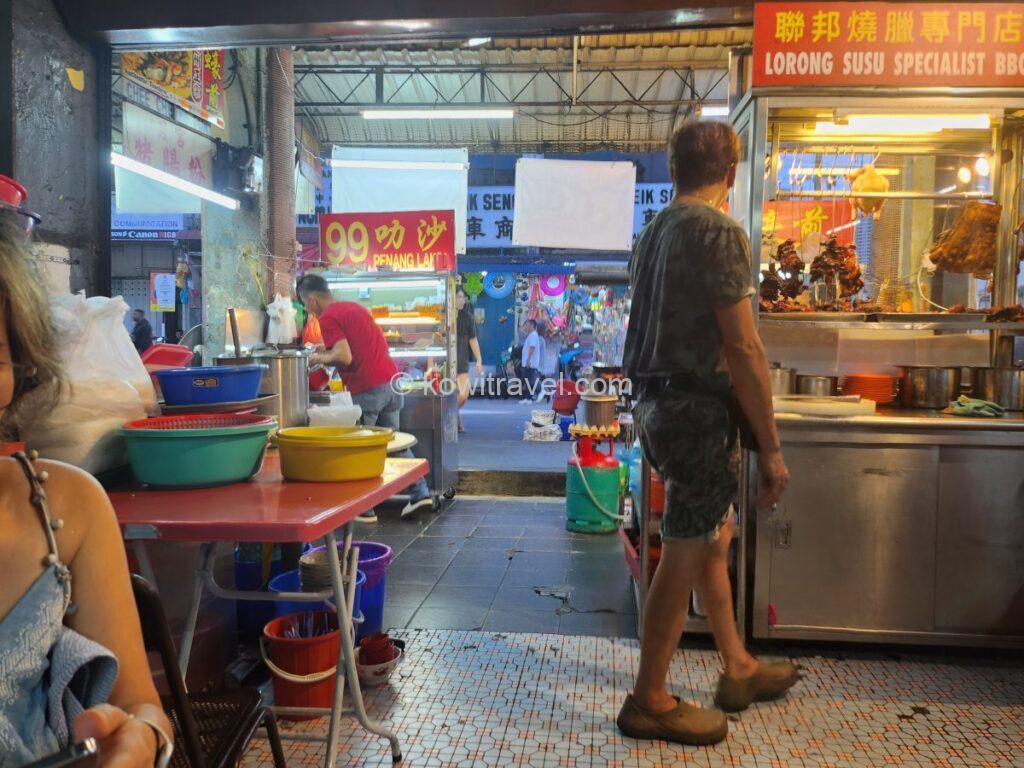
A heartwarming local Kopitiam scene in the heart of Kimberley Street Night Market, thick with the savory aroma of grilled meats. It showcases Penang’s unique dining system where you can order dishes from various surrounding stalls and enjoy them all in one space.
The dining system at these kopitiams offers a fascinating experience for travelers. Once you claim a seat inside the shop, you can order different signature dishes from various independent stalls stationed inside and outside the building (such as laksa, stir-fried noodles, or Cantonese roasted meats) and enjoy a massive feast all at one table.
However, once you sit down, it is a longstanding rule and polite etiquette to order at least one drink or cup of local coffee per person from the host kopitiam.
For our Kimberley Street tour, we chose a dish everyone says is a mandatory eat in Penang: ‘Local Fried Oyster Omelette’ (Oh Chien), served alongside a house-made chili vinegar dipping sauce.
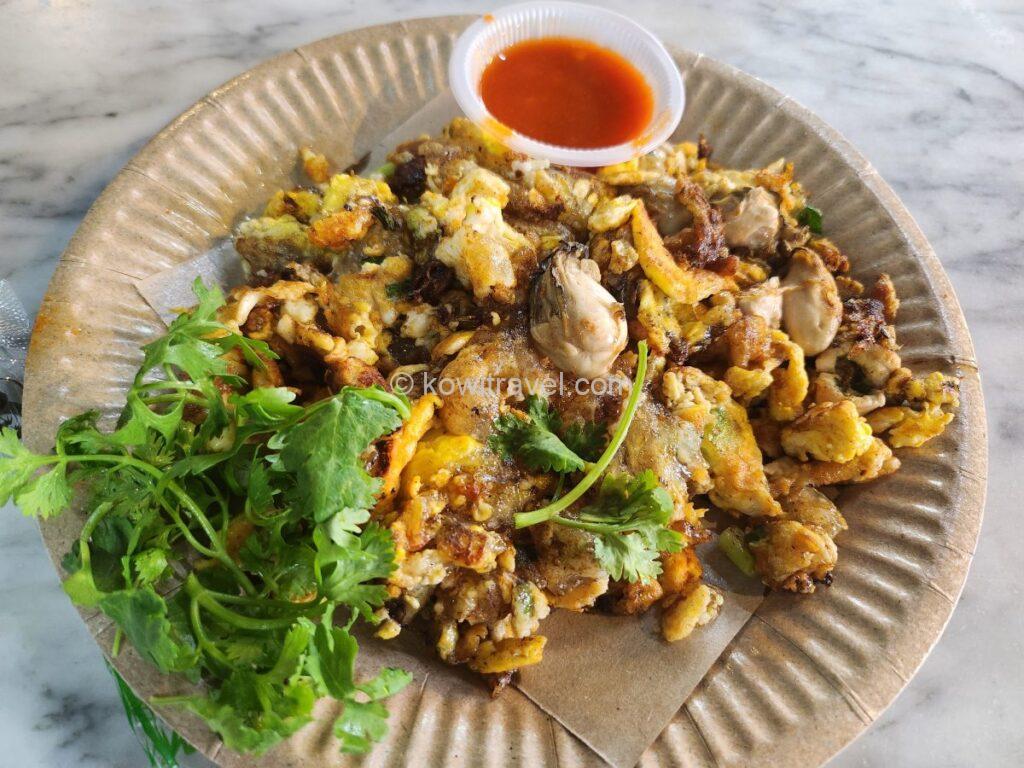
The mouthwatering sight of Oh Chien (Fried Oyster Omelette), Kimberley Street Night Market’s ultimate delicacy, featuring a crispy-yet-chewy egg and starch base generously loaded with plump, juicy fresh oysters.
Cooked over high heat on a massive cast-iron griddle, the egg and tapioca starch batter turns out wonderfully crispy on the edges yet delightfully chewy inside, topped generously with large, plump fresh oysters.
Fresh cilantro and a tangy, spicy chili sauce cut right through any potential greasiness, balancing the flavors beautifully.
I personally found it unique and delicious, though if you aren’t a fan of the slightly sticky, gelatinous texture of cooked starch, I’d recommend trying one of the other local specialties instead.
Spending an evening at Kimberley Street Night Market with a cold drink under the gentle breeze of vintage ceiling fans felt like witnessing Penang’s multicultural history—stretching back to the British colonial port era—and the grit of its working class blooming under the name of ‘gastronomy.’
It was a night that made us feel in our bones why Penang is hailed as one of Asia’s premier food capitals.
👌 Visiting & Payment Tips
Recently, Penang’s night markets and local kopitiams have widely adopted Malaysia’s unified QR payment system (DuitNow QR) and Touch ‘n Go eWallet, making app-based QR scan payments super convenient. However, since some traditional old-school shops and small street stalls still operate strictly on cash (Malaysian Ringgit), carrying small-denomination bills alongside your QR payment apps is the safest bet.
4. Comfortable Modern Infrastructure – Slipper-Friendly Late-Night Grocery Runs at the Underground Sunshine Supermarket
As I mentioned in my previous post, because we are long-term travelers who cook our own meals, grocery shopping isn’t a choice—it’s an absolute necessity wherever we go.
We always have a long shopping list ranging from fresh produce to various sauces, and above all, our biggest daily consumption item is bottled water.
👉 Why You Should Drink Bottled Water in Penang, Malaysia
Although Malaysia’s tap water is officially classified as ‘potable’ by government standards, even locals do not drink straight from the tap, relying instead on water purifiers or bottled water.
● Aging Pipes and Building Water Tank Hygiene
Much of Malaysia’s municipal water pipeline infrastructure is aging.
Moreover, apartments, hotels, and commercial buildings store and supply water through massive rooftop or underground tanks.
Because cleaning and maintenance of these tanks can be inconsistent, bacteria and sediment can easily accumulate.
● Rapid Microbial Growth in a Tropical Climate
Penang has a hot and humid tropical climate year-round. High temperatures cause residual chlorine in storage tanks and pipes to evaporate quickly, creating an ideal breeding ground for microorganisms like bacteria and protozoa.
● Calcium Content and Impurities
While Penang’s raw water quality is considered relatively good compared to other parts of Malaysia, it still contains high mineral/calcium levels and often picks up sediment from old pipes.
This is precisely why water purifiers are an essential household appliance in local homes.
For these reasons, having a large underground grocery store—‘Sunshine Supermarket’—located just a five-minute walk from our condo building was another key piece of infrastructure that elevated our one-month stay in Jelutong.
Had we lived in the heart of George Town’s Old Town, picking up a bottle of water or a cold canned drink late at night would have meant calling a Grab or walking a long way down dark, narrow alleys. Here in Jelutong, we could simply slip on our sandals, head downstairs, and enjoy safe, comfortable late-night grocery shopping in crisp air-conditioning.
It was the ultimate local convenience, allowing us to keep our kitchen stocked every single night with fresh fruit and daily essentials without ever running short.
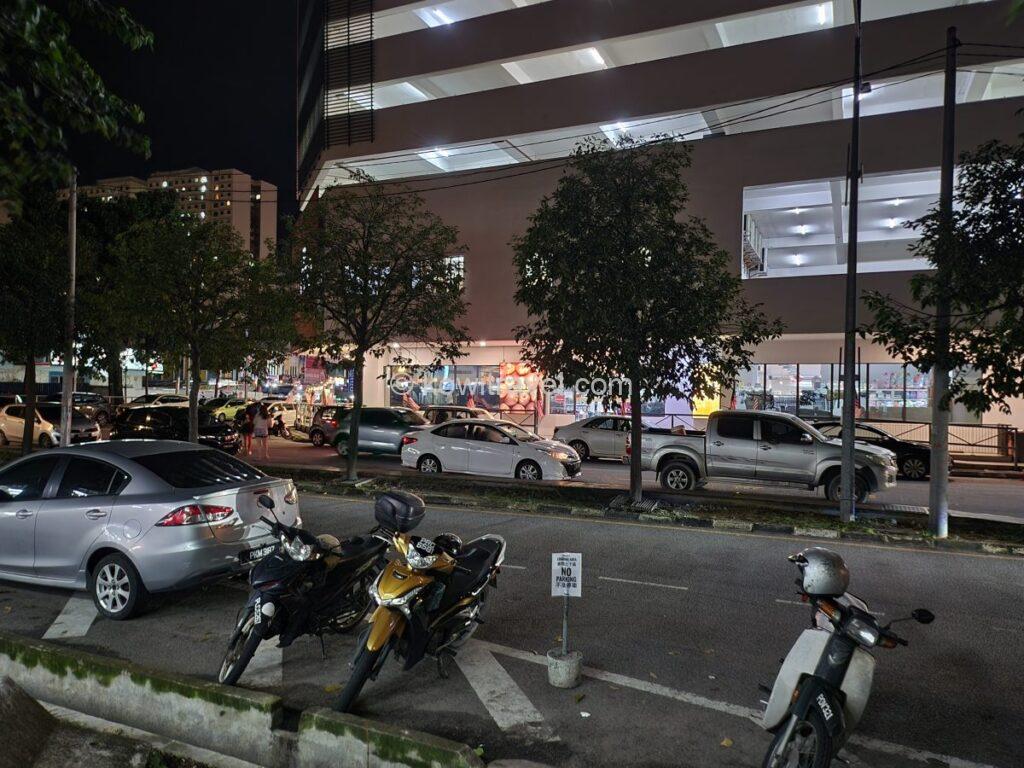
Exterior view of the underground Sunshine Supermarket brightly lit up at night.
5. Wrapping Up – A Sneak Peek at Our Next Journey
After surviving nights of intense culture shock brought on by the roaring red tents of the Hungry Ghost Festival, and finding sweet, crispy comfort in the Friday night market and Kimberley Street eats, Jelutong’s multifaceted nightlife became a priceless experience that let us feel the deeper layers of Penang firsthand.
There is likely no other city in the world where noise and gastronomy, tradition and modernity coexist so seamlessly within such narrow alleyways.
Now, my wife and I are stepping away from our beloved local residential hub of Jelutong for a bit to embark on a full-fledged walking tour of Penang’s true beating heart—the UNESCO World Heritage city center of George Town, an entire city often described as a living museum!
In the upcoming Part 3 (#18), we will start at the historic coastal defense outpost of Fort Cornwallis and the Queen Victoria Memorial Clock Tower at George Town’s northern tip, pass through the opulent Pinang Peranakan Mansion, and walk step-by-step down Penang’s extraordinary Street of Harmony, where a Hindu temple, an Islamic mosque, and a Chinese clan house (Yap Kongsi) sit side-by-side just across the street from one another.
We will also dive deeply into the touching life story of Mr. Gregor, a remarkable German marionette artist we met by chance while wandering the old alleys of Armenian Street, and how he came to settle in Penang.
From the iconic street murals of Ernest Zacharevic—the artist who transformed Penang into a world-renowned art destination—to the hidden behind-the-scenes stories of local wall art tucked into every corner, we will be back with 100% firsthand facts and vivid travel logs.
Stay tuned for our third story as we dig into the real soul of George Town, where walking with knowledge turns old bricks into a grand narrative!
“As part of an affiliate marketing program, this post may earn a small commission at no extra cost to you if bookings are made through the links provided.”
Leave a Reply