#16. Cracking the Code on Living Infrastructure, Transport, and Local Market Foodies—Off to Penang, Where Continent Ends and East Meets West!
1. Introduction – From Guangzhou to Daily Life in Penang: Kicking Off a Month-Long Epic Journey
Our three-week epic journey through the massive, breathtaking nature of the Chinese continent and its hyper-modern megacities has finally come to an end.
Starting from the mystical canyons of Zhangjiajie, we shot over to the culinary paradise of Guangzhou on a high-speed train clocking 304 km/h.
Leaving behind our sweet 2-night layover rest there, we finally boarded a flight toward the genuine main stage of this trip: Malaysia.
👉 [Check Domestic Flight Status to Penang on Trip.com]
The hot, humid air that hit us the moment we stepped foot in Kuala Lumpur International Airport felt like a flare gun signaling the start of a brand-new adventure.
However, our ultimate destination was not the flashy capital city, but an island packed with a unique heritage where the long histories of East and West crash together like waves—‘Penang’.
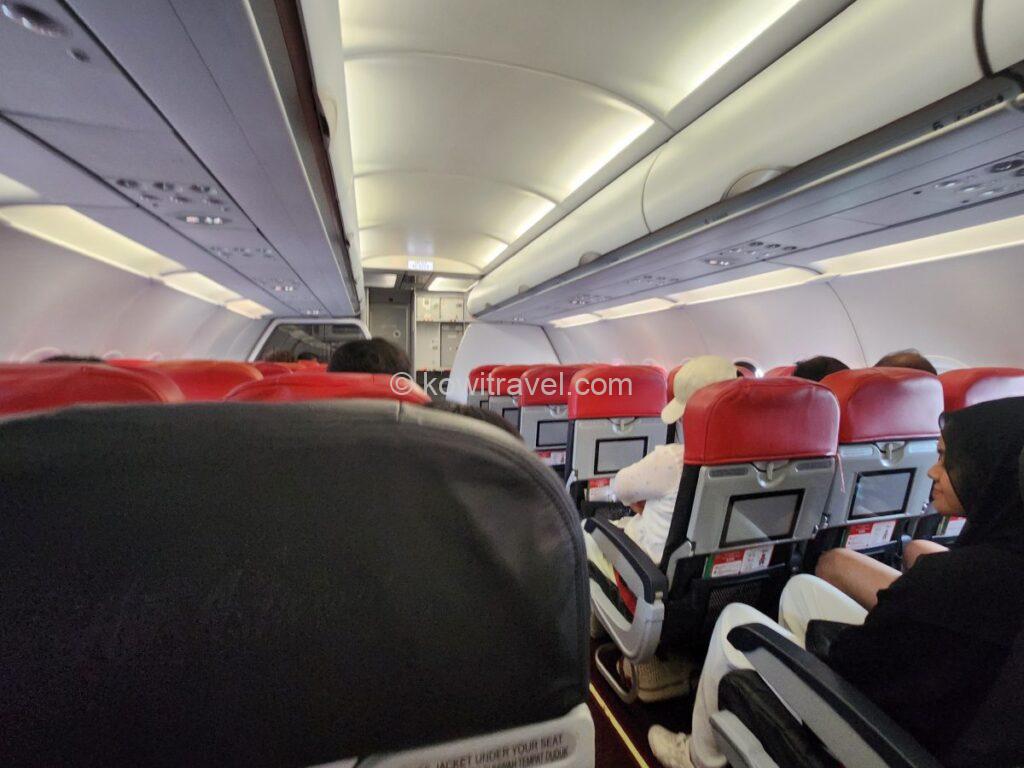
Inside view of an AirAsia flight heading from Kuala Lumpur to Penang for Penang 1-month stay.
Initially, I wanted to squeeze everything from our 5-week stay on Penang Island into just one or two posts.
However, the raw, real-life episodes we experienced while exploring every single alleyway on foot and mingling with locals—along with the sheer volume of useful, practical information I need to pass on to future travelers—was mind-blowingly massive.
Fearing that a superficial summary would wash away the value of these absolute gems of information, I have no choice but to split our Malaysia Penang 1-Month Stay journey into a 5-part series.
I hope this helps you map out the overall flow of our journey.
👉 [Preview of the 1-Month Immersive Penang Travel Series]
- Part 1 (Current Post): The behind-the-scenes strategy of picking our Jelutong accommodation, completely mastering the Touch ‘n Go (TNG) transit ecosystem, and an honest review of the local breakfast scene and dining habits at the Jelutong Morning Market.
- Part 2: The intense cultural shock, noise, and hygiene realities of the Hungry Ghost Festival that kept us awake all night, plus an energetic dive into the Jelutong Friday Night Market.
- Part 3: An in-depth exploration of the history and art of the UNESCO World Heritage site, George Town! Capturing the stories of the marionette puppet master on Armenian Street and touring the iconic murals of Ernest Zacharevic.
- Part 4: An all-out foodie run through the emotional culinary landscape of old town George Town, from classic Kaya Toast to legendary Dim Sum cart runs at Tai Tong (George Town Core Walking Route).
- Part 5: Diving into the stilt-house maritime clan society of Chew Jetty, late afternoon Dim Sum feasts, and spectacular coastal sunset views (Coastal & South-Eastern Route).
2. The First Gateway to Penang – Honest Reasons Why We Chose a Local Condo in Jelutong Over George Town
When independent travelers start planning a month-long stay in Penang, the very first dilemma they face is undeniably the “location of the accommodation.”
We also spent days meticulously searching through properties right in the middle of George Town—the most popular, historic heart of the island.
However, a granular analysis of actual reviews left by long-term stayers from all over the world quickly exposed some deal-breaking structural issues.
Because it is a protected historic zone, the complex, atmospheric core areas were plagued by non-stop noise from live bars and modified motorbikes late into the night, making a solid night’s sleep nearly impossible.
On top of that, behind their gorgeous, vintage facades lay decaying infrastructure—meaning poor water pressure and terrible cooling efficiency that just wouldn’t cut it for a long-term stay.
Consequently, the smart alternative my wife and I settled on after heavy deliberation was ‘Jelutong’, a genuine residential hub for local working professionals located just a stone’s throw south of George Town.
For the next month, our incredibly cozy home base was ‘Straits Garden Condominium A1’.
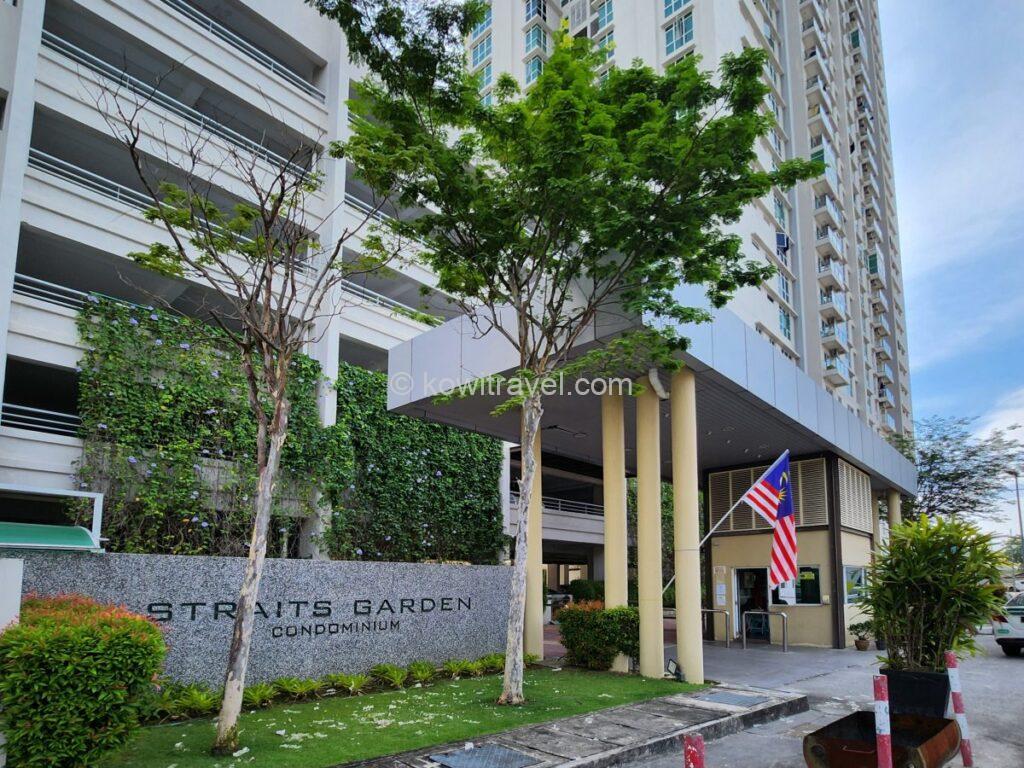
The main entrance gate and private security guard of Straits Garden Condominium in the Jelutong area, our home base for a one-month stay in Penang, Malaysia.
This condo packed so many outstanding advantages that I absolutely have to recommend it to any reader eyeing a long-term stay.
The interior came fully loaded with a spacious kitchen, a cozy dining table with chairs, a completely separated bedroom, and a comfortable sofa.
A washing machine was also neatly installed out on the private balcony, checking every single box for long-term living.
Furthermore, with 24-hour private security guards strictly stationed at the entrance controlling all incoming traffic, the building felt incredibly secure and safe.
On top of that, the condo featured a clean, modern gym for daily workouts.
Right outside the gym doors lay a spectacular outdoor swimming pool where you could do laps while taking in a panoramic view of the Penang skyline.
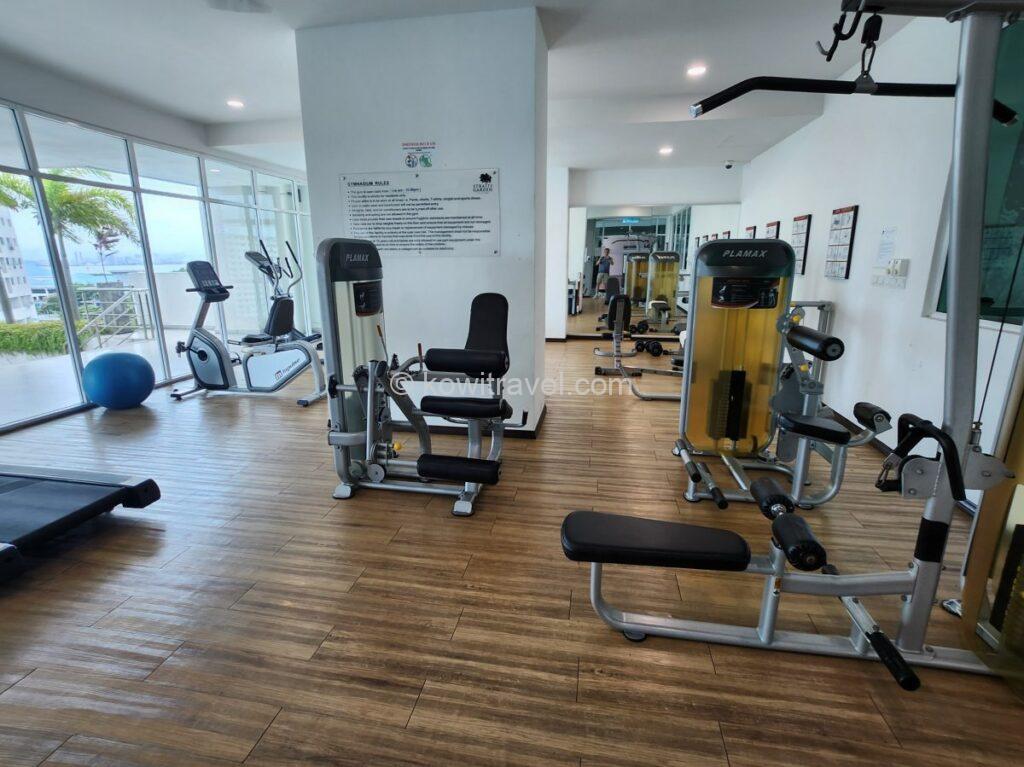
The spacious, clean, and comfortable resident-only fitness centre gym facilities inside Straits Garden Condominium during a one-month stay in Penang, Malaysia.
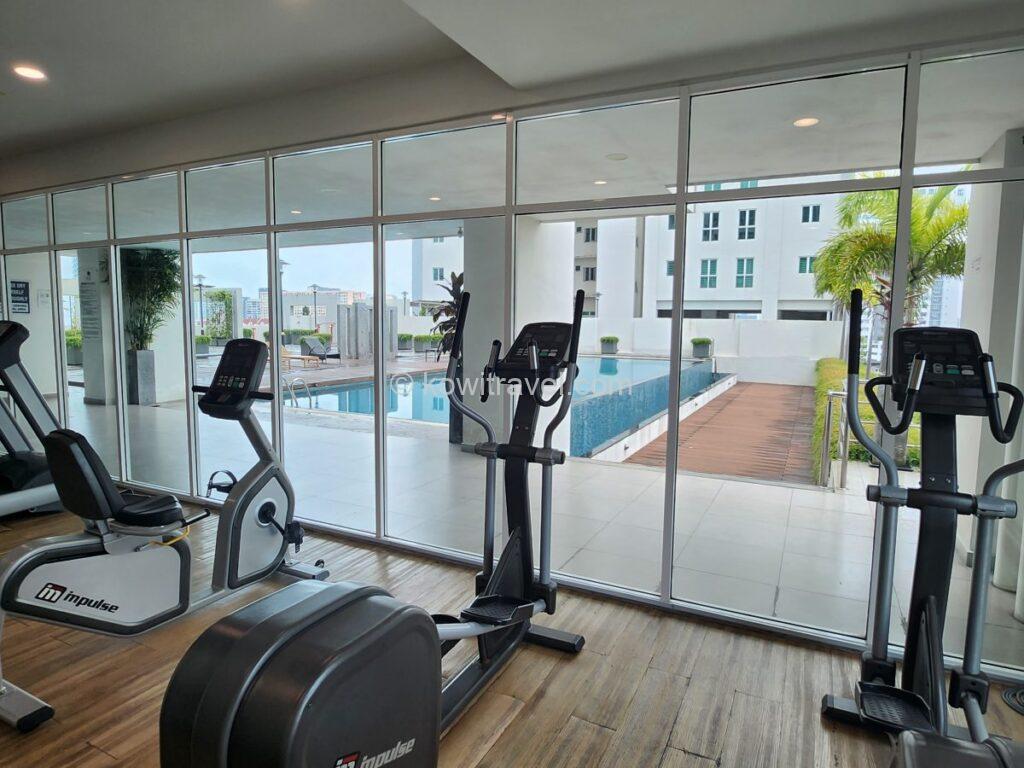
The superb structural flow connecting the gym to the outdoor pool right in front of it was the absolute crown jewel of this accommodation, helping us effortlessly maintain our healthy daily routine.
Every single morning, we would walk to the nearby wet market to harvest fresh ingredients for a healthy home-cooked meal, and then build up our physical endurance through swimming and weight sessions.
It truly was the ultimate high-value, wellness sanctuary for us in Penang.
Since Straits Garden operates as a residence-style condo where individual hosts manage their own units, the real-time pricing and interior designs vary a bit across different booking platforms.
I highly recommend cross-referencing recent guest reviews and tracking down the lowest prices on the two global platforms you trust the most.
*Disclaimer: This post contains affiliate links. If you book through them, I may earn a small commission at no extra cost to you.
👉 [Check Room Availability at Straits Garden Suites on Agoda.com]
👉 [Check Room Availability at Straits Garden Suites on Klook.com]
To sum it up, Jelutong sits squarely at the “strategic transport bottleneck” of Penang Island.
If you prioritize seamless airport runs, smooth access to long-distance interstate coaches (Aeroline), efficient Grab rides, and quick hops onto the Penang Bridge over the vintage aesthetic of George Town—while retreating to a pin-drop quiet, comfortable local condo at night—this is hands-down your best geographical choice.


The clean, modern, and welcoming entrance lobby area of Straits Garden Suites Building A1 (left) alongside a fantastic high-floor panoramic ocean view captured from inside the room (right).
My wife and I have lived by a strict golden rule throughout our years of long-term international travel: any accommodation where we stay for more than three nights must have a proper kitchen and cooking facilities.
No matter how mind-blowing the local cuisine is, eating out for every single meal inevitably triggers nutritional imbalances, packs on hidden sodium, and puts a heavy, unnecessary dent in your travel wallet.
Maintaining the clean, healthy eating routine we practice at home is our ultimate secret weapon for travel endurance.
To help you visualize, here is a clear, head-to-head comparison of a George Town core stay versus a local Jelutong condo stay from the perspective of an independent, walking traveler.
👌 Comprehensive Infrastructure Comparison from a Walking Traveler’s Perspective
| Comparison Metrics | George Town Core Accommodations (Traditional Heritage) | Jelutong Local Condos (Reflecting Actual Experience) |
| Geographical Strategy | Optimized for Sightseeing: Old town vibes, major historical landmarks, and trendy cafes are right outside, favoring short-term tourists. | Mid-Point Corridor Hub: Acts as a brilliant central nexus connecting the historic old city with the southern hubs (Airport, Queensbay coach terminals). |
| Public Transit (Bus) Grid | Frequent Delays: Plenty of bus routes exist, but they constantly crawl through narrow, suffocating one-way grids and horrific city traffic jams. | Walk-and-Ride Optimized: Excellent direct bus stops sit right outside the condo gates, shooting you straight into the George Town core in about 20 minutes. |
| Pedestrian Infrastructure | Hostile Walking: Pedestrian paths (Walkways) are incredibly narrow, uneven, and blocked, making walking brutal under the intense midday tropical heat. | Locally Integrated: A complete ecosystem of giant supermarkets, fresh morning wet markets, and massive local hawker food courts sits within easy walking distance. |
| Long-Term Living Value | Premium Rates for Small Spaces: Location premiums mean tiny, restricted square footage. Staying long-term creates heavy financial friction with low discount rates. | High Long-Term Efficiency: Generous apartment layouts featuring integrated full kitchens and washing machines, dramatically slashing daily living costs. |
| Building Mechanics | Decaying Infrastructure: Dominated by properties that are decades or a century old, introducing frequent water pressure drops and potential sewage backups. | Modern High-Rise Standard: Built around a modern, tightly sealed concrete framework ensuring powerful water pressure and flawless central air conditioning. |
| Acoustic Integrity | Acoustically Vulnerable: Vintage wooden structural designs cause heavy vertical and wall-to-wall noise leaks. Street-level modified scooter noise hits units directly. | Rock-Solid Acoustic Seals: Heavy concrete wall buffers and double-glazed modern framing completely isolate you from street noise and neighborly hums. |
| Tropical Climate & Pests | High Pest Exposure: Low-rise historic layouts and micro-cracks in timber framing create easy entry points for tropical mosquitoes, ants, and roaches. | High-Floor Pest Fortress: Fully airtight windows and doors on high-floor units mean zero stress from tropical insects or mosquitoes. |
| Amenities & Logistics | Restricted Facilities: Swimming pools and fitness centers are non-existent or incredibly tight. Zero street parking adds extreme navigation anxiety if renting cars. | Resort-Style Living: Access to a giant outdoor lap pool, fully equipped modern gym, and free, secure multi-story indoor parking structures. |
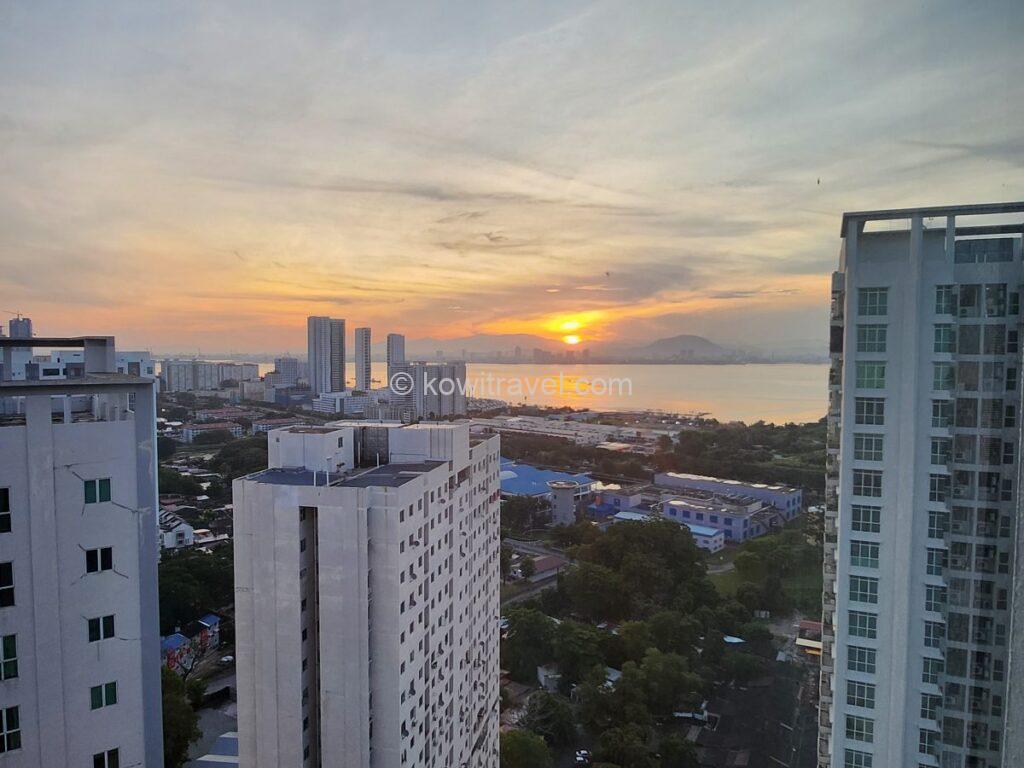
A breathtaking high-floor panoramic ocean view looking over the wide Penang cityscape and deep blue sea through a tightly sealed modern window frame.
3. Public Transport That Became Our Wings – Ultimate Guide to Buying and Instantly Mobile-Charging a Touch ‘n Go Card
The absolute MVP that allowed us to treat the flashy, historic streets of George Town like our own front yard while living out in Jelutong was Penang’s spectacular municipal bus network: ‘Rapid Penang’.
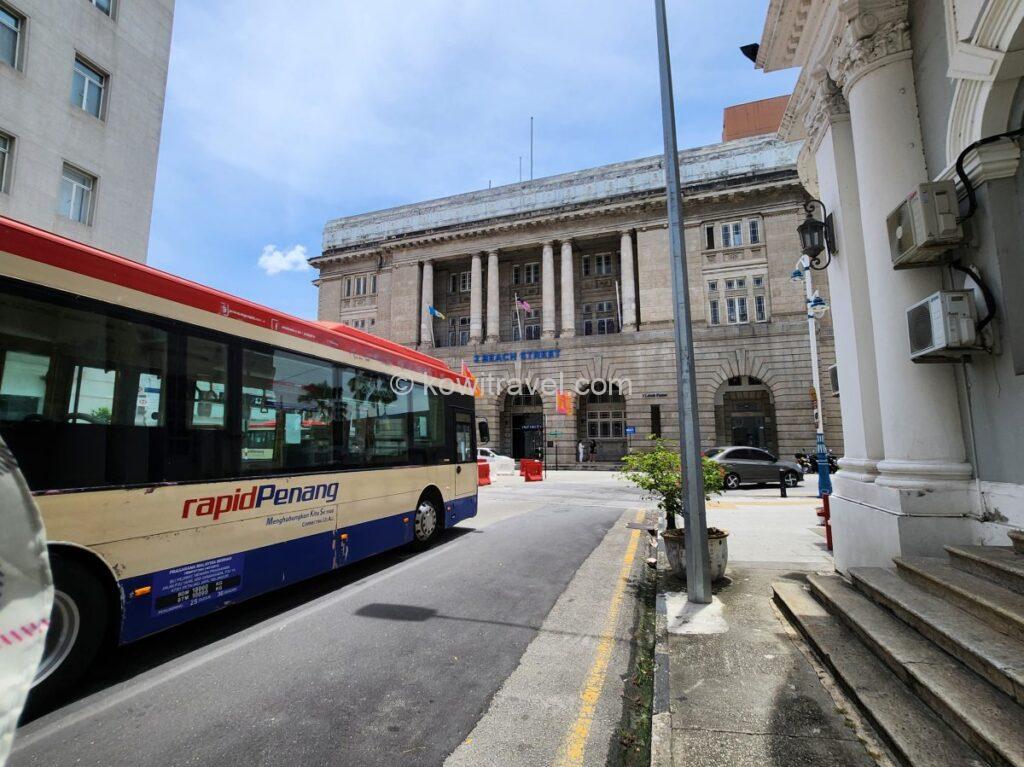
The crisp, clean, and sharp exterior of a bright Rapid Penang public bus smoothly passing in front of a majestic, vintage European-style heritage building in George Town where history and modern transit intersect.
The major friction of constantly scrambling for exact physical coins every single time we boarded a bus was instantly wiped away by Malaysia’s ultimate transit card and e-wallet: ‘Touch ‘n Go (TNG)’.
👌 Real-World Fact Check for Maximizing Your Touch ‘n Go Card!
- The Ultimate Easy Purchase Location: There was absolutely no need to travel to a major transit terminal. We simply walked down to the Seven-Eleven convenience store sitting right on the ground floor of our condo building and picked up a blank card effortlessly. A standalone card generally runs between 10 to 15 Ringgit (approx. 2.25 USD to 3.37 USD).
- Instant Smartphone NFC Top-Ups: In the past, adding funds (Top-up) required lining up at convenience store registers to hand over physical cash. However, if you secure an ‘Enhanced TNG Card’—identifiable by the clear NFC logo on the back—a whole new digital world opens up. You simply turn on your smartphone’s NFC feature, open the Touch ‘n Go eWallet app, and firmly press the physical card against the back of your phone for just 5 seconds. Funds are instantly transferred from your digital app wallet directly onto the physical card chip with absolute zero service fees. You can track balances and load fares right from your living room sofa in under 10 seconds flat, completely eliminating any boarding anxiety.
👉 [Download the Official Touch ‘n Go eWallet App Here]
※ Insider Tip: Even if you don’t have the physical card yet, downloading the app and completing the registration while you’re still at home allows you to purchase the card the second you touch down in Penang and load fares via NFC within 10 seconds flat.
👌Rapid Penang Bus Fare Structure by Distance
Penang’s public bus system runs on a highly logical, distance-proportionate fare model that keeps commutes incredibly economical:
• Within 7 km (Our Standard Commute Zone): 1.40 Ringgit (Approx. $0.30 USD)
• 7.01 km to 14 km: 2.00 Ringgit (Approx. $0.45 USD)
• 14.01 km to 21 km: 2.70 Ringgit (Approx. $0.60 USD)
Because the commute from our Jelutong home base to the dead-center core of George Town fell entirely within the sub-7km base tier, we zipped back and forth across the island for a mind-bogglingly cheap one-way fare of just $0.30 USD.
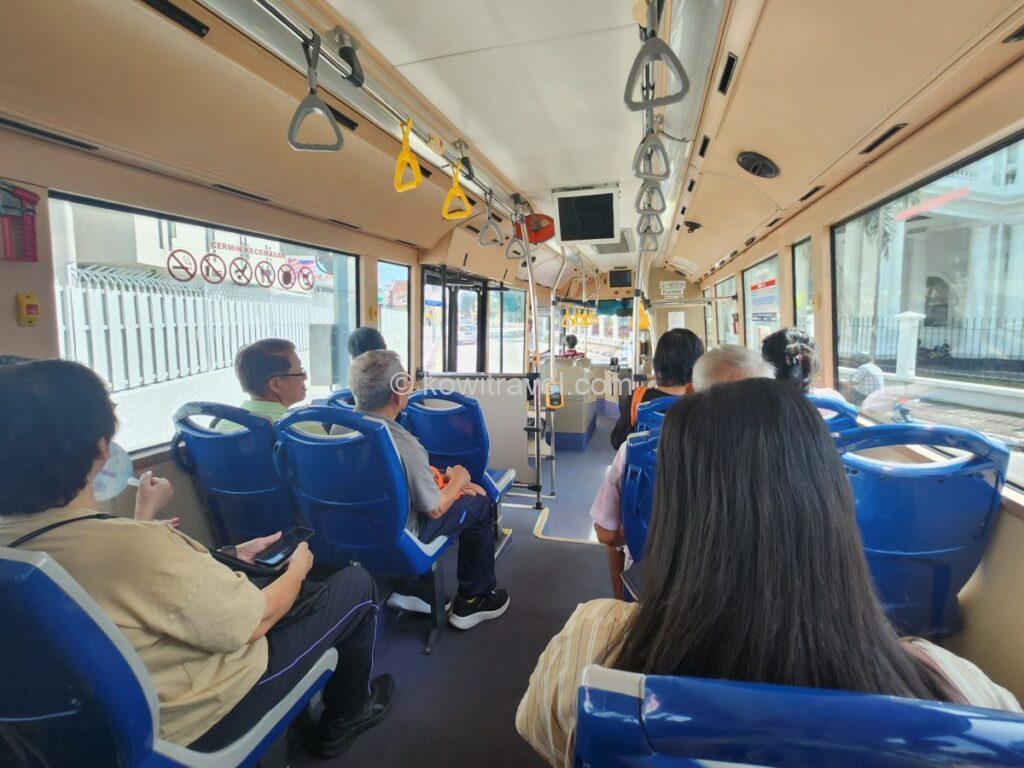
The refreshing, crisp blue-toned interior view of a highly comfortable, perfectly air-conditioned Rapid Penang municipal bus packed with modern commuter seating.
⚠️ The Golden Rule for Boarding Fares
While tapping your card on the scanner upon entering the front door (Tag-on) is basic common sense, you must absolutely tap your card on the reader once more at the exit door when stepping off (Tag-off).
If you fail to tag off, the system automatically logs your journey as if you stayed on until the absolute final terminal of the bus line and forces a deduction of the maximum possible route fare from your card balance. Never forget to tag off!
On top of that, an unexpected and massive source of joy while navigating Penang’s transit grid was occasionally crossing paths with the magnificent ‘Double-Decker Public Buses’.
Whenever luck was on our side and a double-decker bus pulled up, we bolted straight up to the second floor without a second thought to lock down the absolute front-row seats.
Because the entire front face of the upper deck is a massive, unobstructed sheet of panoramic glass, you get a front-row ticket to cruise past Penang’s exotic roadside trees and local historic alleyways.
It feels exactly like riding an expensive open-top hop-on-hop-off city tour bus, except it only costs you a flat $0.30 USD fare. It is, hands-down, the best secret VIP seat on the island.
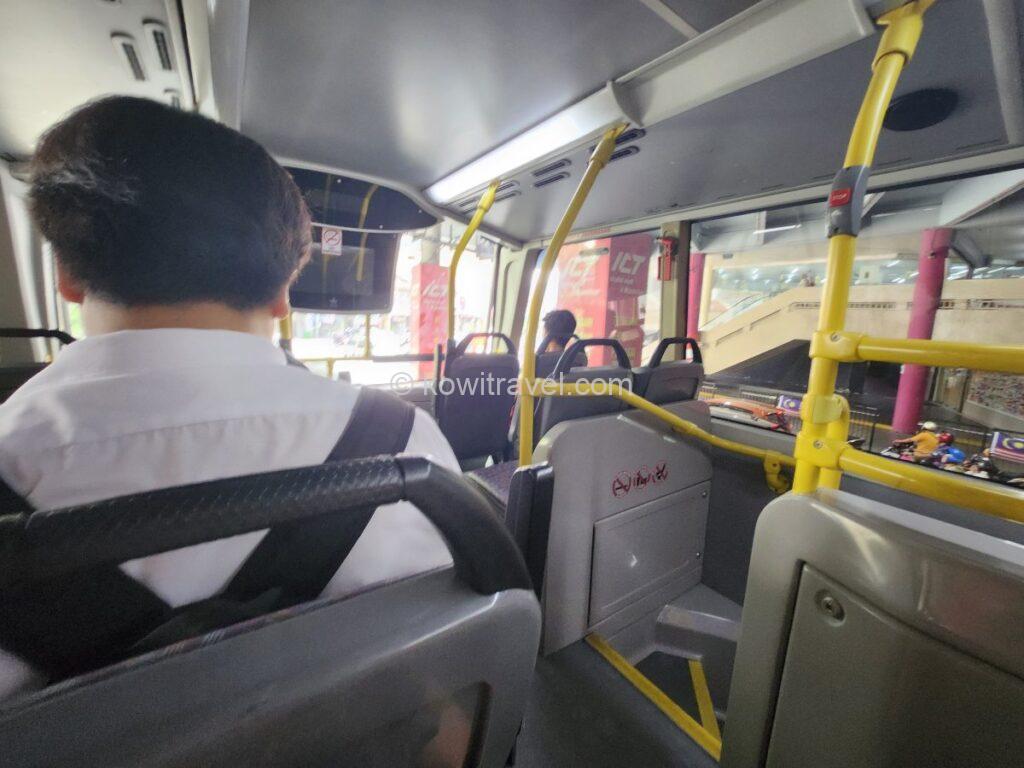
Pure 0.30 USD happiness! A stunning front-row view captured through the wide, crystal-clear panoramic window from the upper deck of a Rapid Penang double-decker bus as it glides through the exotic streets.
If you are embarking on a walking-based one-month stay, you must absolutely experience the thrilling, open-air perspective of this double-decker front-row seat at least once.
4. Eating Out for All Three Meals? – Behind the Scenes of the Jelutong Morning Market and Its Unique Dining Culture
4.1) Jelutong Morning Market
To source the absolute anchors of our daily nutritional routine—crisp, ultra-cheap greens and rich tropical fruits—we skipped the clinical supermarket chains and headed straight into the buzzing local energy of the ‘Jelutong Morning Market’ (also widely known on maps as Jelutong Street Market or Jelutong Wet Market).
On Google Maps, it sits roughly 14 minutes away on foot (approx. 1 km) from our condo building. While it isn’t a stone’s throw away, it is a perfectly flat, highly walkable distance. It serves as an ideal morning stroll to jump-start your metabolism after waking up.
👉 [View the Exact Location of Jelutong Morning Market on Google Maps]
Here is a quick snapshot of the essential details:
● Exact Street Address:
94, Lrg Batu, Taman Jelutong, 11600 George Town, Pulau Pinang, Malaysia
● Operating Hours:
Daily from 5:30 AM to around 11:00 AM. It functions as a hyper-vibrant raw ingredient wet market at dawn and seamlessly doubles as an essential breakfast hub (Kopitiams) for local residents.
● Key Characteristics:
A quintessential traditional open-air wet market trading in fresh agricultural produce, premium meats, and local fruits.
Along the neighboring arteries like Ipoh Lane, endless rows of hawker stalls light up their burners to serve dirt-cheap, highly authentic Penang breakfasts like Hokkien Mee and Curry Mee.
This market, which wraps tightly around Jalan Penaga (Penaga Road) every single morning, doesn’t actually carry one singular, officially mandated administrative name.
Government entities technically label it the Jelutong Public Market or Jelutong Wet Market, but Google Maps and local tongues organically call it the Jelutong Street Market or Jelutong Morning Market.
However, the real magnetic pull for travelers lies in the Morning Hawker Stalls that sprawl across the connecting pathways like Ipoh Lane.
The area is packed with traditional open-air Kopitiams serving fiery bowls of Hokkien Mee and aromatic Curry Mee.
For just a few Ringgit, you can push your way into a table among the locals and unlock a top-tier, highly cost-effective authentic breakfast experience.
Arriving early at Jalan Penaga, the entire street was already pulsating with pure raw energy.
It was a beautiful, deeply local slice of life where neighborhood residents drifted out in their slippers, sharing light morning greetings while picking out produce.
Even under a light drizzle, the roaring voices of vendors and the dynamic momentum of the crowds infused the entire market space with a distinct vitality.


A lively view of the Jelutong Morning Market under a light morning drizzle, showing local residents carrying umbrellas and navigating the crowded rows of fresh produce stalls at dawn.
Living up to its classic wet market reputation, the stalls were packed with towering displays of high-sugar, perfectly ripe apples, pears, and kiwis alongside local tropical greens.
There is a distinct, poetic romance in buying fresh, affordable food straight from an elderly vendor with a gentle smile, sitting right in front of a historic red-brick building backdrop—a pure joy unique to these dawn markets.
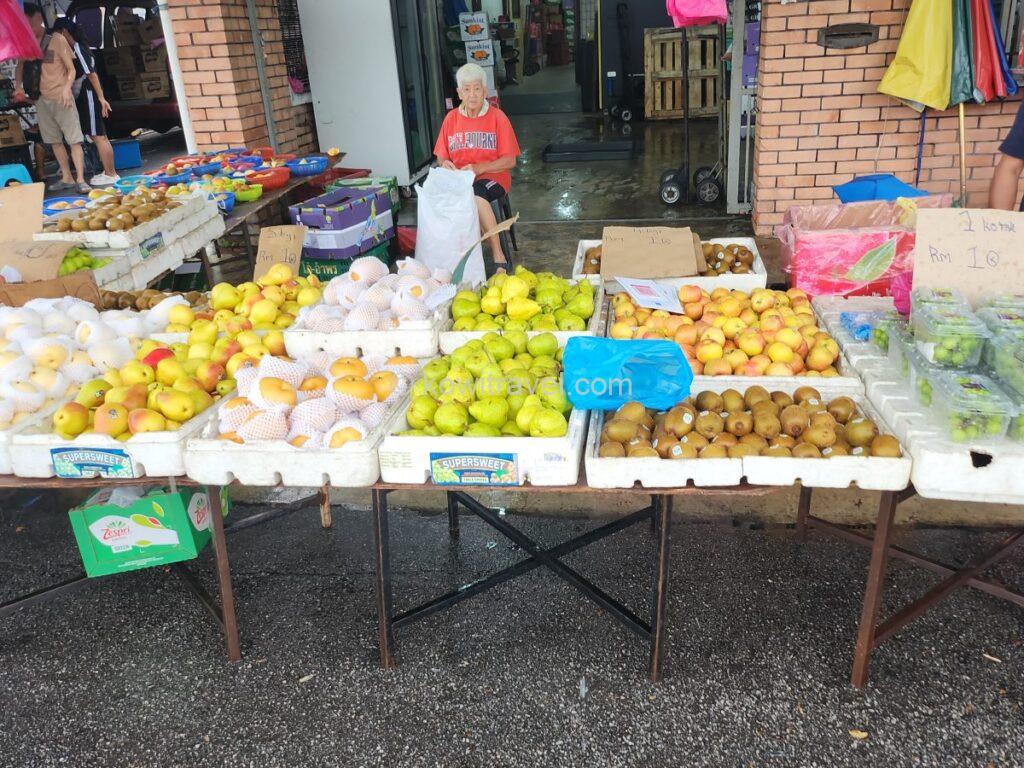
A warm, authentic market stall packed with vibrant displays of fresh fruit, featuring an elderly local vendor with a kind, gentle expression welcoming morning shoppers.
After an extensive exploratory loop around the market stalls, we guided our steps into an adjacent indoor Kopitiam (a traditional local open-air food hall).
Pushing our way through families crowded around round marble tables to secure a couple of stools, we quickly blended into the environment.
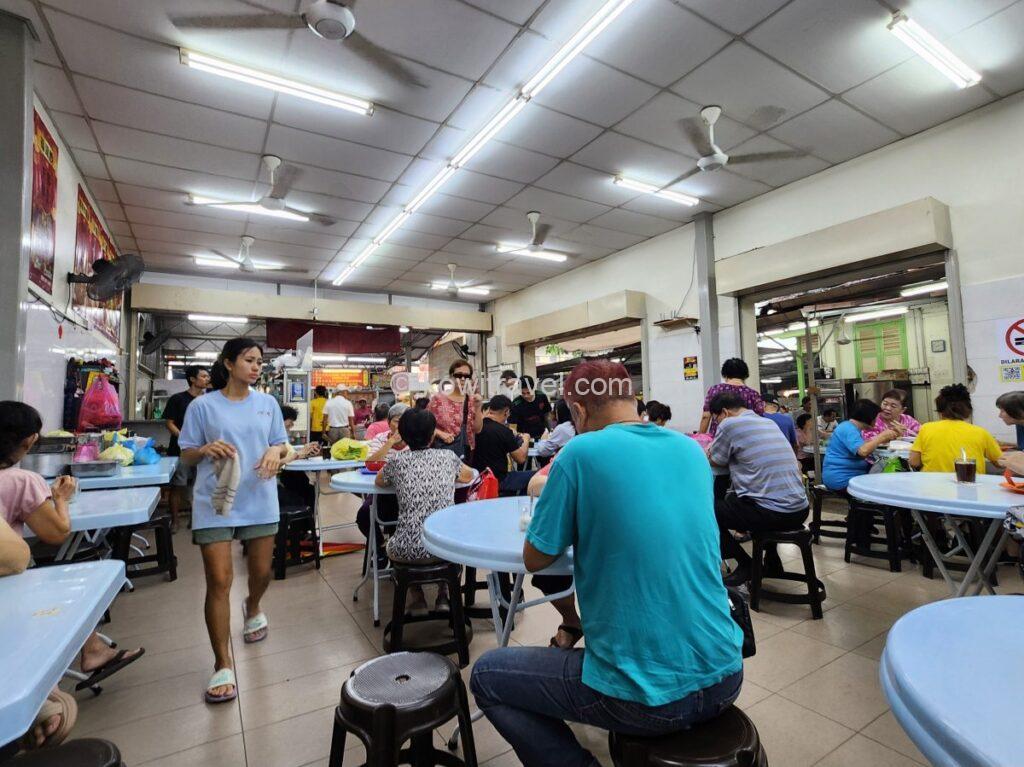
The crowded, buzzing interior of a traditional local Kopitiam food hall under spinning ceiling fans, where multi-generational local families gather at tables to eat breakfast.
Inside these local food halls, you aren’t limited to standard traditional Malaysian fare; you can easily lock down a highly substantial Western-style morning platter loaded with perfectly seared butter toast, crispy bacon, savory baked beans, and two flawlessly executed sunny-side-up eggs with liquid yolks.

A golden, crispy Western-style breakfast platter served inside a local Kopitiam, showcasing hot buttered toast, two soft sunny-side-up eggs, savory bacon, and a side of baked beans.
With the symphonic roar of the busy market serving as our background music, we fully absorbed the true flavors and atmosphere of local living alongside the residents.
These alleyways, packed from the crack of dawn with roaring vendors and lines of local shoppers, felt exactly like a living, breathing documentary—the precise, raw slice of authentic human life we hunt for in every destination we visit.
4.2) Returning at Dusk: The Stunning Nighttime Transformation of Jalan Penaga
While the dawn market vendors along Jalan Penaga pack up their stalls and vanish completely by noon, the exact same street pulls off a mind-boggling trick once the clock strikes 4:00 or 5:00 PM.
An entirely different fleet of Night Hawker Stalls rolls in one by one to stake their claims.
Returning to the exact same street for a casual evening walk, we were welcomed by a completely different world painted in brilliant neon lights.
The same Jalan Penaga street that turns empty and whisper-quiet after 11:00 AM explodes back to life as a spectacular, neon-lit late-night street food paradise the moment the sun dips past 5:00 PM.
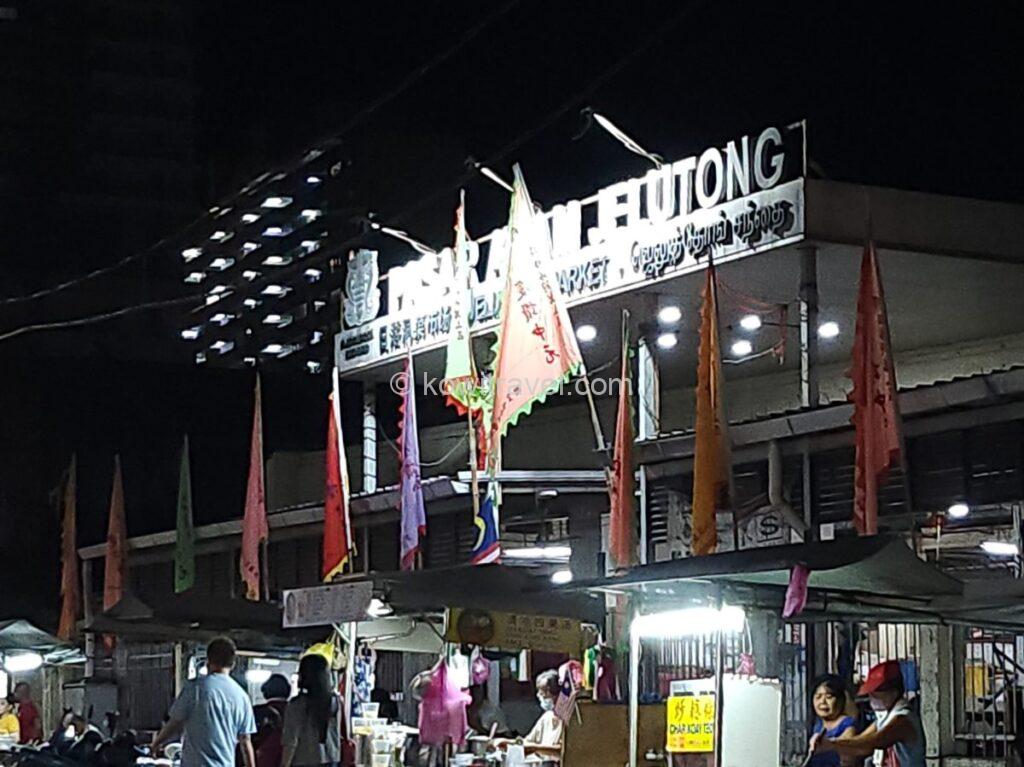
The massive, brightly illuminated evening signage of ‘PASAR MALAM JELUTONG’ glowing sharply against the dark night sky, signaling the start of the night market.
A massive, blazing electronic sign cuts through the dark, alerting the neighborhood that the night market has officially begun.
The humble, quiet morning alleyway pulls off a complete chameleonic shift by night, morphing into a theatrical street-food arena thick with aromatic smoke, blazing open fires, and the irresistible scents of roasting meats.
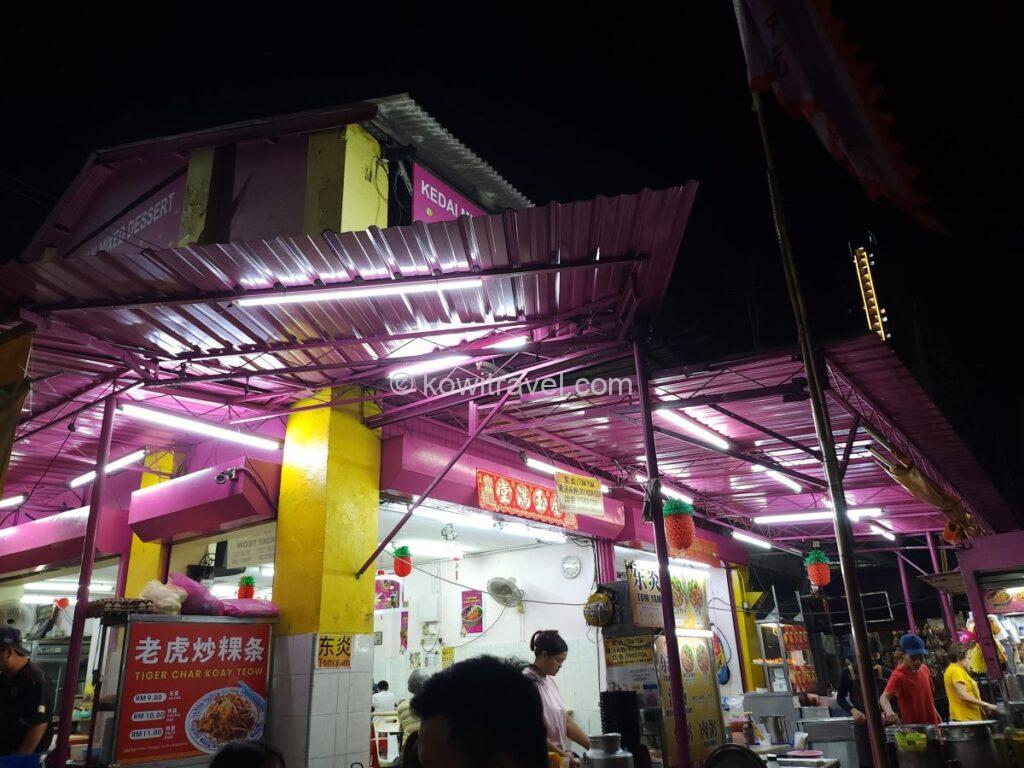
A massive, brightly lit indoor hawker food center packed with local diners enjoying late-night street food plates under glowing bulbs.
Among the endless options, a massive indoor hawker center packed to the brim with local foodies instantly caught our attention. Standing proudly at the entrance was a giant signboard for Penang’s legendary culinary icon: ‘Tiger Char Koay Teow ‘, radiating a powerful aura of a true time-tested local institution.
From the surrounding vendors, we tracked down and ordered a highly substantial, incredibly comforting local Chicken Rice plate.
The dish features a freshly fried chicken cutlet with a shattering, ultra-crisp exterior and a deeply juicy core, paired with a perfectly lacquered fried egg and sides of pickled cabbage and okra (lady’s finger)—a vegetable deeply adored by local Malaysians.
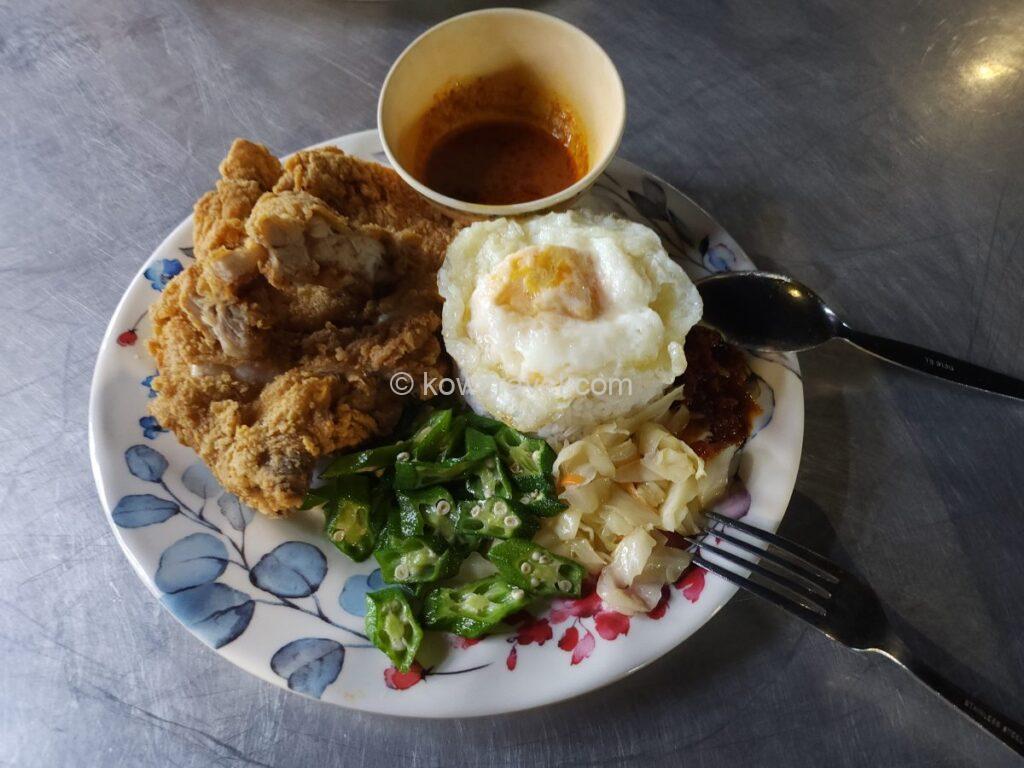
A comforting local evening plate of crispy fried chicken cutlet rice paired with a fried egg, okra, and a rich ladle of thick, aromatic Malaysian curry sauce.
When you mix this crisp chicken and hot rice with a generous ladle of their intensely spicy, deeply aromatic local curry sauce, the built-up fatigue of a long day of walking instantly melts away with the heat of the spice.
It is, without a doubt, the ultimate late-night comfort food plate.
Day or night, the twin markets of Jelutong stand ready to deliver the pure, beating pulse of authentic Penang flavor and life. If you find yourself staying in Penang, make sure you save these exact locations on your map and dive headfirst into the true local rhythm.
Observing this hyper-vibrant dining habit got me thinking deeply about a highly fascinating cultural thread that seamlessly connects Zhangjiajie, Guangzhou, and now Malaysia. Why do these populations flock to the streets from the crack of dawn to buy their meals while keeping their domestic kitchens largely cold?
4.3) The Structural Secret Behind Southeast Asia and Southern China’s Eating-Out Culture
This highly distinct lifestyle, woven tightly over centuries of history, is driven by three incredibly practical and logical realities:
- The Inverted Math of Food Capital
The raw operational efficiency and scale of local hawker centers and Kopitiams mean that a hot, highly complex local meal is priced significantly cheaper than buying individual raw ingredients at the market and burning your own domestic cooking gas. In this economic environment, cooking for yourself is mathematically a financial loss. - The Tropical Climate Filter
Cooking over open fires inside a residential home amidst the naturally blistering, humid baseline temperatures of Southeast Asia and Southern China turns living spaces into trapped heat boxes. Outsourcing the massive heat generation to street-level burners is sheer common sense. - Architectural Limitations
Historically, traditional heritage shophouses and even a vast majority of modern high-rise condos across Asia are structured without heavy-duty, industrial-grade external ventilation hood ducts or heavy cooking stations. The underlying residential infrastructure is built around the fundamental assumption that high-heat, highly aromatic frying belongs entirely outdoors—cementing a beautifully social, deeply communal, and vibrant street-food culture.
5. Closing Thoughts – A Preview of Our Next Adventure
Our very first week in Penang was a spectacular lesson in urban adaptation—settling smoothly into the deeply authentic residential pocket of Jelutong, unlocking the dirt-cheap efficiency of the Rapid Penang bus grid, and riding the raw waves of energy inside the dawn wet markets.
Loading transit card balances right from our apartment sofa in under 10 seconds and zipping back and forth into George Town for a flat 0.30 USD fare made our Penang daily life feel staggeringly seamless. Yet, long-term travel isn’t always built on smooth, frictionless comfort.
In our upcoming Part 2 (#17), we are pulling back the curtain on the single greatest test of our patience during our peaceful Jelutong stay—an earth-shattering event that rattled our condo window frames all night long. Get ready for an unfiltered, raw dive into the intense cultural shock, noise levels, and unique administrative background of the Hungry Ghost Festival.
On top of that, we will take you on a sensory run through the dazzling night stalls of the Jelutong Friday Night Market and the legendary Kimberley Street Food Night Market in Little India, packed with live video records of mouth-watering hawker delicacies. The next chapter of our deep Penang chronicle is coming fast!
👉 [Click Here to Read Previous Post:#15. The Ultimate Guangzhou Layover Guide]
“*Disclaimer: This post contains affiliate links. If you book through them, I may earn a small commission at no extra cost to you.
Leave a Reply