#18. An In-Depth Walking Tour of UNESCO World Heritage George Town – From the Street of Harmony to Ernest Zacharevic’s Iconic Murals and a Master Marionette Artist
The true charm of spending a month living in Penang lies in exploring centuries of history embedded in every alleyway at your own unhurried pace.
In this third installment of our Penang series, we share a seamless, step-by-step walking tour route through the beating heart of George Town, a designated UNESCO World Heritage Site.
Starting from a British Empire coastal fortress, our route winds past an opulent mansion blending Eastern and Western aesthetics, continues down a historic street where four faiths coexist, and leads straight into the vibrant art scene of Armenian Street.
At the very end of the walk awaits a heartwarming encounter with one of George Town’s hidden gems—a master marionette street artist.
Let’s now head into the heart of George Town walking tour in George Town, Penang, and experience it firsthand.
📌 TL;DR (Quick Summary)
- The Route: A relaxed full-day walking tour of UNESCO-listed George Town—from Fort Cornwallis and Pinang Peranakan Mansion to the Street of Harmony and Armenian Street’s famous 3D murals.
- Best Moment: Watching German master puppeteer Mr. Gregor busk live with his violin-playing marionette on Armenian Street.
- Practical Tip: Catch the Rapid Penang bus from Jelutong for 1.40 MYR(0.30 USD), or hire a Trishaw (40–50 MYR/hr;$9.79-$12.24 USD) to beat the afternoon heat.
1. Introduction – Stepping Into the Living Museum of George Town’s Old Alleys
Having settled comfortably into local life in Jelutong—complete with its modern condo conveniences and vibrant day-and-night market food scene—my wife and I finally set out to explore the true soul of Penang: George Town.
👉 Click here for more information on the official Penang tourism portal!
Hopping onto a Rapid Penang bus right outside our condo for just 1.40 MYR (approx. $0.30 USD) and watching the scenery roll past the window, the cluster of modern high-rises gradually gives way to a living time capsule lined with 18th-century British East India Company colonial buildings and ornate Chinese shophouses.
Designated in its entirety as a UNESCO World Heritage Site, George Town is far more than just a backdrop for snapping quick photos in front of cute murals.
It is a living, breathing museum where Western imperial history, the pioneering spirit of Chinese immigrants, and the deep devotion of Indian settlers miraculously coexist within the same narrow lanes.
When you walk with knowledge, old bricks transform into a grand narrative; without it, they remain merely weathered buildings.
Let’s trace the real, unfiltered heart of George Town step by step, starting from the northern waterfront and working our way deep into its historic alleys.
👣 George Town Walking Tour at a Glance (Relaxed Full-Day Route)
- Stop 1 (Northern Waterfront): Fort Cornwallis → Esplanade Promenade & Penang City Hall → Queen Victoria Memorial Clock Tower
- Stop 2 (Colonial & Peranakan Heritage): Central Fire Station (1908) → Pinang Peranakan Mansion
- Stop 3 (Street of Harmony): Church of the Assumption → Kapitan Keling Mosque → Yap Kongsi → Sri Mahamariamman Temple
- Stop 4 (Street Art & Local Soul): Stewart Lane & Armenian Street Murals → Trishaw Ride & Live Marionette Busking
2. Where George Town Begins – Northern Waterfront Landmarks and Opulent Peranakan Heritage
The most natural and scenic starting point for a George Town walking tour is the line of historic landmarks stretching along its northeastern shoreline.
With a refreshing sea breeze at our backs, we open the very first chapter of Penang’s modern history.
2.1) The Birthplace of Modern Penang: Fort Cornwallis
Arriving at the northeastern tip of George Town, travelers are welcomed beneath the shade of lush tropical trees by a traditional wooden-roofed gate bearing the sign “Fort Cornwallis (Since 1786).”
Built after Captain Francis Light of the British East India Company first set foot on Penang in 1786 to defend the island against foreign invasion, this is the largest standing fort in Malaysia.
Originally constructed as a timber stockade, it was later rebuilt with sturdy red brick ramparts.
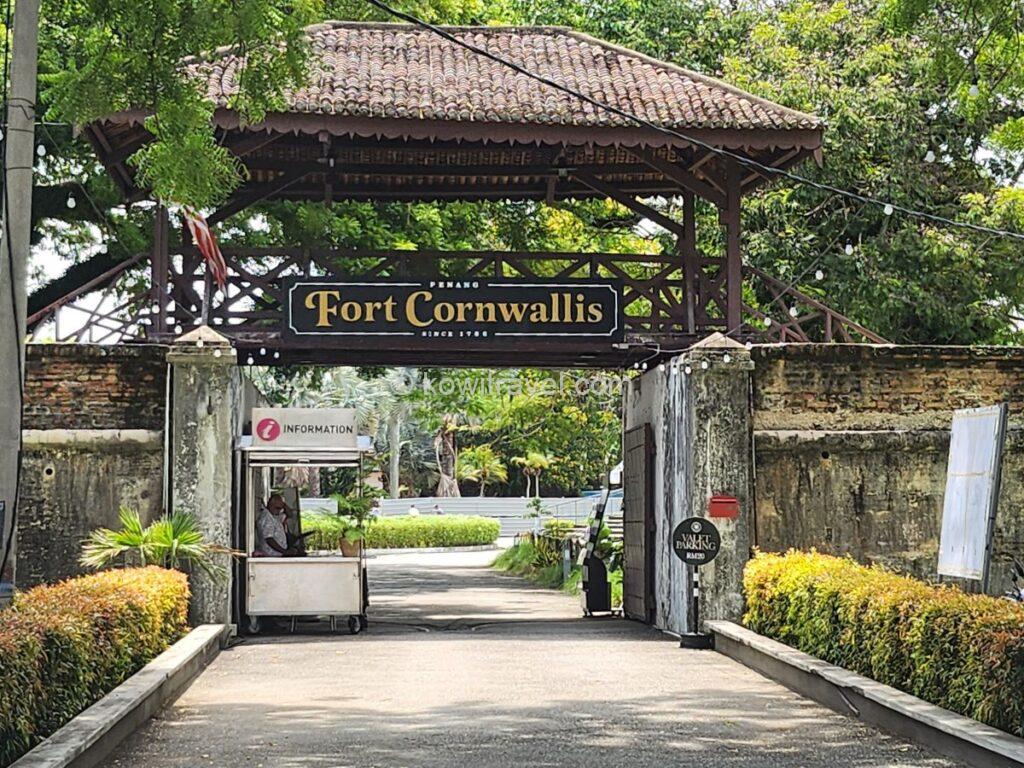
The main gate of Fort Cornwallis nestled beneath towering tropical trees—the entrance to Malaysia’s largest standing fortress, founded by the British East India Company in 1786.
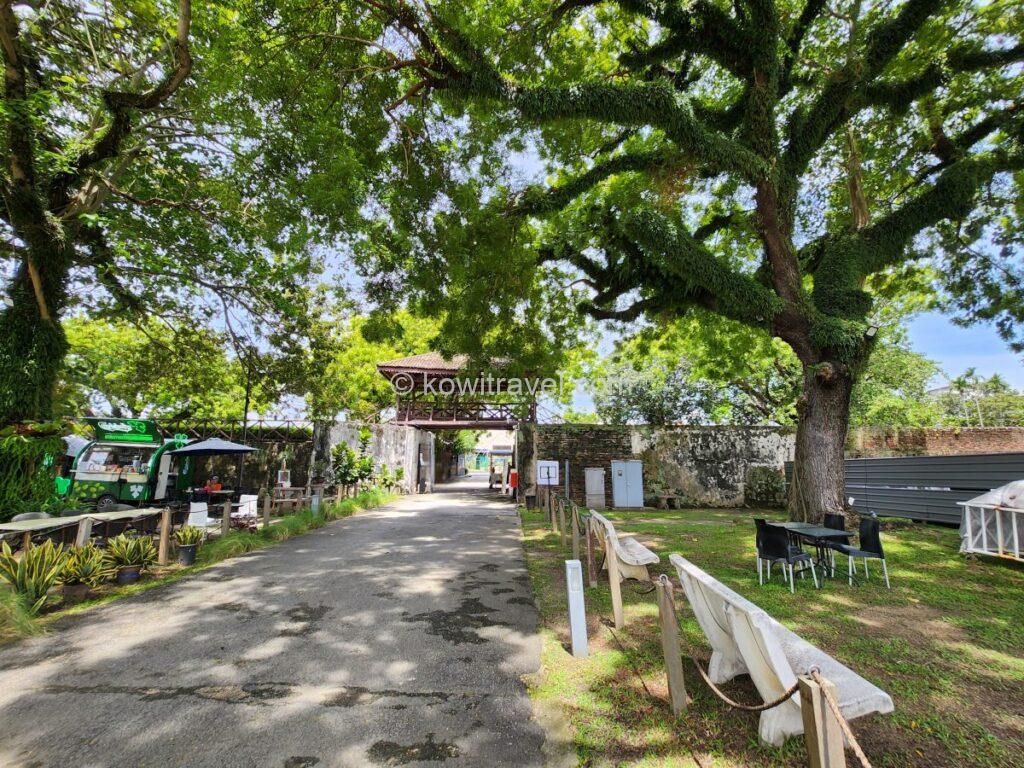
The fortress’s antique wooden, tiled-roof main gate and an entrance path shaded by lush trees
Stepping inside the gate, moss-covered red brick walls stretch majestically across a wide green lawn.
Although restoration work restricted access to parts of the eastern section during our visit, following the site map along the open rampart walkways and core monuments gave us a vivid sense of the fort’s coastal defense strategy.


Red brick ramparts and a grassy plaza inside the fortress entrance (left), and a map of the fortress (right)
Walking along the ramparts, we came across a stout, barrel-vaulted stone structure: the old Gunpowder Magazine.
Engineered with thick brick and concrete walls to protect ammunition from tropical humidity and accidental sparks, this heavy arched building preserves the tense atmosphere of colonial warfare.
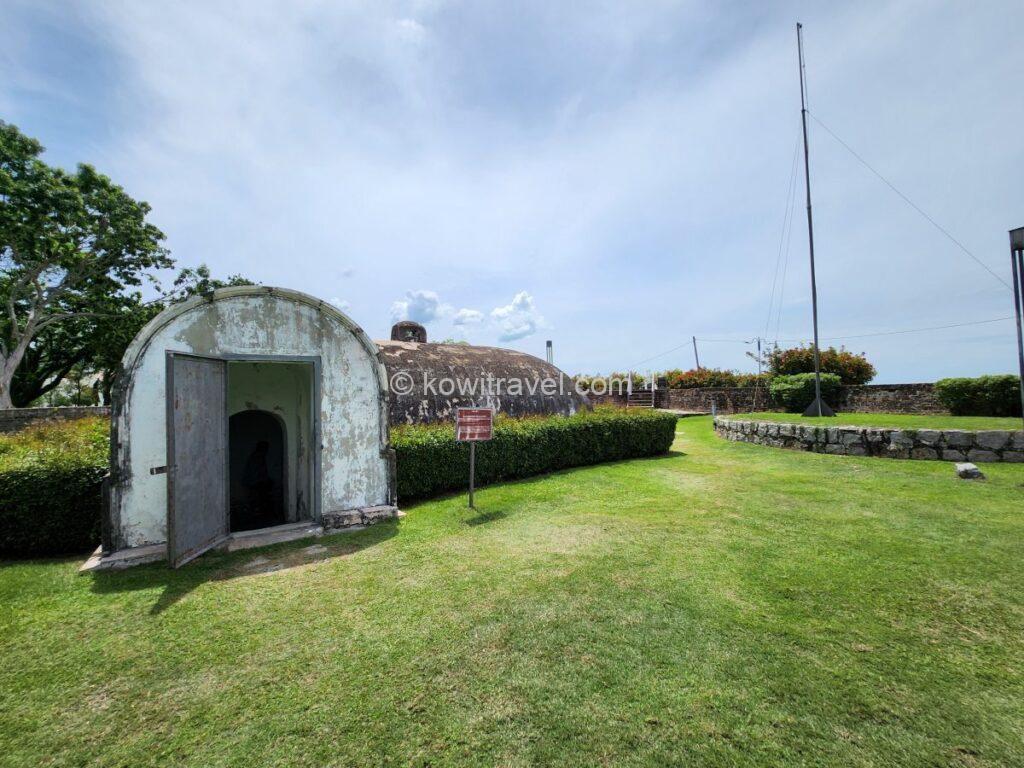
A gunpowder magazine, a place where gunpowder for cannons was once stored safely. It is characterized by a roof designed as a very thick, rounded arch, intended to protect the gunpowder from enemy artillery fire.
Just beside it along the sea wall, rows of antique cannons aim their barrels out toward the Strait of Malacca.
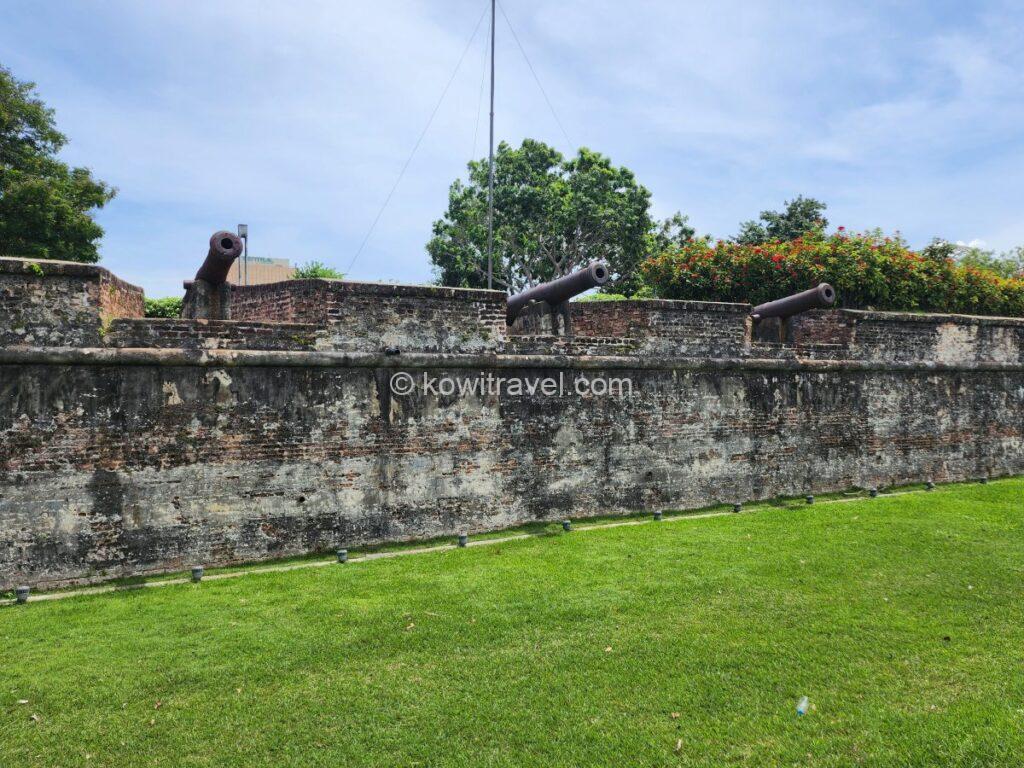
Cannons lined up along the fortress walls, facing the sea
Standing amidst vibrant red ixora bushes overlooking the ocean and coastal road sits the legendary “Seri Rambai”, a massive bronze cannon that immediately stops visitors in their tracks.
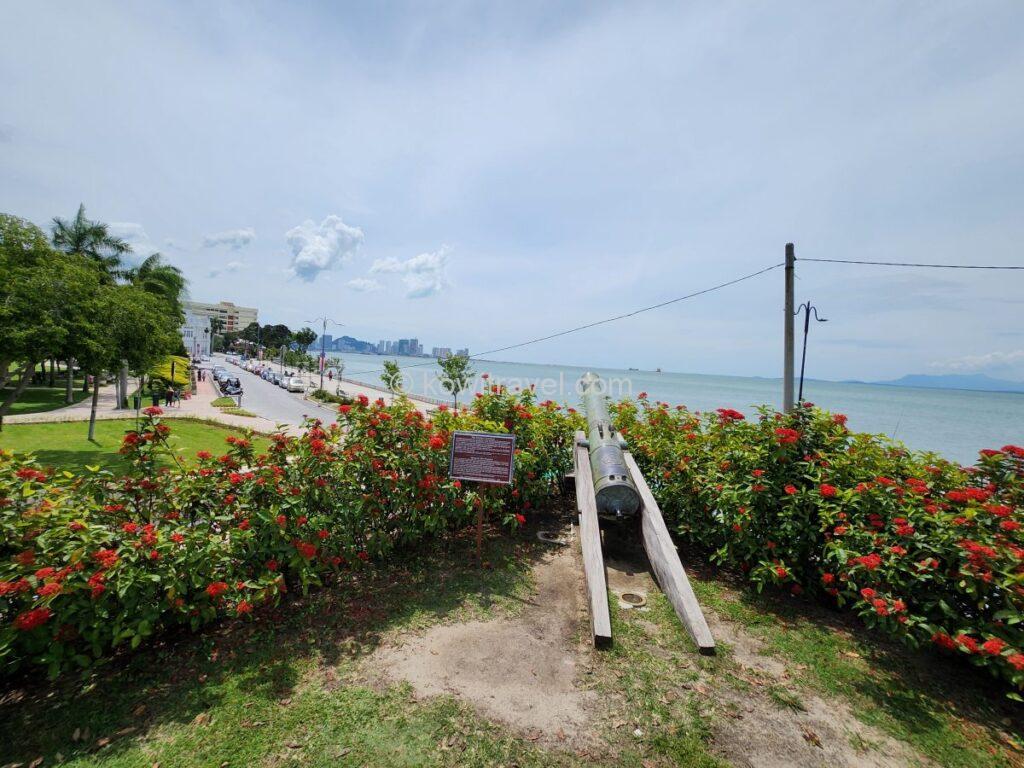
The storied bronze cannon ‘Seri Rambai’ gazing out across the Strait of Malacca amidst blooming red ixora flowers.
Cast in the early 17th century by the Dutch and passed through the hands of the Aceh Sultanate, Johor Sultanate, and British Navy over a turbulent history, this iconic cannon now frames one of George Town’s most striking seaside views.
2.2) Everyday Local Life Along the Esplanade Promenade and Penang City Hall
Stepping out through the brick walls of Fort Cornwallis onto the shoreline, the Esplanade Seaside Promenade stretches out along the open waters of the Strait of Malacca.
Along the stone seawall where gentle waves lap against moss-covered rocks, local families gather to catch the cool ocean breeze while children play with balloons—offering an authentic glimpse into the everyday lives of Penang residents rather than a manicured tourist zone.


The Esplanade—a coastal promenade that runs right alongside Fort Cornwallis(left), a local family enjoys a relaxed moment, sitting on the railing of the rocky seawall and taking in the cool sea breeze.(right)
Continuing down the seaside walkway, a stark white stone obelisk—the Cenotaph War Memorial—stands proudly at the center of a grassy waterfront square beneath fluttering Malaysian and Penang state flags.
Built to honor those who fell during World War I and World War II, it invites a quiet moment of reflection amid the breezy coastal scenery.
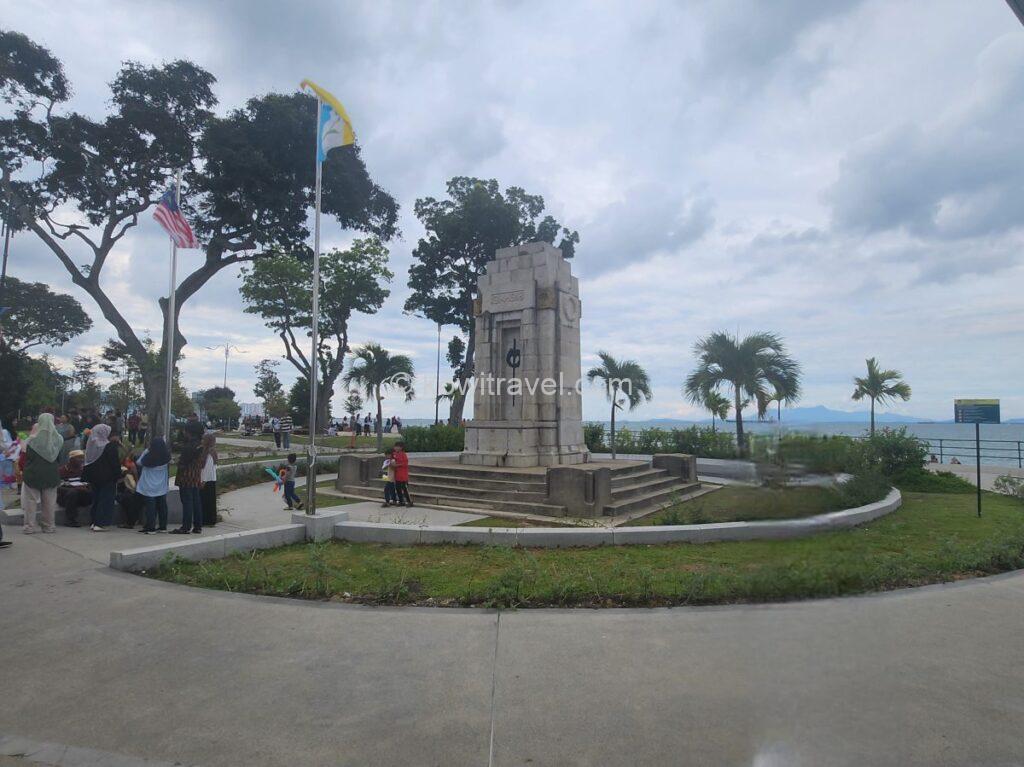
The white stone Cenotaph memorial standing proud by the sea
Right beside the memorial at the far end of the promenade sits the bustling Esplanade Hawker Centre (Medan Selera Renong) beneath large white canopies.
Inside, tidy rows of local stalls serve up Penang staples like Char Koay Teow, crispy banana fritters (Goreng Pisang), and waffles, filling the air with the lively energy of locals grabbing an affordable seaside bite.


The exterior of the Esplanade Hawker Centre, bustling with locals (left), and a view of the neat, orderly local food stalls inside (right)
Turning our gaze across the street toward the inland side of the Esplanade, a dazzlingly white, grand Victorian-style edifice commands immediate attention.
Completed in 1903, this is Penang City Hall.
Adorned with ornate Corinthian columns, intricate facade carvings, and rows of Malaysian flags, the building stands as unmistakable proof of George Town’s prestige as a British colonial administrative hub.
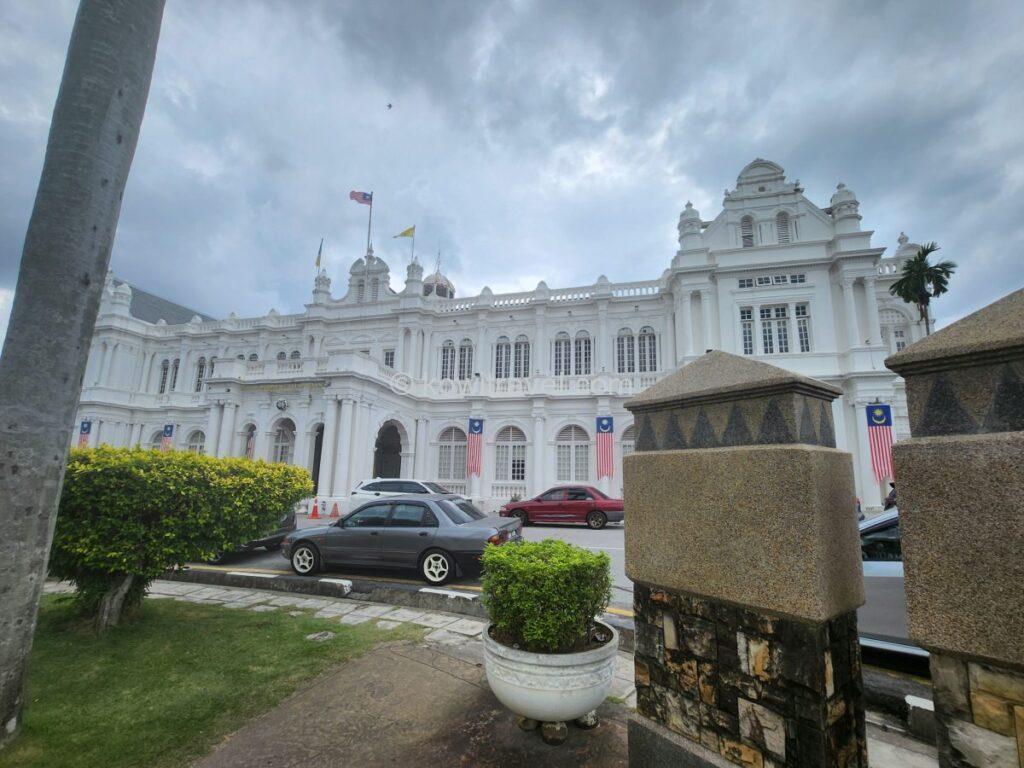
Standing majestically across from the Esplanade promenade, the dazzling white Penang City Hall (built in 1903) showcases the grandeur of British colonial architecture.
2.3) Queen Victoria Memorial Clock Tower and the Betel Nut Sculpture
Just across the road from Fort Cornwallis, a crisp white clock tower rises prominently from the center of a busy roundabout.
Built in 1897 to commemorate the Diamond Jubilee (60th year on the throne) of Britain’s Queen Victoria, the tower was donated by Cheah Chen Eok, a wealthy local Chinese businessman.
Interestingly, the tower was engineered to stand exactly 60 feet (approx. 18.3 meters) tall—one foot for every year of the Queen’s reign. Blending British colonial structure with a golden Moorish-style dome, it serves as a fitting symbol of George Town’s East-meets-West heritage.
(As a fun local trivia note, the tower leans ever so slightly due to shockwaves from nearby bombings during World War II!)
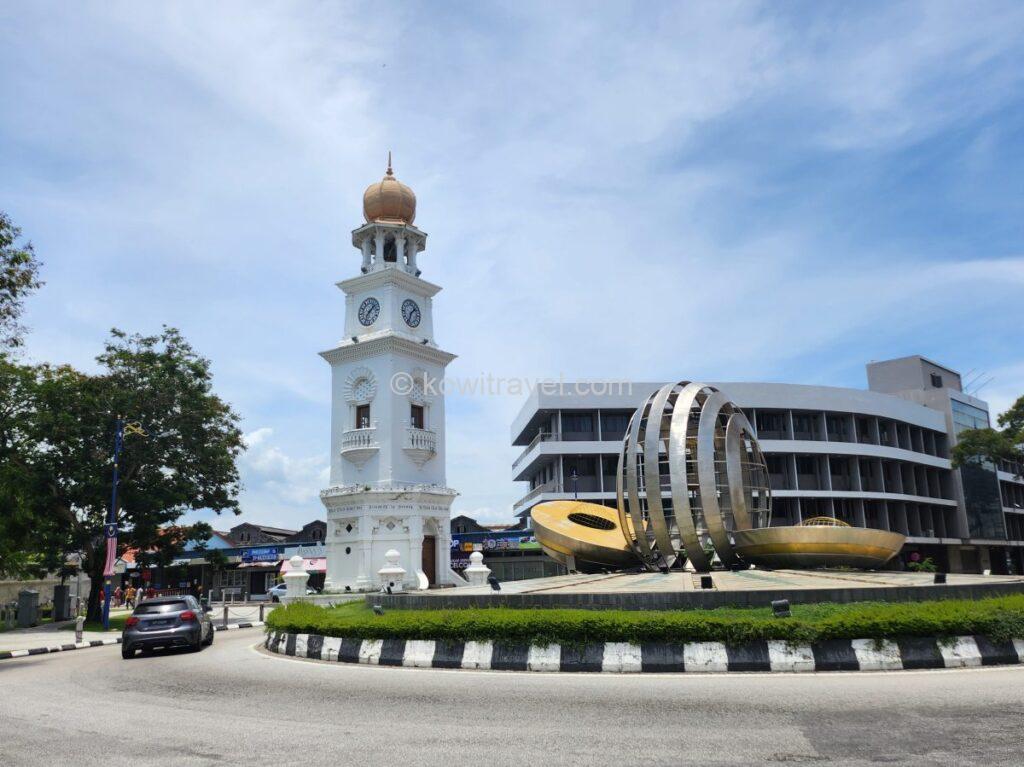
The 60-foot Queen Victoria Memorial Clock Tower (left) standing beside the modern metallic sculpture of a ‘Pinang’ (betel nut) that gave Penang its name (right), backed by the Penang Port Commission building(back)
Right beside the clock tower in the middle of the roundabout sits a striking modern metallic sculpture resembling a giant halved fruit (Pinang Fountain).
This artwork represents the areca nut (betel nut)—known in Malay as Pinang, the very word from which Penang gets its name.
Seeing a century-old colonial clock tower stand side by side with a sleek contemporary tribute to the island’s namesake creates a dramatic visual contrast, framed against the curved modernist facade of the Penang Port Commission building just behind them.
2.4) A Fire Station Straight Out of a Storybook: Central Fire Station (1908)
Walking along Beach Street (Lebuh Pantai) on our way from the clock tower toward the Peranakan Mansion, a remarkably charming building made us stop in our tracks and reach for our cameras.
Sporting crisp red-brick trim against bright white plaster walls—complete with a graceful watchtower rising on the back left—this is the George Town Central Fire Station (1908), built in the Edwardian Baroque style.
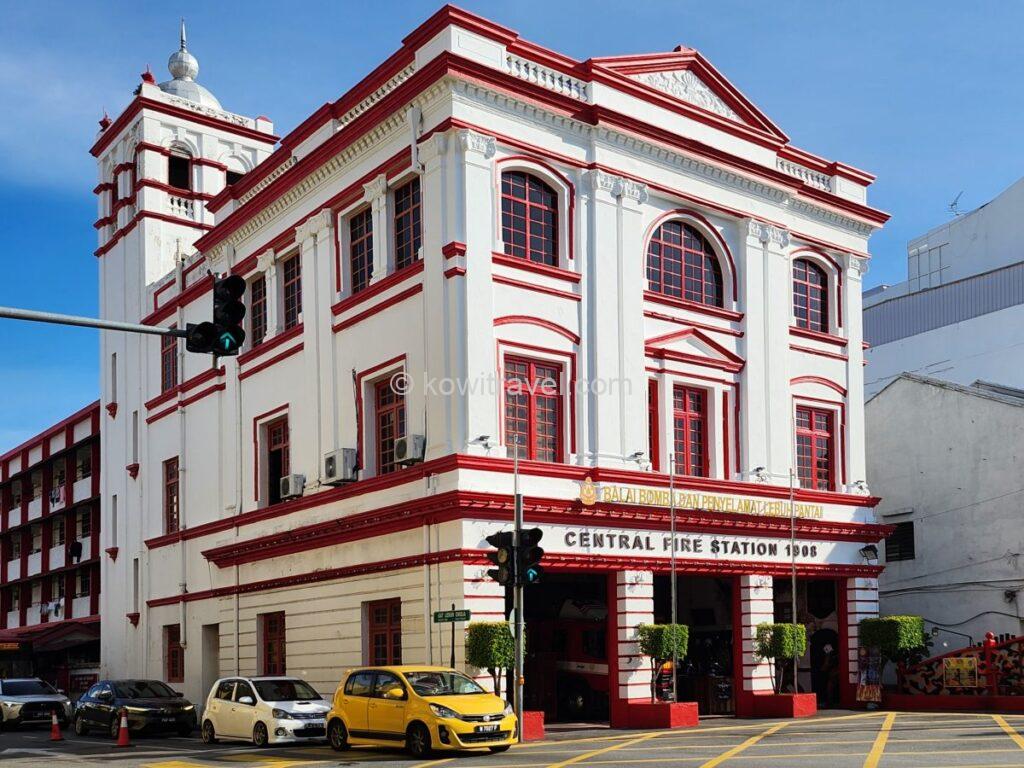
Built in 1908 and still in active service today, the Central Fire Station on Beach Street catches every passerby’s eye with its red-and-white European-style facade and watchtower.
Constructed in 1908 and still operating as an active fire station more than a century later, it is one of the oldest working fire stations in Malaysia.
At first glance, its refined facade looks more like a vintage European museum or boutique hotel, making it a wonderful hidden photo spot that highlights the architectural diversity of George Town’s streets.
2.5) The Pinnacle of East-Meets-West Opulence – Pinang Peranakan Mansion
Stepping just a short distance inland from the waterfront onto Church Street, we arrived before a dazzling emerald-green mansion: the Pinang Peranakan Mansion.
📌 Section TL;DR – Northern Waterfront & Heritage
- Key Stops: Fort Cornwallis → Esplanade Promenade & City Hall → Queen Victoria Clock Tower → 1908 Central Fire Station → Pinang Peranakan Mansion.
- Highlight: Experience Penang’s rapid transition from 18th-century British colonial defense to the lavish East-meets-West lifestyle of 19th-century Peranakan tycoons—all within easy walking distance
This museum showcases the rich cultural heritage of the Peranakans (Baba-Nyonya)—descendants of 15th- and 16th-century Chinese immigrants who settled in the Malay Peninsula and married local Malay women.
From the street, the mansion’s vivid emerald exterior and red lanterns immediately draw the eye, while the courtyard entrance (bearing the ancestral plaque “Chun Yang”) is framed by delicate, lace-like Scottish cast-iron balcony pillars that radiate old-world grandeur.


Once the grand residence of 19th-century Penang tycoon Chung Keng Kwee, Pinang Peranakan Mansion dazzles from the outside with its emerald facade (left) and intricate cast-iron courtyard balconies (right).
Originally the residence and office of 19th-century Penang’s wealthiest tycoon, Chung Keng Kwee, the mansion’s interior is jaw-dropping from the moment you cross the threshold.
In the main reception hall, European crystal chandeliers sparkle above colorful English patterned floor tiles, surrounded by intricately carved Chinese gilded wood screens and mother-of-pearl inlaid furniture.
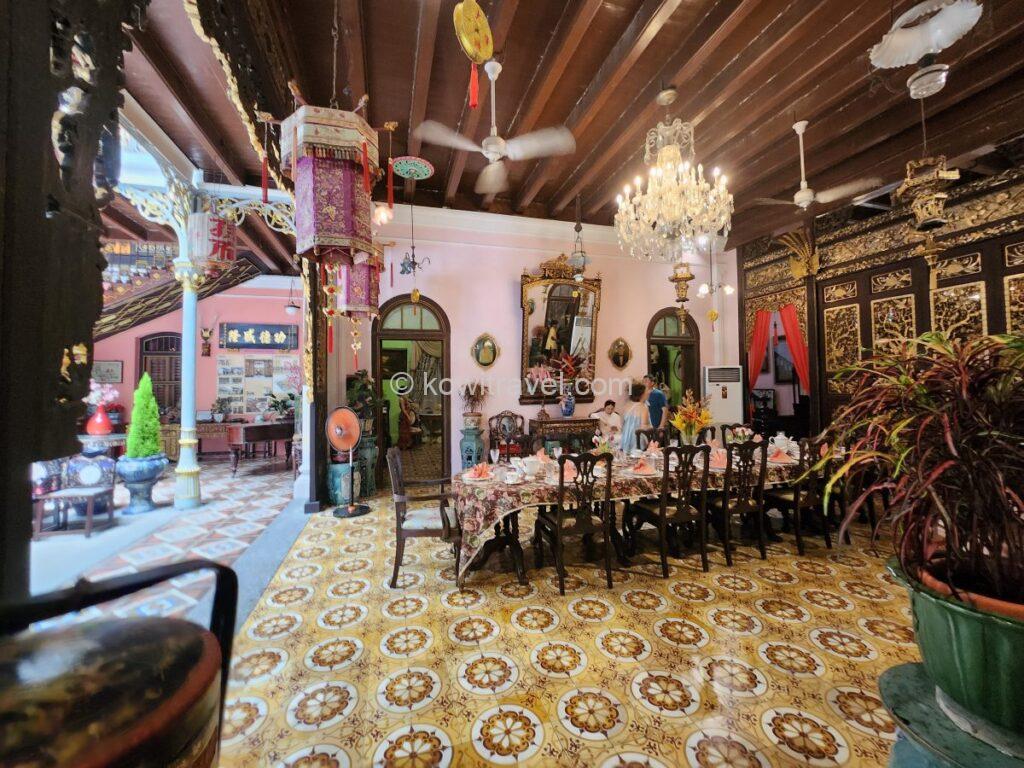
A lavish fusion of English tiles, European chandeliers, and Chinese gilded wood screens in the main hall
Heading up to the second floor, golden iron railings wrap around a sunlit central airwell, leading into lavishly preserved rooms including a traditional Peranakan bridal chamber complete with purple silk drapes and an ornate carved wooden bed—offering an unforgettable window into the immense wealth and eclectic aesthetic taste of Penang’s elite.


The sunlit second-floor courtyard gallery (left), and the ornate bridal chamber (right).
3. Where Four Faiths Coexist on One Street – George Town’s “Street of Harmony”
Leaving Pinang Peranakan Mansion and heading toward the center of old town, we walked down one of the most extraordinary streets in the world. Known locally as the Street of Harmony (Jalan Masjid Kapitan Keling), this historic avenue features houses of worship from four distinct religions standing peacefully within a few hundred meters of one another.
3.1) The Cradle of Malaysian Catholicism, Church of the Assumption
Right at the entrance to Love Lane along Farquhar Street stands a historic church crowned with a graceful white bell tower, the Church of the Assumption.
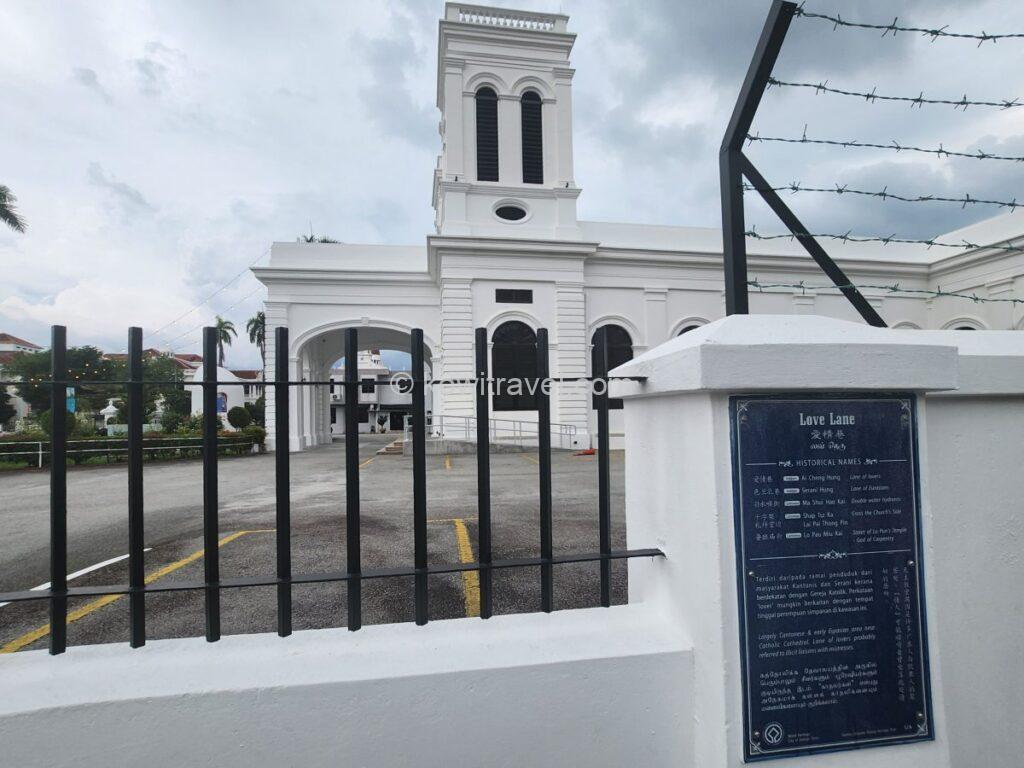
Pure white historic Church of the Assumption standing beside the Love Lane heritage sign in George Town, Penang
Founded in 1786 by Captain Francis Light and early Eurasian settlers shortly after landing in Penang, this church is the birthplace of Catholicism in Malaysia and a cornerstone of the UNESCO heritage zone.
As practicing Catholics, my wife and I make it a cherished travel routine to look up local Mass schedules and attend services alongside local parishioners wherever we go in the world.
We arrived at the Church of the Assumption full of anticipation, only to realize we had misread the Mass schedule—finding the iron front gates firmly locked for the afternoon.
Even though we couldn’t step inside to pray, standing quietly before the pure white bell tower and arched portico behind the historic “Love Lane” plaque brought a deep sense of peace.
According to the heritage plaque on the wall, the romantic name Love Lane dates back to the days when Eurasian Catholics living near the church—and wealthy local suitors—strolled down this very lane.
3.2) A Majestic Mughal Landmark, Kapitan Keling Mosque
Walking a few minutes down Jalan Masjid Kapitan Keling from the church, Penang’s oldest and grandest mosque—the Kapitan Keling Mosque—commands the skyline.
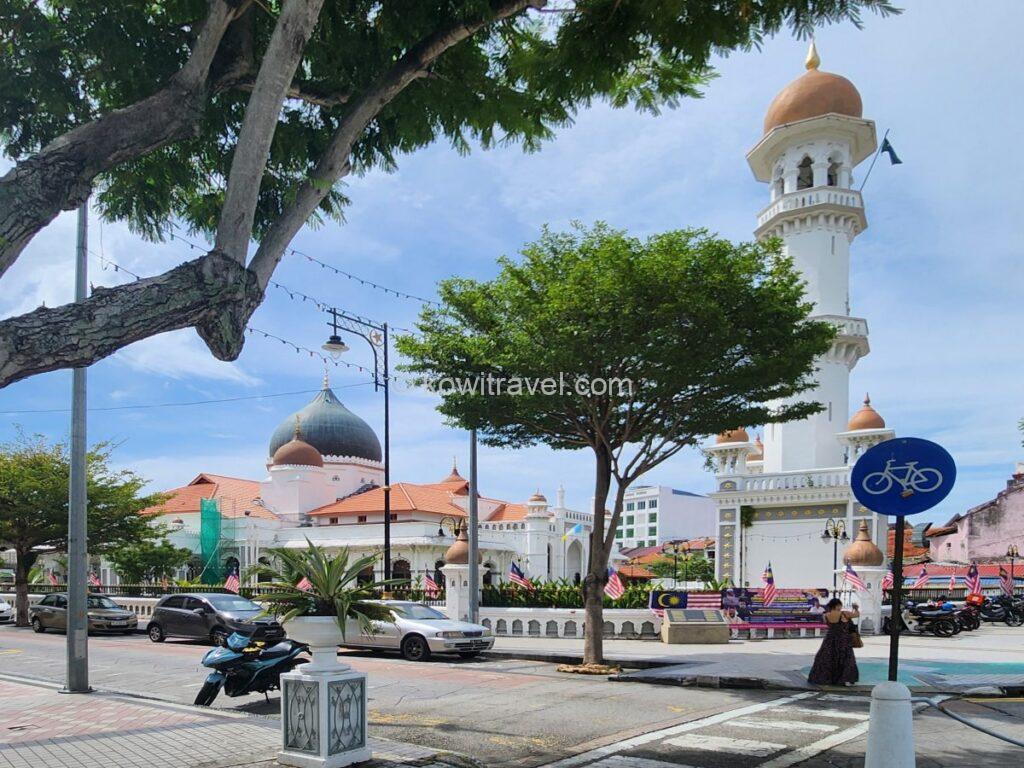
Grand teal domes and white Mughal arches of Kapitan Keling Mosque framed by a manicured garden pathway in Penang
Built in the early 19th century by Indian Muslim merchants and named after community leader Cauder Mohuddeen Merican, it has long served as the spiritual heart of Penang’s Indian Muslim community.
Following a neat stone walkway lined with manicured shrubs into the mosque grounds, the blindingly white walls contrast strikingly against deep teal central domes, terracotta-hued smaller domes, and pointed Mughal horseshoe arches, creating an atmosphere of serene majesty.


A magnificent turquoise central dome and an arched entrance façade (left), along with garden pathways and a minaret (right)
On the right side of the courtyard rises a towering white minaret.
Built with a square base crowned by four corner cupolas and a tiered octagonal shaft reaching high into the sky, this graceful spire stands out as an unmistakable landmark across George Town’s skyline.


The soaring white minaret (left) and full corner view of Kapitan Keling Mosque (right)
3.3) Pride of the Hokkien Clan, Yap Kongsi and Choo Chay Keong Temple
Turning toward the corner of Armenian Street from the mosque, the architectural scenery shifts dramatically from Mughal arches to ornate Southern Chinese (Hokkien/Minnan) craftsmanship at Yap Kongsi and its neighboring Choo Chay Keong Temple.
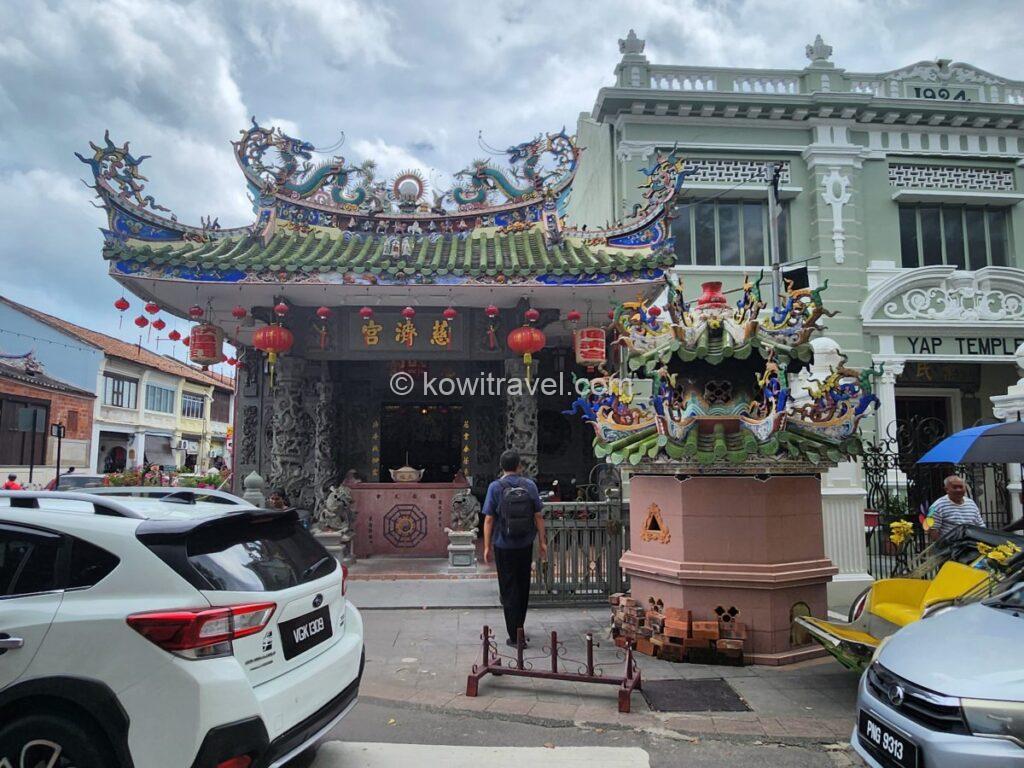
Intricate ceramic roof dragons and the street-side joss burner at Yap Kongsi (left), paired with the adjacent 1924 ‘YAP TEMPLE’ building (right).
Serving as a vital social and ancestral anchor for Hokkien Chinese immigrants who arrived in Penang during the 19th century, the clan temple captivates visitors with ceramic dragons chasing flaming pearls across green-glazed tiled roofs and intricately carved granite pillars.
Out front along the street stands a vibrant, roofed brick joss paper burner, while the adjacent mint-green building bears the bold inscription “YAP TEMPLE” alongside its 1924 construction date—standing as a proud testament to the resilience and solidarity of Penang’s Chinese clan associations.
3.4) A Towering Masterpiece of Sculpture, Sri Mahamariamman Temple
Completing our walk along the Street of Harmony is Penang’s oldest Hindu temple, the Sri Mahamariamman Temple, founded in 1833.
Unfortunately, by the time we arrived in the late afternoon, daily visiting and prayer hours had already concluded, and the metal shutters behind the golden entrance archway were closed.
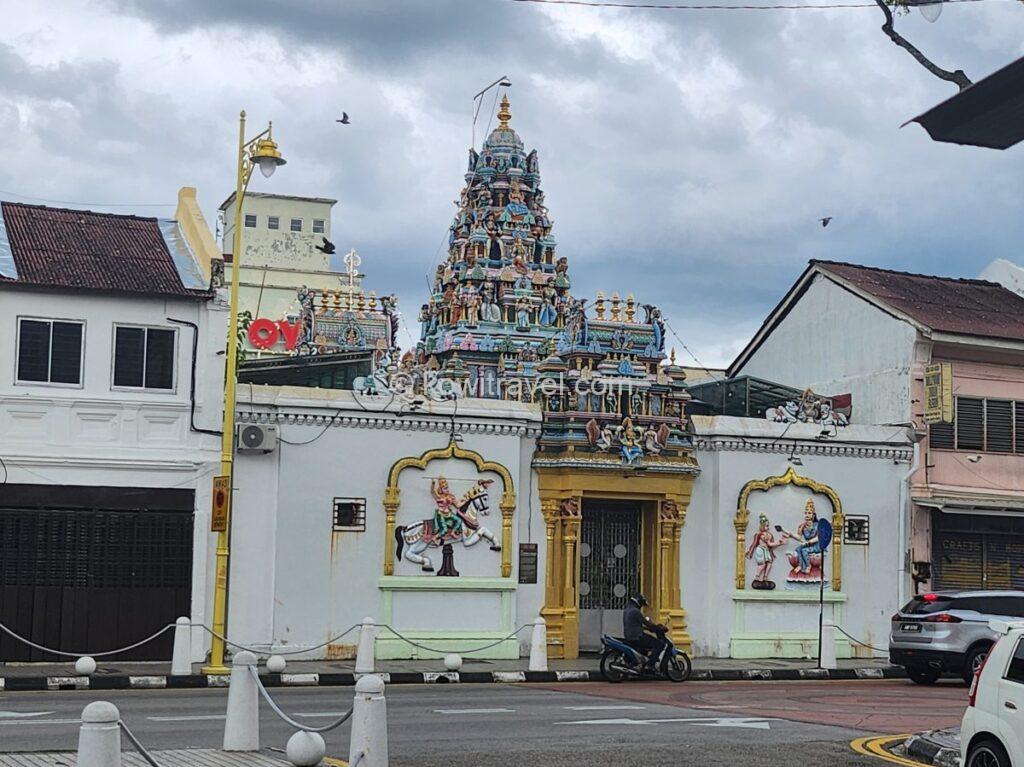
Viewed from outside after afternoon closing hours, Sri Mahamariamman Temple’s intricately sculpted Gopuram tower and golden wall reliefs still command awe along the Street of Harmony.
Even from the sidewalk outside, however, looking up at the temple’s towering entrance tower (Gopuram) was enough to stop us in our tracks.
Crowded with dozens of vividly painted Hindu deities, celestial beings, and warriors—flanked by detailed wall reliefs of deities on horseback set inside golden arches along the white perimeter wall—the temple radiates the deep devotion of Penang’s Tamil Hindu community.
4. Breathing Life Into Weathered Walls – From Stewart Lane to the Murals of Armenian Street
Leaving the Street of Harmony (around Kapitan Keling Mosque and Sri Mahamariamman Temple) and heading toward the main mural zone on Armenian Street, a massive masterpiece at the corner of Lebuh Klang and Lorong Stewart brings every passerby to a standstill.
📌 Section TL;DR – George Town Street Art Trail
- Key Stops: The Indian Boatman (Stewart Lane) → Umbrella Alley → Ernest Zacharevic’s 3D interactive murals (Kids on Bicycle, Boy on Motorbike) → Hidden alley murals.
- Highlight: Discover how the 2012 George Town Festival transformed weathered heritage walls into a world-famous open-air gallery blending real vintage props with lifelike street painting
This is “The Indian Boatman”, painted in 2014 by Russian muralist Julia Volchkova.
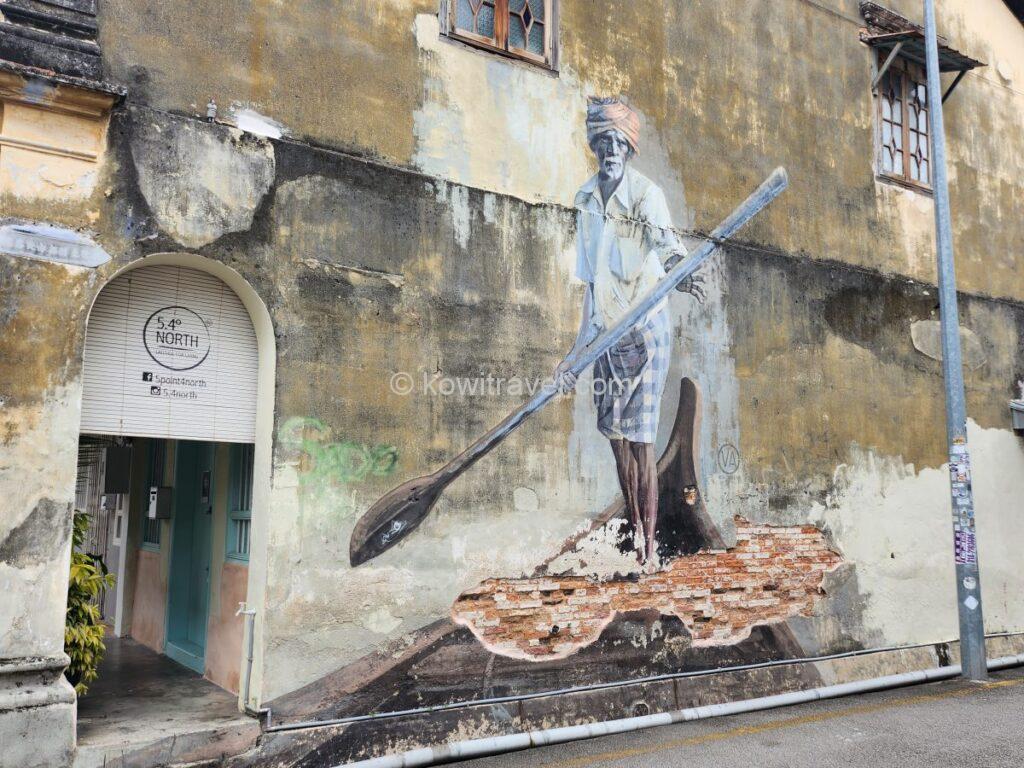
Encountered on the way from the Street of Harmony to Armenian Street, ‘The Indian Boatman’ uses peeling red brickwork to evoke rippling water with astonishing realism.
Created to honor the tough, resilient lives of South Indian Tamil boatmen who ferried goods and passengers across Penang’s harbor and rivers during its 19th-century port boom, the artwork blends seamlessly with the peeling red bricks of the weathered wall—making the exposed brickwork look like ripples of water around the wooden boat.
It sets a dramatic, unforgettable opening note for a George Town street art walk.
Leaving that striking first impression behind and stepping deeper into the lanes, the true heart of George Town’s mural district—Armenian Street—unfolds before us.
Right at the entrance to the alley, a colorful canopy of hanging umbrellas (Umbrella Alley) and bold portrait murals warmly welcome visitors into the neighborhood.
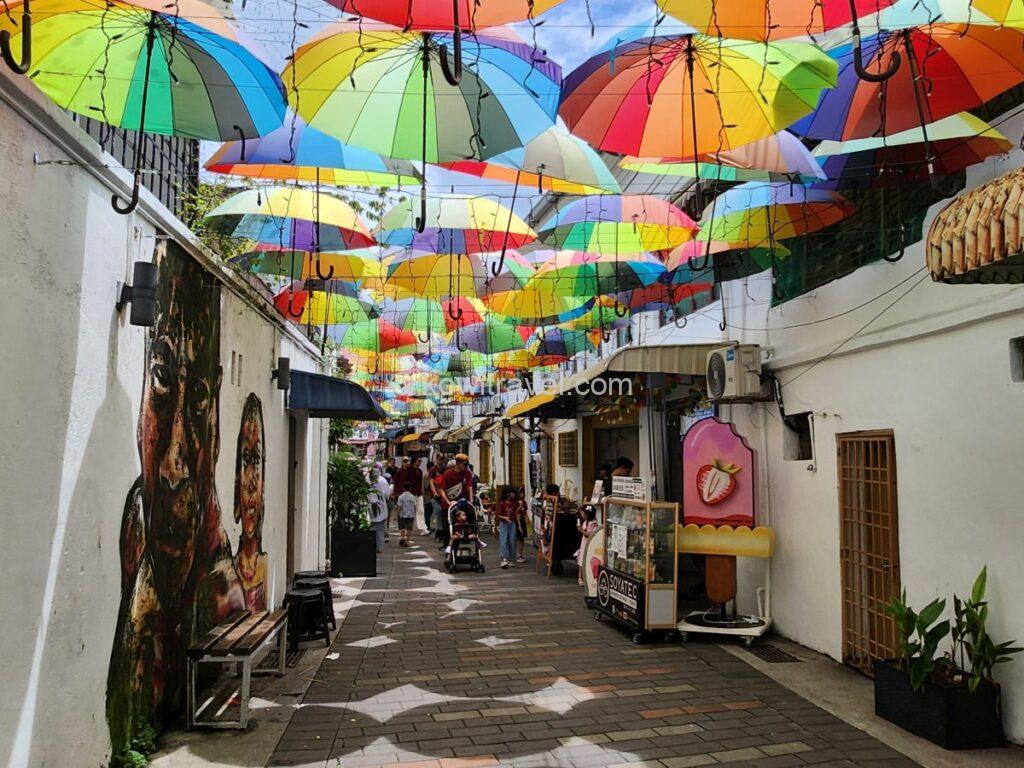
Rows of colorful umbrellas floating overhead create a storybook atmosphere as you step into George Town’s famous mural alleys.
There is a fascinating backstory behind how these weathered backstreets became a global art destination.
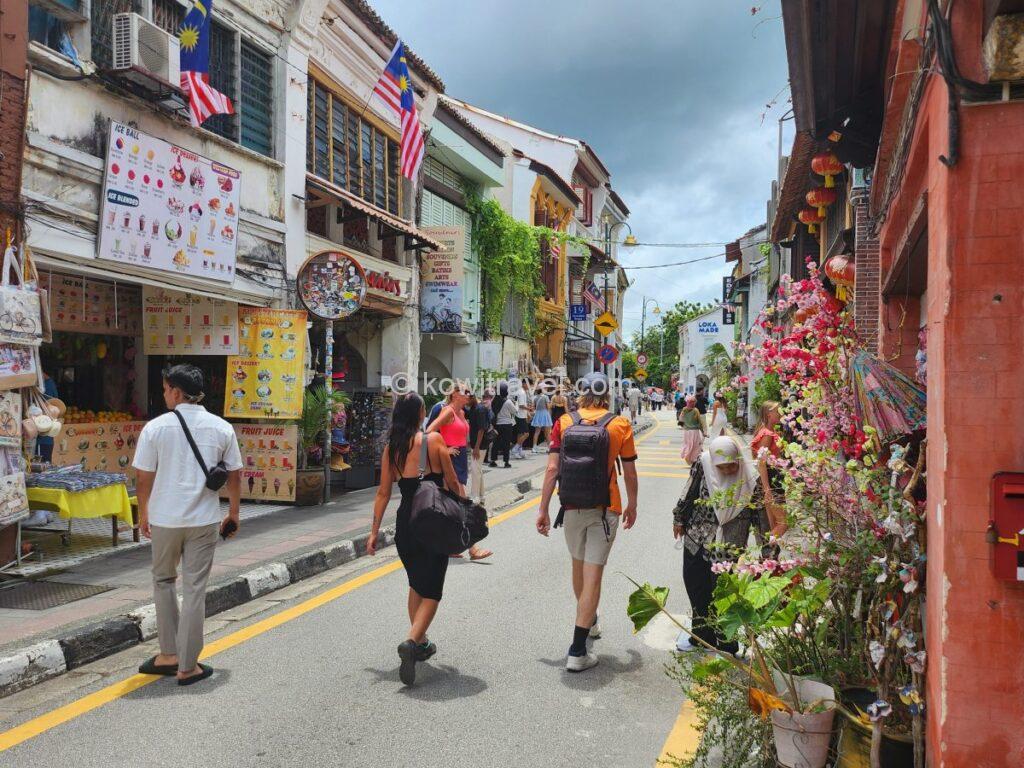
Armenian Street, always bustling with tourists and locals alike
Shortly after George Town was inscribed as a UNESCO World Heritage Site in 2008, the Penang State Government commissioned young Lithuanian artist Ernest Zacharevic for the 2012 George Town Festival to spark interest in local heritage among younger generations and revitalize the old quarter.
Zacharevic painted scenes of everyday Penang life directly onto aged walls and integrated real physical props—such as bicycles, motorbikes, and wooden chairs—creating interactive 3D street art that took the world by storm.
4.1) The Two Iconic Murals That Put George Town on the Global Art Map
① Kids on Bicycle
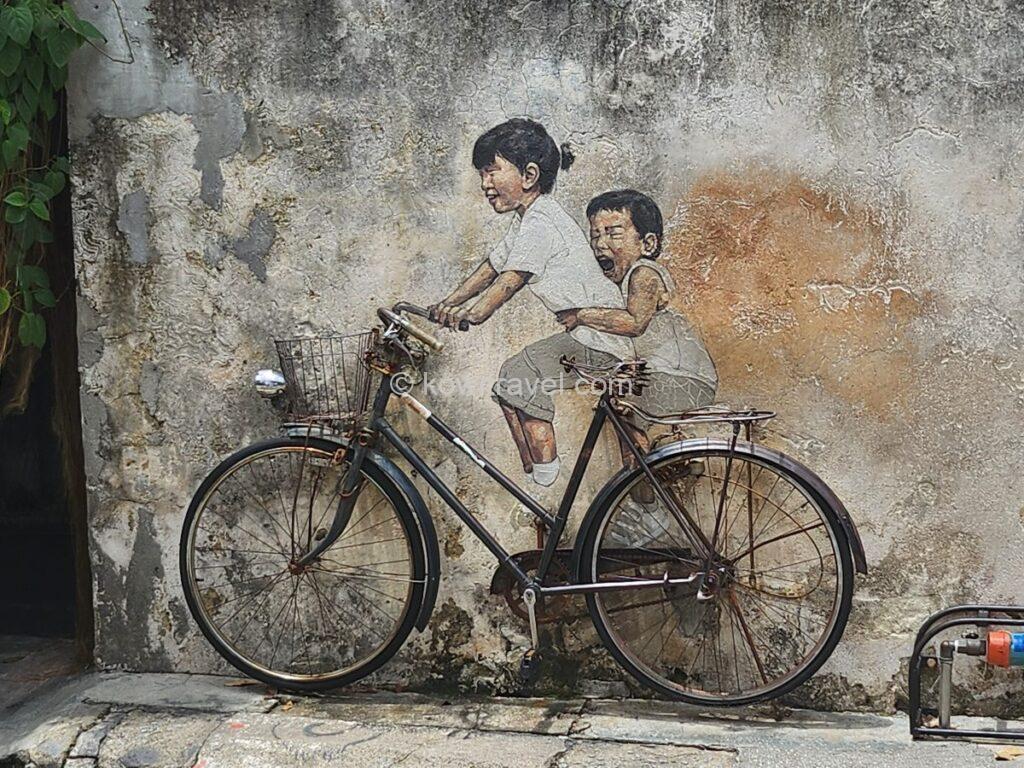
The “Kids on a Bicycle” mural is the most iconic symbol that brought George Town, Penang, to global attention. It is a masterpiece that combines a painting of an older sister and her younger brother—joyfully riding a bicycle together—with an actual bicycle, making it a popular spot where people line up to take photos.
Ernest Zacharevic’s signature masterpiece and the undisputed icon of George Town.
Using a real rusty bicycle propped against a weathered wall, the mural depicts a joyful older sister beaming as she pedals while her younger brother clings tightly to the back seat, screaming in playful terror.
For more than a decade, travelers from around the world have lined up here daily, making it Penang’s #1 photo spot.
② Boy on Motorbike
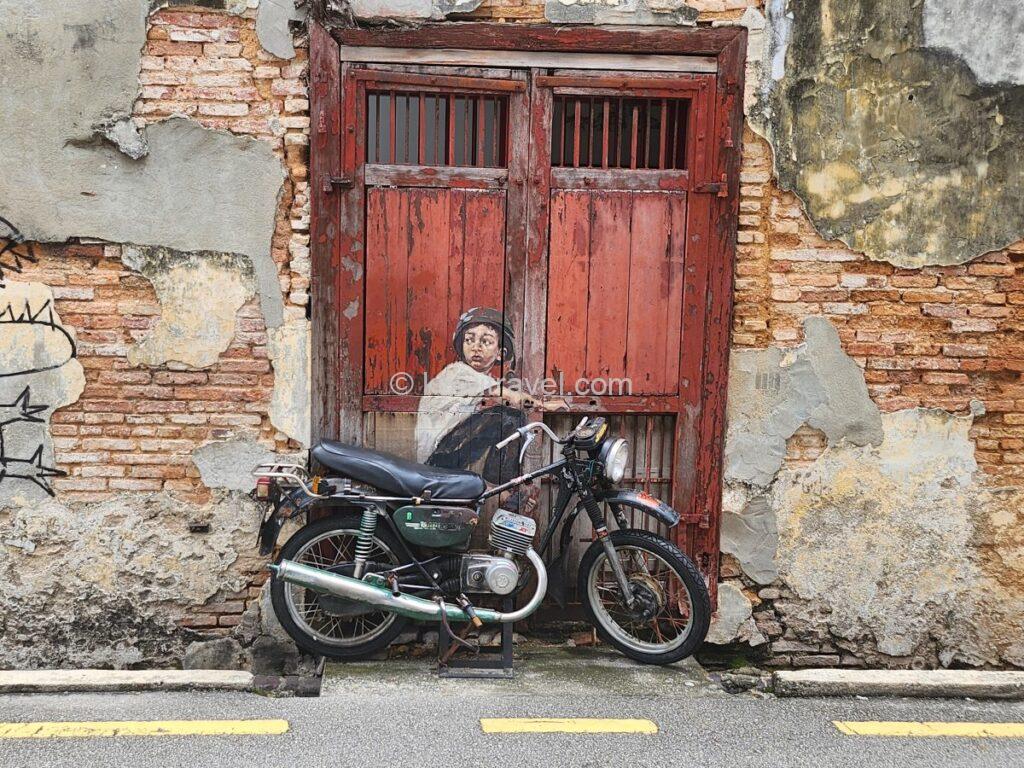
Ernest Zacharevic’s famous 3D interactive murals ‘Kids on Bicycle’ and ‘Boy on Motorbike’
Located just a short stroll from Armenian Street, this equally famous piece incorporates a real vintage motorcycle parked against the wall.
A mischievous young boy sits atop the bike looking back over his shoulder, while the rough texture and peeling paint of the wall itself become dynamic elements of motion in the artwork.
4.2) Hidden Alleyway Mural Gems Worth Seeking Out
Once you’ve snapped your obligatory photos at the headline murals, slowing down to explore the quieter back lanes reveals even more charming works tucked into unexpected corners.
③ Reaching Up
Another brilliant work by Ernest Zacharevic, showing a young boy standing on his tiptoes atop a real wooden chair, stretching his hand toward an actual ventilation hole high up on a flaking white plaster wall.
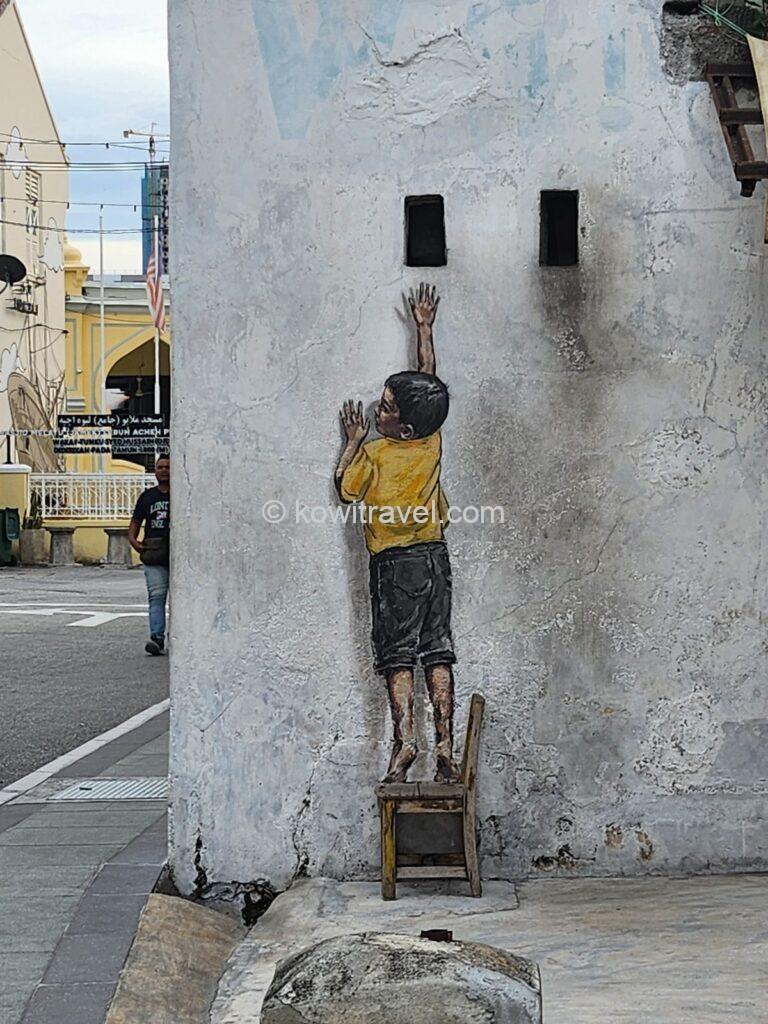
Reaching Up’—another clever stroke of genius by Ernest Zacharevic that turns an ordinary wall ventilation hole into part of a child’s playful curiosity.
④ Children in a Window
Painted directly inside an authentic wooden-shuttered, iron-barred heritage window frame, two children peer out at the street with bright eyes and outstretched hands, accompanied by a real woven basket resting on the ground below.
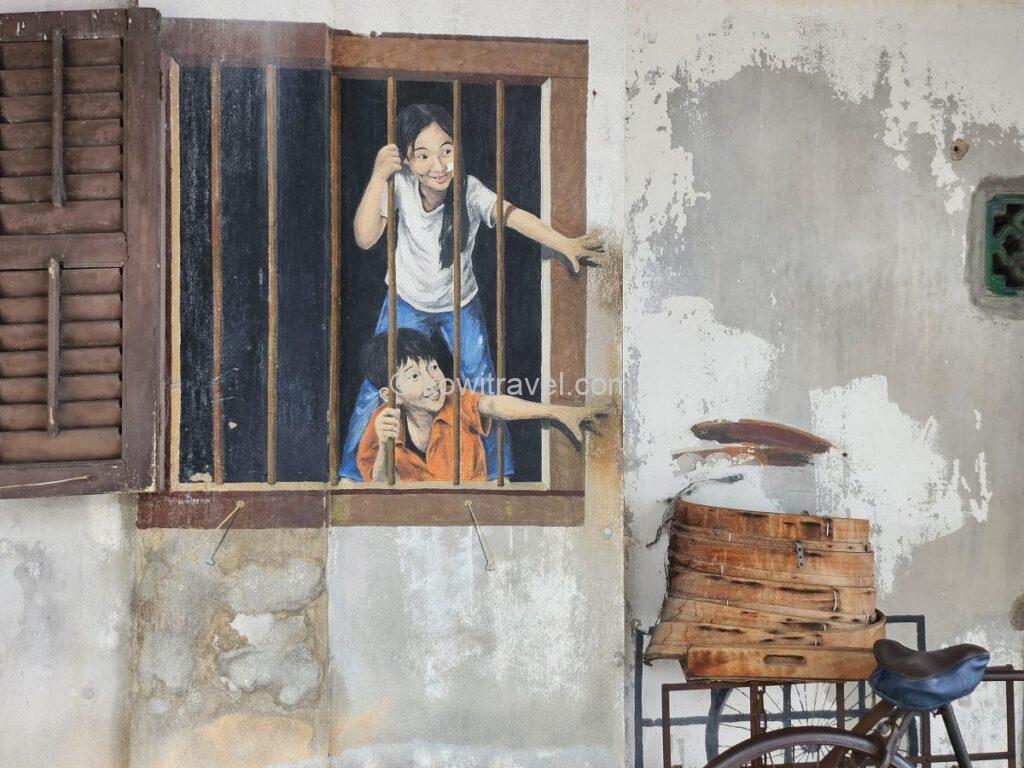
Mural of two smiling children reaching out from behind an actual iron-barred heritage window
⑤ Honoring Vanishing Traditional Trades (The Blacksmith & Nyonya Kebaya Merchant)
Alongside Zacharevic’s pieces, talented Malaysian artists have painted powerful tributes to Penang’s traditional trades and heritage.
One dynamic mural captures a blacksmith hammering glowing hot iron amid flying sparks (by artist Vincent), while another depicts a smiling merchant proudly holding up an intricately embroidered traditional Peranakan Nyonya Kebaya blouse—celebrating the hardworking artisans who built Penang’s history.
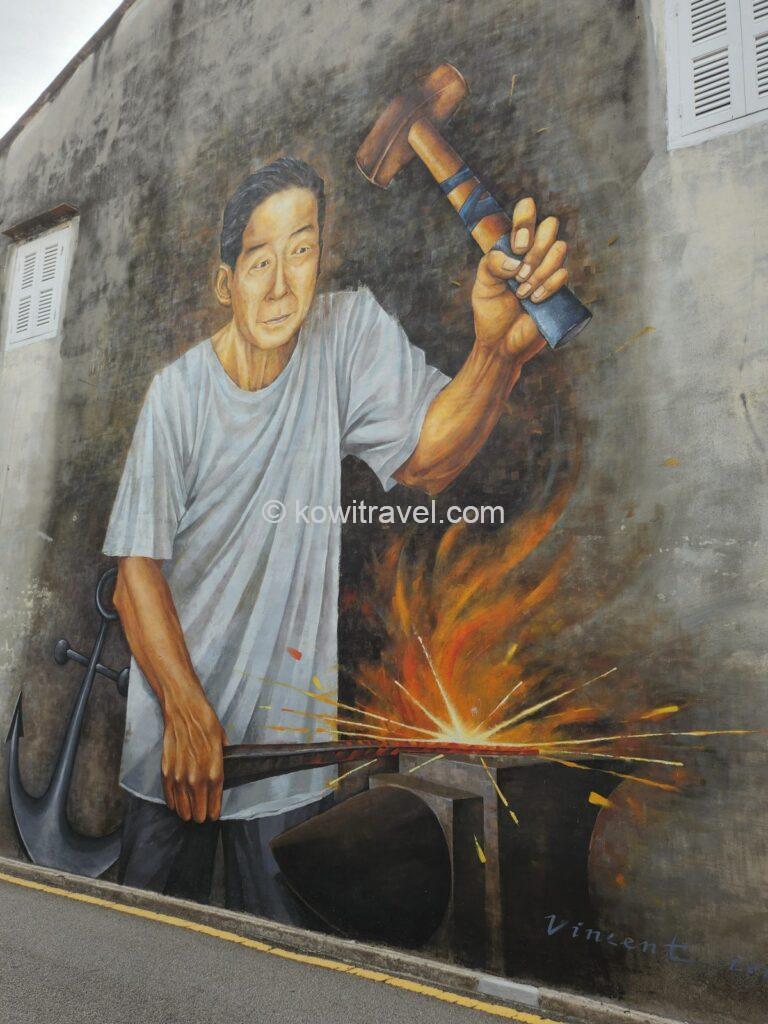
A vivid tribute to Penang’s traditional blacksmiths
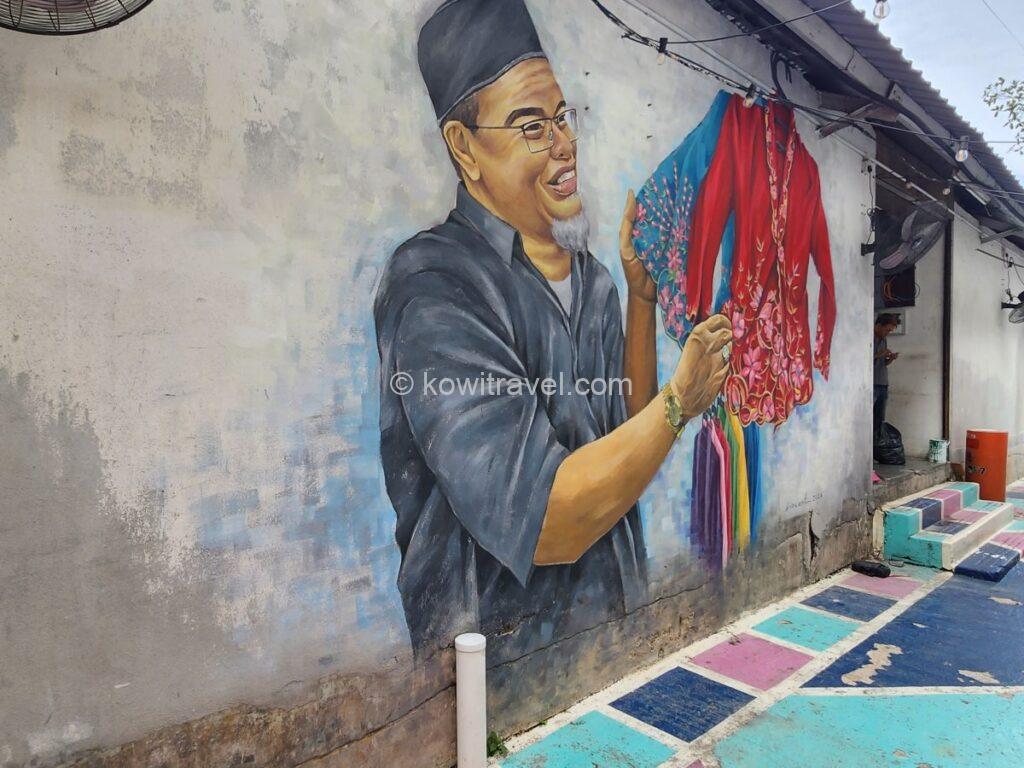
A proud merchant displaying a traditional Nyonya Kebaya
⑥ Heartwarming Scenes of Daily Alley Life, Couple on a Bicycle
I stumbled upon this mural, “Lovers on a Bicycle,” while wandering through the tucked-away alleyways of the George Town Arts District.
The paint has faded over time, giving the piece the delicate, ethereal quality of a watercolor painting.
Inspired by the interactive art of Ernest Zacharevic, local artists created this hidden gem, capturing the everyday romance of Penang in a soft, watercolor-like style.
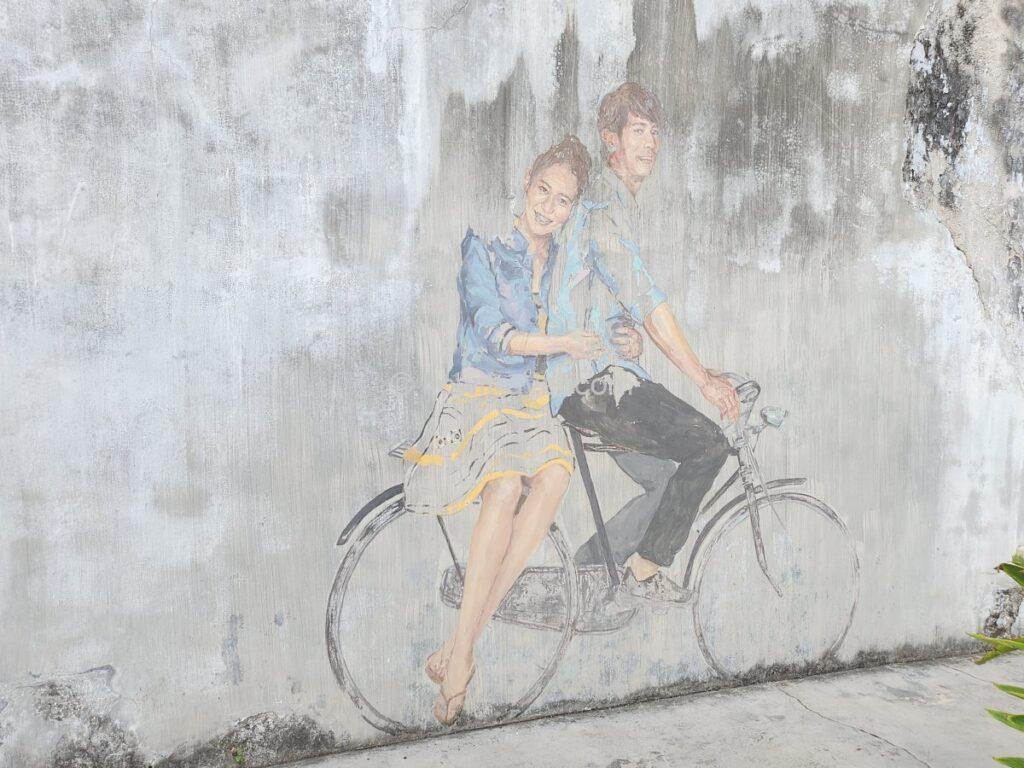
This mural, which evokes a sense of nostalgia due to the paint having faded significantly over the years, depicts a couple and is painted on the wall of a traditional house in Penang.
Every corner and alleyway I wandered into felt like one vast, open-air art museum.
5. Unexpected Romance in the Old Alleys
5.1) Gliding Through Time on Penang’s Iconic “Trishaw”
As you wander past the colorful murals and craft workshops lining Armenian Street, you’ll frequently spot three-wheeled cycle rickshaws—known locally as Trishaws—parked beneath bright canopies along the curb.


Penang’s iconic attraction, the Trishaw
Unlike conventional rickshaws, Penang’s trishaws place the passenger seat in front while the rider pedals from behind, giving passengers a completely unobstructed panoramic view of the streets.
Once a primary mode of daily transport in late 19th-century Penang, these vintage trishaws now offer travelers a breezy, romantic way to tour George Town’s heritage lanes and mural spots without exhausting themselves under the midday tropical sun.
Experienced riders happily stop at key photo spots and even help take your pictures, making a short trishaw ride an ideal option if you’re traveling with elderly parents or visiting during the hottest afternoon hours.
👌Trishaw Fair Tip:
Trishaw fares are generally calculated on an hourly basis. Even if you only take a 30-minute ride, you will most likely be charged the full hourly rate (RM40–RM50).
Therefore, it is highly recommended that you agree on your destination and the total fare before getting on!
5.2) Busking With Soul on Armenian Street – Master Marionette Artist “Mr. Gregor”
While strolling along Armenian Street admiring the murals, an unforgettable street performer standing beneath the eaves of a lime-green shophouse drew my wife and me in like a magnet.
With just a modest tip box resting on the curb in front of him, a German gentleman—Mr. Gregor—was putting on a mesmerizing open-air busking performance with an intricately handcrafted wooden marionette.
Dressed crisply in a white linen shirt and trousers, a blue-and-white striped scarf, and a plaid flat cap, Mr. Gregor worked more than sixteen fine strings with effortless grace.
With every subtle flick of his fingers, the small wooden puppet—attired in a burgundy velvet tailcoat and yellow trousers—came completely alive, drawing a bow across a miniature violin, dancing to the rhythm, and bowing politely to captivated onlookers.
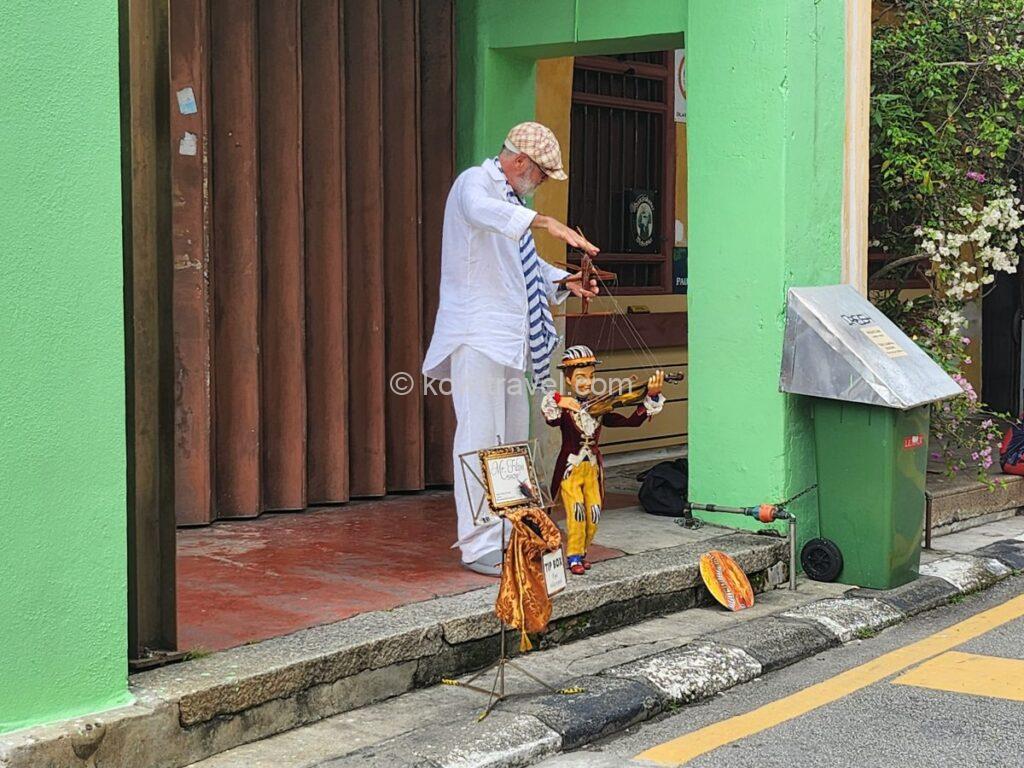
Mr. Gregor was putting on a fantastic street performance by manipulating intricate wooden marionettes.
The fluid articulation of the puppet’s wrists and expressive posture held both tourists and locals completely spellbound.
“No matter how fast the digital world moves, nothing can ever replace the human warmth and soul transmitted through a string.”
That unwavering artisan spirit woven into every joint and thread of his puppet delivered the deepest cultural resonance of our entire month in Penang.
Born in Germany, Mr. Gregor spent decades traveling across Europe and around the globe as a puppetry artist before falling deeply in love with the East-meets-West charm and warm community spirit of George Town’s historic alleys, eventually choosing to make Penang his home.
🎥Watch!: Master marionette artist Mr. Gregor busking live on Armenian Street—bringing his violin-playing wooden puppet to life with subtle movements of his fingertips.
Trading grand theater stages for a sun-dappled shophouse doorstep, he pours decades of refined craftsmanship into bringing pure, childlike wonder to passing travelers.
Seeing the genuine joy on his face throughout his performance stayed with us far longer than any grand monument in George Town.
6. Wrapping Up – A Sneak Peek at Our Next Journey
From the coastal ramparts of Fort Cornwallis in the north to the multi-faith Street of Harmony, Ernest Zacharevic’s iconic mural alleys, and the moving street performance of a master marionette artist, every step through George Town’s weathered lanes felt like unlocking a living treasure chest of history and art.
Now that we’ve worked up a serious appetite exploring George Town’s heritage and street art on foot, it’s time to refuel and cool off from the tropical heat!
In the upcoming Part 4 (#19), we dive straight into an Old Town culinary tour tucked inside George Town’s hidden backstreets—from Toh Soon Cafe, the legendary alley spot toasting bread over glowing charcoal for kaya toast, to atmospheric local gems like Mimiya Cafe and The Loft, an afternoon dim sum feast with bustling pushcarts at the 90-year-old Tai Tong Restaurant, and a refreshing shaved-ice rescue at Ice City near Kapitan Keling Mosque.
Stay tuned for our fourth story as we bring you a 100% honest, fact-checked foodie guide packed with vivid videos from the heart of George Town!
👉 Check out Part 2 (#17) for Penang’s nightlife and more
“As part of an affiliate marketing program, this post may earn a small commission at no extra cost to you if bookings are made through the links provided.”
Leave a Reply